
Type & Discipline
Bibliotherapy is a clinical technique rather than a standalone modality: the structured, guided use of written material — self-help texts, fiction, poetry, picture books — to support psychological insight and behavior change 3. It sits within the broad family of expressive and creative arts therapies, but in practice most of its evidence comes from material grounded in cognitive behavioral therapy, delivered as self-help reading with limited therapist contact 1. LLM
Clinicians distinguish two broad forms. Clinical (or interactive) bibliotherapy involves a trained provider who selects material, structures the reading, and processes the patient’s response in session. Developmental bibliotherapy uses literature for ordinary growth, coping, and education, often in schools or self-guided settings 3. The technique can function as standalone treatment, as an adjunct to other care, or as a bridge while a patient waits to be seen 3.
Creators & Lineage
The term “bibliotherapy” was coined in 1916 by the essayist Samuel Crothers, who described it as “the prescription of literature for healing,” though the practice long predates the word 3. Benjamin Rush, often called the founder of American psychiatry, advocated for hospital libraries as early as 1802, arguing they should be “part of its furniture,” and by the 1850s the physician John Galt had outlined five reasons reading benefits psychiatric patients 3. Victorian-era psychiatric and military hospitals integrated libraries as therapeutic tools 3.
In its modern, evidence-tested form, bibliotherapy draws its lineage primarily from cognitive behavioral therapy: the self-help books most studied in trials translate CBT skills into readable, structured workbooks 1. It also overlaps conceptually with narrative therapy (re-authoring one’s story through engagement with text), expressive arts therapy (meaning-making through a creative medium), and psychoeducation (structured information delivery) LLM. The modality is best understood as a delivery vehicle that carries the active ingredients of more established therapies into a low-cost, scalable format LLM.
Core Principles
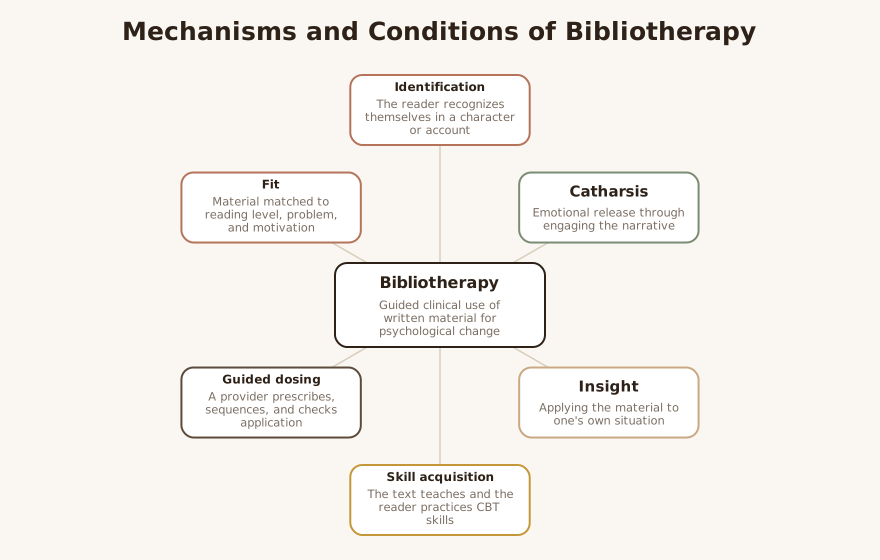
The central premise is that engaging with carefully selected written material can produce therapeutic change through several overlapping mechanisms LLM. Classical accounts describe identification (the reader recognizes themselves in a character or account), catharsis (emotional release through the narrative), and insight (applying the material to one’s own situation) LLM. In CBT-based bibliotherapy, the more mechanistic principle is straightforward skill acquisition: the text teaches cognitive restructuring, behavioral activation, or exposure principles, and the reader practices them 1.
A second core principle is guided dosing. Bibliotherapy is not simply handing a patient a book; in clinical form a provider prescribes specific material, sequences it, and checks comprehension and application 3. Trials that work best pair the reading with at least minimal therapist contact — telephone or email check-ins — rather than relying on the text alone 1. A third principle is fit: the material must match the patient’s reading level, presenting problem, motivation, and capacity to complete it, which makes patient selection a clinical act in its own right 3.
Interventions & Techniques
In practice, the clinician’s work centers on selection, structuring, and processing LLM. Selection means matching a vetted text to the diagnosis and the patient — for depression, CBT self-help such as David Burns’s Feeling Good has been studied repeatedly; for childhood anxiety, Helping Your Anxious Child is a recurring example 1. Curated, evidence-linked catalogs exist to support this; one Canadian resource organizes 51 vetted books across seven psychiatric categories, by illness, audience, genre, and evidence tier, capped at six books per category to avoid overwhelming clinicians 3.
Structuring assigns specific chapters or exercises between sessions and sets a pace the patient can sustain 3. Processing brings the reading back into the room: the clinician asks what resonated, what the patient tried, and what got in the way, converting passive reading into active rehearsal LLM. Minimal-contact support — brief phone or email contact rather than full sessions — is a defining feature of the efficacious trial format and distinguishes “guided self-help” from pure self-help 1.
LLM-generated illustrative example (not a guideline): A clinician treating an adult with mild depression and a long wait for individual therapy might “prescribe” the behavioral-activation chapters of a CBT self-help book over four weeks, with a 10-minute phone check-in each week to review the activity log and troubleshoot avoidance, then process barriers when the patient is seen. LLM
Evidence Base
The evidence base is established, with the important caveat that strength varies sharply by population and problem LLM. For adults with mild-to-moderate depression, meta-analytic work reports effect sizes comparable to individual therapy, and Canadian practice guidance positions bibliotherapy as a reasonable second-line option, alone or as an adjunct, particularly for patients waiting for clinical care 3. A meta-analysis of bibliotherapy in unipolar depression supports a beneficial effect for CBT-based self-help reading 4. A systematic review of randomized controlled trials examining long-term outcomes — 10 articles reporting 8 RCTs and 1,347 participants, with follow-up from 3 months to 3 years — found that bibliotherapy reduced adult depressive symptoms over the long term, describing it as an affordable, prompt treatment that could reduce reliance on medication 2.
The picture in children and adolescents is weaker and more variable 1. A meta-analysis of 8 RCTs (979 participants) found an overall standardized mean difference of −0.52 (95% CI −0.89 to −0.15) favoring bibliotherapy, but with substantial heterogeneity (I² = 84%) 1. Effects were meaningful for depressed adolescents (SMD −0.78) but did not reach significance for anxious children (SMD −0.36) 1. Critically, bibliotherapy outperformed waitlist controls but showed no advantage over psychological placebo, suggesting non-specific factors account for part of the benefit 1. The same long-term review found no statistically significant effect in younger populations 2. Dropout was comparable to controls, indicating acceptable tolerability, though absolute attrition was high in both arms and publication bias was a noted concern 1.
Bottom line: robust for adult mild-to-moderate depression as guided CBT self-help; promising for adolescent depression; unproven for child anxiety; and dependent on minimal therapist contact and good patient selection to realize its effect 123. LLM
Populations & Indications
Bibliotherapy has been studied and applied across children, adolescents, adults, and older adults, and is frequently offered to caregivers as a parallel support 1. Its clearest indication is the adult with mild-to-moderate depression, especially when motivated, literate, and facing a wait for therapy 23. It is a sensible stepped-care entry point, an adjunct that extends between-session work, and a bridge for patients in queue for higher-intensity treatment 3.
For adolescents with depression, the data support a trial of CBT-based self-help, ideally with therapist contact 1. For children, and for anxiety presentations generally, the evidence is thinner and clinicians should hold expectations modest and monitor closely 1. Notably, in the pediatric meta-analysis, formats without heavy parental delivery outperformed parent-delivered formats, a useful design consideration when planning for younger clients 1. LLM
Problems-for-Work
- Major depressive disorder (mild-to-moderate): Prescribe sequenced CBT self-help reading with weekly minimal contact, processing cognitive-restructuring and behavioral-activation exercises in session 12. LLM
- Generalized anxiety disorder: Use anxiety-specific self-help (e.g., worry-management and exposure principles), holding expectations modest given weaker pediatric anxiety data 1. LLM
- Grief, adjustment disorder: Narrative and memoir-style material can support identification and meaning-making while a patient normalizes their reaction LLM.
- Low self-esteem, social skills deficits: Skills-oriented workbooks and, for children, picture books modeling competence and connection LLM.
- Emotional dysregulation, stress, insomnia, health anxiety: Targeted psychoeducational self-help (sleep hygiene, stress management, reassurance-reduction reading) can serve as a low-intensity first step or adjunct 3. LLM
LLM-generated illustrative example (not a guideline): A grieving older adult who declines group support might be offered a short, vetted memoir on loss, with the clinician using identification — “Did any of her experience match yours?” — to open a conversation the client could not start unprompted. LLM
Contraindications, Cautions & Cultural Humility
Bibliotherapy requires careful patient selection, and several exclusion criteria recur: severe depression, active suicidality, acute crisis, and significant comorbidity are situations in which self-help reading is not an appropriate substitute for direct care 3. Two specific risks are documented — incorrect self-diagnosis from material the patient applies to themselves wrongly, and treatment failure when a patient cannot complete the reading, which may compound discouragement 3. Because the technique offloads work onto the patient, low literacy, cognitive impairment, low motivation, or limited time can quietly doom it LLM.
A non-trivial caution from the evidence itself: in children, benefit over psychological placebo was not demonstrated, so clinicians should not overstate the specific power of the text 1. Bibliotherapy should be framed as one component, monitored like any intervention, with a clear plan to step up if the patient does not improve LLM.
Cultural humility matters because text is culturally loaded LLM. Material reflects the worldview, language, idioms of distress, family structures, and assumptions of its author; a book that lands for one patient may alienate or misrepresent another. Clinicians should select material that fits the patient’s language, literacy, and cultural frame — and remain willing to abandon a text that does not resonate rather than treat non-engagement as patient failure. LLM
Treatment-Plan Suggestions & SMART Objectives
| Goal | SMART objective (example) | Mechanism |
|---|---|---|
| Reduce depressive symptoms | Complete the behavioral-activation chapters of a prescribed CBT self-help book and log one scheduled activity daily for 4 weeks, reviewed in weekly 10-min contact | Behavioral activation; skill acquisition 1 |
| Build cognitive-restructuring skill | Identify and record 3 automatic thoughts per week using a worksheet from the assigned text, across 6 weeks | Cognitive restructuring 1 |
| Bridge a treatment wait | Read and apply one prescribed self-help module weekly until first therapy appointment, with brief check-ins | Stepped care; early engagement 3 |
| Normalize a grief reaction | Read a vetted memoir on loss and bring two passages that resonated to each of 3 sessions | Identification; meaning-making LLM |
| Improve sleep | Apply sleep-hygiene strategies from an assigned guide and maintain a sleep diary for 2 weeks | Psychoeducation; behavior change 3 |
| Reduce health-anxiety reassurance-seeking | Read the reassurance-reduction chapter and track reassurance urges daily for 3 weeks | Psychoeducation; response prevention LLM |
| Support a caregiver | Read a prescribed parenting/coping guide and trial one strategy weekly, reviewed in session, over 4 weeks | Skill acquisition; modeling 1 |
| Strengthen between-session work | Complete one assigned reading exercise before each session and process it in the first 10 minutes | Active rehearsal; consolidation LLM |
Common Misconceptions
- “Just give them a book.” Pure self-help underperforms guided self-help; the efficacious format includes selection, structuring, and minimal therapist contact 13. LLM
- “It works equally well for everyone.” Evidence is strong for adult depression, weaker for adolescents, and largely unproven for child anxiety 12. LLM
- “The book itself is the active ingredient.” In children, bibliotherapy did not beat psychological placebo, implying non-specific factors carry meaningful weight 1. LLM
- “It’s only for waiting rooms.” While it serves as a bridge, it also functions as legitimate second-line treatment and as an adjunct that extends therapeutic work 3. LLM
- “More books is better.” Curated, capped lists (e.g., a maximum of six per category) are designed precisely to prevent choice overload and ensure quality 3. LLM
Training & Certification
Bibliotherapy as studied in trials demands no specialized certification: the clinical skill is competent assessment, evidence-based selection, and integration with an existing therapeutic frame, most often CBT 13. Clinicians can build competence by familiarizing themselves with vetted, evidence-linked catalogs of recommended reading organized by diagnosis and evidence tier 3. LLM More formalized credentialing exists in the adjacent field of poetry/bibliotherapy through professional creative-arts-therapy bodies for those pursuing interactive bibliotherapy as a defined practice, but the depression and anxiety evidence base does not require it LLM.
Key Terms
- Bibliotherapy: The prescription of literature for healing — structured, guided use of written material for therapeutic change 3.
- Clinical / interactive bibliotherapy: Provider-led use of material with in-session processing of the patient’s response 3. LLM
- Developmental bibliotherapy: Use of literature for ordinary coping, growth, and education, often self-guided or in schools LLM.
- Guided (minimal-contact) self-help: Self-help reading paired with brief therapist contact; the format most associated with efficacy 1.
- Identification / catharsis / insight: Classical mechanisms by which a reader recognizes, releases, and applies material to their own life LLM.
- Stepped care: A framework in which low-intensity interventions like bibliotherapy are offered first, with escalation if needed 3. LLM
Resources & Further Reading
▶ Watch — a video introduction to this concept:
- Comparative efficacy and acceptability of bibliotherapy for depression and anxiety disorders in children and adolescents (meta-analysis) 1
- The long-term effects of bibliotherapy in depression treatment: systematic review of RCTs (PubMed) 2
- Bibliotherapy: recommended reading for psychiatry patients (BC Medical Journal) 3
- Bibliotherapy in unipolar depression: a meta-analysis 4
Reflective / Supervision Questions
- For this specific patient, what makes guided reading more likely to land than passive recommendation — and what is my plan for minimal-contact support? LLM
- Have I matched the material to the patient’s reading level, language, cultural frame, and motivation, or to my own preferences? LLM
- Given that the evidence is strongest for adult depression and weak for child anxiety, am I setting realistic expectations and monitoring outcomes accordingly? 12 LLM
- What are my criteria — severity, suicidality, crisis, comorbidity — for deciding bibliotherapy is not appropriate as a substitute for direct care? 3 LLM
- If the patient does not engage with the text, how will I distinguish a poor fit from a clinical signal, and avoid framing non-completion as failure? LLM