
Type & Discipline
The Unified Protocol for Transdiagnostic Treatment of Emotional Disorders (UP) is a modular, emotion-focused cognitive-behavioral treatment developed within clinical psychology.1 It belongs to the cognitive-behavioral family but breaks from the dominant “one disorder, one manual” tradition: instead of a separate protocol for panic, for social anxiety, for depression, the UP is a single intervention applied across the spectrum of emotional disorders — the anxiety, depressive, obsessive-compulsive, trauma-related, and somatic-symptom conditions that share a common temperamental and functional core.1 Its organizing claim is that these disorders are surface variations on the same underlying machinery, so treating the machinery treats the family.1 This makes the UP transdiagnostic by design rather than by accident, and positions it as a CBT-based answer to the high comorbidity and diagnostic overlap clinicians encounter daily.1 LLM
Creators & Lineage
The UP was developed by David H. Barlow and colleagues — including Todd J. Farchione and Shannon Sauer-Zavala — at the Boston University Center for Anxiety and Related Disorders (CARD), with a first edition published by Oxford University Press and a substantially revised second edition therapist guide following.4 Barlow’s earlier work building disorder-specific CBT protocols (notably for panic) gave way to a conviction that the field had over-fragmented, and that shared mechanisms were being treated redundantly across manuals.1 LLM The UP draws explicitly on traditional cognitive and behavioral therapy (cognitive reappraisal, exposure, behavioral experiments) while integrating elements that align it with the so-called third wave: mindfulness and present-focused awareness reminiscent of mindfulness-based cognitive therapy, an acceptance-and-willingness stance toward internal experience that echoes acceptance and commitment therapy, and a central focus on the function and processing of emotion that overlaps with emotion-focused therapy.14 LLM It is best understood as a synthesis: classic CBT mechanics organized around an emotion-science account of why people suffer.1 LLM
Core Principles
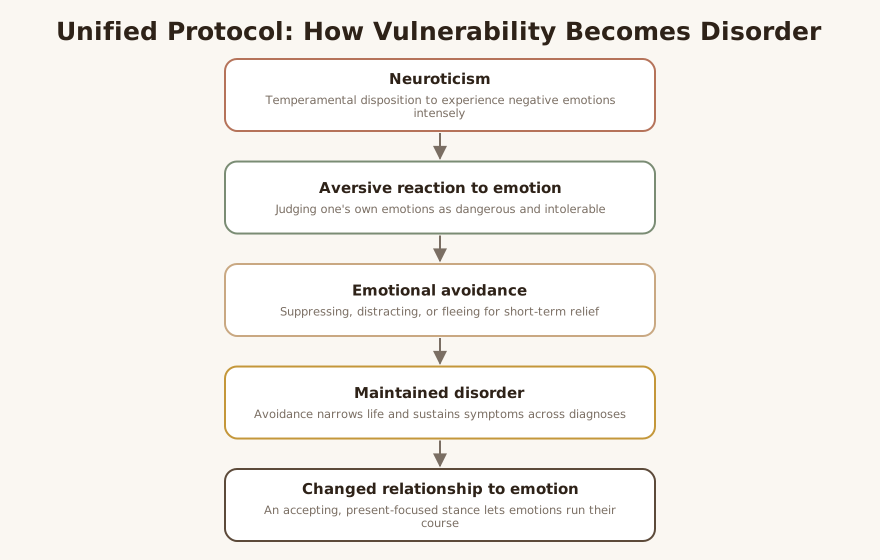
The UP rests on the premise that emotional disorders share a temperamental vulnerability — neuroticism, the trait disposition to experience negative emotions frequently and intensely.1 What converts that vulnerability into disorder, in the UP model, is not the emotions themselves but the person’s aversive, judgmental reaction to their own emotions and the avoidant or escape behaviors that follow.1 A panic sensation is frightening, the person judges the fear as dangerous and intolerable, and they suppress, distract, or flee — which provides short-term relief but strengthens the conviction that emotions are threats to be controlled.1 LLM This emotional avoidance (overt and subtle) is the engine the UP targets; over time it narrows life and maintains symptoms across diagnoses.1 The therapeutic goal is therefore not to eliminate emotions but to change the person’s relationship to them — to build a more accepting, present-focused, action-tolerant stance so that emotions can run their course without driving maladaptive behavior.14 In this sense the UP reframes “symptom reduction” as a downstream consequence of improved emotion regulation.4 LLM
Interventions & Techniques
The UP is delivered as eight modules, typically across 12-21 sessions, with five core change-oriented modules bracketed by an opening motivation module and a closing relapse-prevention module.4 The sequence is structured but flexible, and the emotion-focused logic threads through every module.4 LLM
- Module 1 — Motivation and goal-setting: building readiness and resolving ambivalence about change, often using a decisional-balance exercise.4
- Module 2 — Understanding emotions: psychoeducation on the adaptive function and three-component structure of emotion (thoughts, physical sensations, behaviors).4
- Module 3 — Mindful emotion awareness: present-focused, nonjudgmental attention to emotional experience, countering the habit of reacting against one’s own feelings.4
- Module 4 — Cognitive flexibility: loosening automatic appraisals and catastrophic interpretations through reappraisal rather than rigid disputation.4
- Module 5 — Countering emotional behaviors: identifying and reversing emotion-driven behaviors (avoidance, escape, safety behaviors, subtle suppression).4
- Module 6 — Understanding and confronting physical sensations: interoceptive exposure to reduce fear of bodily cues such as racing heart or breathlessness.4
- Module 7 — Emotion exposures: graded exposure to emotion-provoking situations, images, and internal states, the central behavioral driver of change.4
- Module 8 — Recognizing accomplishments and looking ahead: consolidating gains and planning for relapse prevention.4
Because the modules map onto shared mechanisms rather than a specific phobia or worry content, the same skills generalize across whatever emotional disorders a given client presents.14 LLM
Evidence Base
The UP’s evidence base is best characterized as established: it has randomized controlled trial support and meta-analytic synthesis, though much of the strongest evidence demonstrates equivalence to existing treatments rather than superiority.23 The pivotal trial randomized adults with anxiety disorders to the UP, to gold-standard single-disorder CBT protocols, or to a waitlist.2 Both active treatments substantially outperformed waitlist (UP vs. waitlist Cohen’s d ≈ -0.93; single-disorder protocols vs. waitlist d ≈ -1.08), and the UP proved statistically equivalent to the disorder-specific protocols, with a negligible between-treatment effect (d ≈ 0.15 at post-treatment).2 Crucially, the UP showed better retention: treatment-completion rates were 87.5% for the UP versus 69.2% for the single-disorder protocols (odds ratio ≈ 3.11), a clinically meaningful advantage given how often dropout undermines real-world care.2 A systematic review and meta-analysis pooling UP trials reported large pre-to-post reductions in both anxiety and depression symptoms and supported its use as a transdiagnostic, emotion-regulation-based intervention across emotional disorders.3 The Unified Protocol Institute maintains a continually updated repository of this outcome and dissemination research.5
Honest read: The UP is a legitimate, evidence-based first-line option that does roughly as well as the best single-disorder protocols while being simpler to learn and apply, and it may retain clients better.23 LLM What it has not clearly shown is superiority over established CBT, and long-term, effectiveness, and diverse-population data remain comparatively thin.23 LLM
Populations & Indications
The UP was designed for and tested primarily with adults with anxiety disorders and with comorbid anxiety and depression, the population for whom diagnostic overlap is most pronounced and a single unifying protocol is most efficient.12 Its transdiagnostic structure makes it especially attractive for outpatient psychotherapy clients who carry more than one emotional-disorder diagnosis, where running sequential single-disorder manuals would be slow and redundant.1 LLM The protocol has also been adapted and studied beyond this core — with adolescents, and in populations such as veterans — extending the same mechanism-focused approach across developmental stages and service settings.35 LLM More broadly, any presentation maintained by aversive reactivity to emotion and avoidance — rather than by a single discrete, circumscribed fear — is a natural fit.1 LLM
Problems-for-Work
The UP applies wherever neuroticism, emotion dysregulation, and emotional avoidance maintain a problem, which spans much of the internalizing spectrum.1 Representative targets and how the model is used:
- Panic disorder: interoceptive exposure (Module 6) plus countering escape behaviors directly target the fear-of-fear cycle.4
- Generalized anxiety disorder and worry: mindful emotion awareness and cognitive flexibility loosen the grip of worry as an avoidance strategy.4 LLM
- Major depressive disorder: countering emotion-driven withdrawal (Module 5) functions much like behavioral activation, reversing depressive avoidance.4 LLM
- Social anxiety disorder: emotion exposures to feared social-evaluative situations replace safety behaviors.4 LLM
- Obsessive-compulsive disorder: emotion exposures and reversal of compulsive neutralizing behaviors parallel exposure and response prevention.4 LLM
- Post-traumatic stress disorder: mindful awareness and graded emotion exposure address the avoidance of trauma-linked affect.4 LLM
- Distress intolerance and experiential avoidance: the protocol as a whole builds tolerance for, rather than control of, intense emotion.1 LLM
LLM-generated illustrative example (not a guideline): A client carrying both panic disorder and depression first practices nonjudgmental awareness of a wave of dread, reappraises the thought “this feeling will overwhelm me,” and then — instead of cancelling plans (an emotion-driven behavior) — completes a graded emotion exposure by attending a crowded event while noticing bodily sensations without fleeing. LLM
Contraindications, Cautions & Cultural Humility
The UP is broadly tolerable, but several cautions apply.4 As an exposure-based treatment, it requires sufficient stability to engage with distressing emotion; in acute crisis, active suicidality, or severe substance dependence, stabilization and safety planning generally take precedence before emotion exposures begin.4 LLM The model’s framing — “your emotions are not the problem; your reaction to them is” — can be misheard as invalidation, especially by clients whose distress is driven by ongoing trauma, discrimination, poverty, or unsafe circumstances; here the clinician must be explicit that the goal is workable response to real adversity, not acceptance of injustice.1 LLM Cultural humility matters in how emotion itself is conceptualized: norms around expressing, suppressing, and somatizing emotion vary across cultures, and the “mindful awareness” and “emotional avoidance” constructs should be applied collaboratively rather than imposed.4 LLM Most of the supporting trials were conducted in relatively narrow samples, so generalization to underrepresented populations calls for sensitivity and ongoing outcome monitoring.23 LLM
Treatment-Plan Suggestions & SMART Objectives
Goals center on improving emotion regulation and reducing emotional avoidance, with symptom reduction as the expected downstream result.1 LLM
| Goal | SMART objective (example) | Mechanism |
|---|---|---|
| Increase mindful emotion awareness | Within 4 weeks, client completes a brief present-focused awareness practice ≥4 days/week, logged | Mindful emotion awareness |
| Reduce emotional avoidance | Over 8 weeks, client identifies and refrains from 1 emotion-driven avoidance behavior per week, tracked | Countering emotional behaviors |
| Build cognitive flexibility | Within 5 weeks, client reappraises a recurrent catastrophic interpretation ≥3×/week, rating belief 0-100 | Cognitive flexibility |
| Reduce fear of physical sensations | Over 6 weeks, client completes 2 interoceptive exposure exercises/week, rating distress before/after | Interoceptive exposure |
| Increase tolerance of intense emotion | Over 8 weeks, client completes 1 graded emotion exposure/week without escape, tracked | Emotion exposure |
| Strengthen treatment motivation | Within 2 sessions, client completes a decisional-balance worksheet and names 2 concrete treatment goals | Motivation enhancement |
| Consolidate gains and prevent relapse | By termination, client produces a written relapse-prevention plan listing early-warning cues and coping responses | Relapse prevention |
These are illustrative; tailor to the client and measure with a validated instrument. LLM
Common Misconceptions
- “The UP is just generic CBT with a new name.” It is CBT-based, but its modules are organized around shared mechanisms (neuroticism, emotional avoidance) rather than disorder-specific content, and trials treat it as a distinct, equivalence-tested protocol.12 LLM
- “It teaches people to control or get rid of their emotions.” The opposite — the UP cultivates acceptance of and willingness to experience emotion, treating attempts at emotional control as part of the problem.1 LLM
- “Transdiagnostic means vague or one-size-fits-all.” The protocol is highly structured and the same skills are individualized to each client’s specific feared situations and behaviors.4 LLM
- “There’s no exposure in it.” Emotion exposure and interoceptive exposure are central, change-driving modules.4 LLM
- “It’s only for anxiety.” It targets the full family of emotional disorders, including depression, OCD, and trauma-related conditions.13 LLM
Training & Certification
There is no statutory license specific to the UP; competence is built by working from the second-edition therapist guide (paired with the client workbook), attending workshops, and obtaining supervised consultation.4 The Unified Protocol Institute is the central hub for formal training, certification pathways, and the research repository, offering structured courses for clinicians seeking to deliver the protocol with fidelity.5 LLM As with most manualized CBT, fidelity-monitored supervision and case consultation are the practical route to competence, particularly for the exposure-based modules.4 LLM
Key Terms
- Neuroticism — the temperamental tendency toward frequent, intense negative emotion that the UP treats as the shared vulnerability across emotional disorders.1
- Aversive reactivity to emotion — the negative, judgmental response to one’s own emotional experiences that the UP targets.1
- Emotional (experiential) avoidance — overt and subtle efforts to escape or suppress unwanted emotion, the maintaining mechanism.1
- Emotion-driven behaviors — actions prompted by emotion (avoidance, escape, safety behaviors) that the protocol works to reverse.4
- Interoceptive exposure — deliberate provocation of feared bodily sensations to reduce their alarm value.4
- Transdiagnostic — applicable across multiple diagnoses by targeting shared mechanisms rather than disorder-specific symptoms.1
Resources & Further Reading
▶ Watch — a video introduction to this concept:
Foundational overview - Barlow et al. (2020) — The unified protocol for transdiagnostic treatment of emotional disorders (World Psychiatry)
Research & reviews - Barlow et al. (2017) — UP vs. diagnosis-specific protocols for anxiety disorders: a randomized clinical trial (PMC) - Sakiris & Berle — systematic review and meta-analysis of the UP (ScienceDirect)
Clinical guide & training - Psychology Tools — UP Therapist Guide (Second Edition) summary - Unified Protocol Institute — Research and training
Reflective / Supervision Questions
- When I tell a client “your emotions aren’t the problem,” how do I make sure that lands as validation rather than dismissal of real adversity?
- Am I delivering the UP’s emotion-focused logic, or quietly reverting to symptom-by-symptom firefighting when a comorbid client presents?
- How do I decide, with a multi-diagnosis client, whether the transdiagnostic UP or a single-disorder protocol better fits their goals and stability?
- Where might my own discomfort with intense affect lead me to soften or skip the emotion-exposure modules?
- How am I monitoring outcomes for clients from populations underrepresented in the UP’s trials?