
Type & Discipline
Trauma-sensitive (or trauma-informed) mindfulness and yoga are adaptations of contemplative practice rather than freestanding psychotherapies LLM. They sit within the family of trauma-informed contemplative adaptations: a cluster of modifications applied to mindfulness meditation and hatha yoga so that the practices build present-moment safety and interoceptive awareness without destabilizing trauma survivors 36. The central insight motivating this work is counterintuitive but clinically important: asking a dysregulated, overwhelmed person to pay sustained, nonjudgmental attention to present-moment experience can intensify what they are already feeling, producing flashbacks, emotional flooding, dissociation, or autonomic dysregulation rather than calm 6. Traumatized individuals, as the foundational yoga research notes, tend to have difficulty tolerating unstructured meditation 1.
These approaches are best understood as adjunctive and skill-building rather than as primary trauma treatment 3. They are typically delivered alongside, or in preparation for, evidence-based trauma-focused psychotherapy LLM. For practicing therapists, the relevant clinical posture is not “mindfulness is good for trauma” but rather “mindfulness and yoga can help or harm depending on how they are delivered, to whom, and within what window of regulation” 6.
Creators & Lineage
The lineage draws on two converging streams. The first is mindfulness-based stress reduction (MBSR) and the broader secular mindfulness movement, which demonstrated that nonjudgmental present-moment attention can support affect regulation 1. The second is hatha yoga, a comprehensive system of physical postures, breathing exercises, and meditation that is among the most widely practiced forms of complementary health care in the United States 1.
Trauma-Sensitive Yoga (TSY) was developed at the Trauma Center in Brookline, Massachusetts, by Bessel van der Kolk, David Emerson, and Jenn Turner, as a deliberate modification of traditional hatha yoga for trauma survivors 3. Van der Kolk’s group also ran the pivotal randomized controlled trial that anchors the yoga evidence base 1.
On the meditation side, David Treleaven crystallized the field with Trauma-Sensitive Mindfulness: Practices for Safe and Transformative Healing (2018), articulating a framework for recognizing and responding to trauma-related distress during meditation 4. Treleaven now teaches and disseminates this work through training programs and public-facing education 57. Conceptually, both streams are informed by adjacent somatic and physiological frameworks—polyvagal theory and Somatic Experiencing among them—that emphasize the body, autonomic state, and interoception as primary sites of trauma and of healing LLM.
Core Principles
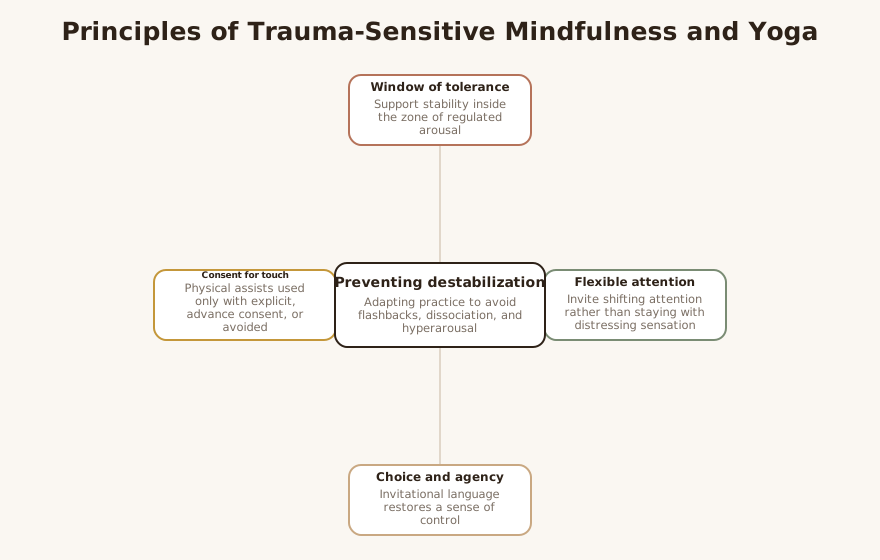
Several principles distinguish trauma-sensitive practice from conventional mindfulness and yoga. The most operationally important is staying within the window of tolerance—the zone of autonomic arousal in which a person remains regulated and able to process experience 6. Practice should support stability inside this window rather than pushing a person toward overwhelming sensation 6.
A second principle is flexible attention. Rather than dogmatically instructing clients to stay with distressing sensations, facilitators invite them to shift attention—opening the eyes, anchoring on an external object within view, or moving rather than sitting still—to maintain regulation 6. This directly inverts the conventional meditation instruction to “stay with whatever arises” LLM.
A third principle is choice and agency. TSY uses invitational language (“you might consider,” “if it feels right for you”) rather than directive commands, restoring a sense of control that interpersonal trauma often strips away 3. Physical assists or touch are used only with explicit, advance consent—and many trauma-informed settings avoid hands-on adjustment entirely 3.
A fourth principle is interoceptive focus over achievement. The emphasis is on noticing internal sensation—body tension, heart rate, breath—rather than attaining a correct posture 3. This heightened body awareness is hypothesized to help survivors detect and accurately label physiological aspects of emotional responses, a prerequisite for affect regulation 1.
Finally, the work attends to relationship and social context: practice is safest within trusted relationships where a provider can help co-regulate the nervous system, and competent facilitators examine their own biases, privilege, and power dynamics in the room 6.
Interventions & Techniques
In trauma-informed yoga, the concrete adaptations are predictable structure, invitational cueing, an emphasis on present-moment sensory experience (especially breath and physical sensation), and the removal of coercive or unexpected touch 3. The trial intervention was a weekly one-hour hatha-based class emphasizing flexibility over aerobic fitness, with attention directed to the sensory experience of breathing and movement 1.
In trauma-sensitive mindfulness, techniques include offering choice in posture and gaze (eyes open or closed), providing external anchors (a visible object, sounds in the room, contact of feet on the floor) as alternatives to the breath when breath-focus is activating, titrating the duration of practice, and explicitly orienting to the present environment to counter dissociation 6. Facilitators are taught to watch for signs that a client has left the window of tolerance and to pivot toward grounding and stabilization rather than continuing the formal practice 6.
LLM-generated illustrative example (not a guideline): A client with complex trauma reports that closing her eyes during a body scan produces a rush of fear and a sense of “floating away.” A trauma-sensitive response is to normalize this, invite her to keep her eyes open and rest her gaze on a fixed point in the room, shift the anchor from internal breath to the felt pressure of her feet on the floor, and shorten the practice to ninety seconds—framing each adaptation as her choice LLM.
A useful clinical heuristic is that the goal is regulation first, depth second: a brief, regulated practice is more therapeutic than a longer one that tips a client into hyperarousal or shutdown LLM.
Evidence Base
The evidence base is emerging, and clinicians should represent it as such 2. The strongest single study is van der Kolk and colleagues’ 2014 randomized controlled trial: 64 women with chronic, treatment-resistant PTSD secondary to childhood interpersonal assault were randomized to a weekly one-hour trauma-informed yoga class for 10 weeks or to a supportive women’s health education control 1. At the end of the study, 16 of 31 yoga participants (52%) no longer met criteria for PTSD on the Clinician-Administered PTSD Scale, compared with 6 of 29 (21%) in the control group 1. The yoga group showed a large within-group effect size (Cohen d = 1.07) on the CAPS 1. Notably, both groups improved initially, but the control group relapsed toward baseline on the Davidson Trauma Scale while the yoga group’s gains held, suggesting the physical and interoceptive components—not merely the social support—drove sustained symptom reduction 1. The authors concluded that effect sizes were comparable to well-researched psychotherapeutic and pharmacologic approaches 1.
That headline must be read against the authors’ own limitations. The sample was exclusively adult women, relatively well educated, all in the United States, with chronic rather than acute trauma; the trial lasted only 10 weeks with no formal follow-up; and the authors explicitly called for replication in younger, less educated, more acutely traumatized, and mixed-gender populations across cultural settings 1. A single RCT, however positive, is not a mature evidence base LLM.
For mindfulness-based interventions specifically, the literature on trauma and PTSD is developing rather than definitive, which is why these practices are positioned as adjunctive and complementary rather than first-line 2. Trauma-focused psychotherapies remain the established frontline treatments, and trauma-sensitive contemplative practice is most defensibly framed as a stabilization, skills, or adjunctive layer LLM. Importantly, part of the rationale for the trauma-sensitive movement is itself an evidence claim about harm: unmodified mindfulness can produce adverse responses—increased distress, intrusive memories, painful physical sensations, and dissociation—in some trauma survivors 6.
Populations & Indications
The populations with the clearest rationale and emerging support are adults with chronic, treatment-resistant PTSD, particularly survivors of interpersonal violence and childhood abuse—the group studied directly in the yoga trial 1. By extension, trauma survivors broadly, veterans, and people with PTSD are common targets, as are populations in high-trauma-prevalence settings such as incarcerated individuals and community programs 3. People with chronic stress are a frequent indication given yoga’s adjunctive use across stress-related conditions 1.
Symptom targets include hyperarousal, emotion dysregulation, dissociation, and interoceptive deficits—domains where building tolerable, regulated body awareness is the proposed mechanism 13. Yoga has also been studied as an adjunct across chronic pain, insomnia, anxiety, and depression, which supports its use for the somatic and mood-related sequelae that frequently accompany trauma 1.
Problems-for-Work
- Posttraumatic stress disorder — the central indication; trauma-informed yoga reduced CAPS-measured PTSD severity and helped over half of participants lose their diagnosis in the anchor trial 1.
- Interoceptive deficits and somatic distress — practices cultivate noticing of internal sensation, helping clients detect and label physiological signs of emotional states 13.
- Dissociation — trauma-sensitive technique counters dissociation by orienting to the present environment, keeping eyes open, and using external anchors; severe dissociation warrants a trained somatic practitioner 6.
- Hyperarousal and emotion dysregulation — staying within the window of tolerance and flexibly shifting attention are designed to keep arousal regulated rather than escalating it 6.
- Anxiety, depression, chronic pain, and insomnia — addressed as adjunctive targets consistent with yoga’s broader complementary-health applications 1.
LLM-generated illustrative example (not a guideline): For a veteran with hyperarousal and insomnia, a clinician might integrate a brief, eyes-open grounding-and-breath practice at the start of session as a regulation skill, explicitly framing it as optional and titratable, with the longer-term aim of building enough interoceptive tolerance to engage trauma-focused therapy LLM.
Contraindications, Cautions & Cultural Humility
The principal caution is that mindfulness and yoga are not universally benign for this population: in dysregulated individuals, sustained present-moment attention can intensify distress, surface intrusive memories, or trigger dissociation 6. Practice that pushes a client outside the window of tolerance is iatrogenic 6. Clients with significant dissociation should ideally work with a trained somatic practitioner rather than receiving unmodified meditation 6.
Trauma-sensitive contemplative practice is an adjunct, not a substitute for primary trauma treatment, and should not be offered as standalone care for acute or severe presentations 3. Touch and physical assists require explicit advance consent and are often best omitted entirely 3. Because the anchor evidence comes from a narrow demographic, clinicians should be appropriately humble about generalizing to younger, more acutely traumatized, male, or culturally diverse clients 1.
Cultural humility is built into the framework itself: facilitators are asked to examine bias, privilege, and power dynamics, and to recognize that yoga and mindfulness carry cultural and spiritual histories that may resonate differently—or feel appropriative or alienating—across clients 6. Treleaven frames trauma-sensitive mindfulness not as a checklist but as a humbling, ongoing path with no finish line 6.
Treatment-Plan Suggestions & SMART Objectives
| Goal | SMART objective (example) | Mechanism |
|---|---|---|
| Increase interoceptive awareness | Within 8 weeks, client will identify and name 2 distinct body sensations linked to an emotion in 3 of 4 sessions | Sensory attention builds capacity to detect physiological aspects of emotional responses 13 |
| Stay within window of tolerance | Within 6 weeks, client will use 1 grounding skill to return to a regulated state within 5 minutes of noticing dysregulation, self-reported 4 of 5 instances | Flexible attention and stabilization keep arousal regulated 6 |
| Reduce hyperarousal | Over 10 weeks, client will report a 2-point reduction on a 0–10 distress scale after a brief regulated practice in 4 of 5 sessions | Breath and movement support autonomic down-regulation 1 |
| Reduce dissociation | Within 8 weeks, client will use eyes-open, externally anchored practice to remain oriented to present surroundings in 3 of 4 sessions | Present-moment orientation counters dissociative drift 6 |
| Restore sense of agency | Within 4 weeks, client will exercise an explicit choice (posture, gaze, duration) in every practice, observed each session | Invitational structure and choice rebuild autonomy 3 |
| Reduce PTSD symptom severity | Over 12 weeks, client’s standardized PTSD measure will decrease by a clinically meaningful margin | Adjunct to trauma treatment; trial showed large effect on CAPS 1 |
| Improve sleep | Within 8 weeks, client will report 1 additional night per week of adequate sleep using a wind-down practice | Yoga’s adjunctive effect on insomnia and arousal 1 |
| Build tolerance for trauma-focused work | Within 10 weeks, client will tolerate a 10-minute interoceptive practice without leaving the window of tolerance, 3 sessions running | Graded exposure to internal sensation as preparation LLM |
Common Misconceptions
A first misconception is that meditation and yoga are inherently calming and therefore always safe for trauma survivors; in fact, unmodified practice can intensify distress, intrusion, and dissociation 6. A second is that “more is better”—that clients should push through difficult sensation; trauma-sensitive practice instead prioritizes staying regulated and shifting attention away from overwhelming material 6. A third is that the yoga RCT proves yoga “treats PTSD” as a standalone cure; the study was a 10-week adjunctive trial in a narrow population with no follow-up, framing yoga as adjunctive treatment 1. A fourth is that any yoga or mindfulness class is “trauma-informed”—the defining features (invitational language, choice, no coercive touch, interoceptive emphasis, window-of-tolerance awareness) are specific adaptations, not the default 36. A fifth is that trauma-sensitive mindfulness is a fixed protocol or checklist; it is better understood as an ongoing, humble clinical stance 6.
Training & Certification
There is no single licensure for this work, and the modalities are adjunctive layers on top of a clinician’s primary scope of practice LLM. On the yoga side, Trauma-Sensitive Yoga emerged as a defined approach from the Trauma Center, associated with structured facilitator development 3. On the meditation side, David Treleaven offers training and educational programs in trauma-sensitive mindfulness through his official platform, and his 2018 book functions as the field’s primary text and de facto curriculum 45. Introductory and conceptual material is also available in public talks and recorded presentations 7. Clinicians integrating these practices should pursue dedicated training rather than assuming general mindfulness or yoga experience transfers, given the specific harm-avoidance skills involved 6.
Key Terms
- Window of tolerance — the band of autonomic arousal within which a person stays regulated and able to process experience; practice should keep clients inside it 6.
- Interoception — the sense of the internal physiological state of the body; a core target and proposed mechanism 1.
- Invitational language — cueing framed as options (“you might consider”) rather than directives, to preserve agency 3.
- Hyperarousal / dissociation — over-activation versus disconnection from the body; both are risks during unmodified meditation and targets of trauma-sensitive technique 6.
- Flexible attention — deliberately shifting the object of attention (e.g., to an external anchor) to maintain stability rather than fixating on distress 6.
- Adjunctive treatment — an add-on to primary care; the established framing for trauma-informed yoga in the anchor trial 1.
- Trauma-Sensitive Yoga (TSY) — the hatha-yoga adaptation developed at the Trauma Center emphasizing choice, safety, and interoception 3.
Resources & Further Reading
▶ Watch — a video introduction to this concept:
- Yoga as an Adjunctive Treatment for Posttraumatic Stress Disorder: A Randomized Controlled Trial (van der Kolk et al., 2014)
- Mindfulness-Based Interventions for Psychological Trauma and PTSD (Current Treatment Options in Psychiatry, Springer, 2025)
- Trauma-Sensitive Yoga (TSY) / Trauma-Informed Yoga overview (Institute for the Psychology of Trauma)
- Trauma-Sensitive Mindfulness: Practices for Safe and Transformative Healing (Treleaven, 2018, W.W. Norton)
- David Treleaven — Learn Trauma-Sensitive Mindfulness (official site)
- The Need for Trauma-Sensitive Mindfulness (CASAT OnDemand)
- Trauma Sensitive Mindfulness — with David Treleaven (YouTube)
Reflective / Supervision Questions
- How do I currently assess whether a client is inside their window of tolerance before offering any mindfulness or body-based practice, and how would I notice when they leave it? 6
- When I introduce breath or body awareness, am I genuinely offering choice, or am I issuing directives that could replicate a loss of control for a survivor of interpersonal trauma? 3
- Have I represented the evidence honestly to clients—naming these practices as emerging and adjunctive rather than as established standalone treatments for PTSD? 12
- What is my plan if a client dissociates, floods, or reports increased intrusion during a practice, and at what threshold would I pause contemplative work and refer for somatic or trauma-focused treatment? 6
- How do the cultural and spiritual origins of yoga and mindfulness land for this particular client, and have I examined my own assumptions, biases, and power in the room? 6
- Do I have adequate dedicated training in trauma-sensitive adaptation, or am I relying on general mindfulness or yoga experience that may not carry the harm-avoidance skills this population requires? 56