
Type & Discipline
The Cognitive-Affective Processing System (CAPS), also called the cognitive-affective personality system, is a theory of personality structure and dynamics within social-cognitive psychology, proposed by Walter Mischel and Yuichi Shoda in 1995 1. It is not a treatment modality or a packaged intervention; it is a conceptual framework for understanding how a person’s internal psychological organization produces behavior, and how that behavior remains both stable and situationally variable at the same time 6. For the practicing clinician it functions as a lens — a way of formulating a case — rather than as a manualized protocol LLM.
CAPS sits at the intersection of personality theory and the study of self-regulation, and it was developed in explicit dialogue with two rival traditions: trait theory on one side and situationism on the other 5. Its central proposition is that behavior is best predicted from a comprehensive understanding of the person, the situation, and the interaction between the two, rather than from context-free trait scores alone 6. Because it foregrounds the processing of situations through cognition and affect, it is naturally compatible with the cognitive and emotion-focused therapies most clinicians already use LLM.
Creators & Lineage
The theory was articulated by Walter Mischel and Yuichi Shoda in their 1995 Psychological Review paper, “A Cognitive-Affective System Theory of Personality” 1. Mischel had spent the preceding decades as a provocateur within personality psychology: his 1968 critique argued that behavior can be predicted well only when the specific situation is taken into account, and that intellectual abilities show far more cross-situational stability than personality traits do 5. That critique opened what became known as the person-situation debate 6.
Mischel’s empirical signature outside CAPS is the delay-of-gratification (marshmallow) research, in which preschoolers’ capacity to forgo an immediate reward for a larger delayed one predicted later self-regulation, academic achievement, and life adjustment 5. CAPS can be read as the mature theoretical answer to a question that work raised: if self-control is a real, consequential individual difference, but behavior is nonetheless situation-dependent, what kind of structure inside the person could produce both facts at once? LLM The lineage also runs through Albert Bandura’s social-cognitive theory, from which CAPS inherits the emphasis on cognition, expectancies, and reciprocal interaction between person and environment, and it stands in deliberate contrast to trait theory and the Five-Factor Model 5. Yuichi Shoda extended and formalized the if-then signature methodology in subsequent collaborative work 1.
Core Principles
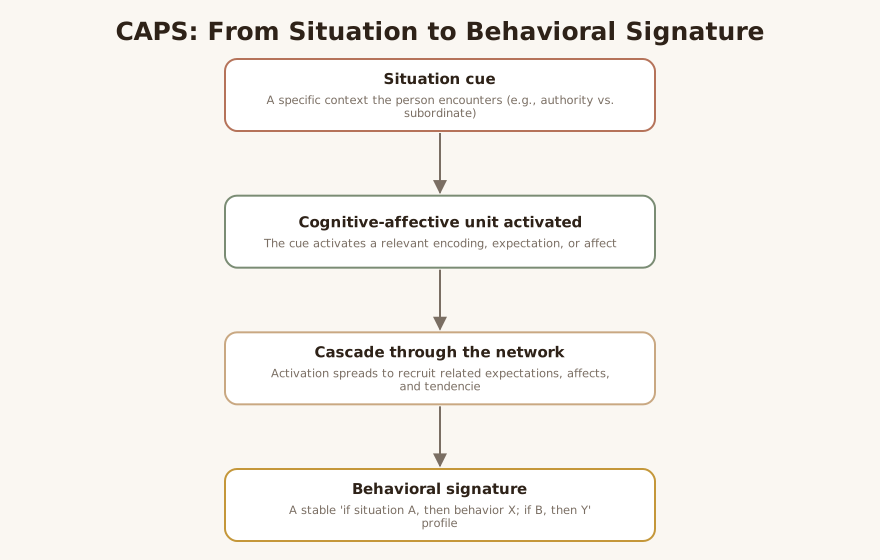
The first principle is that personality is a stable network of cognitive and affective units, not a list of traits 1. These units do not sit in isolation; they are interconnected, so that activating one (for example, a rejection-relevant encoding) cascades through the network to recruit related expectations, affects, and behavioral tendencies 2. The stability of personality lives in the organization of this network — the pattern of relations among units — rather than in any single average level of behavior 6.
The second principle is the behavioral signature, expressed as “if situation A, then behavior X; but if situation B, then behavior Y” 6. What looks like inconsistency from a trait standpoint — a person who is warm with subordinates but hostile with authority figures — is, from the CAPS standpoint, a stable and characteristic profile of situation-behavior contingencies 6. The variability is not noise; it is the data LLM.
The third principle reframes consistency itself. Traditional trait research sought consistency in the form of high average behavior across situations and was repeatedly frustrated by low cross-situational correlations 5. CAPS relocates consistency to the shape of the if-then profile across situations, which can be highly stable even when mean behavior varies enormously 6. The fourth principle is the integration of structure and dynamics: the same model that describes how personality is organized also describes how it operates moment to moment, which Mischel and Shoda argued removes the need to treat personality structure and personality process as separate subfields 6.
Interventions & Techniques
CAPS does not prescribe techniques, but it implies a method of clinical reasoning that translates directly into practice LLM. The foundational move is if-then mapping: rather than asking “is this client aggressive?” the clinician asks “in which situations does aggression appear, and in which does it not?” — building an explicit situation-behavior profile 6. This is conceptually adjacent to functional analysis and to the antecedent-behavior-consequence chains already familiar from cognitive-behavioral work LLM.
A second technique is unit-level formulation: once a problematic if-then pattern is identified, the clinician asks which cognitive-affective units drive it 1. Is the trigger an encoding (the situation is read as threatening), an expectancy (the client predicts rejection or harm), an affect (a fast physiological surge), a goal (prevention of rejection at all costs), or a self-regulatory deficit (the competency to pause is absent under load)? 2 Each answer points to a different intervention target LLM.
The rejection-sensitivity literature shows this in operation: anxious expectations of rejection heighten perception of rejection, which drives hostile cognition and aggressive behavior, while strong self-regulatory competencies — delay-of-gratification capacity, attentional control, and physiological flexibility indexed by respiratory sinus arrhythmia — buffer the entire chain 2. Interventions targeting executive function and emotion regulation are therefore directly indicated for that signature 2. A third technique is situation engineering: because the same person behaves differently across situations, altering the situational input (or the encoding of it) is a legitimate lever, not a failure to address “the real problem” LLM.
LLM-generated illustrative example (not a guideline): A clinician notes that a client is composed in individual therapy but escalates only when a partner withdraws. Instead of treating “anger” as a global trait, they chart the if-then signature, locate the active units (an encoding of withdrawal as abandonment, an expectancy of being left, a fast shame-affect), and target the encoding-to-affect link rather than anger in general LLM.
Evidence Base
The evidence base for CAPS as a theoretical framework is well established, and the framework is considered mature within personality and social-cognitive psychology 1. The 1995 paper is among the most-cited works in modern personality theory, and the if-then signature has been demonstrated empirically — most influentially in observational studies showing that children’s aggression formed stable, individually distinctive situation-behavior profiles even when overall aggression levels were similar across children 1. The model’s account of behavioral variability as structured rather than random has held up across decades of work 6.
Honesty about what “established” means here is important LLM. CAPS is established as a way of describing and predicting behavior and as a productive research program; it is not an established treatment with randomized controlled trials behind it, because it is not a treatment LLM. Its clinical value is indirect: it has generated well-supported applied models, the clearest being the rejection-sensitivity model, where the if-then dynamics, mediating units, and protective self-regulatory factors have been documented in romantic couples, ethnically diverse low-SES middle-school samples, and individuals with borderline personality features 2. Where a clinician adopts CAPS, the evidentiary weight rests on those downstream, testable applications rather than on the abstract framework LLM.
Populations & Indications
CAPS was developed as a general theory of personality and so applies, in principle, to adults across the range 1. It is most clinically useful as an assessment and formulation framework — that is, in any context where a clinician is trying to make sense of behavior that varies by situation 5. The framework is especially apt for people with personality disorders and people with emotion dysregulation, where the presenting complaint is frequently described in trait language (“she’s manipulative,” “he’s unstable”) that obscures the underlying situation-behavior structure 2.
It is well suited to adolescents, given the development of self-regulatory competencies during that period and the situational specificity of adolescent behavior 5. Forensic populations are a natural application because risk is inherently situational — the question is rarely “is this person dangerous?” but “in which situations, with which triggers, does the dangerous behavior emerge?”, which is exactly an if-then signature question LLM. Finally, the framework is indicated for researchers and clinicians in an assessment context, where it argues for situation-behavior profiles over single trait scores as the unit of measurement 5.
Problems-for-Work
Behavioral inconsistency across situations. This is the framework’s home turf: a client who is reliable at work but chaotic at home is not “really” one or the other, but is showing a stable if-then profile to be mapped and worked with 6.
Maladaptive interpersonal patterns. The rejection-sensitivity application is the worked example — accommodating when no threat is perceived, aggressive when rejection is anticipated, in a self-fulfilling loop where the person’s hostility elicits the very rejection they feared 2.
Emotional dysregulation and self-regulation deficits. CAPS locates dysregulation in the affect units and in the competency/self-regulatory units, and the buffering role of delay-of-gratification capacity and attentional control points the clinician toward concrete regulatory targets 2.
Situational behavioral triggers, impulsivity, and aggression. By specifying which situations activate the maladaptive chain, the model supports both trigger identification and the design of situation-level changes alongside person-level skill building 2.
LLM-generated illustrative example (not a guideline): A forensic client’s file labels him “impulsive.” The clinician instead maps that his aggression appears almost exclusively when authority is experienced as humiliating, and is absent in cooperative tasks — converting a global trait label into a workable if-then trigger profile LLM.
Contraindications, Cautions & Cultural Humility
CAPS is a formulation framework, so it has no medical contraindications, but it has misuse risks LLM. The first caution is over-attribution to the situation: emphasizing situational specificity can be misread as denying that stable individual differences exist, when in fact CAPS asserts strong stability — in the organization of the system, not in average behavior 6. A clinician who concludes “it all depends on the situation, so there’s nothing stable to treat” has misunderstood the theory LLM.
The second caution concerns trait language with clients: because trait descriptions are culturally pervasive, both client and clinician may default to them, and the work of re-describing behavior as situational profiles must be done deliberately 5. The third concerns cultural humility in defining the “situation” itself: encodings, expectancies, goals, and the meaning of a given situation are shaped by culture, and a clinician who assumes their own reading of a situation matches the client’s may misidentify the active units LLM. The rejection-sensitivity work was deliberately validated in ethnically diverse and low-SES samples, a reminder that the situational meanings driving the if-then signature are not universal and must be elicited, not assumed 2.
Treatment-Plan Suggestions & SMART Objectives
| Goal | SMART objective (example) | Mechanism |
|---|---|---|
| Build an if-then map of a target behavior | Within 4 sessions, client identifies at least 3 situations that reliably trigger the behavior and 3 that do not, recorded in a written profile | Situation-behavior signature mapping 6 |
| Modify a threat-biased encoding | Within 6 weeks, client generates an alternative reading of a trigger situation in 4 of 5 logged instances | Encoding unit revision 1 |
| Revise rejection expectancies | Within 8 weeks, client reduces self-rated certainty of anticipated rejection by half on a daily log | Expectancy/belief unit change 2 |
| Strengthen affect-down-regulation under load | Within 6 weeks, client applies a paced-breathing or attentional-shift skill within 60 seconds of physiological surge in 3 of 5 episodes | Affect + self-regulatory competency units 2 |
| Reduce trigger-specific aggression | Over 8 weeks, client logs zero physical aggression in the identified high-risk situation while maintaining a coping plan | Competency/self-regulatory unit + situation engineering 2 |
| Realign a prevention goal | Within 6 weeks, client names one approach-oriented relational goal to replace rejection-avoidance in a target context | Goal/value unit reorientation 2 |
| Interrupt the self-fulfilling interpersonal loop | Within 8 weeks, partner-rated hostility during one recurring disagreement decreases on a shared rating | Network-level change in the if-then chain 2 |
Common Misconceptions
“CAPS proves personality isn’t real.” It claims the opposite: personality is a real, stable system; what is unstable is the assumption that a person behaves the same way everywhere 6. “It’s just situationism.” Pure situationism holds that the situation alone determines behavior; CAPS holds that the situation is processed through a person’s distinctive cognitive-affective organization, so two people in the same situation behave differently and predictably so 1. “If-then signatures mean behavior is unpredictable.” The signature is precisely a prediction — a stable map of how a particular person varies — not an admission of randomness 6. “It replaces traits entirely.” It reframes rather than abolishes consistency, and many researchers treat CAPS and trait approaches as complementary levels of description rather than as exclusive rivals 5. “It’s a therapy.” It is a personality theory; its clinical use is as a formulation tool that feeds existing therapies LLM.
Training & Certification
There is no certification in CAPS, because it is a theoretical framework rather than a credentialed treatment modality LLM. Clinicians typically encounter it within graduate personality and social-cognitive psychology coursework, where the 1995 Mischel and Shoda paper and the person-situation debate are standard reading 1. Familiarity is best built by reading the primary paper alongside the applied rejection-sensitivity literature, which models how to move from the abstract framework to a testable clinical formulation 2. The relevant applied competencies — functional analysis, encoding and expectancy work, and emotion-regulation skills training — are taught within established cognitive-behavioral and emotion-focused training rather than under a CAPS banner LLM.
Key Terms
Cognitive-affective units (CAUs). The mental-emotional building blocks of the system, comprising five types: encoding strategies, expectancies and beliefs, affects, goals and values, and competencies and self-regulatory plans 5. Encoding strategies. A person’s individualized manner of categorizing and interpreting situational information 6. Expectancies and beliefs. Predictions about the consequences of different behavioral possibilities in a situation 6. Affects. Emotions, feelings, and physiological responses activated by the encoded situation 6. Goals and values. Desired outcomes and standards that lend direction across contexts 6. Competencies and self-regulatory plans. Capacities for goal pursuit and self-control, including the delay-of-gratification ability that buffers maladaptive chains 2. Behavioral signature. The stable if-A-then-X, if-B-then-Y profile of situation-behavior contingencies that characterizes an individual 6. Person-situation debate. The dispute over whether behavior is governed by stable internal dispositions or by situations, which CAPS sought to resolve by integrating both 6.
Resources & Further Reading
▶ Watch — a video introduction to this concept:
- Mischel, W., & Shoda, Y. (1995). A Cognitive-Affective System Theory of Personality. Psychological Review, 102(2), 246-268.
- Applying the Cognitive-Affective Processing Systems Approach to Rejection Sensitivity (PMC2772175)
- A Cognitive-Affective System Theory of Personality — ERIC record EJ509303
- Basic Constructs in Mischel’s Social Learning Theory — Theories of Personality (Bay Path University open textbook)
- Cognitive-affective personality system — Wikipedia
Reflective / Supervision Questions
- For your most “inconsistent” client, what if-then signature emerges when you chart the situations where the problem behavior appears versus where it does not? LLM
- When you describe a client in trait language in your notes, which underlying situation-behavior profile is that shorthand hiding? 6
- For a recurring maladaptive pattern, which single cognitive-affective unit — encoding, expectancy, affect, goal, or self-regulatory competency — is the most promising intervention target, and why? 2
- Where might your own encoding of a client’s situation differ from theirs, and how would that change the units you identify? LLM
- In a case where situational change is available, are you treating “fix the person” and “change the situation” as genuine alternatives, or defaulting to the former? 6