
Type & Discipline
The Transtheoretical Approach to Therapy is a framework within clinical psychology, sitting in the family of psychotherapy integration and behavior change 3. It is not a discrete brand of therapy with its own techniques but an integrative meta-model: an attempt to organize the many competing systems of psychotherapy according to a shared dimension of client readiness, the stage of change 2. Its best-known component, the transtheoretical model (TTM) and its stages of change, has been used to adapt and tailor treatment to the individual client 1. The broader approach is usually encountered in two places at once: as a clinical heuristic for matching method to motivation, and as a comparative analysis of the psychotherapy systems themselves 2.
The word “transtheoretical” signals the central ambition: to work across, rather than within, the major theoretical schools 3. Where most models prescribe one set of interventions, this framework treats the schools as a toolbox whose contents become useful at different moments in a single client’s trajectory 1.
Creators & Lineage
The model originated with James O. Prochaska and Carlo DiClemente at the University of Rhode Island, beginning around 1977, from a comparative analysis of leading psychotherapy theories 3. It was first developed in the study of smoking cessation and self-change, then extended to a wide range of health behaviors and to psychotherapy more generally 3. The foundational empirical work appeared in Prochaska and DiClemente’s 1983 analysis of the stages and processes of self-change of smoking 1.
The comparative, integrative side of the lineage is carried by Prochaska and John C. Norcross in their text Systems of Psychotherapy: A Transtheoretical Analysis, which examines each major system’s theory of personality, theory of psychopathology, and resulting therapeutic process 2. Norcross is central to the approach’s later development and to the meta-analytic evidence on stages of change in psychotherapy 1. The framework’s intellectual neighbors are psychotherapy integration, common factors theory, and motivational interviewing, the last of which absorbed many of the same lessons about readiness and resistance 1.
Core Principles
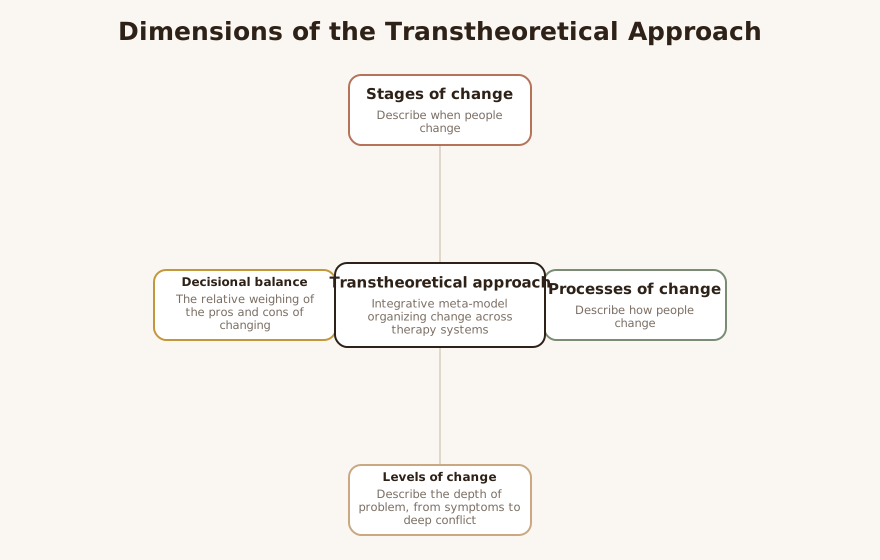
The approach rests on a single integrative claim: the major systems of psychotherapy largely agree on the processes that produce change while diverging on the elements in need of change 2. From that claim the model derives three organizing dimensions. The stages of change describe when people change; the processes of change describe how they change; and the levels of change describe the depth of problem being addressed, from symptoms to long-term intrapersonal conflict 3.
The five stages are precontemplation (no intention to change in the foreseeable future, often with limited awareness of the problem), contemplation (aware of a problem and seriously weighing change but not yet committed), preparation (intending to act within a month, taking small steps), action (overtly modifying behavior, typically for one day to six months), and maintenance (sustaining change and preventing relapse beyond six months) 1. Recycling through earlier stages is expected rather than exceptional 1.
Two cross-cutting constructs track movement. Decisional balance is the relative weighing of the pros and cons of changing; cons outweigh pros in precontemplation, the balance tips through contemplation, and pros dominate by action 3. Self-efficacy is the situation-specific confidence that one can cope with high-risk situations without relapse, drawn from Bandura’s theory 3. The integrative payoff is that different processes are differentially effective at different stages, so the same client may need an insight-oriented stance early and an action-oriented one later 1.
Interventions & Techniques
The processes of change are the model’s intervention vocabulary, each a broad category encompassing techniques from disparate orientations 1. Roughly ten are consistently identified: consciousness raising, dramatic relief, self-reevaluation, environmental reevaluation, social liberation, self-liberation, helping relationships, counterconditioning, reinforcement management, and stimulus control 3. Processes traditionally associated with the experiential, cognitive, and psychoanalytic traditions are most useful in the earlier stages, while those from the existential and behavioral traditions are most useful in action and maintenance 1.
In practice the recommended sequence is concrete. Patients progress optimally from precontemplation and contemplation into preparation through consciousness raising, self-liberation, and dramatic relief (emotional arousal), and from preparation into action and maintenance through counterconditioning, stimulus control, and reinforcement management 1. The clinician’s relational stance shifts in parallel: a nurturing-parent stance with the precontemplator, a Socratic-teacher role with the contemplator, an experienced-coach stance during preparation, and a consultant role as action and maintenance proceed 1.
LLM-generated illustrative example (not a guideline): A clinician seeing a client who minimizes their drinking does not assign a sobriety plan in session one; they first use consciousness raising and reflective listening to build awareness, reserving stimulus-control and reinforcement strategies for later, once the client is preparing to act LLM.
Assessment is brief. Stage can be measured with validated instruments such as the University of Rhode Island Change Assessment (URICA) or the SOCRATES for problem drinking, or, more commonly in practice, with a single tailored question about readiness in the next six months versus the next month 1.
Evidence Base
The maturity of this framework is best described as established but uneven, and the honest clinician should hold two findings in tension 1. The first is strong: stage of change reliably predicts psychotherapy outcomes. A meta-analysis of 39 studies encompassing 8,238 psychotherapy patients found a medium effect size of d = .46 for the association between pretreatment stage and outcome, meaning the progress a client makes tends to be a function of where they start 1. Diagnostic-specific effects ranged from d = .37 for addictions to d = .45 for mood disorders and d = .99 for eating disorders 1. An earlier meta-analysis confirmed that processes of change vary by stage with large effects 1.
The second finding is sobering: the prescriptive claim, that matching psychotherapy to stage improves outcomes, is far less established 1. The same meta-analysis located no controlled group studies meeting inclusion criteria that matched face-to-face psychotherapy to client stage, so that analysis could not be performed 1. Most of the supportive matching evidence comes from population-based health-behavior interventions delivered by computer, mail, or phone, not from psychotherapy 1. Critics have gone further: a 2010 Cochrane review found stage-based self-help and counseling neither more nor less effective than non-stage-based equivalents, and the discrete, time-defined stage boundaries have been criticized as arbitrary and not clearly sequential 3. In short, the model’s predictive and descriptive validity is solid; its prescriptive matching claim in psychotherapy remains weakly evidenced 1.
Populations & Indications
The framework was validated first with people changing health behaviors and addictive behaviors, and its strongest evidence base remains there 1. Within psychotherapy it has been applied to adults across diverse clinical populations, including clients with substance use disorders, eating disorders, and mood disorders 1. It is particularly suited to clients at varying readiness levels and to those presenting with ambivalence about treatment itself 1.
The approach is indicated wherever readiness is variable or uncertain, which describes much of routine practice: aggregating across studies and populations, roughly 40% of a target population sits in precontemplation, 40% in contemplation, and only 20% prepared for action 1. Because stages are problem-specific, the framework is well suited to clients with comorbid presentations, where readiness may differ across problems and the staging question must be asked separately for each 1.
Problems-for-Work
The framework is most useful for problems where motivation and readiness, rather than skill or insight alone, are the bottleneck 1.
- Treatment ambivalence and motivation deficits. Staging reframes a “resistant” client as a precontemplator or contemplator, redirecting the work toward consciousness raising and decisional balance rather than premature action 1.
- Substance use disorders. Readiness measures such as the SOCRATES predict quit attempts and use severity, and 12-step-oriented treatments showed the highest stage-related effect size in the psychotherapy meta-analysis 1.
- Depression and anxiety. Baseline readiness predicted mood-disorder outcomes (d = .45), supporting attention to stage even in symptom-focused work 1.
- Treatment nonadherence and relapse. Anticipating recycling and building relapse prevention into the plan is a direct application, since most patients cycle through the stages several times before durable maintenance 1.
- Behavioral change difficulties and comorbidity. Tailoring processes to stage, and asking the staging question separately per problem, structures work with multidisordered clients 1.
Contraindications, Cautions & Cultural Humility
There is no formal contraindication to assessing readiness, but several cautions matter 1. The first is over-reliance on the prescriptive matching claim, which the psychotherapy evidence does not yet support; clinicians should use staging as a heuristic, not as a validated protocol 1. The second is mismatching processes to stages: imposing action-oriented methods on precontemplators tends to drive them away while the lack of progress is misattributed to client resistance 1. The model itself notes that what looks like client resistance is often a therapist not ready to adapt their stance 1.
The discrete-stage structure should be held loosely. Critics note the stages are not cleanly mutually exclusive, the time boundaries are arbitrary, and movement is not reliably linear, so treating stages as hard categories overstates the model’s precision 3. The sampled meta-analytic studies were predominantly White, and most matching research concerns health behaviors rather than the full range of presentations seen in mental health care, so generalization across cultural and diagnostic contexts requires humility 1.
LLM-generated illustrative example (not a guideline): Where a client’s reluctance to “take action” reflects realistic appraisal of family, economic, or cultural constraints rather than precontemplation, labeling them precontemplative would pathologize a reasonable stance; the clinician should examine context before staging LLM.
Treatment-Plan Suggestions & SMART Objectives
| Goal | SMART objective (example) | Mechanism |
|---|---|---|
| Establish current readiness | Within 2 sessions, clinician and client identify the client’s stage for each target problem using a brief readiness question | Stage assessment, problem-specific staging 1 |
| Move from precontemplation to contemplation | Over 6 weeks, client articulates at least 3 personal costs of the problem behavior in session | Consciousness raising, dramatic relief 1 |
| Tip decisional balance | Within 8 weeks, client completes a written pros/cons list and reports pros outweighing cons | Decisional balance shift 3 |
| Build readiness to act | Within 4 weeks of reaching preparation, client commits to one concrete behavioral step | Self-liberation, experienced-coach stance 1 |
| Support sustained action | For 3 consecutive weeks, client uses at least 2 counterconditioning or stimulus-control strategies weekly | Counterconditioning, stimulus control 1 |
| Strengthen self-efficacy | Over 6 weeks, client rates confidence in handling 3 high-risk situations at 7/10 or higher | Self-efficacy enhancement 3 |
| Anticipate and contain relapse | Within 2 sessions of entering maintenance, client and clinician draft a written relapse-prevention plan | Reinforcement management, recycling anticipation 1 |
| Match relational stance to stage | Each session, clinician adapts stance (nurturing parent, Socratic teacher, coach, consultant) to current stage | Stage-matched relationship of choice 1 |
Common Misconceptions
A frequent misconception is that the transtheoretical approach is a standalone therapy with its own techniques; it is an integrative organizing framework that draws its methods from the established systems 2. A second is that stage-matching is a proven, manualized protocol; in psychotherapy specifically the controlled trials needed to demonstrate that matching improves outcomes have not been conducted 1.
A third misconception is that most clients arrive ready to work, which leads clinicians to design action-oriented treatments and then feel disappointed when few clients engage; in reality the majority are not in the action stage 1. A fourth is that insight alone produces change, a criticism the model levels at classical analysis, while modifying behavior without awareness is its criticism of radical behaviorism, both being characteristic mismatches of process to stage 1. Finally, the time-based stage definitions are often treated as exact when they are better understood as approximate and contested 3.
Training & Certification
There is no certification specific to the transtheoretical approach, and none is required to use it; the staging question and the processes can be learned from the primary literature and integrated into existing practice 1. Practitioners typically build competence through the foundational texts, including Prochaska and Norcross’s Systems of Psychotherapy: A Transtheoretical Analysis for the integrative analysis, and through validated measures such as the URICA and SOCRATES for staging 1.
Because the framework is explicitly integrative, developing it in practice tends to mean broadening one’s repertoire across systems so that the appropriate process is available at each stage 2. Motivational interviewing, which operationalized much of the precontemplation work, offers a closely related and well-developed training pathway 1.
Key Terms
- Stage of change: A period of time and set of tasks marking a client’s readiness, across precontemplation, contemplation, preparation, action, and maintenance 1.
- Processes of change: The covert and overt activities by which people modify behavior, numbering roughly ten and spanning multiple theoretical orientations 3.
- Levels of change: A hierarchy of problem depth, from situational symptoms to long-term intrapersonal conflict, indicating where intervention is aimed 3.
- Decisional balance: The relative weighing of the pros and cons of changing, which shifts as a client advances through the stages 3.
- Self-efficacy: Situation-specific confidence in coping with high-risk situations without relapse 3.
- Recycling: The expected return to an earlier stage before durable maintenance is achieved 1.
- Stage-matched relationship of choice: Adapting the therapist’s relational stance (nurturing parent, Socratic teacher, coach, consultant) to the client’s stage 1.
Resources & Further Reading
▶ Watch — a video introduction to this concept:
- Norcross, Krebs & Prochaska (2011), Stages of Change — review chapter PDF
- Prochaska & Norcross, Systems of Psychotherapy: A Transtheoretical Analysis — Google Books
- Transtheoretical model — Wikipedia
Reflective / Supervision Questions
- For each of my current clients, what stage of change are they in for each target problem, and have I actually asked rather than assumed LLM?
- Where am I designing action-oriented treatment for clients who are still in precontemplation or contemplation, and how might that be read as resistance LLM?
- When a client is not progressing, how often is the obstacle my own reluctance to change relational stance or method rather than the client’s motivation LLM?
- Given that stage-matching in psychotherapy is weakly evidenced, am I using staging as a flexible heuristic or overselling it as a validated protocol LLM?
- How does cultural, economic, or systemic context shape what looks like “readiness,” and am I at risk of pathologizing a reasonable stance as precontemplation LLM?
- How do I build relapse prevention and the expectation of recycling into plans rather than treating relapse as failure LLM?