
Type & Discipline
The Health Belief Model (HBM) is a value-expectancy framework for explaining and predicting health behavior rather than a standalone psychotherapy 1. It sits at the intersection of health psychology and public health, and is conventionally grouped within the family of individual-level health behavior prediction models 5. Its central premise is that a person’s likelihood of taking a health action is a function of how they weigh the perceived threat of a condition against the perceived costs and benefits of acting 6. For practicing therapists, the most useful framing is diagnostic: the HBM gives you a structured set of beliefs to assess and then target when a client is stuck on a health behavior such as taking medication, attending screening, or changing a risk behavior LLM.
Creators & Lineage
The HBM was developed in the 1950s by social psychologists working at the United States Public Health Service, principally Godfrey M. Hochbaum, Irwin M. Rosenstock, S. Stephen Kegeles, and Howard Leventhal 1. It originated as an attempt to explain a concrete and frustrating public health failure: the widespread reluctance of people to accept free preventive services and screening for asymptomatic disease, including the poor uptake of tuberculosis chest X-rays even when mobile screening units were brought into neighborhoods 4. The model originally comprised four constructs (perceived susceptibility, severity, benefits, and barriers), with cues to action and a set of modifying variables 4. In 1988, Rosenstock and colleagues amended the model to incorporate self-efficacy, defined as a person’s perception of their competence to successfully perform a behavior, in order to better account for sustained behavior change rather than one-time acts 4. Self-efficacy had earlier been folded into “barriers” by Janz and Becker before being recognized as a distinct construct 1.
The HBM belongs to the same generation of cognitively oriented behavior theories as Social Cognitive Theory, the Theory of Reasoned Action, the Transtheoretical Model (Stages of Change), and Protection Motivation Theory; it shares with them an emphasis on perceived threat and outcome expectancies, and the self-efficacy construct it borrowed reflects this cross-pollination LLM. In practice the HBM is frequently combined with these other models rather than used in isolation 5.
Core Principles
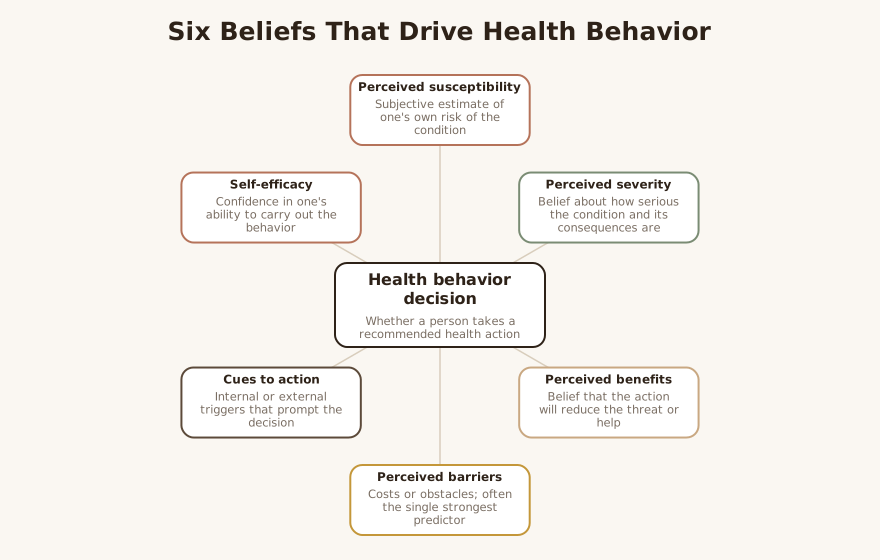
The HBM proposes that health behavior is driven by six interacting beliefs 1 2:
- Perceived susceptibility — the person’s subjective estimate of their own risk of acquiring the condition; for example, asking a patient to rate their chance of developing breast cancer 2.
- Perceived severity — the belief about how serious the condition and its consequences are, including untreated outcomes and effects on life domains such as work or relationships 2.
- Perceived benefits — the belief that the recommended action will actually reduce the threat or produce a positive outcome, such as peace of mind from screening 2.
- Perceived barriers — the belief about the negative aspects, costs, or obstacles of taking the action, such as embarrassment, discomfort, or inconvenience; in most studies this is the single most powerful predictor of behavior 2.
- Cues to action — internal or external triggers that prompt the decision to act, ranging from a new symptom to a media campaign or a clinician’s reminder 1.
- Self-efficacy — confidence in one’s ability to actually carry out the behavior, for example confidence in arranging and keeping a medical appointment 2.
Behavior, in this account, becomes likely when a person feels personally at risk of a serious condition, believes a feasible action will help, perceives the barriers as manageable, encounters a cue, and feels capable of acting 6. These beliefs are shaped by modifying variables — demographic, psychosocial, and structural factors such as age, education, and culture — that influence the core perceptions 4.
A crucial caveat for clinical use: the HBM does not specify how its constructs combine or interact mathematically, which is both a flexibility and a recognized weakness 4.
Interventions & Techniques
Because the HBM is a predictive framework, “intervention” means systematically assessing each construct and then shaping messaging and skills around the deficits you find LLM. The Rural Health toolkit describes a practical sequence: gather information through a needs assessment to determine who is at risk, clearly convey the consequences of the risk behavior to raise perceived severity, communicate the concrete steps of the recommended action while highlighting its benefits, identify and reduce barriers through direct support, and build self-efficacy through skill development and demonstration 5. Selecting cues to action that genuinely resonate with the target person or population is essential to success 5.
At the individual clinical level, practitioner-oriented techniques include using HBM-derived scales adapted to a specific behavior, decisional-balance worksheets that surface perceived benefits against perceived barriers, and SMART goal-setting aimed squarely at the barriers and at building benefit perception 6. Clinicians are advised to set the expectation that change will not be immediate 6.
LLM-generated illustrative example (not a guideline): A client with type 2 diabetes who skips metformin says “I feel fine, so what’s the point?” You hear low perceived susceptibility and severity. Rather than repeat the medical warning, you ask what he imagines life with uncontrolled diabetes would look like in ten years (severity), explore his confidence in building a daily pill routine around an existing habit (self-efficacy and barriers), and pair the medication to his morning coffee as a cue to action LLM.
Evidence Base
The HBM is best described as an established model: it is one of the most widely used and studied frameworks in health behavior, but its empirical track record is mixed and its predictive power is modest 1. Reviews suggest the original model explains only roughly 20% to 40% of variance in health behavior, a low-to-moderate predictive value relative to models that better incorporate social, economic, and environmental factors 1. One frequently cited analysis found the original HBM constructs explained only about 20% (R² < 0.21) of variance, and that the model lacks clear rules for how the variables combine 3.
Findings are genuinely inconsistent across domains. A 2024 systematic review found perceived susceptibility, perceived benefits, and self-efficacy strongly linked to adoption of preventive measures for conditions such as cervical cancer, and HBM-based education improved cervical screening participation among Iranian women 1. By contrast, a 2020 systematic review by Ritchie and colleagues found the HBM often failed to demonstrate effectiveness despite describing screening behavior, with inconsistent results for oral health, medication adherence, and COVID-19 vaccination intentions 1. Efforts to extend the model — for instance by adding self-identity, perceived importance, consideration of future consequences, and concern for appearance — have substantially improved predictive capacity (one extension reported a jump from roughly 40% to 71%), with self-efficacy emerging as the strongest single determinant 3. The honest clinical takeaway: the HBM is a useful organizing lens and a reliable source of assessment targets, but it is not a high-fidelity predictor and should not be oversold LLM.
Populations & Indications
The HBM was built for and is most validated in patients and broader public health populations facing decisions about preventive or screening behavior for asymptomatic disease 1. It has been applied across diabetes prevention, breast and cervical cancer screening, HIV management, vaccination, tobacco cessation, physical activity, dental health, and seatbelt use 1. It is well suited to adults, at-risk populations, and communities where a specific, discrete health action is being recommended and beliefs are the main lever 5. For people with chronic illness, the model maps cleanly onto self-management and adherence decisions, where susceptibility and severity perceptions often erode once symptoms are controlled 1. It can be deployed for both short- and long-term interventions and combined with other theories for a given population 5.
Problems-for-Work
- Medication and treatment nonadherence — assess whether the client underestimates susceptibility/severity, overestimates barriers (side effects, cost, stigma), or doubts the benefit; target the dominant belief 1. Application: a client stops an antidepressant once they “feel better,” reflecting collapsed perceived susceptibility to relapse LLM.
- Preventive health behavior — the model’s original use case; clarify benefits and provide a salient cue to action 1.
- Health screening avoidance — perceived susceptibility and severity significantly predict screening participation, and embarrassment is a classic barrier to address directly 6 2.
- Vaccine hesitancy — higher perceived barriers correlate with hesitancy, while perceived benefits, susceptibility, and self-efficacy correlate with acceptance, giving four explicit levers 6.
- Risk perception deficits and self-management of chronic conditions — work on calibrating susceptibility and severity without inducing paralyzing fear, while building self-efficacy 1.
Contraindications, Cautions & Cultural Humility
The HBM’s core limitation is that it is an individualistic, cognitive, and largely rational-choice model: it assumes people systematically weigh pros and cons, and it under-weights emotion, habit, social pressure, and non-health motivations for behavior 1. Critically for equity-minded practice, it largely ignores structural and environmental barriers — changing a person’s beliefs does nothing about the actual cost of care, transportation, time off work, or access 6 4. Using the HBM as if a client’s nonadherence were purely a belief problem risks blaming the individual for what are often structural failures, and the model has been explicitly criticized for overemphasizing individual responsibility while neglecting social determinants of health 1.
Cultural humility is therefore not optional but corrective: the model treats culture only as a background “modifying variable,” so the clinician must actively ask how the client’s community, beliefs, and lived constraints shape each construct rather than assuming the framework captures them 4 1. The HBM is also static — it does not model how beliefs evolve over time or after intervention — so pair it with a stage-based or motivational approach when readiness is shifting 1.
Treatment-Plan Suggestions & SMART Objectives
| Goal | SMART objective (example) | Mechanism |
|---|---|---|
| Improve medication adherence | Client will take prescribed medication ≥6 of 7 days/week, verified by pill count or app log, for 4 consecutive weeks | Reduce perceived barriers; build self-efficacy via routine 5 |
| Calibrate risk perception | Client will articulate, in two sessions, three personalized consequences of leaving the condition untreated | Increase perceived susceptibility and severity 2 |
| Increase screening uptake | Client will schedule and attend the recommended screening within 60 days | Strengthen perceived benefits; supply a cue to action 1 |
| Reduce a specific barrier | Client will identify top barrier and implement one concrete workaround within 2 weeks | Lower perceived barriers, the strongest predictor 2 |
| Build self-efficacy | Client will rehearse and complete the behavior once with support, rating confidence ≥7/10 | Skill development and demonstration 5 |
| Resolve decisional ambivalence | Client will complete a decisional-balance worksheet weighing benefits vs. barriers by session 3 | Surface and rebalance benefit/barrier appraisals 6 |
| Address vaccine/treatment hesitancy | Client will name two perceived benefits and one mitigated barrier before the next decision point | Shift the belief cluster linked to acceptance 6 |
Common Misconceptions
- “The HBM is a therapy.” It is a predictive framework and assessment lens, not a manualized treatment 1.
- “It strongly predicts behavior.” Its predictive value is low to moderate (≈20–40%), and results are inconsistent across health domains 1 3.
- “Fear (severity) is the main driver.” In most studies perceived barriers are the strongest predictor, so reducing barriers often beats amplifying threat 2.
- “Changing beliefs is enough.” The model ignores structural barriers; belief change does nothing about cost or access 6.
- “The constructs combine in a known formula.” The HBM does not specify how its constructs interact, which limits cross-study comparison 4.
Training & Certification
There is no certifying body or credential for the Health Belief Model; it is a public-domain conceptual framework taught within graduate health psychology, public health, and health-education curricula and disseminated through standard texts such as Health Behavior and Health Education 2. Clinicians typically learn it as part of broader training in behavior-change theory and apply it through validated, behavior-specific HBM scales rather than a proprietary protocol 6. Foundational, freely available references include the StatPearls chapter and the University of Pennsylvania constructs summary 1 2.
Key Terms
- Perceived susceptibility — subjective estimate of personal risk of a condition 1.
- Perceived severity — belief about the seriousness of the condition and its consequences 2.
- Perceived benefits — belief that the action reduces the threat 2.
- Perceived barriers — perceived costs or obstacles to the action; usually the strongest predictor 2.
- Cues to action — internal or external triggers that prompt the behavior 1.
- Self-efficacy — confidence in one’s ability to perform the behavior (added 1988) 4.
- Modifying variables — demographic, psychosocial, and structural factors that shape the core beliefs 4.
Resources & Further Reading
▶ Watch — a video introduction to this concept:
- Alyafei & Easton-Carr (2024), StatPearls: The Health Belief Model of Behavior Change
- Glanz et al., Health Behavior and Health Education — Main Constructs (UPenn)
- Orji, Vassileva & Mandryk (2012): An Extension of the Health Belief Model (PMC)
- Rural Health Promotion and Disease Prevention Toolkit: The Health Belief Model
- PositivePsychology.com: What Is the Health Belief Model? An Updated Look
- Health belief model — Wikipedia
Reflective / Supervision Questions
- For a client stuck on a health behavior, which of the six HBM constructs is actually the bottleneck, and how do I know rather than assume? LLM
- Am I targeting perceived barriers (often the strongest lever) or defaulting to raising fear about severity? 2
- Where in this case am I attributing to belief what is really a structural barrier (cost, access, time), and what does that mean for the plan and for equity? 6
- How has this client’s culture and community shaped their susceptibility, severity, and benefit appraisals, and have I asked rather than inferred? 4
- Given the model’s modest predictive power, what am I not seeing — emotion, habit, relationship, identity — that a purely cognitive lens misses? 1
- Which recognized modality (CBT, MI) am I delivering this within, and is my documentation reflecting that framing? LLM