
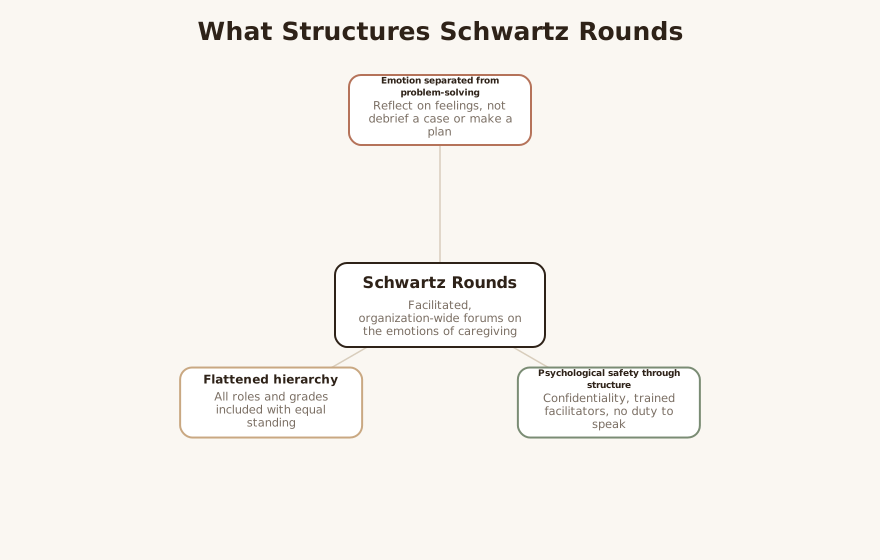
Schwartz Rounds occupy an unusual place in the clinician’s toolkit: they are not a treatment delivered to patients, but a structured organizational practice aimed at the people who deliver treatment. For therapists working inside hospitals, hospices, community mental health teams, or integrated medical settings, understanding Rounds matters in two ways — as something you may be asked to attend or facilitate, and as a model for the kind of reflective, emotion-focused group work that supports a workforce under chronic strain. LLM
Type & Discipline
Schwartz Rounds are a facilitated, organization-wide forum in which healthcare staff of all disciplines and roles gather to discuss the emotional and social dimensions of caring for patients. 1 They are deliberately not case-management or clinical problem-solving sessions; the focus is on how the work feels, not on what to do next clinically. 1 The discipline they belong to is healthcare organizational practice and staff-wellbeing infrastructure rather than psychotherapy proper, and they sit within the broader family of clinician case-consultation and reflective-practice groups alongside Balint groups and clinical supervision. 2
A defining structural feature distinguishes Rounds from most reflective formats: they are open to all staff — clinical and non-clinical, from consultants to porters and administrative staff — and there is no expectation that any attender will speak. 2 This combination of universal access and zero-pressure participation is unusual among staff-support interventions and is part of what the evidence treats as their active ingredient. 2
Creators & Lineage
The Rounds originate from a single patient’s experience. Kenneth B. Schwartz was a Boston healthcare attorney diagnosed with advanced lung cancer in November 1994 at age 40. 6 During his ten-month illness he was struck by how the small acts of kindness from his caregivers — what he called the things that “made the unbearable bearable” — shaped his experience of care. 6 Before his death in 1995 he set out a vision for an organization dedicated to strengthening compassion in medicine and the caregiver–patient relationship, and the Schwartz Center was established days before he died. 6 After his death, the caregivers who had treated him told his family they needed time together to process the emotional weight of their work — and that need became the seed of the Rounds program, founded in 1995. 1
From their US origin the Rounds spread internationally, and now operate in nearly 900 healthcare organizations across the United States, Canada, the United Kingdom, Ireland, Australia, and New Zealand, in settings ranging from pediatrics and hospice to mental health and educational institutions. 1 In the UK and Ireland, more than 300 sites run Rounds. 6 The most influential figure in the academic study and national spread of Rounds is Jill Maben, whose team at the University of Surrey led the longitudinal national evaluation that produced the strongest controlled evidence on their effects. 4
Core Principles
Several principles structure how Rounds work. The first is the separation of emotion from problem-solving: the explicit purpose is to surface and reflect on the feelings caregiving evokes, not to debrief a clinical incident or generate an action plan. 1 The underlying theory is that providers who better understand their own emotional responses can form stronger connections with patients and colleagues. 6
The second is psychological safety through structure. Rounds run under confidentiality ground rules, with trained facilitators who hold the space, and with no requirement to contribute — these structural supports are what allow staff to disclose vulnerability without fear of judgment or professional consequence. 3 The realist evaluation frames this safety as a core mechanism: when the context is right, the structured, confidential format generates a sense of permission to be human, which in turn produces the reflective and connective outcomes. 3
The third is flattening of hierarchy and inclusion across roles. By inviting all staff and giving panelists from different disciplines and grades equal standing to tell their stories, Rounds work against the usual hierarchy of clinical settings. 1 The fourth is the universality of emotional labor — the recognition that distress, grief, and moral strain are not signs of individual weakness but predictable features of caregiving work shared across the whole organization. LLM
Interventions & Techniques
A Round is a regularly scheduled session, typically monthly and around an hour, built around a compelling patient story or a chosen theme. 1 The structure is consistent. A small panel of two to four staff — clinical and often non-clinical — prepares short personal reflections on a case or theme, focusing on how the experience affected them emotionally rather than on the clinical facts. 1 A trained facilitator (and usually a clinical lead) opens the session, sets the ground rules, draws out the panel, and then opens the floor to the wider audience. 3
The facilitator’s task is distinctive: to keep the conversation in the emotional and reflective register and to gently redirect when the group drifts toward problem-solving, blame, or clinical critique. 1 Confidentiality is established at the outset, and the explicit norm that no one must speak lowers the threshold for participation. 2 Food and a shared space are often part of the ritual, reinforcing the communal, non-clinical tone. LLM
LLM-generated illustrative example (not a guideline): In an oncology service, a Round opens with a nurse, a chaplain, and a junior doctor each describing the death of a young patient they had all cared for. The nurse speaks about going home and not being able to explain her flatness to her family; the chaplain about the limits of what he could offer; the doctor about the guilt of feeling relieved when the patient died. The facilitator resists a colleague’s move to discuss whether the escalation decision was correct, and instead asks the room, “Who else recognizes that relief, and the shame that comes with it?” LLM
It is worth being precise about what a technique within a Round is not. Unlike supervision, there is no review of the attender’s own clinical decisions; unlike a critical-incident debrief, there is no aim to extract lessons or improve a protocol. 2 The “intervention” is the facilitated act of collective emotional witnessing itself. LLM
Evidence Base
The evidence base is best described as established in practice but modest in certainty. Rounds are widely disseminated and have been studied, but the controlled quantitative evidence is observational rather than experimental. 2
A systematic review of Rounds and comparable staff-support interventions identified twelve empirical evaluations, all rated low to moderate quality, with weak designs and frequent absence of control groups. 2 Attenders consistently self-report improved individual wellbeing, better collegial relationships, improved interactions with patients, and broader cultural shifts — but the review concluded that evidence of effectiveness remains limited and that no randomized controlled trial evidence exists. 2 The reviewers positioned Rounds as one strategy within a wider systems approach to staff wellbeing, not a standalone fix. 2
The strongest controlled signal comes from the longitudinal national evaluation led by Maben. 4 This mixed-methods realist evaluation followed roughly 800 Rounds attenders and 2,500 control participants across multiple sites with baseline and 8-month follow-up, supplemented by ethnographic fieldwork. 4 The headline finding most often cited is that regular attenders showed roughly half the psychological distress of non-attenders — a figure the Schwartz Center summarizes as an approximately 50% reduction in psychological distress among participants. 1 4 Crucially, the benefit was contextual: it depended on organizational readiness, facilitation quality, and the depth of a person’s engagement, and was strongest for those who attended regularly. 4
The companion realist evaluation adds the “what works for whom, in what circumstances” layer, articulating the program theory — confidential structure and skilled facilitation generating psychological safety, which enables reflection, connection, and a renewed sense of meaning. 3 Honest framing for clinicians: the distress finding is a between-group difference in observational data, vulnerable to self-selection (people already coping better may attend more), so it should be read as a credible association supported by a coherent mechanism rather than proof of causation. 2 4
Populations & Indications
The “population” for Rounds is the workforce, not a patient diagnosis. The indicated group is the full multidisciplinary staff of a healthcare organization — physicians and trainees, nurses and allied health professionals, mental health clinicians, and non-clinical and support staff — explicitly including those who rarely access reflective or wellbeing resources. 1 2 Rounds have been implemented across diverse settings including pediatrics, mental health, hospice, and palliative care, where the emotional intensity and proximity to death make the format especially apt. 1
Indications, in the staff-wellbeing sense, include settings with high exposure to suffering and death, teams marked by hierarchy or fragmentation, organizations seeking to reduce stigma around staff mental health, and workforces showing signs of burnout, isolation, or empathic erosion. 1 4
Problems-for-Work
Although Rounds do not target a clinical diagnosis, several recognizable problems-for-work map onto what they address at the staff level. LLM
- Professional isolation. Staff who carry difficult experiences privately find, in the shared panel format, that colleagues across roles feel the same — reducing the sense of being alone with the work. 1
- Burnout and compassion fatigue. By creating a regular space to process emotional labor, Rounds aim to restore meaning and buffer the erosion of empathy. 4
- Moral distress. Cases where staff felt they could not do the right thing — the guilt, helplessness, or anger that follows — are exactly the material Rounds are designed to hold. LLM
- Team fragmentation and hierarchy. Equal standing for panelists across grades and disciplines builds cross-role understanding and a shared sense of purpose. 1
- Stigma around staff mental health. Normalizing distress as a universal feature of caregiving lowers the barrier to acknowledging struggle. 1
Contraindications, Cautions & Cultural Humility
Rounds are low-risk, but several cautions apply. They are not therapy and not a substitute for it: a Round cannot meet the needs of an individual in acute crisis, and a person disclosing serious distress should be offered private follow-up and a route to occupational health or treatment. LLM They are also not clinical supervision and not a critical-incident debrief; conflating these functions risks both diluting Rounds and leaving genuine supervisory and debriefing needs unmet. 2
Facilitation quality is a real failure point. Because the evidence shows benefit is contingent on skilled facilitation and organizational readiness, a poorly held Round — one that slides into blame, problem-solving, or unsafe disclosure — can do more harm than good. 3 4 Confidentiality must be genuinely protected; if staff suspect that what is said will travel, the psychological safety on which the whole mechanism depends collapses. 3
Cultural humility cautions: the norm of public emotional disclosure is culturally and professionally loaded. Staff from backgrounds or specialties where emotional stoicism is valued may experience the invitation to share as exposing rather than supportive, and the explicit no-pressure-to-speak rule must be honored as a real accommodation, not a token one. 2 Organizations should also resist using Rounds as a substitute for addressing the structural drivers of distress — staffing, workload, and safety — since the literature is clear that Rounds are one element of a systems approach, not a way to make individuals more resilient to unacceptable conditions. 2
Treatment-Plan Suggestions & SMART Objectives
Because Rounds are an organizational practice rather than a patient-facing modality, the framing below adapts the SMART structure to a staff-wellbeing or facilitation context. LLM
| Goal | SMART objective (example) | Mechanism |
|---|---|---|
| Reduce professional isolation | Attend at least 6 of the next 8 monthly Rounds and contribute or listen as comfortable | Shared witnessing reveals that distress is common across roles 1 |
| Process emotional impact of difficult cases | Within one panel cycle, prepare and deliver one reflective panel story on a death-related case | Structured disclosure in a safe space metabolizes affect 3 |
| Build cross-disciplinary cohesion | Over a quarter, ensure panels include at least one non-clinical staff member each session | Equal standing across roles flattens hierarchy 1 |
| Improve facilitation safety | Complete facilitator training and co-facilitate 3 Rounds before leading solo | Skilled facilitation is a precondition of benefit 4 |
| Reduce stigma around staff mental health | Survey staff at baseline and 6 months on willingness to discuss work-related distress | Normalizing emotional labor lowers disclosure threshold 1 |
| Sustain regular engagement | Establish a protected monthly time slot with leadership endorsement for 12 months | Regular attendance drives the distress-reduction association 4 |
| Strengthen sense of meaning in work | Each Round closes with a brief facilitator-led reflection on what the team gave the patient | Reconnecting with purpose buffers empathic erosion 4 |
Common Misconceptions
“Rounds are for solving hard cases.” They are the opposite: the facilitator actively steers the group away from clinical problem-solving toward the emotional and social experience of the work. 1
“Rounds are a debriefing tool after a critical incident.” They are a regularly scheduled, ongoing forum, not an incident-triggered debrief, and they do not aim to extract operational lessons. 2
“There is strong trial evidence that Rounds prevent burnout.” There is no RCT evidence; the best controlled data are observational, showing an association between regular attendance and lower distress. 2 4
“You have to speak to benefit.” Attendance with no verbal contribution is explicitly permitted, and listening is treated as legitimate participation. 2
“Rounds fix burnout on their own.” The literature consistently frames them as one component of a systems approach, not a replacement for addressing workload and structural conditions. 2
Training & Certification
Running Rounds is licensed and supported rather than free-form. The Schwartz Center in the US and its partner organizations internationally provide the model, materials, and facilitator training, and member organizations join a structured program rather than improvising the format. 1 In the UK and Ireland, national spread has been supported by organizations including the King’s Fund, which has documented and disseminated the format. 5 Facilitator development is not incidental: because benefit is contingent on skilled, safe facilitation, training and ongoing support for facilitators and clinical leads is treated as essential to fidelity. 4 Clinicians interested in bringing Rounds to their setting typically begin by engaging their organization with the licensing body rather than attempting an unsupported local version. LLM
Key Terms
- Schwartz Round — a regularly scheduled, facilitated organizational forum focused on the emotional and social challenges of caregiving. 1
- Panel — the small group of staff who open a Round with prepared personal reflections on a case or theme. 1
- Facilitator — the trained leader who sets ground rules, holds emotional safety, and keeps the discussion out of problem-solving. 3
- Psychological safety — the climate of confidentiality and non-judgment that the Round’s structure is designed to create, and the proposed mechanism of its effects. 3
- Program theory (realist evaluation) — the “what works for whom in what circumstances” account linking context, mechanism, and outcome for Rounds. 3
- Psychological distress — the staff-level outcome measure on which attenders show roughly half the level of non-attenders in the national evaluation. 4
Resources & Further Reading
▶ Watch — a video introduction to this concept:
- Schwartz Rounds Research — The Schwartz Center
- Can Schwartz Center Rounds support healthcare staff with emotional challenges at work? (PubMed)
- Realist evaluation of Schwartz Rounds for enhancing compassionate healthcare (BMC Health Services Research)
- A Longitudinal National Evaluation of Schwartz Centre Rounds (University of Surrey)
- Schwartz Center Rounds (The King’s Fund)
- Schwartz Center for Compassionate Healthcare (Wikipedia)
Reflective / Supervision Questions
- In your own setting, where do staff currently process the emotional weight of the work — and what happens to that weight when there is no such space? LLM
- The evidence for Rounds is observational and self-selected. How does that change what you would claim for them when proposing Rounds to leadership? 2
- Rounds deliberately exclude problem-solving. Where in your practice do you blur emotional processing and case management, and what is lost when you do? 1
- The format depends on confidentiality and skilled facilitation. What would a poorly facilitated Round risk, and how would you safeguard against it? 3
- For staff whose culture or specialty prizes stoicism, how would you honor the “no pressure to speak” norm as a genuine accommodation rather than a formality? 2
- Rounds are framed as one part of a systems approach. What structural drivers of distress in your organization would Rounds leave untouched? 2