
Type & Discipline
Balint groups are a structured, ongoing form of clinician case-consultation, not a treatment delivered to patients 4. They sit at the intersection of psychoanalysis and medical education: the method imports psychoanalytic attention to unconscious process and the clinician’s emotional life into the training of practitioners who work in non-analytic settings 6. The unit of study is never the patient’s diagnosis or management plan; it is the relationship between clinician and patient and the feelings that relationship stirs in the clinician 4.
For the practicing therapist, the most useful framing is this: a Balint group is a reflective-practice container that treats your countertransference as clinical data worth a full hour of group attention. LLM What a clinician carries out of the room is not a discharge plan for the presented patient but a sharpened relational awareness that can be brought back into the consulting room. LLM In that sense the Balint method is best understood, within a clinician’s own work, as a technique that informs relational and psychodynamic practice rather than as a standalone treatment modality. LLM
The method is participatory and experiential rather than didactic 4. There are no slides, no protocol checklist, and no expert who delivers the correct interpretation; the learning happens through the group’s collective, in-the-moment exploration of one presented encounter 4.
Creators & Lineage
The method was developed by Michael Balint, a Hungarian-born British psychoanalyst, together with his wife and collaborator Enid Balint 2. Working in London in the 1950s, the Balints convened groups of general practitioners to study, in psychoanalytically informed terms, what actually happened in the emotional space between doctor and patient 2. The foundational text, Michael Balint’s The Doctor, His Patient and the Illness (1957), articulated the central ideas that still organize the method today 6.
The most enduring of those ideas is the “drug ‘doctor’”: Balint argued that the physician’s own personality and manner function like a prescribed medication—with a dosage, indications, side effects, and the risk of misuse—and that this “drug” had never been studied with the seriousness it deserved 6. The Balint group was the instrument designed to study it 2.
Enid Balint’s contribution is often underacknowledged in casual accounts; she was central to the development of the group method and to its later refinement, and the work was genuinely a joint enterprise 2. From these London beginnings the method spread internationally, carried by national Balint societies, and became especially embedded in family-medicine training—most family-medicine residency programs in the United States incorporate Balint or Balint-style groups 2.
Core Principles
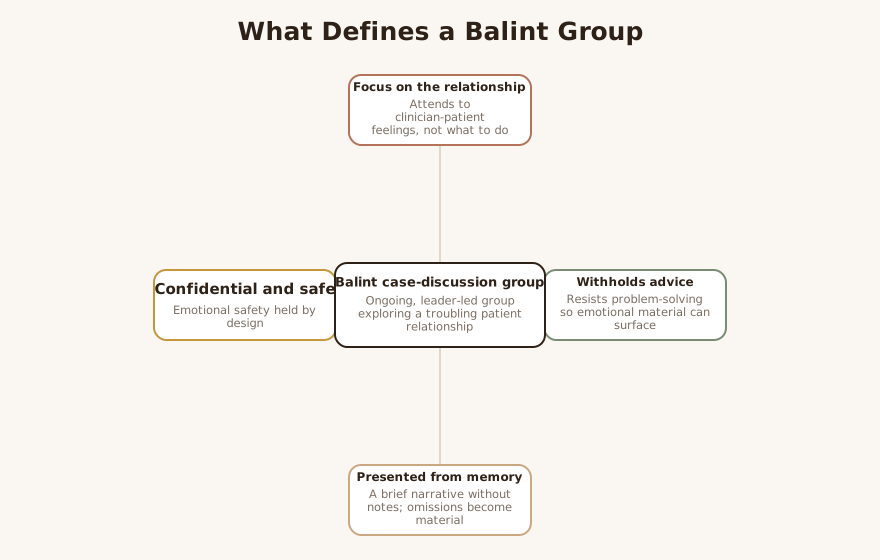
Several principles distinguish a Balint group from other forms of case discussion. LLM
First, the focus is the relationship, not the problem to be solved. The group sets aside the question “what should this clinician do?” in favor of “what is going on emotionally between this clinician and this patient?” 4. The aim is to uncover new perceptions of the patient’s and the clinician’s feelings and of their experience of each other 4.
Second, the group works by deliberately not giving advice. Members resist the strong pull toward problem-solving, reassurance, and clinical recommendations, because premature solutions foreclose the emotional exploration that is the whole point 4. The group tolerates uncertainty in order to let unconscious and affective material surface 3.
Third, the presented case is offered from memory and without notes—usually a brief narrative of a few minutes—precisely so that what the presenter spontaneously foregrounds, omits, or distorts becomes part of the material 2. The group attends as much to how the story is told as to its content. LLM
Fourth, the work is confidential and emotionally safe by design. Confidentiality is held as in psychotherapy, creating an environment in which clinicians can voice negative, shameful, or “difficult” feelings about a patient without fear of judgment 2. This safety is a precondition, not a courtesy 2.
Fifth, the orientation is experiential and collective: insight emerges from the group’s process—its associations, fantasies, and reactions to the presented relationship—rather than from any single authoritative interpretation 4.
Interventions & Techniques
A Balint group follows a recognizable choreography, though leaders vary in how strictly they hold it. LLM
A session opens with a member offering a case for discussion 4. The presenter narrates a recent or troubling encounter from memory, typically in a few minutes, conveying both the patient and the presenter’s own perspective on the relationship 2. The group then begins to discuss—often led by the facilitator inviting reactions, associations, and felt impressions rather than questions of fact 3.
A widely used structural device is the “push-back”: after an initial round of clarifying questions, the presenter is invited to physically or psychologically step back from the discussion—sometimes literally moving their chair out of the circle—and to listen while the group talks as if the presenter were not there. LLM This frees the group to wonder aloud, to fantasize about the patient and the relationship, and to voice impressions the presenter might otherwise feel compelled to correct, before the presenter is brought back in to respond. LLM
Throughout, the group’s task is to generate multiple, divergent readings of the encounter rather than to converge on a single answer 4. Discussion commonly runs an hour or more for a single case 2. The facilitator protects the frame: keeping the focus on the relationship, deflecting the slide into clinical management, ensuring airtime is shared, and tending to the emotional safety of the presenter 2.
LLM-generated illustrative example (not a guideline): A therapist presents a client who is unfailingly polite, pays on time, and completes every between-session task—yet the therapist confesses she dreads the sessions and cannot say why. With the therapist pushed back, the group wonders aloud about the patient’s invisibility, the compliance that leaves no room for a real relationship, and the therapist’s guilt at disliking someone “so easy.” The therapist returns recognizing a parallel: the client’s flawless compliance is itself the defense, and her own dread is a clue to a hidden contempt the client expects from others. LLM
Evidence Base
Maturity here is best described as established practice with mixed outcome evidence. LLM Balint groups have been in continuous use for roughly seven decades, are formally embedded in medical curricula, and are sustained by national societies—so as a practice they are mature and durable 2. The empirical question is narrower: do they measurably improve what they claim to improve?
A 2025 systematic review examined Balint groups specifically as an intervention to improve doctors’ and medical students’ ability to manage the doctor-patient relationship 1. The broad pattern in this literature is consistent with that review’s framing: studies are heterogeneous in design, populations, and outcome measures, and much of the work is observational or uses small, uncontrolled samples, which limits firm causal conclusions 1. Reported benefits cluster around relational and attitudinal outcomes—greater patient-centeredness, psychological-mindedness, empathy, and professional satisfaction—rather than hard clinical endpoints 2.
Descriptive and qualitative work is more confident than the controlled-trial literature. Participation has been associated with increased coping ability, psychological-mindedness, and patient-centeredness, and with reduced professional isolation and stronger collegial support that may buffer burnout 2. The honest reading for clinicians is that Balint groups have strong face validity and high acceptability among participants, a coherent theoretical rationale, and suggestive but not definitive evidence for their effects on measurable outcomes 1. They should be offered as a reflective and developmental practice rather than promoted as an evidence-based treatment for burnout or a guaranteed driver of measurable clinical change. LLM
Populations & Indications
The method was built for physicians and remains most deeply embedded in family medicine, but its logic extends to any clinician whose work is relationally demanding 2. Common participants include practicing physicians, medical students and residents, nurses and allied-health clinicians, and psychotherapists and their trainees 4. The improvement of the clinician-patient relationship is the unifying indication across these groups 4.
Balint groups are indicated wherever clinicians repeatedly encounter relationships that are emotionally charged, confusing, or depleting and lack a structured space to think about them 3. They are particularly apt for early-career and trainee clinicians forming a professional identity, and for experienced clinicians at risk of isolation or erosion of empathy 2. They are a developmental and preventive resource as much as a remedial one. LLM
Problems-for-Work
Several recurring clinical problems map naturally onto the Balint method. LLM
- Countertransference and strong emotional reactions to patients. When a clinician notices disproportionate dread, attraction, rescue urges, or irritation toward a patient, the group helps surface and metabolize that reaction rather than act it out 4.
- “Difficult” or heart-sink patient relationships. The patient who induces helplessness, anger, or a wish to refer away becomes the ideal Balint case, because the difficulty lives in the relationship and is workable there 3.
- Burnout and compassion fatigue. By restoring reflective space, reducing isolation, and providing collegial support, the group can help replenish clinicians depleted by relational labor 2.
- Therapeutic-alliance ruptures. Recurrent breakdowns in connection—stalled work, unexplained dropouts, mutual withdrawal—can be re-read through the group’s multiple perspectives to recover a path back to the patient 4.
- Professional isolation. For clinicians in solo or virtual practice, the group itself counteracts isolation and rebuilds a felt sense of professional community 2.
Contraindications, Cautions & Cultural Humility
A Balint group is not psychotherapy for its members, and the boundary matters. The presenter brings a patient relationship, not their own personal history, and a competent leader steers the group away from turning a member into a patient 2. Clinicians in acute personal crisis are better served by their own therapy or by employee support than by a Balint group, and a group is not a substitute for clinical supervision where competence, safety, or risk must be addressed. LLM
Confidentiality is essential, and its breach is the principal way harm occurs; the safe, non-judgmental frame is what permits members to disclose difficult feelings, and a group that leaks or that allows shaming is actively unsafe 2. Power differentials require care: when supervisors, evaluators, or senior colleagues sit in the same group as those they assess, the safety needed for honest disclosure can collapse, and group composition should account for this. LLM
Cultural humility belongs at the center of the work. The patient discussed is not present and cannot correct the group’s projections, so the group’s fantasies about a patient’s motives can drift into stereotype—particularly across lines of race, class, gender, sexuality, religion, immigration status, and disability. LLM The facilitator’s task includes naming when the group’s “insight” may in fact encode bias, and holding the curious, tentative stance the method demands toward people whose worlds differ from the clinicians’. LLM The method’s psychoanalytic roots also carry assumptions about the self and emotional expression that are not culturally universal and should be applied reflectively. LLM
Treatment-Plan Suggestions & SMART Objectives
Because a Balint group serves clinicians, the “treatment plan” framing below is best read as the clinician’s own professional-development plan, with downstream benefit to the client relationship. LLM The objectives are illustrative, not prescriptive.
| Goal | SMART objective (example) | Mechanism |
|---|---|---|
| Recognize countertransference earlier | Over 8 weekly sessions, name at least one felt reaction to a presented patient relationship in each session attended | Group exploration of the clinician’s emotional response to the patient 4 |
| Reduce reactivity to a “difficult” patient | Within 6 sessions, present one heart-sink relationship and identify two alternative readings of the patient’s behavior | Multiple divergent perspectives generated by the group 3 |
| Strengthen alliance-rupture repair | Over a 3-month group cycle, apply one group-derived insight to a stalled case and document the shift in two follow-up notes | Re-reading the relationship through collective reflection 4 |
| Buffer burnout and isolation | Attend ≥80% of monthly group sessions over 6 months and rate perceived collegial support at start and end | Restored reflective space and peer support 2 |
| Deepen psychological-mindedness | Across one term, complete pre/post self-rating of psychological-mindedness with a target improvement | Experiential engagement with unconscious relational process 2 |
| Increase patient-centeredness | Within 10 sessions, identify in two cases how the clinician’s own manner functioned as the “drug” affecting the patient | Reflection on the drug “doctor” concept 6 |
| Sustain reflective practice | Establish a standing monthly Balint group and maintain attendance for 12 months | Ongoing structured case-consultation container 3 |
Common Misconceptions
“It’s a case conference where the group helps me manage the patient.” It is the opposite: the group deliberately withholds clinical advice and management suggestions, because solving the problem ends the exploration the method exists to support 4.
“It’s group therapy for clinicians.” The presenter brings a patient relationship, not their own life story, and the leader protects that boundary; the personal benefit is a by-product of studying the work, not the explicit target 2.
“It’s an unstructured chat.” It is participatory and experiential, but it follows a recognizable form—presentation, exploration, often a push-back, and return—held by a trained facilitator 4.
“There’s a right interpretation the leader is waiting for.” The value lies in multiplying perspectives, not converging on one authoritative reading 4.
“It’s proven to prevent burnout.” It is associated with reduced isolation and greater coping, and it is plausibly protective, but the controlled evidence is limited and heterogeneous, and overclaiming misrepresents the literature 1.
Training & Certification
Balint group leadership is a learned skill, not an automatic extension of clinical seniority, and groups are typically run by one or two trained leaders 4. National Balint societies—such as the Balint Society in the United Kingdom and the American Balint Society—maintain the method, accredit leaders, and offer training pathways for clinicians who wish to lead groups 3. Leadership training generally involves experiential learning within groups, supervised leadership, and ongoing membership in the Balint community 3. For clinicians who simply wish to participate, no certification is required; joining or convening a group, ideally with an experienced leader, is sufficient 4.
Key Terms
- The drug “doctor”: Balint’s concept that the clinician’s personality and manner act like a prescribed medication, with dosage, indications, and side effects 6.
- Push-back: the structural move in which the presenter withdraws from active discussion to listen while the group explores the relationship as if the presenter were absent LLM.
- Reflective practice: the disciplined examination of one’s own emotional responses and assumptions in clinical work, which the Balint group operationalizes for the clinician-patient relationship 3.
- Countertransference: the clinician’s emotional reactions to the patient, treated in the group as informative data rather than as an error to suppress 4.
- Heart-sink patient: the patient whose relationship reliably induces dread, helplessness, or a wish to refer away—prime material for a Balint case LLM.
Resources & Further Reading
▶ Watch — a video introduction to this concept:
- Balint groups for improving the ability of doctors and medical students to manage the doctor-patient relationship: a systematic review (BMC Medical Education, 2025)
- Balint groups: A tool for personal and professional resilience (PMC3303639)
- Balint groups and the Balint method (The Balint Society, UK)
- What is a Balint Group? (The American Balint Society)
- Investing in Each Other: Balint Groups and the Patient-Doctor Relationship (AMA Journal of Ethics, 2012)
- The Doctor, His Patient and the Illness (Michael Balint, 1957) — review, British Journal of Psychiatry
Reflective / Supervision Questions
- When a patient relationship leaves you depleted or dreading the session, where in your professional life do you currently take that feeling—and is it a space designed to hold it? LLM
- Recall a recent “heart-sink” patient: what might the group have noticed in how you would have told the story that you cannot see alone? LLM
- How do you distinguish, in your own practice, between countertransference as useful clinical data and countertransference as something to manage privately? LLM
- If your manner is a “drug,” what is your typical dosage and what are its side effects with the patients you find hardest? 6
- In a group that discusses absent patients, how would you guard against the moment when collective “insight” becomes shared stereotype? LLM
- What would have to be true about a group’s safety, leadership, and composition for you to disclose a feeling about a patient you would otherwise keep hidden? 2