
Psychological safety is not a therapy modality, but it is a construct practicing clinicians increasingly need to understand. It names the interpersonal climate that determines whether a person will speak up, admit a mistake, ask for help, or voice a concern — and that climate operates in work teams, in group and family therapy rooms, in supervision, and, by extension, in the therapeutic dyad itself. This article summarizes the construct, its evidence base in organizational research, and the ways thoughtful clinicians translate it into clinical and group work, while being honest about where that translation outruns the original science. LLM
Type & Discipline
Psychological safety is a construct — a measurable belief held in common by members of a group — rather than a treatment, technique, or theory of change. LLM It originates in organizational behavior and management research, specifically in the study of team learning and performance. 1 Amy Edmondson, who developed the modern operationalization, defines it as a shared belief held by members of a team that the team is safe for interpersonal risk-taking. 1 Its conceptual home is the literature on team and group climate, where it sits alongside related constructs such as team learning behavior, voice, and group cohesion. 1 For clinicians, it is most usefully treated as a lens and a target — something you assess and try to cultivate — rather than as a standalone intervention. LLM
A crucial definitional point: psychological safety is not the same as trust, comfort, or lowered standards. 4 Edmondson is explicit that psychological safety describes a climate in which people can take interpersonal risks, not one in which everyone is comfortable or unaccountable. 4 In her framing, high psychological safety paired with high accountability is what produces learning and high performance; safety without accountability produces complacency, and accountability without safety produces anxiety. 5 This distinction matters clinically because it guards against the misreading that a “safe” therapy group is one where nothing difficult is ever said. LLM
Creators & Lineage
The term predates Edmondson. Edgar Schein and Warren Bennis used “psychological safety” in the 1960s to describe conditions that help people tolerate the anxiety of organizational change and learning. 4 William Kahn, in his work on personal engagement at work, identified psychological safety as one of the conditions under which people bring their full selves to a role rather than withdrawing or defending. 4 These earlier threads framed safety primarily as an individual experience tied to learning and engagement. LLM
Edmondson’s contribution, beginning with her 1999 study in Administrative Science Quarterly, was to relocate the construct at the level of the team and to tie it empirically to learning behavior and performance. 1 Studying work teams, she found that psychological safety was a group-level property — members of the same team tended to share the perception — and that it predicted the learning behaviors (seeking feedback, sharing information, asking for help, discussing errors) through which teams improve. 1 Her later book, The Fearless Organization, extended the construct from teams to whole organizations and to questions of innovation, voice, and growth, and popularized it well beyond academia. 5 Edmondson’s own platform and public talks have since made the idea broadly accessible to leaders and practitioners. 46
Core Principles
Several principles recur across Edmondson’s work and are the ones most worth carrying into clinical thinking. LLM
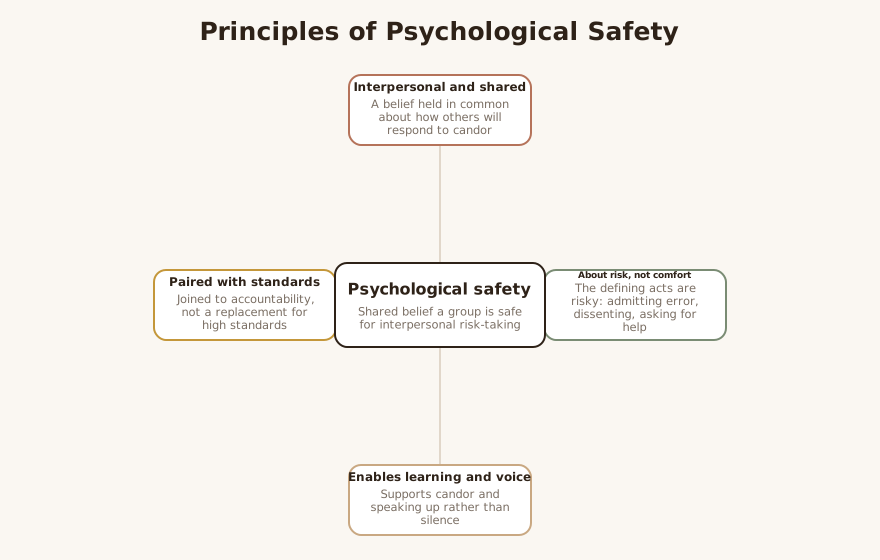
First, psychological safety is interpersonal and shared. It is a belief about how others in the group will respond to one’s candor or vulnerability, and it tends to be held in common by people who share the same immediate context. 1 This is why it is measured and intervened on at the level of a team or group, not merely as an individual trait. 1
Second, it is about risk, not comfort. The defining behaviors are interpersonally risky: admitting you do not know something, reporting an error, challenging a superior, offering a dissenting view. 4 A climate is psychologically safe to the extent that people believe these acts will not be met with humiliation, rejection, or punishment. 4
Third, safety enables learning and voice but does not replace standards. Edmondson repeatedly pairs psychological safety with accountability and high standards; the goal is candor in service of learning and performance, not the absence of challenge. 5 In the workplace context she describes, the absence of safety shows up as silence — people withhold concerns, questions, and bad news because the perceived risk is too high. 3
Fourth, leaders and facilitators shape it. The behavior of those with status — managers, clinicians, group leaders — disproportionately sets the climate, because their reactions to the first risky disclosures teach everyone else what is safe. 3 Modeling fallibility, framing work as uncertain and interdependent, and responding to candor with appreciation rather than blame are among the levers Edmondson emphasizes. 35
Interventions & Techniques
Because psychological safety is a climate, the “interventions” are leader and facilitator behaviors that cultivate it rather than discrete clinical techniques. LLM Edmondson describes a recognizable toolkit. 5
Framing the work. Naming the task as uncertain, interdependent, and learning-oriented — rather than as a test of individual competence — lowers the perceived cost of admitting uncertainty. 5 In her account, leaders set expectations that mistakes and questions are expected features of complex work. 5
Inviting participation. Asking genuine questions, displaying situational humility, and explicitly soliciting dissent and bad news signal that voice is wanted. 35 Edmondson stresses that proactive, specific invitations work better than a generic open door. 3
Responding productively. How a leader reacts to the first piece of candor — a reported error, a challenge, a “dumb” question — is decisive. 3 Responding with appreciation, curiosity, and a focus on learning rather than blame reinforces safety; punishing or dismissing it teaches silence. 35
Modeling fallibility. Leaders who acknowledge their own limits and mistakes make it safer for others to do the same. 3
For clinicians, the translation is direct in any group-format work, where the therapist functions as the climate-setting leader. LLM The same behaviors — framing the group as a place for honest, imperfect disclosure; inviting participation explicitly; responding to risky shares with warmth and curiosity; modeling humility — are recognizable as facilitation skills already embedded in group and family therapy. LLM
LLM-generated illustrative example (not a guideline): In an early process-group session, a member haltingly admits she has not done the between-session practice and “feels stupid bringing it up.” The facilitator responds, “I’m really glad you said that out loud — a lot of people feel that and stay quiet. Let’s look at what got in the way.” The facilitator’s response to this first risky disclosure functions exactly as Edmondson describes: it rewards candor and signals to the whole group that admitting difficulty is safe. LLM
Evidence Base
In its home discipline, psychological safety is an established construct. LLM Edmondson’s 1999 study provided validated measurement and field evidence that psychological safety operates at the team level and predicts team learning behavior, which in turn relates to performance. 1 The paper is among the most-cited in organizational behavior, and the construct has been replicated and extended across many subsequent studies and settings, including healthcare teams. 15 The measurement approach — a small set of survey items capturing shared beliefs about the safety of interpersonal risk in the team — has been widely adopted. 1
Two honest caveats matter for clinicians. First, the robust evidence concerns work teams and organizations, with team learning, error reporting, and performance as outcomes. 1 The extension of psychological safety to psychotherapy groups, families, and the therapeutic dyad is conceptually reasonable and clinically intuitive, but it is largely a translation rather than a separately validated clinical literature; the construct’s maturity as a clinical tool is far less established than its maturity in organizational research. LLM Second, much of the mechanism evidence is correlational and self-report based, and Edmondson herself frames safety as an enabling condition for learning rather than a guarantee of good outcomes — safety without standards can breed complacency. 5 Clinicians should therefore present psychological safety to organizational clients and groups as a well-supported organizational construct with sensible clinical analogues, not as an empirically validated therapy. LLM
Populations & Indications
The construct’s primary population is work teams and organizations, and it is especially salient in high-stakes, interdependent settings such as healthcare, where silence about errors carries real risk. 13 This makes psychological safety directly relevant to clinicians who consult to, lead, or work within clinical teams. LLM
By analogy, the construct informs work with any group whose function depends on candor and shared risk-taking: therapy groups, families, couples, and supervisory or training relationships. LLM In group therapy, the willingness to disclose, give and receive feedback, and tolerate interpersonal exposure maps closely onto the speaking-up behaviors Edmondson studied. LLM In supervision, a supervisee’s willingness to bring forward mistakes, uncertainties, and difficult countertransference depends on whether the supervisory climate is safe for that risk. LLM In couples and family work, the question of whether it is safe to voice a grievance, an unmet need, or a vulnerable feeling without retaliation is a recognizable psychological-safety question. LLM
Problems-for-Work
Psychological safety gives clinicians a vocabulary for several common presentations. LLM
Silence and non-disclosure. When members of a group, a family, or a team systematically withhold concerns and bad news, Edmondson’s framing locates the cause not in individual deficiency but in a climate where the perceived risk of speaking is too high. 3 Application: a clinician consulting to a clinical team that “never raises problems until they explode” can assess and target the climate rather than coaching individuals to be braver. LLM
Fear of speaking up / interpersonal risk avoidance. The core behaviors psychological safety enables — asking for help, admitting error, dissenting — are exactly the ones avoidant or shame-prone clients struggle with in groups. 4 Application: framing a member’s reluctance to share as a response to perceived climate, then deliberately shaping a safer climate, can shift participation. LLM
Error concealment and reduced help-seeking. In teams, low safety predicts hiding mistakes and not asking for help. 1 Application: in a family where a child conceals struggles to avoid punishment, the same dynamic — risk of disclosure outweighing its benefit — can be named and re-engineered. LLM
Impaired group learning. Where the group’s task is to learn from each other, low safety suppresses the very behaviors learning depends on. 1 Application: a process group that has stalled may be stuck not on content but on a climate that has made honest feedback feel unsafe. LLM
Contraindications, Cautions & Cultural Humility
The chief caution is conceptual overreach: psychological safety is an organizational construct, and treating it as a validated clinical intervention overstates the evidence. LLM Clinicians should distinguish what the research supports (team-level effects on learning behavior) from clinically reasonable analogy. 1
A second caution is the comfort/safety confusion. 4 Pursuing a group climate in which no one is ever uncomfortable can collapse into collusion and avoidance; Edmondson’s pairing of safety with high standards and accountability is the corrective. 5 In clinical terms, a “safe” group is one where hard things can be said, not one where they are avoided. LLM
Cultural humility is essential because perceptions of interpersonal risk are shaped by culture, power, language, and prior experiences of marginalization. LLM What feels safe to disclose, who is expected to defer, and how dissent is read all vary across cultural and hierarchical contexts, so a clinician or leader cannot assume that the same facilitation behaviors land identically for everyone. LLM For clients and team members with histories of being punished for honesty — including experiences of discrimination — the cost of speaking up is realistically higher, and climate-building must account for that rather than treating reticence as resistance. LLM Edmondson’s own emphasis on leaders’ disproportionate role implies a corresponding responsibility: those with more power must do more of the work of making risk safe. 3
Treatment-Plan Suggestions & SMART Objectives
| Goal | SMART objective (example) | Mechanism |
|---|---|---|
| Increase candid disclosure in a therapy group | Within 6 weeks, member voluntarily shares one difficult disclosure in group on at least 3 occasions, by clinician self-report tracking | Lowering perceived interpersonal risk increases voice behavior 1 |
| Reduce silence on a clinical team (consultation) | Within 8 weeks, team members raise at least 2 concerns or errors in team meetings per week, tracked by the team lead | Safe climate enables error reporting and help-seeking 1 |
| Build supervisee willingness to bring mistakes | Within 4 sessions, supervisee proactively presents one clinical error or uncertainty per session, by supervision log | Modeling fallibility and non-punitive response raise safety 3 |
| Increase help-seeking in a family | Within 6 weeks, child voices a need or struggle to a parent twice weekly without first concealing it, by family report | Re-engineering disclosure cost-benefit increases help-seeking 1 |
| Strengthen voice in a couple | Within 5 sessions, each partner names one unmet need in session without escalation, by clinician observation | Safety for interpersonal risk supports voicing grievances 4 |
| Improve group learning behavior | Within 8 weeks, group gives and receives peer feedback in at least 4 sessions, by attendance/process notes | Psychological safety predicts team learning behaviors 1 |
| Pair candor with accountability in a team | Within 8 weeks, team both raises errors and tracks follow-through on agreed fixes, by meeting minutes | Safety plus high standards yields learning, not complacency 5 |
| Reduce impression-management in group | Within 6 weeks, member reduces self-reported “performing okay-ness” and shares one vulnerability per session, by self-rating | Reducing image-protection cost frees authentic participation 4 |
Common Misconceptions
“Psychological safety means being nice or comfortable.” It does not; it is about the safety of interpersonal risk, and Edmondson explicitly pairs it with high standards and accountability. 45
“It is the same as trust.” The two are related but distinct: trust is largely about one person’s expectations of another, whereas psychological safety describes a shared, group-level climate experienced in the moment of deciding whether to speak. 4
“It lowers performance standards.” On the contrary, the framework positions safety as the condition under which high standards can actually be met, because people surface problems early rather than hiding them. 5
“It is an individual trait.” In Edmondson’s operationalization it is a property of the team or group, shared among people in the same context. 1
“It is a proven psychotherapy.” The strong evidence is organizational; clinical applications are reasoned analogues, not a separately validated treatment. LLM
Training & Certification
There is no licensure or formal certification in “psychological safety,” and clinicians should be wary of anyone implying otherwise. LLM The primary route to competence is the source literature: Edmondson’s 1999 empirical paper for the construct and its measurement, and The Fearless Organization for the applied framework and leader behaviors. 15 Edmondson’s own site and public talks offer accessible overviews suitable for orienting teams and clients. 46 Practitioner-facing summaries such as the HBR IdeaCast conversation translate the framework into concrete leadership practice. 3 For clinicians, existing training in group facilitation, family systems, and supervision already supplies most of the relevant skills; the construct mainly reframes and sharpens them. LLM
Key Terms
Psychological safety. A shared belief held by members of a team that the team is safe for interpersonal risk-taking. 1
Interpersonal risk-taking. Acts such as admitting error, asking for help, dissenting, or asking a question that expose a person to potential judgment. 4
Team learning behavior. Activities — seeking feedback, sharing information, experimenting, discussing errors — through which teams detect and correct, and which psychological safety predicts. 1
Voice / silence. Speaking up with concerns and ideas versus withholding them; low safety predicts silence. 3
Accountability (paired with safety). The standards-and-follow-through dimension Edmondson pairs with safety; the two together produce learning and performance. 5
Framing. Casting work as uncertain, interdependent, and learning-oriented to lower the perceived cost of candor. 5
Resources & Further Reading
▶ Watch — a video introduction to this concept:
- Edmondson, A. (1999). Psychological Safety and Learning Behavior in Work Teams — Harvard DASH
- Edmondson, A. (1999). Psychological Safety and Learning Behavior in Work Teams — Administrative Science Quarterly (SAGE/JSTOR)
- Creating Psychological Safety in the Workplace — HBR IdeaCast with Amy Edmondson (2019)
- Psychological Safety — Amy C. Edmondson (official site)
- The Fearless Organization — Amy C. Edmondson (2018, Wiley)
- Building a Psychologically Safe Workplace — Amy Edmondson (TEDxHGSE)
Reflective / Supervision Questions
- In the groups, teams, or dyads I facilitate, how do I actually respond to the first risky disclosure — and what does that response teach everyone else about what is safe? 3
- Where in my work am I confusing comfort with safety, allowing a “safe” climate to drift into avoidance of hard truths? 5
- How does my own status and power raise the cost of candor for clients, supervisees, or team members — and what disproportionate share of the climate-building work falls to me as a result? 3
- For clients with histories of being punished for honesty, how do I avoid reading realistic risk-assessment as resistance? LLM
- When I invoke “psychological safety” with an organizational client, am I clear about where the evidence is strong and where I am reasoning by clinical analogy? 1