
Type & Discipline
Religious and spiritual (R/S) struggles are a psychological construct rather than a treatment, defined as the tensions, conflicts, or incompatibilities a person experiences in relation to their religious and spiritual lives 1. The construct sits within the psychology of religion and spirituality, the subfield that studies how the sacred functions in human coping, identity, and distress 3. What distinguishes a struggle from ordinary religious experience is the element of conflict or strain: the sacred has become a site of tension rather than only a source of comfort 1. Because the construct names a clinical phenomenon and not a method, it is something clinicians assess and work with inside established therapies, not a stand-alone intervention in its own right LLM.
The construct is operationalized most influentially through the Religious and Spiritual Struggles Scale, a measure organizing struggle into six domains and giving the field a common language and a validated instrument 1. This places R/S struggles at the intersection of basic psychology-of-religion research and applied clinical work, where it informs assessment, case formulation, and treatment planning across modalities 3. The clinician’s interest is practical: struggles are reliably associated with poorer mental health, so detecting and addressing them is clinically consequential 7.
Creators & Lineage
The construct in its current form is most associated with Julie Exline and Kenneth Pargament, whose 2014 paper with Grubbs and Yali developed and validated the Religious and Spiritual Struggles Scale 1. Pargament’s broader program of research on the psychology of religion and coping is the soil this work grew from, and he and Exline co-edited the APA Handbook of Psychology, Religion, and Spirituality, the field’s reference compilation 3. Pargament’s own body of work continues to be curated and disseminated through his professional site, which anchors the construct in an established research tradition rather than a one-off study 4.
The intellectual lineage runs from Pargament’s theory of religious coping, which distinguished helpful from harmful ways of drawing on the sacred under stress, into the more focused mapping of struggle as its own multidimensional phenomenon 3. R/S struggles are therefore best read as a refinement and extension of religious-coping research, sharpening the “negative” or strained pole of coping into a structured six-domain model 1. The construct also shares conceptual territory with existential therapy and with spiritually integrated psychotherapy, which take up the lived experience of meaning, finitude, and the sacred as legitimate clinical material LLM.
Core Principles
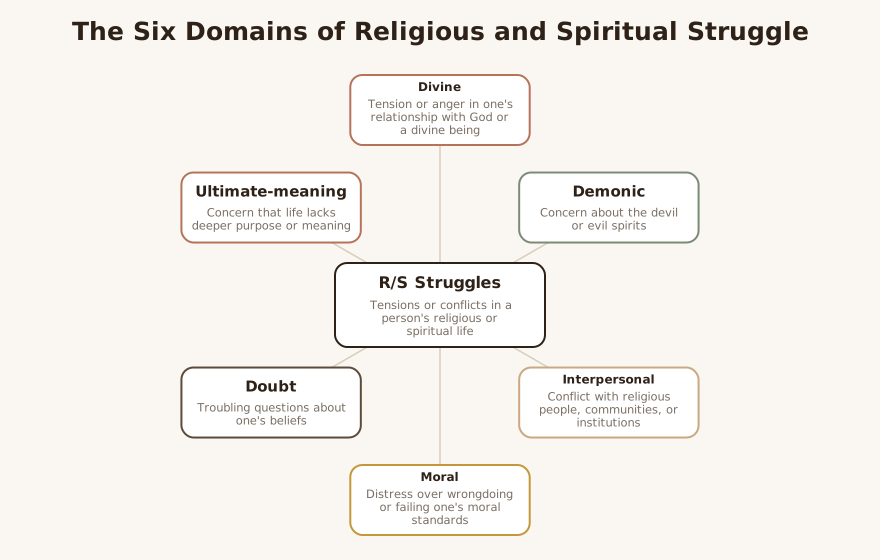
The first principle is that struggle is multidimensional, not a single state, and the six domains capture distinct kinds of conflict: divine struggles (tension or anger in one’s relationship with God or a perceived divine being), demonic struggles (concern about the devil or evil spirits), interpersonal struggles (conflict with religious people, communities, or institutions), moral struggles (distress over wrongdoing or failing to live up to one’s moral standards), doubt struggles (troubling questions about one’s beliefs), and ultimate-meaning struggles (concern that life lacks deeper purpose or meaning) 1. Naming the specific domain matters clinically, because a doubt struggle and a moral struggle call for different therapeutic emphases LLM.
A second principle is that struggle is common and not inherently pathological; it is a normal feature of religious and spiritual life that becomes clinically relevant when it is intense, persistent, or distressing 5. A third, central principle is that struggles are pivotal moments — critical crossroads with long-lasting trajectories — that can lead either toward psychological decline or toward wholeness and growth, depending on the person’s resources and how the struggle is metabolized 5. A fourth principle is that the sacred is a distinct dimension of functioning, interconnected with but not reducible to the psychological, social, and biological, which is why struggles cannot simply be reinterpreted away as “really” something else 5. The empirically established fact undergirding all of this is that R/S struggles correlate positively with distress, including depression, anxiety, and stress, while relating negatively to life satisfaction and the presence of meaning 7.
Interventions & Techniques
Because R/S struggles are a construct rather than a manualized therapy, the relevant techniques are those of assessment and of holding struggle within whatever modality the clinician already practices LLM. Assessment can begin with a direct, low-barrier screening question that requires no specialized training, such as asking how problems with religious or spiritual communities and ideas are affecting the client’s mental health 5. The Religious and Spiritual Struggles Scale and its short forms can structure this inquiry, locating which of the six domains are active and how severe they are 1. The aim of assessment is not to resolve the struggle on the spot but to make it visible and nameable, since a strictly secular intake will often miss it entirely 5.
The core clinical stance is to attend to spiritual content with the same curiosity applied to any other charged emotional material, holding difficult emotions such as anger at God or doubt without judgment rather than rushing to reassure or correct 5. Two opposite errors are to be avoided: anti-religious bias, in which the clinician recommends abandoning faith or assumes all religious involvement is toxic, and proselytizing, in which the clinician inadvertently promotes theological views the client does not hold 5. Practitioners are encouraged to do their own work first — writing a spiritual autobiography and examining personal biases — so that countertransference does not steer the session 5. Within that stance, the clinician can recognize spirituality’s potential as a resource while taking the struggle seriously as real and important 5.
LLM-generated illustrative example (not a guideline): A client raised in a strict tradition is leaving it and reports waves of fear that she will be punished, along with grief at losing her community. The clinician names this as overlapping divine, interpersonal, and ultimate-meaning struggle, holds the fear and grief without either defending or attacking the tradition, and helps her examine the catastrophic belief that she is now “beyond help” while she renegotiates what, if anything, remains sacred to her LLM.
Evidence Base
Honestly characterized, the construct and its measure are established, while the clinical-outcome literature built on them is younger and largely correlational LLM. The Religious and Spiritual Struggles Scale was developed and validated by Exline, Pargament, Grubbs, and Yali in 2014 as a 26-item measure, and a 14-item short form (the RSS-14) was subsequently produced 7. Validation work has been replicated and extended internationally; a Polish validation of the RSS-14 reported strong internal consistency across three studies (Cronbach’s alpha of .85, .87, and .88) and confirmatory factor analyses confirming good fit for the six-factor model (CFI at or above .945, RMSEA at or below .075) 7. A dedicated psychometric synthesis of the RSS across studies further consolidates the instrument’s standing as a well-studied, broadly validated measure 6.
The most robust substantive finding is associational: R/S struggles correlate positively with depression, anxiety, and distress and negatively with life satisfaction and presence of meaning, with ultimate-meaning struggles showing the strongest links to depressive symptoms 7. This is the established core of the construct’s clinical relevance 7. The honest caveat is that much of this evidence is cross-sectional and correlational, so it documents that struggle travels with distress more firmly than it demonstrates the direction of causation LLM. The growth side of the construct — the claim that struggle can be a catalyst for psychological and spiritual growth — is well theorized and clinically plausible but rests more on the crossroads framing than on a deep longitudinal trial base, and clinicians should hold it as a possibility to support rather than a guaranteed outcome 5.
Populations & Indications
The construct is most clearly indicated for religious and spiritual clients for whom faith is a meaningful axis of identity and coping, since they are the people most likely to experience the sacred as a site of conflict 1. Trauma survivors are a natural population, because trauma can shatter assumptions about a just and benevolent order and precipitate divine and meaning struggles that complicate recovery if left unaddressed 5. People with chronic or terminal illness frequently confront ultimate-meaning and divine struggles as they face uncertainty, suffering, and mortality, making explicit attention to struggle clinically apt LLM.
Bereaved individuals often experience divine struggle in the form of anger at, or felt abandonment by, God after a loss, alongside meaning struggles about why the loss occurred 5. Clients experiencing faith transitions or deconversion are a distinctive group, often carrying interpersonal struggle (rupture with community), doubt struggle, and meaning struggle simultaneously as a whole framework destabilizes LLM. Survivors of religious abuse may present with intertwined interpersonal, moral, and divine struggles, where the very tradition that should have offered safety became a source of harm, and where careful, non-imposing work is especially important LLM. Across all of these, the indication is the salience and intensity of the struggle, not the diagnosis alone 1.
Problems-for-Work
R/S struggles map onto several clinical problems. The diagnostic category of religious or spiritual problem (V62.89) is the most direct fit, covering distressing experiences such as loss of faith, questioning of beliefs, and conflict between behavior and spiritual values — essentially the lived form of the six struggle domains 1. Loss of meaning and purpose and existential distress correspond closely to ultimate-meaning struggle, which carries the strongest association with depressive symptoms in the data 7. Demoralization, the collapse of hope and confidence in one’s capacity to cope, frequently co-travels with these meaning struggles LLM.
Major depressive disorder and generalized anxiety disorder are common comorbid presentations, given the established positive correlations between struggle and both depression and anxiety, and struggles can act as maintaining factors that purely symptom-focused work may leave untouched 7. Moral injury and moral struggle overlap substantially, both centering on the conviction of having done or witnessed something that violates deeply held standards, often with a religious dimension of guilt and unforgivability LLM. Grief and bereavement and adjustment disorder are apt problems-for-work where loss or transition has destabilized the client’s relationship to the sacred 5.
LLM-generated illustrative example (not a guideline): A man in recovery from a near-fatal medical crisis says he prayed and “got no answer,” and now feels both abandoned by God and quietly certain his life “added up to nothing.” The clinician formulates active divine and ultimate-meaning struggle, treats the demoralization and depressive symptoms with an evidence-based modality, and within it makes room for the man to voice his anger and his fear of meaninglessness without being talked out of either LLM.
Contraindications, Cautions & Cultural Humility
The construct itself has no contraindication, but the manner of working with struggle carries real cautions LLM. The foremost is that the work must remain client-led: the clinician must neither steer the client toward the clinician’s own beliefs nor toward abandoning faith, since both proselytizing and anti-religious bias are misuses of the relationship 5. Clinicians should practice within their competence, pursue self-awareness about their own spiritual history and biases, and use consultation or referral when a client’s tradition or struggle exceeds their knowledge 5. Attending to a struggle is not the same as resolving it, and premature attempts to “fix” a client’s theology can deepen rupture rather than help LLM.
Suicidal ideation warrants particular care: where struggle co-occurs with acute risk, safety assessment and stabilization take priority, and the clinician should not treat exploration of spiritual meaning as a substitute for indicated crisis care LLM. Because the sacred is deeply embedded in culture and tradition, cultural humility is intrinsic to competent work here, and the clinician should approach each client’s meaning system as its expert informant rather than assuming familiarity 3. This is especially salient with survivors of religious abuse and with clients in faith transitions, where the clinician’s assumptions about what a tradition “should” mean can do harm if imposed LLM.
Treatment-Plan Suggestions & SMART Objectives
| Goal | SMART objective (example) | Mechanism |
|---|---|---|
| Identify which struggle domains are active | Within 2 sessions, client and clinician will complete a structured screen and name which of the six R/S struggle domains are present and most distressing | Multidimensional assessment of struggle 1 |
| Reduce distress tied to divine struggle | Over 10 sessions, client will voice and tolerate anger toward or felt abandonment by the sacred and rate its effect on mood weekly | Holding difficult spiritual affect without judgment 5 |
| Address ultimate-meaning struggle | Over 8 weeks, client will articulate 1 source of meaning and take 1 weekly meaning-aligned action, tracking depressive symptoms | Targeting the meaning struggle most linked to depression 7 |
| Work through moral struggle / spiritual guilt | Within 10 sessions, client will examine an absolute self-condemning belief and engage 1 tradition-consistent practice of repair | Reappraisal of moral struggle 1 |
| Stabilize an interpersonal struggle | Over 6 sessions, client will describe a rupture with a community and define a desired, self-determined relationship to it | Naming and processing interpersonal struggle 1 |
| Support a faith transition without imposition | Over 12 sessions, client will tolerate doubt struggle and articulate what remains sacred to them, with the clinician taking no position | Client-led, non-imposing stance 5 |
| Convert crisis toward growth | By session 16, client will identify 1 way the struggle has shifted their values or relationships and rate hope and demoralization | Struggle as a crossroads toward growth 5 |
Common Misconceptions
A frequent misconception is that religious or spiritual struggle is itself a symptom or a sign of weak faith; in the research framing it is a normal, common feature of spiritual life that becomes clinically relevant only when intense or distressing 5. A second is that struggle is uniformly destructive; the crossroads model holds that the same struggle can lead toward decline or toward growth depending on resources and how it is met 5. A third is that “spiritual struggle” is one thing, when it is in fact a six-domain construct in which divine, demonic, interpersonal, moral, doubt, and ultimate-meaning struggles are distinguishable and call for different emphases 1.
Another misconception is that addressing struggle requires the clinician to share the client’s faith or to be religious at all; what it requires is competence, curiosity, and the discipline to avoid both proselytizing and anti-religious bias 5. A further error is to assume the correlational link between struggle and distress proves that faith causes harm, when the evidence is largely cross-sectional and the sacred is just as often a resource as a stressor 7. Finally, R/S struggles are sometimes confused with chaplaincy or spiritual direction, whereas here they are treated as a dimension of psychological functioning assessed and addressed within secular, clinically governed psychotherapy LLM.
Training & Certification
There is no certification in “religious and spiritual struggles”; it is a construct that licensed clinicians fold into their existing scope and modalities LLM. The foundational competence comes from the primary literature — the 2014 development and validation of the Religious and Spiritual Struggles Scale and the broader APA Handbook of Psychology, Religion, and Spirituality co-edited by Pargament and Exline 13. Pargament’s professional site curates much of this body of work and is a useful entry point for clinicians building familiarity 4.
Importantly, basic engagement does not require specialized training: a simple screening question about how religious or spiritual issues are affecting the client’s mental health is accessible to any clinician 5. Deeper competence is built through the psychology-of-religion literature, focused continuing education, the clinician’s own spiritual self-examination, and supervision or consultation when a client’s tradition or struggle exceeds the clinician’s knowledge 5. The instruments themselves — the 26-item scale and the RSS-14 short form — are available for structured assessment and can be incorporated without a separate credential 7.
Key Terms
Religious and spiritual struggles — tensions, conflicts, or incompatibilities a person experiences in relation to their religious and spiritual lives 1. Divine struggle — conflict, tension, or anger in one’s relationship with God or a perceived divine being 1. Demonic struggle — distress related to the devil, evil spirits, or perceived demonic forces 1. Interpersonal struggle — conflict with religious people, communities, or institutions 1. Moral struggle — distress over wrongdoing or failing to live up to one’s own moral standards 1. Doubt struggle — troubling questions or uncertainty about one’s beliefs 1. Ultimate-meaning struggle — concern that life lacks deeper purpose or meaning, the domain most strongly tied to depressive symptoms 7. Religious and Spiritual Struggles Scale (RSS) — the 26-item, six-factor measure operationalizing the construct, with a 14-item short form (RSS-14) 7. Crossroads / pivotal moment — the framing of struggle as a turning point that can lead toward decline or toward growth 5. Religious or spiritual problem (V62.89) — the diagnostic category for distressing experiences such as loss of faith or value conflict 1.
Resources & Further Reading
▶ Watch — a video introduction to this concept:
- Exline, Pargament, Grubbs & Yali (2014). The Religious and Spiritual Struggles Scale: Development and initial validation (full PDF)
- Semantic Scholar entry: The Religious and Spiritual Struggles Scale
- Pargament & Exline (eds.). APA Handbook of Psychology, Religion, and Spirituality
- Kenneth Pargament — official site
- Working with Spiritual Struggles in Psychotherapy (Psychiatry & Psychotherapy Podcast, ep. 138)
- Psychometric Synthesis of the Religious and Spiritual Struggles (RSS) Scale (Taylor & Francis, 2025)
- Polish Validation of a 14-Item RSS Scale (RSS-14) (PMC)
Reflective / Supervision Questions
- When a client raises spiritual material, am I genuinely following their meaning system, or am I subtly steering toward my own beliefs, disbelief, or discomfort 5?
- Have I identified which of the six struggle domains are active for this client, rather than treating “spiritual struggle” as one undifferentiated thing 1?
- Am I holding the client’s anger, doubt, or fear about the sacred without rushing to reassure, correct, or resolve it 5?
- How might this client’s struggle be a crossroads, and what resources could tip the trajectory toward growth rather than decline 5?
- Where struggle co-occurs with depression, anxiety, or suicidal risk, am I delivering indicated evidence-based and safety care alongside the spiritual work rather than letting one displace the other 7?
- How does my own religious or spiritual history shape my countertransference here, and what am I at risk of missing or over-attending to as a result 5?