
Type & Discipline
Moral injury is a clinical construct rather than a formal diagnosis, describing the enduring psychological, social, and spiritual harm that follows acts which transgress a person’s deeply held moral beliefs 1. It sits at the intersection of military and trauma psychology, chaplaincy, and spiritual care, and is studied as a phenomenon distinct from – though frequently co-occurring with – post-traumatic stress disorder 4. The construct names a wound to conscience and moral identity, sometimes summarized as “damage done to one’s conscience or moral compass” 4. Because the injury is to meaning and self-concept rather than to threat-conditioning alone, it draws on both behavioral science and the pastoral, theological, and existential traditions of spiritual care 7. This dual location is the defining feature of the field: moral injury is the clearest contemporary example of a problem that neither mental-health treatment nor chaplaincy can fully address in isolation 2. For practicing clinicians, that means the construct is as much an organizing framework for collaborative care as it is a description of symptoms LLM.
Creators & Lineage
The term and its clinical formulation emerged from work with combat veterans whose distress did not fit a fear-based trauma picture 1. Jonathan Shay, drawing on classical literature and his work with Vietnam veterans, emphasized betrayal of “what’s right” by legitimate authority in high-stakes situations as a central engine of moral wounding 4. Brett Litz and colleagues then advanced the most influential clinical model, framing moral injury as the lasting harm following acts of perpetration, failure to prevent, or witnessing that violate one’s moral code 1. Their 2009 paper proposed both a preliminary mechanism and an intervention strategy, and remains the field’s foundational reference 1. The lineage runs directly out of trauma psychology and existing PTSD treatment models, which moral injury both extends and critiques 1. A parallel stream developed within chaplaincy and spiritual care, where practitioners articulated the explicitly spiritual dimensions of the wound and proposed structured pastoral interventions 2. Adaptive Disclosure Therapy, developed by Litz and colleagues, is the most direct clinical descendant of this lineage 1.
Core Principles
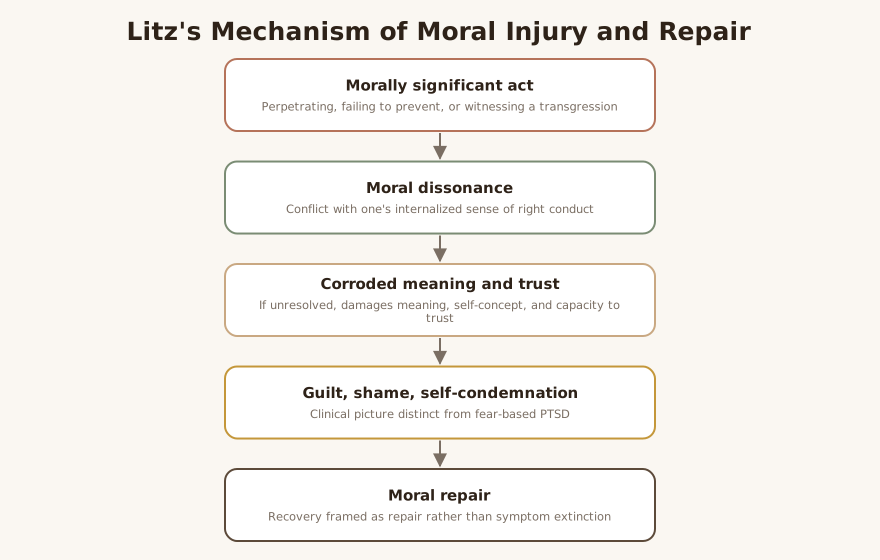
The central premise is that some morally significant experiences produce dissonance between what a person did, saw, or failed to stop and their internalized sense of right conduct 1. Litz and colleagues describe a mechanism in which transgression generates dissonance, which – if unresolved – corrodes global meaning, self-concept, and the capacity to trust 1. The resulting clinical picture is dominated by guilt, shame, and self-condemnation rather than by the fear and hyperarousal that anchor classic PTSD 1. A second principle is that moral injury can stem from one’s own acts of commission or omission, or from witnessing the transgressions of others, including betrayal by trusted leaders 4. A third is that the wound is fundamentally relational and existential: it damages the capacity to trust others and impairs family and community relationships 4. Spiritual-care formulations add that the injury frequently disrupts a person’s relationship with the sacred, their faith framework, or their sense of forgivability 7. Recovery is therefore framed as “moral repair” rather than symptom extinction 1.
Interventions & Techniques
Litz and colleagues proposed Adaptive Disclosure Therapy as a moral-repair intervention that processes the morally injurious event through structured disclosure, then works to reconcile the gap between values and actions and to rebuild adaptive meaning and identity 1. A recurring technique across approaches is imaginal or written disclosure of the event in a context of acceptance, which interrupts avoidance and shame-driven concealment 1. On the spiritual-care side, Carey and colleagues describe Pastoral Narrative Disclosure, an eight-stage intervention – spanning rapport, reflection, review, reconstruction, restoration, ritual, renewal, and reconnection – intended to address the spiritual dimensions of the wound while remaining adaptable across faith traditions 2. Co-facilitated moral injury groups, jointly led by mental-health providers and chaplains, are an increasingly described format that pairs psychological processing with spiritual and communal repair 3. Common technical elements across these models include forgiveness work, meaning-making, ritual and confession where culturally appropriate, and amends or reparative action 2. Chaplains additionally use spiritual screening instruments to identify those at risk and route them toward responsive care 2.
Evidence Base
The evidence base is best characterized as a well-established construct with still-maturing treatment research LLM. The construct itself is firmly established: moral injury is widely recognized in the trauma literature, has a foundational theoretical model, and is consistently associated with depression, suicidality, and impaired trust and relationships 14. Litz and colleagues explicitly framed their 2009 model and intervention as preliminary, and that framing still applies to much of the treatment literature 1. Adaptive Disclosure Therapy and the spiritually oriented protocols have promising conceptual foundations and accumulating support, but the controlled-trial base specific to moral-injury treatment remains thinner than that for established PTSD therapies LLM. Co-facilitated and chaplain-partnered models are described and increasingly implemented, yet rigorous outcome data are still emerging 3. Authors across both disciplines emphasize that treating PTSD does not necessarily resolve moral injury, and vice versa, which underscores why dedicated approaches are being developed and studied 4. Clinicians should adopt these interventions as reasoned, theory-driven practice rather than as settled, gold-standard protocols LLM.
Populations & Indications
Military veterans and active-duty service members are the populations in whom moral injury was first identified and remain the most studied, particularly combat-exposed personnel 4. The construct has since been extended to first responders, who face comparable exposure to morally ambiguous, high-stakes decisions 7. Healthcare workers are an increasingly recognized population, especially around triage decisions, resource scarcity, and institutional constraints that force action against one’s values LLM. Trauma survivors more broadly – including those harmed by abuse, assault, or violence – may carry analogous wounds to conscience and trust 4. Refugees and others exposed to atrocity, coerced participation, or survival under regimes of violence are a further population in whom moral and spiritual dimensions of trauma are clinically salient LLM. The shared indication across these groups is a presentation dominated by guilt, shame, self-condemnation, betrayal, or loss of faith and meaning, rather than by fear and threat alone 1. Spiritual-care involvement is particularly indicated where the distress is explicitly framed in moral, religious, or existential terms 7.
Problems-for-Work
Moral injury itself is the primary problem-for-work, presenting as persistent guilt, shame, and self-condemnation tied to a specific transgression or betrayal 1. PTSD frequently co-occurs and must be assessed separately, since the two can require distinct interventions 4. Loss of trust – in others, in institutions, or in a moral order – is a core relational problem that erodes family and community functioning 4. Spiritual and existential distress, including crises of faith and a sense of being unforgivable, is a defining feature that often surfaces most clearly in spiritual-care settings 7. Major depressive disorder and suicidal ideation are serious associated risks that demand active screening 4.
LLM-generated illustrative example (not a guideline): A combat veteran who froze during an ambush presents not with nightmares but with relentless self-loathing and the conviction that he is “beyond forgiveness,” refusing contact with his unit – a presentation better understood as moral injury with loss of trust than as fear-based PTSD LLM.
Substance use disorders and complicated grief also commonly travel with moral injury, as avoidance strategies and unresolved loss intertwine with the moral wound LLM.
Contraindications, Cautions & Cultural Humility
Disclosure-based and confession-oriented work is exposing, and clinicians should stabilize acute suicidality and substance-driven crisis before pursuing deep moral-repair processing LLM. Because moral injury is closely linked with suicidality and depression, ongoing risk assessment is a standing requirement rather than a one-time gate 4. A central caution is conceptual: moral injury is subjective and personally defined, so clinicians must let the client name the transgression and its meaning rather than imposing a moral or religious frame 4. Cultural and spiritual humility is essential, since the wound is embedded in the client’s own moral and faith tradition, and a mismatched framework can deepen rather than repair the injury 7. Carey and colleagues stress that chaplains and clinicians should not work unilaterally, and that effective care requires fluency across clinical, cultural, and spiritual languages 2. Forgiveness should never be prescribed or rushed, and ritual elements must be invited rather than assumed LLM. Where a client is non-religious, the spiritual dimension is addressed in existential and meaning-based terms without imported religious content LLM.
Treatment-Plan Suggestions & SMART Objectives
| Goal | SMART objective (example) | Mechanism |
|---|---|---|
| Name the transgression | Within 4 sessions, client will narrate the morally injurious event in full to the clinician at least once LLM | Structured disclosure interrupts shame-driven avoidance 1 |
| Reduce self-condemnation | Over 8 weeks, client will reduce global self-condemnation statements, tracked weekly, by a self-rated margin LLM | Reworking the dissonance between values and actions 1 |
| Rebuild meaning | Within 10 sessions, client will articulate one revised, livable account of self and the event LLM | Restoration of disrupted global meaning 1 |
| Restore trust | Over 12 weeks, client will re-establish one previously avoided supportive relationship LLM | Repair of relational and trust damage 4 |
| Address spiritual distress | Within 6 sessions, client will identify their faith or meaning framework and one point of rupture within it LLM | Engagement of the spiritual dimension of the wound 7 |
| Enable amends or reparative action | Within 8 weeks, client will identify and take one concrete reparative or values-aligned action LLM | Moral repair through restitution and renewed agency 2 |
| Mitigate suicide risk | Each session, client and clinician will review risk and maintain an updated safety plan LLM | Active management of associated suicidality 4 |
Common Misconceptions
A frequent misconception is that moral injury is simply a synonym for PTSD; in fact, the two are distinct, can occur independently, and treating one does not reliably resolve the other 4. A second is that moral injury arises only from one’s own wrongful acts, when it can equally follow failing to prevent harm, witnessing atrocity, or being betrayed by trusted authority 4. A third is that it is purely a psychological problem; the construct explicitly encompasses spiritual and existential injury that often falls outside conventional mental-health scope 7. A fourth misconception is that moral injury is a formal DSM diagnosis – it is a construct and a framework, not a diagnostic category 1. Some clinicians assume the work belongs solely to chaplains or solely to therapists, whereas the literature consistently argues for collaborative, interdisciplinary care 2. Finally, there is a misconception that moral repair means achieving forgiveness or absolution; repair is broader, encompassing meaning reconstruction, restored trust, and reparative action that the client defines 1.
Training & Certification
There is no single licensing credential specific to moral-injury treatment; competence is built through trauma training augmented by familiarity with the dedicated models LLM. The foundational starting point is the Litz and colleagues model and the Adaptive Disclosure Therapy framework that operationalizes it 1. Chaplains and spiritual-care providers bring distinct training in theology, pastoral care, and confidential spiritual support, and may use structured protocols such as Pastoral Narrative Disclosure 2. The literature emphasizes that effective practitioners develop “multiliteracy” across clinical, cultural, and spiritual languages so that collaboration is genuine rather than nominal 2. Co-facilitated moral injury groups, jointly run by mental-health providers and chaplains, are themselves a model that practitioners can learn and adopt 3. Mental-health chaplaincy, as described in military settings, represents a further specialized role that bridges the two domains 5. For most therapists, the practical path is supervised trauma practice plus deliberate partnership with spiritual-care colleagues LLM.
Key Terms
Moral injury – the lasting psychological, social, and spiritual harm from transgressing, failing to prevent, or witnessing acts that violate one’s moral beliefs 1. Transgression – the morally significant act or omission that initiates the injury 1. Dissonance – the unresolved conflict between one’s actions and one’s moral code that drives the wound 1. Global meaning – the overarching beliefs about self, others, and the world that moral injury disrupts 1. Moral repair – the recovery process aimed at rebuilding meaning, trust, and moral identity rather than merely extinguishing symptoms 1. Betrayal – the violation of “what’s right” by legitimate authority, a central source of moral wounding in Shay’s account 4. Spiritual distress – the disruption of faith, meaning, or relationship with the sacred that frequently accompanies moral injury 7. Pastoral Narrative Disclosure – an eight-stage chaplaincy intervention for the spiritual dimensions of moral injury 2. Mental health chaplaincy – a specialized role bridging clinical and spiritual care 5.
Resources & Further Reading
▶ Watch — a video introduction to this concept:
- Litz et al. (2009). Moral injury and moral repair in war veterans
- Carey et al. (2018). Chaplaincy, Spiritual Care and Moral Injury
- Core Components of Moral Injury Groups Co-Facilitated by Mental Health Providers and Chaplains
- What is Moral Injury? – The Moral Injury Project, Syracuse University
- Spiritual Dimensions of Moral Injury: Mental Health Chaplains in the Canadian Armed Forces
- Spiritual Wounds and Injuries (Part 1): Moral Injury – A Prelude for Spiritual Care Practitioners
- Moral Injury: An Intersection for Psychological and Spiritual Care
Reflective / Supervision Questions
- How confidently can I distinguish, in a given client, moral injury from fear-based PTSD, and does my treatment plan reflect that distinction 4?
- When a client frames their distress in moral, religious, or existential terms, do I have a pathway to spiritual care, or am I attempting to carry that dimension alone 2?
- Where are my own moral or religious assumptions at risk of being imposed on a client’s account of their transgression 7?
- Am I screening consistently for the suicidality and depression that travel with moral injury, rather than treating risk as a one-time assessment 4?
- Do I treat forgiveness as something to be invited and client-defined, or am I subtly steering toward absolution as a goal LLM?
- Finally, what would genuine interdisciplinary collaboration look like in my setting, and what concrete step would move me toward it 2?