
Type & Discipline
Religious coping, operationalized through the RCOPE and its abbreviated form the Brief RCOPE, is a construct and an assessment framework rather than a standalone psychotherapy 2. It belongs to the psychology of religion and sits within the broader religious coping family of research 4. The core move is descriptive and dimensional: rather than asking whether a client is religious, it asks how a person actually recruits faith, spirituality, and the sacred when facing a stressor 4.
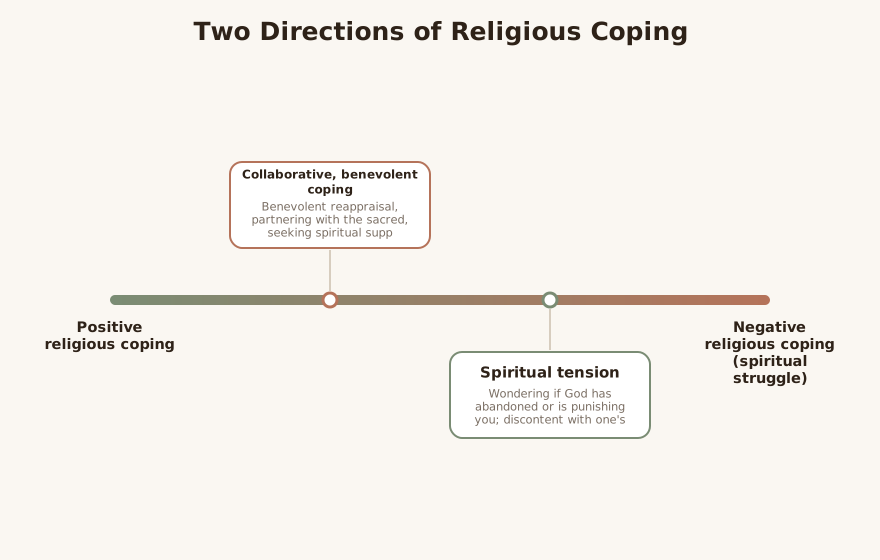
The framework’s defining contribution is the distinction between positive religious coping—a secure relationship with the sacred, a sense of spiritual connectedness, and the use of religion to find comfort, meaning, and collaborative strength—and negative religious coping, which reflects spiritual struggle, tension, or conflict concerning sacred matters 5. This second dimension is frequently labeled religious and spiritual struggle in the contemporary literature 3. For clinicians, the practical payoff is that the same client’s faith can be both a resource and a battleground, and the two are not opposite ends of one line but largely independent dimensions that can be high or low at the same time 2.
It is important to be clear about scope: RCOPE measures a coping process, not a diagnosis, and elevated negative religious coping is a marker of distress and a target for clinical attention, not a disorder in itself LLM. Used well, the construct gives a therapist precise language for clinical phenomena that otherwise get flattened into “the client is religious” LLM.
Creators & Lineage
The framework was developed by Kenneth I. Pargament and colleagues, with the original RCOPE introduced and validated by Pargament, Harold G. Koenig, and Lisa M. Perez in 2000 1. Pargament’s 1997 book, The Psychology of Religion and Coping: Theory, Research, Practice, laid the conceptual foundation, integrating religion explicitly into the stress-and-coping tradition of Lazarus and Folkman while arguing that religion is not merely a defense or a coping “resource” but a distinctive orienting system that shapes appraisal, problem-solving, and meaning-making 4.
The original RCOPE was an extensive instrument designed to map the full territory of how people use religion under stress, organized into multiple theoretically derived subscales covering domains such as benevolent religious reappraisal, collaborative religious coping, seeking spiritual support, religious purification and forgiveness, and—on the struggle side—punishing-God reappraisal, demonic reappraisal, and spiritual discontent 1. Recognizing that the full measure was impractical for many settings, Pargament, Mark Feuille, and Donald Burdzy published the Brief RCOPE in 2011, distilling the work into 14 items—seven positive and seven negative—and reviewing its accumulated psychometric evidence 2. The Brief RCOPE has since become the most widely used measure of religious coping in research worldwide 3. The lineage continues into spiritually integrated psychotherapy, the clinical approach Pargament built atop this body of work to help therapists address the sacred dimension of clients’ lives directly LLM.
Core Principles
Religion is a coping process, not just a trait. The framework’s first principle is that what matters clinically is the activity of coping—what a person does with their faith when stressed—rather than static markers like denomination or attendance 4. Two clients who both identify as devout can cope in opposite directions 2.
Positive and negative religious coping are distinct dimensions. Positive religious coping reflects a secure attachment to the sacred and benevolent reframing—seeing a stressor as an opportunity for spiritual growth, partnering with God to solve a problem, and seeking spiritual support 5. Negative religious coping reflects an underlying spiritual tension: wondering whether God has abandoned or is punishing you, attributing events to demonic forces, questioning God’s love or power, and feeling discontent with one’s faith community 5. These are not simply the presence versus absence of faith; they are two different ways of being religious under duress 2.
The two dimensions predict different outcomes. Across studies and populations, positive religious coping tends to correlate with better adjustment—positive affect, self-esteem, quality of life, and meaning—while negative religious coping (struggle) is the more consistent and often stronger predictor of poorer outcomes: depression, anxiety, distress, and posttraumatic symptoms 3. In a prospective study of 937 African American adults followed over 2.5 years, both dimensions had independent, cumulative effects, with negative religious coping more strongly predicting depressive symptoms and negative affect even after controlling for baseline well-being 6.
Neither dimension is universally good or bad. The literature explicitly cautions that positive religious coping is not always adaptive and negative religious coping is not always maladaptive; context, chronicity, and how a struggle resolves all matter 3. A time-limited period of spiritual questioning may be part of healthy meaning-making rather than pathology LLM.
Interventions & Techniques
RCOPE is fundamentally an assessment-and-formulation tool, and most “techniques” involve weaving it into clinical conversation rather than administering a manualized protocol LLM.
Screening and assessment. The Brief RCOPE is a brief self-report measure: 14 items rated on a 4-point scale from “not at all” (1) to “a great deal” (4), with the seven positive and seven negative items summed into two separate subscale scores 5. Sample positive items include “Looked for a stronger connection with God” and “Tried to see how God might be trying to strengthen me in this situation”; sample negative items include “Wondered whether God had abandoned me,” “Felt punished by God for my lack of devotion,” and “Questioned God’s love for me” 5. Because it is short, it can be administered at intake or readministered to track change 2.
Targeting spiritual struggle. A high negative-coping score flags a specific, workable problem-for-work: the client is in conflict with the sacred 3. Clinically, this opens collaborative exploration of the struggle—naming it, normalizing that struggle is common, and helping the client move toward resolution rather than chronic spiritual discontent LLM.
Mobilizing existing spiritual resources. Where positive religious coping is already present, the therapist can amplify it—supporting collaborative reappraisal, connection to a faith community, and benevolent meaning-making as adjuncts to standard treatment 6.
LLM-generated illustrative example (not a guideline): A bereaved client scores high on both subscales. The therapist reflects the split back: “It sounds like prayer steadies you and, at the same time, part of you is angry that God let this happen.” Naming the negative dimension as a legitimate spiritual struggle—rather than something to suppress—lets the client work it rather than hide it. LLM
Evidence Base
The evidence base is best described as established for the construct and the measure, while the clinical interventions built on it are less mature LLM. The Brief RCOPE has accumulated substantial psychometric support and is the most widely used religious coping measure in research 3. Internal reliability is strong across cultures, with Cronbach’s alphas consistently between roughly 0.70 and 0.96, and convergent and concurrent validity meet conventional standards 3.
The construct’s predictive validity is well replicated: positive religious coping associates with better psychological outcomes and negative religious coping with worse ones across diverse samples 3. The prospective African American study strengthens causal plausibility by showing that baseline religious coping predicts change in well-being over 2.5 years, not merely cross-sectional correlation 6. Applications continue to extend into new populations and stressors—for example, examining religious coping in relation to academic burnout among Generation Z university students 7.
Honest caveats: most evidence is observational and correlational, normative data for non-Western populations are lacking, and one negative item (“Questioned God’s power,” Item 14) performs poorly across many cultures and is sometimes dropped 3. Crucially, that RCOPE predicts outcomes does not by itself establish that intervening on religious coping changes them; the construct is far better validated than any specific therapeutic technique derived from it LLM.
Populations & Indications
RCOPE is most useful when a client’s stressor intersects with faith, meaning, or mortality LLM. Indicated populations include religious and spiritual clients of any tradition; people with chronic or life-threatening illness, where religious coping is heavily studied in cancer, HIV, and chronic disease samples 3; bereaved individuals and trauma survivors, for whom negative religious coping tracks with posttraumatic symptoms 3; caregivers, including Alzheimer’s caregivers 3; and older adults, in whom faith is often a central coping system 3.
It is especially salient in communities where faith is historically central. In African American samples, religion plays a particularly important role in handling stress, and the authors emphasize honoring the role spiritual coping has played in community resilience 6. The Brief RCOPE has been validated across many countries and traditions—including Islam, Judaism, Hinduism, Buddhism, Roman Catholicism, and Greek-Orthodox Christianity—supporting its use with diverse clients 3. Newer work extends it to university students experiencing academic burnout 7.
Problems-for-Work
The construct maps cleanly onto several problems-for-work LLM:
- Religious or spiritual problem (V62.89 / Z65.8) — the most direct fit; elevated negative religious coping operationalizes a spiritual struggle worth addressing 3.
- Major depressive disorder and demoralization — negative religious coping is a consistent and often strong predictor of depressive symptoms; addressing punishing-God appraisals may be one lever within broader treatment 6.
- Grief and bereavement — clients commonly experience simultaneous spiritual comfort and spiritual anger; the two-dimension model gives language for both 3.
- Generalized anxiety and stress/coping difficulties — positive religious coping can be mobilized as an existing resource, while negative coping is monitored as a risk marker 3.
- Health-related distress — in chronic and life-threatening illness, religious coping shapes adjustment and quality of life 3.
- Academic burnout — emerging work applies the framework to student populations under chronic academic stress 7.
Contraindications, Cautions & Cultural Humility
RCOPE is a lens, not a treatment, so the cautions are mostly about misuse LLM. Do not use the measure to pathologize faith or to push a client toward (or away from) religion; the therapist’s job is to understand the client’s own coping, not to evaluate the truth or worth of their beliefs LLM. Negative religious coping is a marker of distress, not a disorder, and a time-limited struggle can be a normal, even growthful, part of meaning-making 3.
Cross-cultural humility is essential. The Brief RCOPE has been translated widely (Persian, Arabic, Portuguese, Greek, Spanish, and others), but no normative data exist for non-Western populations, which limits interpretation of any individual’s raw score 3. The item “Questioned God’s power” consistently fails to perform across diverse populations—possibly because questioning divine power conflicts with religious prohibitions in some traditions—and is sometimes removed 3. More research is still needed in vulnerable populations and minority religious groups 3. Clinically, the construct may not map neatly onto traditions that are non-theistic or that frame the sacred without a personal God, so the therapist should adapt language to the client’s own cosmology rather than impose the scale’s LLM. Always obtain consent before exploring spiritual material, and stay within scope—deep theological direction belongs to clergy, not the therapist LLM.
Treatment-Plan Suggestions & SMART Objectives
| Goal | SMART objective (example) | Mechanism |
|---|---|---|
| Reduce spiritual struggle | Within 8 weeks, client will reduce Brief RCOPE negative-coping subscale score by ≥25% from intake baseline | Identifying and reappraising punishing-God and abandonment appraisals 2 |
| Mobilize spiritual resources | Within 6 weeks, client will identify and use 2 positive religious coping strategies (e.g., collaborative prayer, faith-community contact) during high-stress episodes, logged weekly | Activating benevolent reappraisal and spiritual support 6 |
| Reduce depressive symptoms | Over 10 sessions, client will lower PHQ-9 by ≥5 points while negative religious coping is addressed collaboratively | Negative religious coping predicts depressive symptoms; reducing struggle supports mood 6 |
| Process grief-related spiritual conflict | Within 6 sessions, client will articulate both the comfort and the anger their faith holds about the loss, without suppressing either | Holding both dimensions reduces avoidance and supports meaning-making 3 |
| Reconnect with faith community | Within 30 days, client will re-establish one supportive spiritual relationship or practice | Spiritual support is a core positive coping pathway 5 |
| Reduce academic-stress burnout | Over one term, student will apply positive religious coping during exam periods and self-rate burnout weekly | Positive religious coping buffers chronic stress 7 |
| Resolve God-image distress | Within 12 weeks, client will report a shift toward a less punitive, more secure image of the sacred on a self-anchored scale | Restructuring the relationship with the sacred toward security 2 |
Common Misconceptions
“RCOPE measures how religious someone is.” It does not; it measures how religion is used to cope, and two equally devout people can cope in opposite directions 4.
“Positive and negative religious coping are opposites on one scale.” They are largely independent dimensions; a client can score high on both at once, which is clinically common and meaningful 2.
“Negative religious coping is always pathological.” The framework explicitly resists this; struggle is not universally maladaptive, and a resolved struggle can yield growth 3.
“RCOPE is a therapy.” It is a construct and assessment; the therapy it informs is spiritually integrated psychotherapy, which is a separate and less-validated body of practice LLM.
“The scale works the same everywhere.” Cross-cultural review shows item-level and normative limitations, so scores need cultural interpretation 3.
Training & Certification
There is no certification to “use RCOPE”; it is a public research instrument, and competent use depends on general clinical training plus literacy in the psychology of religion LLM. Clinicians should read the foundational sources—Pargament’s 1997 theory text and the Brief RCOPE psychometric paper—before relying on the measure 4. The administration is straightforward: a 14-item, 4-point self-report yielding two subscale scores 5.
For clinicians who want to work with this material therapeutically rather than just measure it, the relevant skill set is spiritually integrated psychotherapy, for which Pargament and colleagues have written practitioner-facing texts and workshops; building competence in religious and spiritual struggle assessment is the practical entry point LLM. Supervision or consultation with someone experienced in spiritual integration is advisable before treating struggle as a primary focus LLM.
Key Terms
- Positive religious coping — a secure relationship with the sacred, spiritual connectedness, benevolent reappraisal, and collaborative problem-solving with the divine 5.
- Negative religious coping / religious and spiritual struggle — spiritual tension or conflict: punishing-God and abandonment appraisals, demonic reappraisal, spiritual discontent, and interpersonal religious discontent 5.
- Benevolent religious reappraisal — reframing a stressor as part of a larger, growth-promoting spiritual purpose 1.
- Collaborative religious coping — actively partnering with God to solve a problem, as opposed to passive deferral or self-directed coping 1.
- Brief RCOPE — the 14-item short form (7 positive, 7 negative) that is now the field standard 2.
- Spiritually integrated psychotherapy — the clinical approach that addresses the sacred dimension of clients’ lives, drawing on this research base LLM.
Resources & Further Reading
▶ Watch — a video introduction to this concept:
- Pargament, Koenig & Perez (2000). The Many Methods of Religious Coping: Development and Initial Validation of the RCOPE
- Pargament, Feuille & Burdzy (2011). The Brief RCOPE: Current Psychometric Status of a Short Measure of Religious Coping
- Reviewing the use of the Brief Religious Coping Scale (Brief RCOPE) across diverse cultures and populations
- Pargament (1997). The Psychology of Religion and Coping: Theory, Research, Practice
- Brief Religious COPE (RCOPE) — Psychological Scales & Instruments Database
- Positive and Negative Religious Coping Styles as Prospective Predictors of Well-Being in African Americans
- Religious Coping (RCOPE) dalam Mengatasi Burnout Akademik Mahasiswa Generasi Z
Reflective / Supervision Questions
- When I learn a client is religious, do I reflexively code it as a strength—and do I miss negative religious coping as a result? LLM
- How do I create permission for a client to voice spiritual anger or doubt without feeling judged by me? LLM
- Where is the boundary between exploring a client’s spiritual struggle therapeutically and stepping into theological direction that belongs to clergy? LLM
- For clients from traditions unlike my own, how do I adapt the language of “the sacred” rather than impose the scale’s framing? LLM
- Am I treating a transient period of spiritual questioning as pathology when it may be healthy meaning-making? LLM
- When positive religious coping is present, how deliberately am I mobilizing it as an adjunct to standard treatment? LLM