
Type & Discipline
Spiritual direction is a contemplative and pastoral practice rather than a school of psychotherapy or a standalone clinical modality LLM. Its native home is Christian spirituality, though the practice and its professional bodies have grown increasingly interfaith and ecumenical 2. The classic working definition comes from William A. Barry and William J. Connolly, who describe it as help given by one believer to another that enables the latter to pay attention to God’s personal communication, to respond to that God, to grow in intimacy with this God, and to live out the consequences of the relationship 5. The defining feature is its object: spiritual direction attends to a person’s lived experience of the sacred, the transcendent, or what Spiritual Directors International names “the Holy” 2.
For the clinician the most load-bearing distinction is that the “director” is not the authority and is not directing in the ordinary sense LLM. The widely repeated maxim is that the true director is God, the Spirit, or the person’s own deepest experience, while the human companion’s role is to help the directee notice and respond to that movement 4. Because of this, many practitioners now prefer the language of “spiritual companionship,” “soul friend,” or “spiritual guidance” over the older, more hierarchical word “direction” 6. This reframing — accompaniment rather than instruction — is precisely why the practice resembles, but is not, the non-directive stance of person-centered and humanistic psychotherapy LLM.
It is worth fixing the boundary early. Spiritual direction is not counseling, not problem-solving, and not primarily concerned with symptom relief; its focus is the directee’s relationship with the divine and the discernment that flows from it 3. Where psychotherapy asks “what is wrong and how do we change it,” spiritual direction asks “where is God moving in your life and how might you respond” LLM. A clinician who understands this difference can discuss, respect, and coordinate with a client’s direction work without conflating the two enterprises LLM.
Creators & Lineage
Spiritual direction has no single founder; it is an ancient practice with roots in early Christian monasticism, the Desert Fathers and Mothers, and parallel traditions of guidance across the world’s contemplative paths 6. Within Christianity it developed through the monastic relationship of the elder or “abba/amma” and the seeker, the Celtic notion of the anamchara or “soul friend,” and the later spiritual classics of figures such as Teresa of Avila and John of the Cross 6. The practice was for centuries embedded in religious life and only more recently became a discrete, teachable vocation open to laypeople and to practitioners outside any single tradition 2.
The most influential lineage for contemporary practice is Ignatian. Ignatius of Loyola, the sixteenth-century founder of the Jesuits, systematized a method of discernment and a structured retreat, the Spiritual Exercises, that gave direction a working set of tools for distinguishing the movements of “consolation” and “desolation” and for making decisions in light of one’s deepest desires 6. Two of those Ignatian instruments — discernment of spirits and the daily prayerful review of experience known as the Examen — remain central to how direction is practiced today and are the elements most likely to surface in a religiously identified client’s account of their own practice LLM.
For clinicians, the most useful modern reference points are the contemporary teachers who articulated the practice in accessible, professionalized terms. Barry and Connolly’s The Practice of Spiritual Direction is a foundational text that frames direction around attending and responding to God’s self-communication 5. Richard J. Foster, through Renovaré, helped bring contemplative practices including spiritual direction to a broad Protestant and evangelical audience 1. Spiritual Directors International, founded to support and connect directors across traditions, has been the principal force in professionalizing the field, offering an ethical framework and a global network 2. The Center for Action and Contemplation, associated with Richard Rohr, represents a widely read contemporary voice describing direction to a general audience 4.
Core Principles
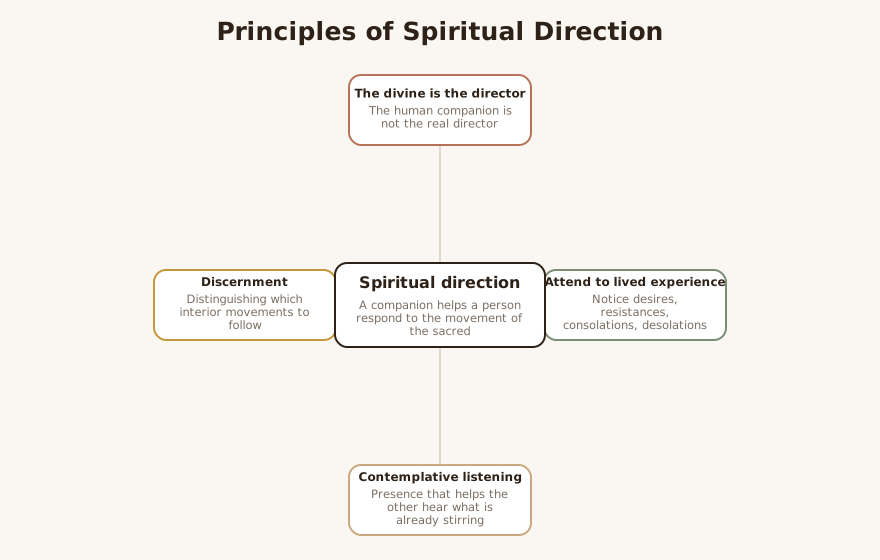
The first principle is that the divine, not the human companion, is the real director 4. The person offering direction is a companion who helps the directee become aware of and responsive to a movement they understand as coming from God, the Spirit, or the deepest truth of their own experience 4. This decenters the human guide and positions the relationship as triadic — directee, director, and the sacred presence between them — rather than as an expert dispensing answers LLM.
The second principle is attentiveness to lived experience 5. Direction works by helping a person notice the texture of their actual experience — desires, resistances, consolations, and desolations — rather than by importing doctrine or advice 5. The companion’s primary activity is contemplative listening: a quality of presence and attention that helps the other hear what is already stirring in them 3. This is the practice’s deepest point of resonance with non-directive, person-centered therapy, where empathic attention rather than expert direction is the engine of change LLM.
The third principle is discernment — the disciplined practice of distinguishing which interior movements draw a person toward life, love, and their authentic direction, and which pull away 6. In the Ignatian stream this is structured around the language of consolation and desolation and is applied to concrete decisions, which is why direction is so often sought at decision points and life transitions 6. The fourth principle is the freedom and agency of the directee: direction is non-coercive, the person remains the author of their own response, and the companion holds a posture of unknowing and accompaniment rather than control 4. A clinician will recognize in these principles a familiar set of relational values — presence, attunement, autonomy — even though the frame and goal differ LLM.
Interventions & Techniques
The central “technique” is contemplative or deep listening within a regular one-to-one meeting, typically monthly, in which the directee brings their prayer, experience, and questions and the director helps them attend to where the sacred is at work 3. The companion asks open, exploratory questions, reflects back what they hear, and notices movements the directee may have missed, but refrains from advising, fixing, or interpreting in the clinical sense 5. Silence is itself an intervention; pauses allow the directee to listen inwardly and allow the relationship to remain oriented toward the divine rather than toward problem-solving LLM.
Two Ignatian practices are the most concrete tools a clinician is likely to encounter. The first is the Examen, a short, structured prayerful review of the day — gratefully recalling the day, noticing where one felt drawn toward or away from love and life, and looking ahead — practiced daily and brought into direction as raw material 6. The second is discernment of spirits, the practice of attending to “consolation” and “desolation” to read the direction of one’s interior life and to inform decisions 6. The Spiritual Exercises offer a more intensive, retreat-based container for these practices, sometimes given over thirty days or in an adapted form spread across daily life 6.
LLM-generated illustrative example (not a guideline): A client in person-centered psychotherapy mentions she also meets monthly with a spiritual director and has begun a nightly Examen. Rather than treating this as competing care, her therapist asks her to describe what “consolation” and “desolation” have felt like in her week. Naming a pattern — that she feels alive when serving others but depleted when performing for approval — gives both the therapy and the direction a shared thread to follow, without the therapist having to adopt or evaluate her theology LLM.
For most clinicians, the practical “intervention” is rarely to provide spiritual direction, which is a distinct vocation, but to work alongside it: clarifying its non-directive logic with a client, helping them carry insights from direction into therapy and vice versa, and, where the client wishes, integrating discernment-oriented reflection within an established psychotherapy LLM. The Examen, in particular, can be discussed as a client’s existing practice and gently connected to the noticing and meaning-making work of therapy, provided the clinician stays within their scope and the client’s framework leads LLM.
Evidence Base
Honest framing matters here, and the evidence label is best read as established practice with limited clinical-outcome evidence LLM. As a spiritual discipline, spiritual direction is highly established: it has centuries of continuous tradition, a defined method, a global professional body in Spiritual Directors International, codified ethics, and recognized graduate-level training programs at institutions such as seminaries 2. Its maturity as a practice is not in question 3.
As a clinical intervention, however, its dedicated empirical literature is thin, and a clinician should not present it as an evidence-based treatment for any disorder LLM. Direction’s own aims are spiritual and relational rather than symptom-focused — attending and responding to God — so symptom change is by design a secondary matter, and the practice has not been subjected to the randomized controlled trials that define first-line psychotherapies 5. The defensible and accurate stance is to treat spiritual direction as a well-established spiritual practice that may support wellbeing, meaning, and coping for those for whom it is congruent, while keeping evidence-based psychotherapy central wherever a diagnosable condition is present LLM.
There is a related body of evidence worth invoking carefully LLM. The broader field of spiritually integrated psychotherapy and religious/spiritual coping has accumulated meaningful research, and direction overlaps conceptually with that field — but that overlap cannot simply be borrowed, because direction is a distinct practice with its own non-clinical aims LLM. Generalizing from the spirituality-and-health literature to claim outcomes for spiritual direction specifically would overstate what is actually demonstrated LLM.
Populations & Indications
Spiritual direction is, first and most appropriately, indicated for clients for whom it is already meaningful or congruent: religiously or spiritually identified clients, and contemplatives and retreatants whose lives are organized around prayer and practice 2. For these clients the explicitly transcendent framing is a strength rather than a barrier, and respecting or coordinating with their direction honors rather than overrides their worldview LLM. Spiritual Directors International’s interfaith orientation means the practice is no longer confined to one tradition, which broadens the range of clients for whom a culturally matched director may be available 2.
Clergy and religious professionals are a particularly apt population, since many traditions expect or require ongoing direction as part of formation and self-care, and direction offers a sustaining contemplative rhythm within their own framework — relevant to burnout that is common in helping and ministry roles LLM. Adults seeking meaning, people in religious transition, and older adults reviewing the arc of their lives are also natural fits, because direction is built around meaning-making, discernment, and attention to the larger story of a life 3. People at decision points — vocational, relational, or existential — are classic seekers of direction, since the Ignatian tools are explicitly designed for discernment and choice 6.
Problems-for-Work
The practice speaks most directly to suffering that carries a spiritual, existential, or discernment dimension, and for clinicians the value is usually in coordinating with or integrating its stance rather than delivering it LLM. For spiritual distress and the DSM/ICD religious or spiritual problem (V62.89), direction offers a relational container for sitting with struggle around faith, God, or ultimate meaning, which the clinician can frame within therapy while respecting the client’s parallel work with a director 3. For faith doubt and crisis, the non-directive, accompanying posture is well suited to a person whose certainties have come apart, because it does not demand answers and does not abandon the person to the doubt 4.
LLM-generated illustrative example (not a guideline): A seminarian presents with demoralization and a sense that he is “going through the motions” of ministry. In therapy he is helped to see the difference between clinical burnout, which needs rest and boundary work, and a vocational discernment question, which his spiritual director is better positioned to companion. Distinguishing the two stops him from pathologizing a genuine call-and-doubt struggle and stops him from spiritualizing what is, in part, exhaustion LLM.
For discernment and decision-making difficulties and life transition distress, the Ignatian language of consolation and desolation gives a structured way to read which options draw a person toward life, and a clinician can connect this to the values-clarification and meaning work of therapy 6. For existential crisis and meaning-making difficulties, direction’s orientation toward the larger story of a life complements therapeutic exploration of purpose 3. For grief and demoralization, direction can hold a space for the sacred and for hope alongside — not instead of — evidence-based treatment, and for burnout in clergy and contemplatives the regular rhythm of accompaniment can be protective LLM.
Contraindications, Cautions & Cultural Humility
The most important caution is one of fit, consent, and scope: spiritual direction is an explicitly transcendent practice, and neither the practice nor its tools should be imposed on clients who do not share its framework or who would experience it as the clinician’s religion intruding into therapy LLM. Spiritually integrated work requires that the client’s beliefs lead, never the clinician’s, and a therapist must not drift into the role of spiritual director, which is a distinct vocation with its own formation and ethics 2. Recommending that a client seek direction, when they want it, is appropriate; covertly converting therapy into direction is not LLM.
A second caution concerns the very real risk of spiritual bypassing and of using “discernment” to avoid clinical reality LLM. A depressive episode is not desolation to be discerned away, and acute risk, trauma, psychosis, or a treatable disorder must not be reframed as a purely spiritual matter; where these are present, evidence-based assessment and care take priority LLM. Power and authority are a third caution: the older “director” framing carries a hierarchy that can be misused, which is part of why the field has moved toward the language of companionship and has developed codes of ethics, and a clinician coordinating with an outside director should be alert to any dynamic that undermines the client’s autonomy 6.
Cultural and theological humility means representing the practice accurately and within its tradition, not as a decontextualized wellness technique LLM. The Ignatian and Christian roots of much direction are specific, and an interfaith client may need a director matched to their own path, which the broadening of the field has made more possible but not universal 2. The clinician’s job is to honor the client’s spiritual world without claiming an authority they do not hold and without flattening a rich tradition into a generic intervention 4.
Treatment-Plan Suggestions & SMART Objectives
| Goal | SMART objective (example) | Mechanism |
|---|---|---|
| Support meaning and coping during spiritual distress | Over 8 weeks, client will keep a brief weekly reflection on where they sense the sacred at work and discuss it in session | Attending and responding to the divine in lived experience 5 |
| Clarify a discernment or decision question | Within 6 sessions, client will use consolation/desolation language to map two options and articulate which draws them toward life | Ignatian discernment of spirits 6 |
| Establish a daily reflective practice | For 4 weeks, client will complete a nightly Examen on 5 of 7 days and note recurring patterns | Structured prayerful review of experience 6 |
| Distinguish clinical and spiritual struggle | Within 4 sessions, client will name which concerns are symptom-driven and which are vocational/spiritual, and route each appropriately | Differentiation of therapy from direction’s aims 3 |
| Coordinate care with an outside spiritual director | Over 8 weeks, with consent, client will identify two themes to carry between therapy and direction and review the integration | Complementary accompaniment and contemplative listening 4 |
| Sustain a protective rhythm against burnout | For 6 weeks, client (clergy/contemplative) will protect a regular direction or reflective practice and review its effect on depletion | Ongoing contemplative self-care within their framework 2 |
| Hold faith doubt without forcing resolution | Within 10 sessions, client will tolerate uncertainty about belief while continuing values-based action, tracking distress weekly | Non-directive accompaniment of doubt 4 |
Common Misconceptions
The most consequential misconception is that the “director” tells the person what to do or hands down authoritative answers; in the practice’s own self-understanding the human companion is not the director at all, but a listener helping the person notice the movement of the sacred, while God or the person’s deepest experience is the true director 4. A second is that spiritual direction is a form of counseling or therapy; it is a distinct practice focused on relationship with the divine rather than on symptom relief or psychological problem-solving, even though the two can run alongside each other 3. A third is that it is inherently Christian or sectarian; while its dominant lineage is Christian and Ignatian, the contemporary field is explicitly interfaith and supports companions and seekers across many traditions 2. A fourth, common among clinicians, is conflating direction with non-directive psychotherapy because both prize listening and autonomy; the resemblance is real, but direction’s object and goal are spiritual, not clinical 5. A fifth is treating it as an evidence-based treatment; its formal clinical-outcome literature is limited, and its aims are spiritual rather than symptom-focused LLM.
Training & Certification
There is no clinical license or psychotherapy certification in spiritual direction; it is a spiritual vocation, not a healthcare credential LLM. Formation typically occurs through certificate or graduate programs at seminaries and spirituality centers, often two to three years in length, combining coursework, supervised practicum, the candidate’s own ongoing direction, and a contemplative formation component 3. Spiritual Directors International serves as the principal professional body, offering a community of practice, continuing education, and an ethical framework, though it functions as a membership and standards organization rather than a licensing board 2.
For practicing therapists, the relevant competence is twofold and distinct from training to give direction LLM. First is enough familiarity with the practice — through reputable sources such as Barry and Connolly, Renovaré, or Spiritual Directors International — to discuss it accurately, recognize Ignatian tools like the Examen when a client describes them, and avoid the common misconceptions 5. Second, and more important clinically, is training in spiritually integrated psychotherapy and in the ethics of working with clients’ religious and spiritual lives, so that the clinician supports, coordinates with, or appropriately refers for direction without overstepping scope, prescribing, or evangelizing 1. A therapist who wants to engage this domain seriously should also know how to make a respectful referral to a qualified director, ideally one matched to the client’s own tradition 2.
Key Terms
Spiritual direction — a contemplative-pastoral practice of accompaniment in which one person helps another notice and respond to the personal communication of the divine in their experience 5. Spiritual companionship — the increasingly preferred, less hierarchical language for the same practice, emphasizing accompaniment over instruction 6. Director / directee — the traditional terms for the companion and the person seeking guidance, with the understanding that the true “director” is God or the person’s deepest experience, not the human companion 4. Discernment — the disciplined practice of distinguishing interior movements that draw toward life and love from those that draw away, often applied to decisions 6. Consolation and desolation — Ignatian terms for interior movements toward and away from God, life, and one’s authentic direction, used as data in discernment 6. The Examen — a short, structured daily prayerful review of experience drawn from Ignatian practice 6. Spiritual Exercises — Ignatius of Loyola’s structured retreat and method of prayer and discernment 6. Anamchara — the Celtic “soul friend,” an early form of the spiritual companion relationship 6. Spiritual Directors International (SDI) — the principal interfaith professional body supporting directors and the field’s ethics 2.
Resources & Further Reading
▶ Watch — a video introduction to this concept:
- What is Spiritual Direction? — Renovaré (Richard J. Foster)
- SDI — The Home of Spiritual Direction and Companionship (Spiritual Directors International)
- What Is Spiritual Direction? — Portland Seminary, George Fox University
- What is Spiritual Direction? — Center for Action and Contemplation
- The Practice of Spiritual Direction — William A. Barry & William J. Connolly
- Spiritual direction — Wikipedia
Reflective / Supervision Questions
- Is my client already engaged in or drawn to spiritual direction, or am I introducing it from my own framework, and how do I keep the client’s beliefs leading the work LLM?
- Am I clear with myself and my client about the boundary between psychotherapy and spiritual direction, so that I neither convert therapy into direction nor stray outside my scope LLM?
- Where a client uses discernment language, am I checking that a treatable condition — depression, trauma, risk — is not being reframed and bypassed as a purely spiritual matter LLM?
- Have I represented the practice accurately, including its Ignatian roots and its contemporary interfaith breadth, rather than flattening it into a generic wellness technique 2?
- Am I honest that the clinical-outcome evidence is limited, so that I support and coordinate with direction without overselling it as a treatment for my client’s disorder LLM?
- When coordinating with an outside director, am I alert to any power dynamic that could undermine my client’s autonomy, and am I keeping evidence-based care central where it is needed 6?