
Type & Discipline
Religiously Integrated Cognitive Behavioral Therapy (RICBT, also abbreviated RCBT in the original trial literature) is a manualized psychotherapy protocol within clinical psychology. 1 It belongs to the cognitive-behavioral family but sits inside the broader category of spiritually integrated psychotherapy, in which a client’s faith is treated as a clinical resource rather than as material to be set aside. 4 Structurally it is conventional CBT — psychoeducation, cognitive restructuring, behavioral activation, homework — delivered across ten 50-minute sessions, but its cognitive and behavioral content is drawn explicitly from the client’s own religious tradition. 6 1
The protocol was developed and tested as a treatment for major depression in adults living with chronic, disabling medical illness, the population in which it was first manualized and trialed. 1 6 It is best understood as an adaptation, not a new theory of change: the mechanisms remain cognitive and behavioral, while the content used to drive those mechanisms is religious. 4
Creators & Lineage
RICBT was developed by Michelle Pearce and Harold Koenig, working with collaborators at Duke University, and was first described in detail in Psychotherapy in 2015. 1 Its intellectual lineage is direct: it descends from Aaron Beck’s cognitive therapy and the broader CBT tradition, and from a line of earlier religiously accommodated cognitive therapies — the chapter literature situates RICBT alongside foundational work by Propst and by Pecheur and Edwards on religious versus conventional cognitive therapy for depression in religious individuals. 5 It also draws conceptually on the psychology-of-religion research on religious coping, which frames faith practices as either adaptive or maladaptive ways of managing adversity. LLM
A defining feature of the lineage is breadth across traditions. The developers produced parallel treatment manuals for five major world religions — Christianity, Judaism, Islam, Buddhism, and Hinduism — so that the same underlying CBT structure could be populated with tradition-specific beliefs, texts, and practices. 1 The Cambridge chapter positions the resulting protocol as an empirically grounded treatment for depression and anxiety that uses the patient’s religious tradition as the foundation for identifying and changing unhelpful thoughts and behaviors. 5
Core Principles
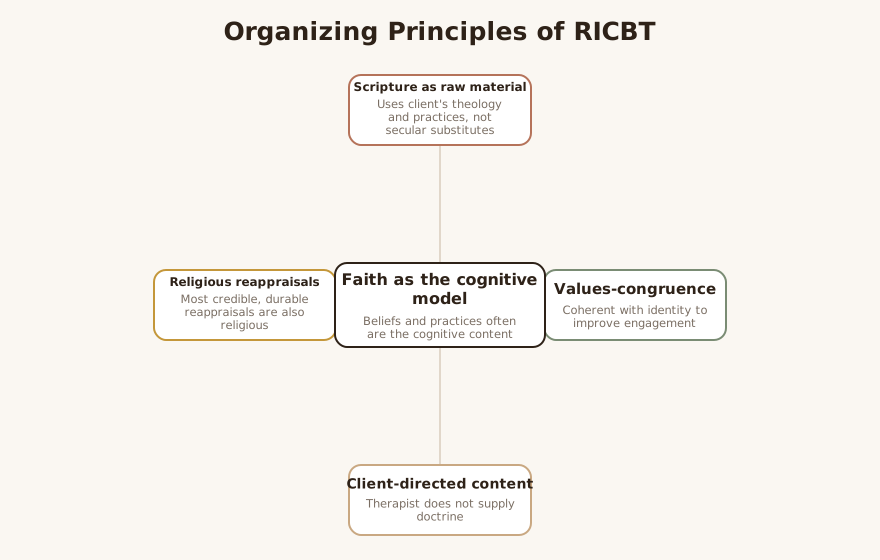
The central premise is that, for a religiously committed client, beliefs and practices are not peripheral to the cognitive model — they often are the cognitive model. LLM The client’s appraisals of illness, suffering, self-worth, and the future are frequently expressed in religious terms, and so the most credible and durable reappraisals are also religious. 4 RICBT therefore works with the client’s own scripture, theology, and devotional practices as the raw material of cognitive change rather than importing secular alternatives. 1 4
A second principle is values-congruence. Because the content is drawn from the client’s faith, the intervention is designed to feel coherent with the client’s identity, which is hypothesized to improve engagement and the therapeutic relationship. 4 3 The original developers framed this as a way to make therapy as effective, if not more so, for religious clients as standard CBT, on the logic that beliefs integrated into treatment carry more motivational weight than beliefs left at the door. 1
A third principle is that the protocol is client-directed in its religious content. The therapist does not supply doctrine; the client’s tradition does. LLM This keeps RICBT within the CBT frame of collaborative empiricism: the therapist and client jointly examine whether a distressing thought is consistent with the client’s own most considered religious understanding. 4
Interventions & Techniques
The procedural skeleton of RICBT is recognizable CBT delivered over ten 50-minute sessions, comparable in dose and structure to the conventional CBT arm against which it was tested. 6
Religious cognitive restructuring. Maladaptive cognitions are identified and challenged, but the disputation draws on the client’s own scripture and theological resources. 4 1 A depressive thought such as “my illness means I am being punished and abandoned” is examined against what the client’s own tradition teaches about suffering, grace, or divine presence. 4
Religious behavioral activation. Scheduled activity and pleasant-event planning incorporate faith-congruent behaviors — attending services, communal worship, devotional reading, or service to others — alongside ordinary activation targets. 4 LLM
Faith practices as skills. The review literature describes integrating practices such as prayer, scripture reading and memorization, gratitude, forgiveness, and altruism as therapeutic behaviors with cognitive and affective effects. 4
LLM-generated illustrative example (not a guideline): A Muslim client with end-stage renal disease and a BDI in the moderate range identifies the automatic thought “I am useless to my family now.” The therapist invites him to weigh that thought against his own understanding of dignity and patience (sabr) in adversity, and they schedule brief daily dhikr and a weekly call to a relative as activation. The reappraisal lands because it is his theology, not the therapist’s argument. LLM
A practically important feature is that the treatment materials were developed for the five traditions to support delivery across faiths, which lowers the barrier for therapists who do not share the client’s religion. 1
Evidence Base
The evidence for RICBT is emerging and limited, and clinicians should represent it that way. LLM The pivotal data come from a single multisite pilot randomized controlled trial conducted by the Duke group (ClinicalTrials.gov NCT01208428), which enrolled 132 adults aged 18–85 with chronic disabling medical illness, major depressive disorder confirmed by structured interview, Beck Depression Inventory scores of 16–28, and self-reported importance of religion. 6 Participants were randomized to religious CBT or conventional CBT, each delivered as ten 50-minute sessions, with the BDI as the primary outcome measured at baseline and 4, 8, 12, and 24 weeks. 6 2
The descriptive and trial reports indicate that religiously integrated CBT performed comparably to conventional CBT for these religious clients — consistent with the developers’ hypothesis that faith-integrated therapy is at least as effective as standard CBT for this population — rather than demonstrating clear superiority. 1 2
A companion analysis examined whether religious integration strengthens the therapeutic alliance. Among the 108 participants who completed the alliance measure, religious CBT produced marginally greater early alliance gains, but the advantage was not sustained: the group-by-time interaction over the course of treatment actually favored standard CBT. 3 In other words, the intuitive “better rapport” rationale for RICBT received only weak and transient empirical support in the one trial that tested it directly. 3
Key limitations follow from this. The evidence rests largely on one pilot RCT in a specific population (depressed adults with chronic medical illness), the sample is modest, comparative superiority was not established, and replication in other diagnoses and settings is sparse. 6 2 3 The honest summary is that RICBT is a credible, structured option for religious clients, not a treatment with a mature multi-trial evidence base. LLM
Populations & Indications
The population with the most direct evidence is religiously committed adults experiencing depression in the context of chronic or disabling medical illness — the exact group enrolled in the pilot trial, including a wide age range up to 85 and therefore many older adults. 6 1 Indication hinges on two features: a current depressive (or, per the broader chapter literature, anxious) presentation, and a client for whom religion is genuinely important. 6 5
The protocol’s design across five world religions makes it applicable, in principle, to Christian, Jewish, Muslim, Buddhist, and Hindu clients, and more generally to clients who prefer values-congruent care that does not require bracketing their faith. 1 It is most appropriate when the client wants their religion engaged in treatment; faith importance is an inclusion consideration, not an assumption to impose. 6 LLM
Problems-for-Work
- Major depressive disorder in chronic illness. The primary tested indication; religious cognitive restructuring targets illness-related hopelessness and self-blame using the client’s tradition. 6 4
- Demoralization and hopelessness. Faith-based reappraisal of suffering and the future can address the loss of meaning that often accompanies serious illness. 4 LLM
- Generalized anxiety. The broader review and chapter literature describes religion-adapted CBT for anxiety as well as depression. 5 4
- Adjustment disorder and grief/bereavement. Religious frameworks for loss, continuity, and hope can be mobilized within standard CBT structure. LLM
- Religious and spiritual struggles. When a client’s distress is itself partly religious (e.g., feeling punished or abandoned by God), working within the tradition is often more credible than secular reframing. 4 LLM
- Maladaptive cognitions / cognitive distortions generally. The core mechanism — restructuring distorted thoughts — is unchanged; only the disputing content is religious. 4
Contraindications, Cautions & Cultural Humility
RICBT is contraindicated, or at least inappropriate, when religion is not important to the client; the intervention assumes and depends on faith salience, and integrating religion with a secular or ambivalent client risks alienation. 6 LLM The original trial also excluded clients with significant cognitive impairment or substantial suicidal risk, and clinicians should treat acute suicidality and severe cognitive limitation as reasons to stabilize or select a different pathway first. 6
The largest clinical caution is the risk of the therapist imposing belief. The protocol’s integrity depends on the client’s tradition supplying the content; the therapist functions as a CBT clinician, not a religious authority. LLM Because manuals exist for five traditions, a therapist can deliver RICBT across faiths without sharing the client’s religion — but doing so demands genuine cultural and religious humility, willingness to learn the client’s framework rather than approximate it, and care not to flatten doctrinal differences. 1 LLM When a presentation is primarily a theological or spiritual struggle rather than a mental-health disorder, appropriate collaboration with or referral to the client’s clergy or spiritual community may be the more competent move. LLM
Treatment-Plan Suggestions & SMART Objectives
| Goal | SMART objective (example) | Mechanism |
|---|---|---|
| Reduce depressive symptom severity | Lower BDI score by ≥5 points over 8 weeks of weekly sessions | Religious cognitive restructuring of depressive thoughts 6 4 |
| Re-engage in valued activity | Complete 3 faith-congruent activation tasks (e.g., service attendance, devotional reading, calling a relative) per week for 4 weeks | Religious behavioral activation 4 |
| Reframe illness-related self-blame | Identify and dispute 2 punishment/abandonment beliefs per session against the client’s own scripture for 4 weeks | Cognitive restructuring using client’s tradition 4 1 |
| Restore meaning / reduce demoralization | Articulate, in own words, a tradition-based understanding of suffering by session 6 and rate hopelessness weekly | Reappraisal of meaning via faith framework 4 LLM |
| Build adaptive coping skills | Practice a daily faith practice (prayer, gratitude, scripture) and log it 5 of 7 days for 4 weeks | Faith practices as coping behaviors 4 |
| Strengthen social/spiritual support | Increase supportive contacts (community or congregation) measured by Duke Social Support items over 12 weeks | Behavioral activation + social support 6 |
| Address forgiveness/resentment barriers | Complete a structured forgiveness exercise drawn from the client’s tradition by session 8 | Forgiveness as therapeutic behavior 4 LLM |
Common Misconceptions
- “It’s religious counseling, not psychotherapy.” RICBT is structured CBT with measurable outcomes (BDI as primary endpoint), not pastoral guidance; the change mechanisms are cognitive and behavioral. 6 1
- “It’s only for Christian clients.” Manuals were built for five world religions — Christianity, Judaism, Islam, Buddhism, and Hinduism — and for delivery across traditions. 1
- “The therapist must share the client’s faith.” The cross-tradition manuals are designed precisely so a CBT clinician can deliver the protocol without sharing the client’s religion, provided they work from the client’s framework. 1 LLM
- “It clearly outperforms standard CBT for religious clients.” The pilot evidence shows comparability, not clear superiority; even the alliance advantage was marginal and not sustained. 2 3
- “It works for any depressed client.” It assumes faith importance and was tested specifically in religious adults with chronic medical illness. 6
Training & Certification
There is no widely recognized standalone licensing body for RICBT in the provided literature; the realistic prerequisite is competence in cognitive behavioral therapy, onto which the religious adaptation is layered. LLM The protocol was disseminated through its published description and tradition-specific treatment manuals developed by the Duke group, which lowers the entry barrier for trained CBT clinicians who wish to apply it. 1 In practice, the clinician needs (a) solid CBT skill, (b) familiarity with the relevant manual for the client’s tradition, and (c) cultural and religious humility to apply the content faithfully rather than approximately. 1 4 LLM
Key Terms
- RICBT / RCBT: Religiously Integrated (or Religious) Cognitive Behavioral Therapy — a manualized, ten-session CBT adaptation using the client’s faith content. 1 6
- Religious cognitive restructuring: Identifying and disputing maladaptive thoughts using the client’s own scripture and theology. 4 1
- Religious behavioral activation: Scheduling faith-congruent activities (worship, devotion, service) as activation targets. 4
- Spiritually integrated psychotherapy: The broader umbrella treating the client’s spirituality as a clinical resource. 4
- Therapeutic alliance: The working bond between therapist and client; hypothesized — but not robustly confirmed — to be strengthened by religious integration. 3
- Five-tradition manuals: Parallel RICBT manuals for Christianity, Judaism, Islam, Buddhism, and Hinduism. 1
Resources & Further Reading
▶ Watch — a video introduction to this concept:
- Pearce et al., Religiously integrated cognitive behavioral therapy (Psychotherapy, 2015) — PubMed 1
- Koenig et al., Religious vs. Conventional CBT for Major Depression in Chronic Medical Illness (Harvard DASH record) 2
- Koenig et al., Effects of religious vs. standard CBT on therapeutic alliance (Psychother Res, 2016) — PubMed 3
- Religion-Adapted CBT: A Review and Description of Techniques (J. Religion and Health, Springer) 4
- Religiously Integrated Cognitive-Behavioural Therapy (Spirituality and Psychiatry, Cambridge chapter PDF) 5
- Cognitive Behavioral Treatments for Depression in Chronic Illness (ClinicalTrials.gov NCT01208428) 6
Reflective / Supervision Questions
- How do I assess whether a client’s faith is genuinely important to them — and an asset for treatment — versus assuming it because of demographic cues? LLM
- When I do not share a client’s religious tradition, how do I source restructuring content from their framework rather than my approximation of it? 1 LLM
- Given that the pilot evidence shows comparability rather than superiority, how do I describe RICBT’s evidence base honestly to a client choosing between this and standard CBT? 2 3
- Where is the line between legitimate religious cognitive restructuring and imposing my own beliefs, and what would tell me I had crossed it? LLM
- When a presentation is primarily a religious or spiritual struggle rather than a mood or anxiety disorder, when should I collaborate with or refer to the client’s spiritual community? LLM
- How would I document RICBT-style work as recognized CBT while transparently noting the faith-integrated content? 6 4