
Type & Discipline
Epistemic trust is a theoretical construct, not a therapy model, a diagnosis, or a manualized intervention LLM. It names the capacity to acquire and accommodate new knowledge from others in ways that support resilient social functioning—an individual’s openness to treating another person as a reliable source of information about the world 2. It sits within clinical and developmental psychology and is most often discussed as a mechanism that operates across therapies rather than as a property of any one of them 1. Because it is a construct rather than a technique, its clinical value lies in how it reframes what clinicians are already doing—why the relationship matters, why some clients seem unreachable, and what “change” might actually consist of beneath the level of specific intervention LLM.
The construct has gained traction precisely because it is proposed as transdiagnostic: a single dimension of impaired social learning that may cut across personality pathology, trauma-related presentations, and treatment resistance, offering an alternative causal model for difficulties that resist diagnosis-specific explanation 7. It is important to hold it lightly as a heuristic with emerging—not established—empirical support, which this article treats honestly throughout LLM.
Creators & Lineage
The concept was elaborated principally by Peter Fonagy, Elizabeth Allison, Patrick Luyten, Chloe Campbell, and colleagues at the Anna Freud Centre in London, growing directly out of their earlier work on mentalization and attachment 5. The decisive theoretical statement for clinicians is Fonagy and Allison’s 2014 paper proposing that the reopening of epistemic trust is a common factor underlying effective psychotherapy 1. The intellectual lineage runs through three strands: attachment theory, developmental psychopathology, and a theory of social learning—specifically the “natural pedagogy” account of how humans are evolutionarily primed to learn culturally relevant knowledge from trusted others 2.
A later development extended the construct outward, framing epistemic trust as the channel through which culture itself is transmitted between individuals—the mechanism by which one person opens themselves to absorbing socially shared knowledge from another 6. This situates the construct beyond the consulting room: it is offered as an account of how people stay connected to and able to learn from their wider social world, not only their therapist 6. The construct’s practical scaffolding for clinicians has since been consolidated in synthesizing texts and clinical commentaries that translate the theory into the language of the therapeutic relationship 4.
Core Principles
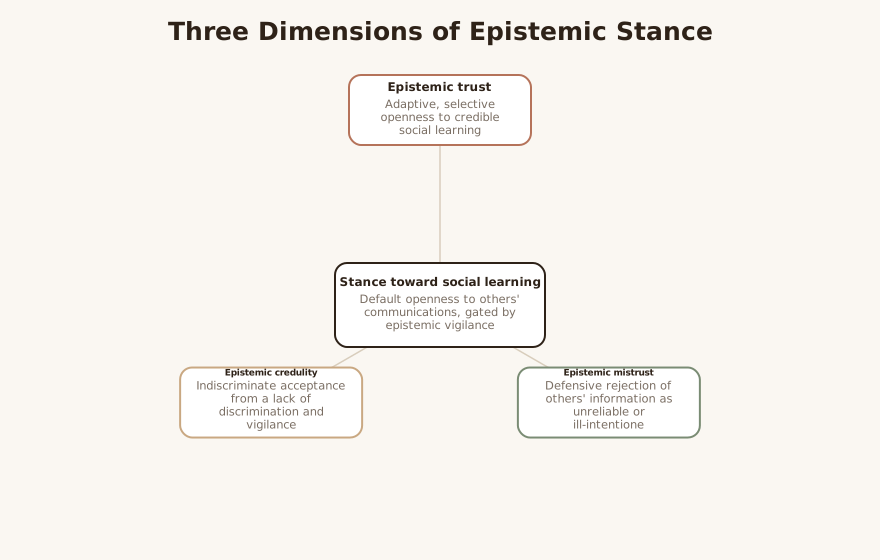
The foundational claim is that humans evolved a default openness to learning from others, but that this openness is gated by epistemic vigilance—cognitive mechanisms that evolved to discern and block false or harmful information 2. Trust and vigilance are not opposites but counterbalances; a healthy stance is selective, opening to credible sources and closing to unreliable ones 2. Crucially, the validation studies suggest the field should think in terms of three correlated-but-distinct dimensions rather than a single trust-to-distrust continuum 3.
- Epistemic trust: an adaptive, selective openness to social learning—the willingness to treat what another communicates as relevant and worth integrating 3.
- Epistemic mistrust: a defensive tendency to reject or interrogate information from others as unreliable or ill-intentioned 3.
- Epistemic credulity: a pronounced lack of discrimination and vigilance—indiscriminate acceptance that leaves the person vulnerable to misinformation or exploitation 3.
A second core principle is developmental: epistemic trust is first established within the primary caregiver relationship, through the experience of being accurately understood 2. The infant who is reliably mentalized—whose internal states are recognized and reflected back—learns that minds can be trusted as guides to the world 2. This is mediated by ostensive cues: signals (eye contact, contingent responsiveness, marked mirroring, being addressed as a person with a mind) that mark information as personally relevant and worth taking in 1. Early adversity, particularly complex trauma and neglect, can drive a protective escalation of vigilance that hardens into pervasive mistrust 2.
The third principle, epistemic petrification, is the construct’s clinical centerpiece. In the validation work, a fearful attachment pattern—high anxiety and high avoidance—was characterized by the lowest trust together with the highest mistrust and highest credulity, a frozen configuration the authors labeled epistemic petrification 3. This is not simply “not trusting”; it is a state in which the learning system is sealed shut against new social information, so that even accurate, well-intentioned input cannot get in and update the person’s models 2.
Interventions & Techniques
Epistemic trust does not prescribe techniques so much as reinterpret what makes existing techniques work LLM. The proposed mechanism of change is that the client must first feel accurately reflected in the therapist’s mind, and that this experience of being understood is what reopens the channel for social learning 4. The clinical literature describes a sequence: the client comes to feel genuinely understood; through that experience their capacity to mentalize is strengthened; and the recovered ability to trust and learn is then generalized to relationships outside the therapy 4.
Practical levers a clinician can use include:
- Generating ostensive cues deliberately. Contingent, marked responding—showing the client that this comment is about them specifically, that you have their particular mind in view—signals personal relevance and lowers vigilance 1.
- Accurate reflection over insight delivery. The active ingredient is the client seeing their own experience recognized, not the cleverness of the interpretation; person-centered work that sees the world from the client’s standpoint is what makes them “safe enough to share openly and learn” 4.
- Assessing and tailoring to the client’s epistemic stance. Clients with relatively intact trust can have maladaptive patterns directly challenged; clients with depleted trust need restoring that trust to become the core treatment goal before content-level work can land 4.
- Working in the “we-mode.” Moments where client and clinician acknowledge each other’s perspectives and reflect together on the same piece of subjective reality reduce isolation and build the shared platform from which learning becomes possible 4.
In the mentalization-based tradition, these are operationalized through a not-knowing, curious stance and active repair of misunderstandings, treating ruptures as opportunities to demonstrate that a mind can be trusted to take the client’s perspective seriously LLM.
LLM-generated illustrative example (not a guideline): A client with longstanding interpersonal hypervigilance dismisses every reflection with “you’re just saying that because it’s your job.” Rather than defending the comment, the clinician marks the client’s experience precisely—“so when someone offers you something warm, the safest read is that it’s strategic”—naming the very mistrust in the room. The client, hearing their stance accurately described rather than corrected, pauses; a small ostensive signal has landed, and the channel opens a crack. LLM
Evidence Base
The evidence base is genuinely emerging, and clinicians should represent it as such LLM. The field is rapidly evolving but the authors of the comprehensive review themselves conclude that “much remains to be done” 2. The strongest empirical foundation is indirect: a large developmental literature shows that children selectively trust informants based on accuracy, expertise, and prosocial cues, consistent with the theory’s account of how selective trust operates 2. Direct adult and clinical investigation became possible only recently, with the development of self-report measurement 2.
The principal measure is the Epistemic Trust, Mistrust and Credulity Questionnaire (ETMCQ), an 18-item self-report instrument whose three-factor structure was confirmed across two samples (n=250; n=705) 3. Cross-sectional findings align with theory: mistrust and credulity correlate with adverse childhood experiences, insecure attachment, difficulties mentalizing, and global psychopathology severity, and partially mediate the path from childhood adversity to mental health symptoms 3. These associations replicate across UK, Italian, German, and Austrian samples 2.
Several honest caveats temper enthusiasm. First, and most important clinically: trust itself did not buffer against psychopathology or reduce symptoms—the lever appears to be reducing mistrust and credulity, not increasing trust 3. This nuances the naive “restore epistemic trust” slogan. Second, only three qualitative psychotherapy studies exist linking restored trust to outcome 2. Third, the designs are cross-sectional, precluding causal inference, and the validation samples were community (low-adversity) rather than clinical 3. Fourth, internal consistency was only acceptable (Cronbach’s α .65–.81), and self-report may not capture actual behavioral trust 3. Fifth, there is still no standardized way to measure epistemic trust within a therapeutic relationship, which limits validation of the mechanism clinicians most care about 4.
Populations & Indications
The construct is offered as broadly relevant but is most clinically resonant for populations whose presentations are organized around disrupted social learning LLM. The originating literature foregrounds children and adolescents, where epistemic trust is first laid down and adolescence is identified as a pivotal phase for its disruption or repair 2. Trauma survivors and maltreated youth are central: both mistrust and credulity were positively associated with all forms of maltreatment, and neglect specifically predicted lower trust 3.
Individuals with personality disorders—particularly borderline presentations—and people with attachment disturbances are the populations for whom the petrification model was most directly developed, given the fearful-attachment signature of frozen, high-mistrust/high-credulity epistemic functioning 3. Finally, the construct is explicitly a framework for understanding what happens with clients in psychotherapy generally, since it proposes that reopening epistemic trust is a transtheoretical condition for any therapy to take hold 1.
Problems-for-Work
- Borderline personality disorder: epistemic petrification offers a model for the rapid shifts between idealization and rejection of the clinician’s input—a learning system that cannot stably hold trusted information LLM. Application: framing alliance ruptures as expectable epistemic closures rather than treatment failures 4.
- Complex PTSD and childhood trauma: persistent mistrust is reframed not as resistance but as an adaptive residue of unsafe early relationships, organizing the clinician toward patience and ostensive signaling 2.
- Therapeutic rupture and mistrust: ruptures are read as moments of epistemic closure; repair that accurately reflects the client’s stance demonstrates the trustworthiness of the clinician’s mind 4.
- Treatment resistance: “resistance” is reinterpreted as a closed channel for social learning—nothing the clinician says can update the client’s models until the channel reopens 2.
- Interpersonal hypervigilance: mapped directly onto elevated epistemic mistrust; the work is lowering vigilance enough to permit selective trust rather than eliminating vigilance 3.
- Difficulties in mentalizing: mistrust and credulity correlate with difficulty understanding mental states, so strengthening mentalizing and reopening epistemic trust are treated as mutually reinforcing targets 3.
- Attachment disorders and social isolation: depleted epistemic trust is implicated in the “vicious cycle of suffering, loneliness and inability to seek or accept help,” making reconnection to a wider social world a treatment aim 7.
Contraindications, Cautions & Cultural Humility
There is no “contraindication” to a construct, but there are real cautions in how it is applied LLM. The most serious risk is using “low epistemic trust” as a label that relocates a social problem into the individual—a sophisticated way of saying the client is the problem LLM. The literature is explicit that epistemic trust deficits reflect environmental deprivation and developmental adversity, not individual pathology alone, and that clinical work must attend to individual development in the context of an unequal social world 7. Mistrust toward systems that have genuinely been untrustworthy—including, for marginalized clients, the mental-health system itself—can be an accurate appraisal rather than a deficit to be corrected LLM.
Cultural humility follows directly: ostensive cues, eye contact, and norms of self-disclosure are culturally patterned, so a clinician’s attempt to signal trustworthiness can misfire if calibrated to their own cultural defaults LLM. Credulity, too, should not be moralized; it is a vulnerability shaped by adversity, not a character flaw, and clients high in credulity may need protection rather than confrontation 3. Finally, because the evidence is emerging and the measures imperfect, clinicians should resist over-interpreting an ETMCQ score as a fixed trait verdict about a person 3.
Treatment-Plan Suggestions & SMART Objectives
| Goal | SMART objective (example) | Mechanism |
|---|---|---|
| Reduce epistemic mistrust in session | Within 8 sessions, client will accept and reflect on at least one clinician observation per session without reflexive dismissal, tracked on a session log | Lowering vigilance through repeated accurate reflection 3 |
| Strengthen the experience of being understood | Over 6 weeks, client will report feeling “accurately understood” at 7/10 or higher on a session-rating measure in 4 of 6 sessions | Felt understanding as the gateway to social learning 4 |
| Repair ruptures as trust-building moments | Within 90 days, client and clinician will identify and explicitly repair at least 3 misunderstandings, with client noting the repair | Demonstrating the clinician’s mind is trustworthy 4 |
| Build mentalizing capacity | Within 12 weeks, client will generate an alternative mental-state explanation for a conflict in 3 of 4 reviewed incidents | Mentalizing and epistemic trust as mutually reinforcing 3 |
| Reduce credulity / increase discrimination | Over 10 sessions, client will pause and appraise one piece of incoming social information per week before acting, logged in a journal | Restoring selective vigilance rather than indiscriminate acceptance 3 |
| Generalize trust beyond therapy | Within 6 months, client will identify and test trust with one new person outside therapy and review the outcome | Generalizing recovered learning to outside relationships 4 |
| Address interpersonal hypervigilance | Within 8 weeks, client will tolerate one supportive interaction without scanning for hidden motives, rated weekly | Selective opening to credible sources 3 |
Common Misconceptions
- “Epistemic trust is just rapport or the working alliance.” It is more specific: a capacity for social learning—treating communicated knowledge as relevant and generalizable—that the alliance may help reopen but is not identical to 1.
- “The goal is to maximize the client’s trust.” The validation data suggest the opposite emphasis: more trust did not buffer psychopathology, and the therapeutic lever is reducing mistrust and credulity, not pushing trust higher 3.
- “It’s a single dimension from trusting to distrusting.” Trust, mistrust, and credulity are three correlated-but-distinct factors; a client can be high in mistrust and high in credulity at once, which is exactly the petrified pattern 3.
- “Low epistemic trust means the client is being difficult.” Mistrust is an adaptive product of adversity and sometimes an accurate reading of genuinely untrustworthy contexts, not willful resistance 7.
- “The science is settled.” The construct is theoretically rich but empirically emerging, resting heavily on cross-sectional self-report in community samples 2.
Training & Certification
There is no certification in “epistemic trust” as such; it is a construct, not a credentialed modality LLM. The relevant training pathway is in Mentalization-Based Treatment, the parent approach within which epistemic trust was developed and operationalized, with formal training offered through the Anna Freud Centre and affiliated programs 5. Clinicians seeking to apply the ideas typically build competence in mentalizing technique—the not-knowing stance, marked mirroring, and rupture repair—since these are the practical means by which epistemic trust is addressed 4. The synthesizing scholarship that consolidates the theory for practitioners is a reasonable starting point for self-directed study before pursuing supervised MBT training 5.
Key Terms
- Epistemic trust: selective openness to treating others’ communicated knowledge as relevant and worth integrating 3.
- Epistemic vigilance: evolved cognitive mechanisms for filtering false or harmful information 2.
- Epistemic mistrust: defensive rejection of information from others as unreliable or ill-intentioned 3.
- Epistemic credulity: indiscriminate acceptance of information without sufficient vigilance 3.
- Epistemic petrification: a frozen state combining lowest trust with highest mistrust and credulity, linked to fearful attachment 3.
- Ostensive cues: signals that mark communicated information as personally relevant, opening the channel for learning 1.
- Natural pedagogy: the evolved human readiness to acquire culturally relevant knowledge from trusted others 2.
- We-mode: shared reflection on the same piece of subjective reality by two people, reducing isolation 4.
Resources & Further Reading
▶ Watch — a video introduction to this concept:
- Fonagy & Allison (2014), The role of mentalizing and epistemic trust in the therapeutic relationship
- Li et al. (2023), Epistemic trust: a comprehensive review of empirical insights and implications for developmental psychopathology
- Campbell et al. (2021), Development and validation of the ETMCQ
- Society for the Advancement of Psychotherapy, Conceptualizing Epistemic Trust in Psychotherapy
- Duschinsky & Foster (2021), Mentalizing and Epistemic Trust: The Work of Peter Fonagy and Colleagues at the Anna Freud Centre
- Fonagy & Campbell (2024), Beyond Mentalizing: Epistemic Trust and the Transmission of Culture
- Epistemic Trust: a Keyword for Contemporary Clinical Practice and Psychopathology
Reflective / Supervision Questions
- When a client dismisses your input, can you distinguish epistemic mistrust born of adversity from an accurate appraisal of something untrustworthy in the room—or in your wider service? LLM
- Where in your work do you privilege the cleverness of an interpretation over whether the client felt accurately understood? LLM
- How do your own ostensive cues—eye contact, tone, contingent responding—differ across clients, and might they misfire across cultural difference? LLM
- Are you, perhaps, aiming to maximize a client’s trust when the more useful target is gently reducing their mistrust or protective credulity? LLM
- What would it look like to treat your next alliance rupture as an opportunity to demonstrate that your mind can be trusted, rather than as a problem to be smoothed over? LLM