
Type & Discipline
Reference group theory is a foundational construct in sociology and social psychology, not a psychotherapy modality 1. It belongs to the broader family of social-comparison frameworks, which examine how people locate themselves relative to others when they form judgments, attitudes, and self-appraisals 1. The central claim is deceptively simple: the groups a person uses as a standard — for evaluating themselves and for shaping their values and behavior — are not necessarily the groups they actually belong to 1. A person can take their standards from a group they aspire to join, or define themselves against a group they reject 1. For clinicians, this matters because the comparison set a client is silently using often explains distress that looks otherwise irrational on paper LLM.
This article treats reference group theory as an explanatory lens that a clinician layers on top of an established psychotherapy, rather than as a treatment in its own right LLM. It helps answer the diagnostic question “compared to whom?” — which sits underneath a large share of self-esteem, body image, identity, and dissatisfaction presentations LLM.
Creators & Lineage
The term “reference group” was coined by social psychologist Herbert Hyman in 1942, in work on subjective social status, which he framed as a person’s conception of their own position relative to other individuals 3. Hyman’s early emphasis was on the comparative use of groups — how people gauge where they stand 1.
The intellectual groundwork predates Hyman. Charles Cooley’s 1902 “looking-glass self” proposed that people form self-perceptions from how they imagine others see them, and W. E. B. Du Bois extended a related idea in describing the “double consciousness” of viewing oneself through more than one conflicting lens 3. These ideas seeded what became symbolic interactionism, one of the theory’s lineage strands LLM.
Samuel Stouffer and colleagues, in The American Soldier (1949), gave the theory its most influential empirical anchor 3. Studying WWII soldiers, they found that satisfaction and a sense of deprivation tracked the group a soldier compared himself to rather than his objective conditions — the origin of “relative deprivation” 3. Robert Merton, with Alice Kitt (later Rossi), synthesized these studies in 1950, formalized the concept of anticipatory socialization — adopting a non-membership group’s norms before joining it — and clarified that people hold multiple reference groups at once 3. Later, French and Raven (1959) described “referent power,” the influence a group exerts through identification rather than coercion 3. W. G. Runciman subsequently developed relative deprivation theory, the lineage strand most directly relevant to clinical dissatisfaction 6.
Core Principles
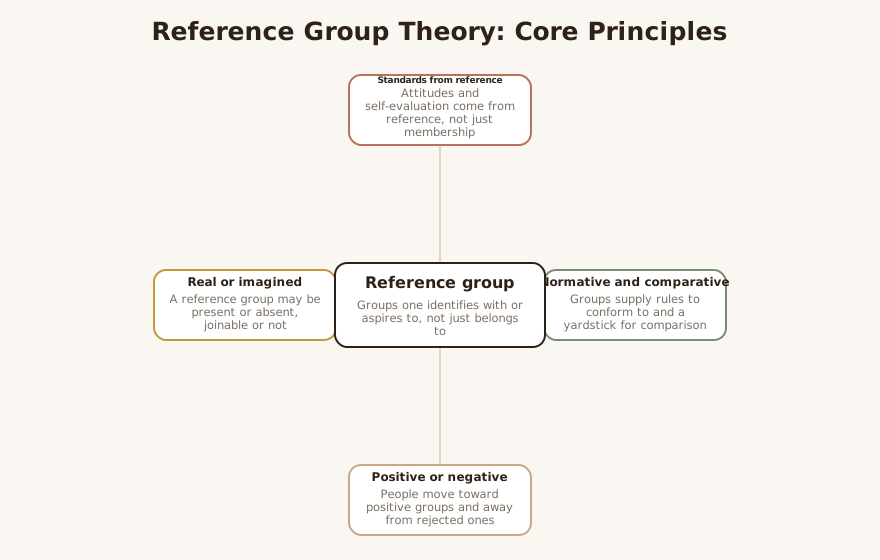
1. Standards come from reference, not just membership. People evaluate themselves and form attitudes against groups they identify with or aspire to, which may differ from the groups they belong to 1. A first-generation college student may judge themselves against affluent classmates rather than their hometown peers LLM.
2. Reference groups serve two functions — normative and comparative. Normative reference groups supply rules, values, and pressure to conform; comparative reference groups supply a yardstick for self-evaluation without necessarily demanding conformity 12. The same group can serve both functions simultaneously 2.
3. Reference groups can be positive or negative. People move toward the norms of positive reference groups and actively away from those of negative or “dissociative” groups they reject 12. Defining oneself in opposition to a group is itself a form of reference 1.
4. Membership is optional; imagination is not. A reference group can be real or imagined, present or absent, a group one might plausibly join or one (like celebrities) one almost certainly will not 1. Symbolic and anticipatory aspiration are both recognized forms 1.
5. Comparison drives relative deprivation. Whether a person feels deprived depends on the comparison group, not absolute circumstances — objectively comfortable people can feel deprived, and objectively disadvantaged people can feel content 36. This is the mechanism most likely to be doing damage in a distressed client LLM.
Interventions & Techniques
Reference group theory is not itself a set of interventions, but it generates a clear clinical move-set that maps onto established therapies LLM. Each technique below is a way of operationalizing the construct within a host modality, not a stand-alone treatment LLM.
-
Comparison-set mapping. Ask explicitly: “When you say you’re failing, compared to whom?” Surfacing the silent reference group makes an automatic comparison available for examination, consistent with how comparative reference groups operate 2. This is naturally housed within cognitive behavioral therapy as a thought-record elaboration LLM.
-
Reference-group inventory. Help the client name their positive, negative, and aspirational reference groups, noticing which carry normative pressure versus which serve only comparison 12. This clarifies where conformity pressure is coming from LLM.
-
Aspirational reframing. Where a client treats an unreachable comparison group as a verdict on their worth, distinguish a symbolic aspiration (admire from afar) from an anticipatory one (a group one is realistically moving toward) 1. Misclassifying the first as the second is a common engine of shame LLM.
-
Comparison hygiene. Reduce exposure to, or reframe engagement with, comparison sources (often social media curated feeds) that the client uses as reference groups without choosing them LLM.
LLM-generated illustrative example (not a guideline): A 16-year-old says she is “ugly and behind everyone.” The clinician asks who “everyone” is; she names the most-followed accounts she scrolls each night. Naming this curated, unreachable set as her active reference group — rather than her actual peers — lets the work shift from “fix my face” to “examine and choose my comparison set.” LLM
Evidence Base
The maturity of reference group theory is best described as established as social-science theory: it is a durable, widely cited framework that organized decades of empirical work, beginning with Stouffer’s wartime data on relative deprivation 3. Its core claim — that judgments are relative to comparison groups — has been replicated across domains from morale to consumer behavior 13.
Clinicians should be precise about what “established” means here LLM. It establishes the explanatory construct, not a manualized treatment with randomized trials and effect sizes LLM. There is no “reference group therapy” with an evidence base of its own; the theory earns its clinical keep by sharpening case formulation inside therapies that do have outcome evidence, such as cognitive behavioral therapy and acceptance and commitment therapy LLM. Relative deprivation research connects the construct to dissatisfaction and, in the broader literature, to well-being and collective grievance, but the clinician should treat these as plausible mechanisms to assess in the individual rather than as a guarantee for any given client 6.
Populations & Indications
The framework is broadly applicable but especially illuminating for several groups LLM. Adolescents and college students are in active identity formation and rely heavily on peer and aspirational reference groups for self-concept, achievement motivation, and gendered behavior 2. Members of minority or marginalized groups may experience double consciousness — evaluating themselves through both an in-group and a dominant-group lens — which the theory directly anticipates 3.
Immigrants often juggle a country-of-origin reference group and a host-culture one simultaneously, a classic multiple-reference-group situation with predictable strain 3LLM. Workplace and organizational groups generate comparison along status and equity lines, where relative deprivation rather than absolute conditions predicts dissatisfaction 36. For general populations, the construct applies wherever social comparison is doing more work than the client realizes LLM.
Problems-for-Work
- Low self-esteem / social comparison distress. Self-worth computed against a high-status comparative reference group produces chronic shortfall 2. Application: map the comparison set, then test whether the client chose it LLM.
- Body image disturbance. The active reference group (idealized media bodies) is treated as the normative standard for “normal” appearance 1LLM.
- Identity issues. Conflict between membership and aspirational reference groups — or between two membership groups — destabilizes self-concept, common in adolescents and immigrants 23.
- Relative deprivation / dissatisfaction. Satisfaction tracks the comparison group, not objective circumstances; a promotion can feel like a loss if peers advanced further 36.
- Conformity / status anxiety. Normative reference groups apply pressure to conform, and fear of deviating drives anxiety 12. Application: distinguish values the client endorses from norms they merely fear violating LLM.
- Anxiety and depression. While not caused by reference processes alone, persistent unfavorable comparison and felt deprivation are maintaining factors worth targeting 6LLM.
Contraindications, Cautions & Cultural Humility
Reference group theory has no contraindications as a concept, but its clinical application carries cautions LLM. The largest is invalidation: reframing a client’s distress as “just a comparison problem” can minimize genuine structural deprivation LLM. Relative deprivation theory explicitly recognizes that comparison-based grievance is often a rational response to real inequity, not a cognitive distortion to be corrected away 6. The clinician must hold both — the comparison is modifiable and the underlying injustice may be real LLM.
Cultural humility is essential because reference groups are culturally constituted LLM. The double-consciousness experience of marginalized and immigrant clients is not pathology; it is an accurate perception of being evaluated by more than one standard 3. Imposing the clinician’s own reference groups — assuming the client should compare themselves to whom the clinician would — is an ethical error LLM. The collectivist-versus-individualist orientation of a client’s culture also shapes which reference groups are salient, so the inventory must be the client’s, surfaced collaboratively LLM.
Treatment-Plan Suggestions & SMART Objectives
| Goal | SMART objective (example) | Mechanism |
|---|---|---|
| Increase awareness of active comparison sets | Within 3 sessions, client will identify and log 3 reference groups currently shaping their self-evaluation | Comparative reference function made explicit 2 |
| Reduce comparison-driven self-criticism | Over 6 weeks, client will reduce self-reported daily appearance comparisons from “constant” to “occasional” on a 0-4 scale | Reframing idealized media as a chosen, not normative, standard 1 |
| Distinguish endorsed values from feared norms | By session 5, client will sort 5 “shoulds” into self-chosen values vs. normative-group pressure | Separating normative pressure from comparative reference 12 |
| Address relative-deprivation dissatisfaction | Within 4 weeks, client will articulate the specific comparison group driving job dissatisfaction and one alternative frame | Satisfaction is relative to comparison group, not absolutes 36 |
| Stabilize identity across multiple reference groups | Over 8 sessions, client will name conflicting membership/aspirational groups and define one integrating value | Resolving multiple-reference-group strain 3 |
| Reduce dissociative-group reactivity | By session 6, client will identify 1 behavior driven by avoidance of a rejected group and choose a value-based alternative | Negative reference group dynamics surfaced 12 |
| Build a realistic aspirational path | Within 5 sessions, client will reclassify 2 “failure” comparisons as symbolic vs. anticipatory aspiration | Anticipatory-socialization framing 13 |
Common Misconceptions
“A reference group is whatever group you belong to.” No — membership and reference are distinct; the standard-setting group is often one the person aspires to or rejects, not one they belong to 13.
“Reference groups only pull people toward conformity.” They also push people away; negative or dissociative reference groups shape behavior by repulsion 12.
“Felt deprivation reflects objective conditions.” It tracks the comparison group instead — the core lesson of The American Soldier 36.
“It’s a therapy.” It is an explanatory theory; clinically it operates inside established modalities, not as a stand-alone treatment LLM.
“People have one reference group.” They typically hold several at once, and conflict among them is itself clinically significant 3.
Training & Certification
There is no certification in reference group theory; it is taught as foundational content within sociology and social-psychology curricula rather than as a credentialed clinical competency LLM. Clinicians typically encounter it through graduate coursework on social influence, identity, and group processes, and through primary readings such as Merton’s social-theory work and Stouffer’s The American Soldier 3. The relevant clinical skill — using the construct in formulation — is developed through supervision within whatever evidence-based modality the clinician already practices, not through a separate training track LLM.
Key Terms
- Reference group: A real or imagined group used as a standard for self-evaluation and for forming attitudes, values, and behavior, regardless of membership 1.
- Membership group: A group one actually belongs to (family, coworkers, team) 1.
- Aspirational group: A group one wishes to join — symbolic (e.g., celebrities) or anticipatory (a future role) 1.
- Dissociative / negative reference group: A group one rejects and defines oneself against 12.
- Normative function: Supplying rules, values, and conformity pressure 12.
- Comparative function: Supplying a yardstick for self-evaluation 12.
- Anticipatory socialization: Adopting a non-membership group’s norms before joining it 3.
- Relative deprivation: A sense of lack defined by comparison to a reference group rather than absolute conditions 36.
- Referent power: Influence exerted through identification rather than coercion 3.
- Double consciousness: Experiencing oneself through more than one conflicting evaluative lens 3.
Resources & Further Reading
▶ Watch — a video introduction to this concept:
- Reference group in Sociology: Definition, Types & Examples — Simply Psychology
- Reference Groups and Role Models — EBSCO Research Starters
- Reference group theory with implications for information studies: a theoretical essay — Information Research
- Relative Deprivation (working paper) — eScholarship
Reflective / Supervision Questions
- For a current client, can you name the specific reference group they are comparing themselves to — and have you asked, or assumed it? LLM
- When does reframing a client’s comparison risk invalidating real structural deprivation, and how would you hold both at once? 6LLM
- Which of your own reference groups might you be unconsciously imposing on clients during formulation? LLM
- For an adolescent or immigrant client, how do conflicting membership and aspirational groups show up in their identity distress? 23
- How would you distinguish a normative “should” the client endorses from one they merely fear violating, and would that change your treatment target? 12