
Type & Discipline
Relative deprivation is a construct drawn from sociology and the social psychology of social stratification, not a freestanding clinical modality 4. At its core it holds that discontent stems not from absolute lack but from a person’s perceived shortfall relative to a chosen comparison standard or reference group 3. The American Psychological Association defines it as the perception that one is worse off than the people or groups to whom one compares oneself, with the emphasis falling on subjective appraisal rather than objective conditions 3.
The construct is deliberately relational. A person earning a comfortable income can experience acute deprivation when surrounded by peers earning more, while a person with objectively scarcer resources may report contentment if their reference group is similarly placed 6. This decoupling of subjective distress from objective circumstance is precisely what makes the idea useful at the clinical interface: it names a mechanism by which two clients with comparable material realities arrive at very different affective states LLM.
For therapists, relative deprivation functions less as a diagnosis and more as a case-formulation lens — a way to understand resentment, demoralization, and comparison-driven distress that absolute circumstances alone do not explain LLM. It sits alongside, and frequently overlaps with, cognitive and social-comparison frameworks already familiar in psychotherapy LLM.
Creators & Lineage
The term entered the scholarly vocabulary through Samuel Stouffer and colleagues in The American Soldier (1949), a landmark study of U.S. servicemembers during World War II 1. Stouffer’s team encountered a paradox: soldiers in units with high promotion rates were more dissatisfied with advancement than those in units with low promotion rates, because the visible success of comparison others raised expectations and sharpened the sense of personal shortfall 1. Relative deprivation was coined to capture this counterintuitive finding that satisfaction tracks comparison rather than absolute reward 1.
The construct was subsequently developed and formalized by Robert K. Merton and Alice Kitt, who connected it to reference group theory — the idea that people evaluate themselves against the standards of groups they identify with or aspire to, not against humanity at large 1. W. G. Runciman later introduced the influential distinction between egoistic (individual) relative deprivation, where a person feels deprived relative to other individuals, and fraternalistic (group) relative deprivation, where one feels one’s whole group is deprived relative to other groups 6. This egoistic-versus-fraternalistic split remains central to how the construct is applied 6.
Across subsequent decades the theory was elaborated by social and political psychologists, with Thomas F. Pettigrew and Heather J. Smith offering some of the most cited modern syntheses and tightening the conditions under which deprivation produces measurable effects 7. Its intellectual neighbors include Festinger’s social comparison theory, Merton’s strain theory and its modes of adaptation, and cognitive dissonance theory, all of which share an account of how discrepancy between expectation and reality drives motivation and affect LLM.
Core Principles
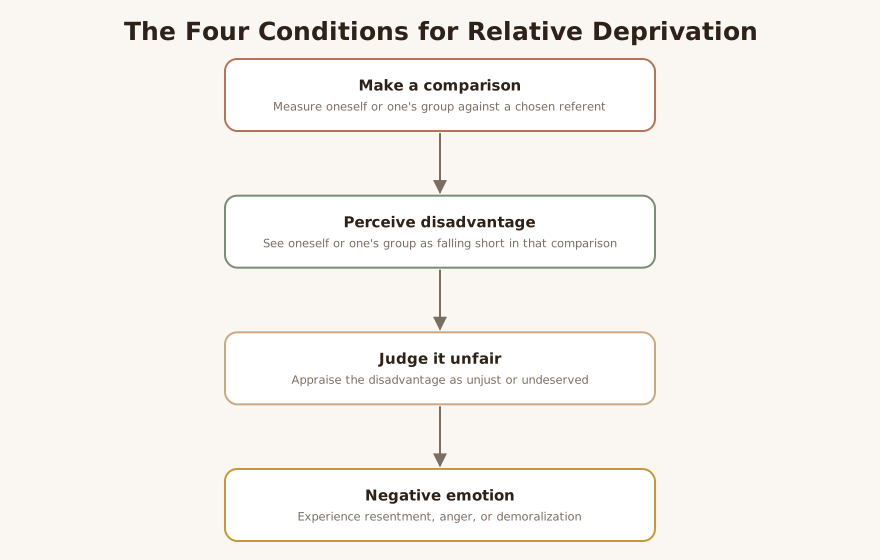
Modern formulations converge on a small set of necessary conditions. For relative deprivation to occur, a person must (1) make a comparison, (2) perceive that they or their group are disadvantaged by that comparison, (3) judge that disadvantage to be unfair or undeserved, and (4) experience associated negative emotion such as resentment or anger 7. The fairness appraisal is critical: a perceived gap that is judged legitimate produces resignation, whereas a gap judged unjust produces grievance 7.
Three principles follow that matter clinically LLM:
- Comparison is constitutive, not incidental. The chosen referent largely determines the emotional outcome. Upward comparison to a more advantaged target tends to generate deprivation and distress; lateral or downward comparison can buffer it 6.
- Subjective appraisal outweighs objective fact. Because the construct is defined by perception, interventions can target the comparison process itself even when external circumstances cannot be changed 3.
- Affect is the engine. Relative deprivation is not merely a cold cognitive judgment; the emotional charge — resentment, anger, demoralization — is what links it to behavioral and health outcomes 7.
The construct also operates at two levels simultaneously: the personal (am I falling short?) and the collective (is my group falling short?), and these can diverge, with implications for whether distress is experienced as private inadequacy or shared injustice 6.
Interventions & Techniques
Relative deprivation does not prescribe a manualized protocol; it is a formulation construct that clinicians translate into intervention using established modalities LLM. Several techniques follow naturally from its principles LLM:
- Comparison mapping. Make the client’s reference group explicit. Who, specifically, are they measuring themselves against, and did they choose that referent deliberately or absorb it from social media, family, or workplace culture? LLM
- Referent flexibility. Cognitive techniques can loosen rigid upward comparisons, introduce lateral and downward comparisons, and surface temporal comparisons to the client’s own past, reframing the standard rather than denying the feeling LLM.
- Fairness appraisal work. Because the unfairness judgment is a defined component, examining and re-evaluating “this is unfair to me” beliefs can be targeted directly through cognitive restructuring 7.
- Values clarification. Shifting evaluation from externally ranked outcomes (income, status, appearance) toward internally chosen values can reduce dependence on social comparison altogether LLM.
- Distinguishing actionable injustice from corrosive rumination. Fraternalistic deprivation can be a legitimate spur to collective action and meaning; the clinical task is to separate grievance that mobilizes from grievance that only erodes LLM.
LLM-generated illustrative example (not a guideline): A client who recently sold a successful company reports persistent emptiness. Comparison mapping reveals his referent shifted from “founders who reached an exit” to “founders whose companies are now worth ten times mine.” The intervention is not to argue he is successful, but to make the referent switch visible and ask who he wants to choose as a standard LLM.
Evidence Base
The evidence base is best described as established at the level of theory and correlation, while remaining thinner at the level of clinical trials LLM. Relative deprivation has accumulated more than seven decades of research since The American Soldier, and modern reviews document a robust association between perceived relative deprivation and a range of attitudinal, behavioral, and well-being outcomes 7. A 2023 bibliometric knowledge-mapping study confirms the theory’s broad and growing applicability across disciplines, including health and well-being domains 2.
Where the literature is strongest is in linking relative deprivation to outcomes such as poorer self-reported health, reduced life satisfaction, and intergroup hostility, with the construct consistently outperforming absolute measures of disadvantage in predicting these outcomes 7. Historically, however, the theory was criticized for inconsistent measurement and for being invoked too loosely to explain almost any grievance; later work responded by specifying the necessary conditions and tightening operationalization 7.
The honest caveat for clinicians is that this is a sociological and social-psychological construct, not an evidence-based psychotherapy LLM. There are no randomized trials of “relative deprivation therapy” because no such standalone treatment exists; its clinical value lies in informing formulation and in being delivered through modalities that do have an established evidence base, such as cognitive behavioral therapy LLM.
Populations & Indications
The construct is most clinically illuminating where social comparison is structurally amplified or where a status gap is salient LLM. Relevant populations include low-income individuals and people in financial stress or instability, for whom visible affluence in their reference environment can intensify subjective hardship beyond what their absolute resources predict 6. Recently unemployed or laid-off workers often experience an abrupt downward shift relative to former peers, a classic egoistic deprivation scenario LLM.
Racial and ethnic minority individuals and immigrants may experience fraternalistic deprivation — distress arising from a sense that one’s group is unjustly disadvantaged relative to others — which is qualitatively different from individual underperformance and is better addressed as such 6. Adolescents and teens, embedded in dense peer-comparison environments and exposed to curated social media, are a developmentally vulnerable group LLM. Finally, high achievers and high-functioning professionals are a frequently overlooked population: their objective success coexists with chronic upward comparison to ever-higher referents, producing distress that can be invisible to others and confusing to the client themselves LLM.
Problems-for-Work
Relative deprivation maps onto a recognizable cluster of presenting problems LLM:
- Resentment, anger, and hostility — the signature affective outputs of an unfairness appraisal; a client convinced a less-deserving colleague was promoted over them is doing the comparison-plus-injustice work the construct describes 7.
- Demoralization and hopelessness — when the perceived gap feels both unjust and unbridgeable, the result is often a flattened, defeated stance rather than active anger LLM.
- Envy and social-comparison distress — direct expressions of upward comparison, especially salient in social-media-saturated presentations 6.
- Major depressive disorder and adjustment disorder with depressed mood — relative deprivation can act as a maintaining or precipitating factor, particularly following a status loss such as a layoff or a peer’s visible advancement LLM.
- Low self-esteem and body-image dissatisfaction — appearance comparison is a specific, well-recognized channel through which upward comparison erodes self-worth LLM.
- Career stagnation and financial strain — here the construct helps separate the objective problem (income, advancement) from the comparison process that determines how painful it feels LLM.
- Material hardship and unmet basic needs — a caution as much as an indication: where deprivation is absolute, the comparison lens must not displace concrete resource advocacy LLM.
LLM-generated illustrative example (not a guideline): A teenage client meets criteria for an adjustment disorder with depressed mood after transferring to a wealthier school. Her absolute circumstances are unchanged; her reference group is not. Naming the shift in comparison standard, rather than treating her sadness as a personal deficiency, reorients the work LLM.
Contraindications, Cautions & Cultural Humility
The foremost caution is not to pathologize legitimate injustice LLM. Fraternalistic deprivation experienced by a minority client may reflect an accurate perception of structural inequity; reframing it as a cognitive distortion would be both clinically wrong and ethically harmful LLM. The clinician’s task is to validate the perception while helping the client choose responses that serve their well-being LLM.
A second caution concerns absolute need. Where a client faces genuine material hardship or unmet basic needs, the comparison framework must not be used to talk them out of a real problem; resource referral and advocacy take precedence over cognitive reframing LLM.
Cultural humility is essential because reference groups, fairness norms, and the meaning of status are culturally shaped LLM. What counts as a legitimate aspiration, an acceptable gap, or a fair distribution varies across communities, and the clinician’s own reference group should not be imposed as the standard LLM. Immigrant clients in particular may hold dual reference points — country of origin and country of settlement — that produce a complex and shifting deprivation profile LLM. Finally, because the construct is sociological rather than clinical, it should inform formulation, not substitute for diagnostic assessment, risk evaluation, or evidence-based treatment selection LLM.
Treatment-Plan Suggestions & SMART Objectives
| Goal | SMART objective (example) | Mechanism |
|---|---|---|
| Increase awareness of comparison patterns | Over 4 weeks, client will log three upward-comparison episodes per week, identifying the referent and resulting emotion in each | Comparison mapping makes the implicit referent explicit LLM |
| Reduce resentment tied to perceived unfairness | Within 6 sessions, client will identify and re-evaluate two “this is unfair to me” beliefs using a thought record | Fairness-appraisal restructuring targets the injustice component 7 |
| Broaden referent flexibility | By week 8, client will generate at least one lateral and one temporal (own-past) comparison when distress arises, in 70% of logged episodes | Introducing alternative referents reduces upward-comparison load 6 |
| Lower social-media-driven comparison distress | Client will reduce passive social-media scrolling by 50% and report associated mood weekly for 3 weeks | Removes the amplifying comparison stimulus LLM |
| Re-anchor self-worth to internal values | Within 8 sessions, client will articulate three personal values and one weekly values-consistent action | Shifts evaluation from external ranking to internal standards LLM |
| Address demoralization and hopelessness | Over 6 weeks, client will rate the perceived “bridgeability” of one valued gap and test one small step toward it | Reframes the gap as partly actionable rather than fixed LLM |
| Channel legitimate grievance adaptively | Client will identify one constructive response (advocacy, boundary, support-seeking) to a group-level inequity within 4 weeks | Converts fraternalistic deprivation into agency rather than rumination 6 |
Common Misconceptions
“It’s just about being poor.” No — the defining feature is subjective comparison, and a materially comfortable person can be relatively deprived while a materially scarce person may not be 6. Equating it with absolute poverty misses the entire point of the construct 3.
“It explains any grievance.” This was a genuine historical criticism, and modern theory answers it by specifying necessary conditions — comparison, perceived disadvantage, an unfairness appraisal, and negative affect — so that not every dissatisfaction qualifies 7.
“It means the client’s distress isn’t real or valid.” The opposite is true: subjective deprivation predicts real outcomes, often better than objective measures, so it should be taken seriously, not dismissed as “all in their head” 7.
“It’s a therapy you can deliver.” It is a construct, not a modality; clinically it is delivered through established treatments rather than as a standalone protocol LLM.
Training & Certification
There is no certification in relative deprivation, because it is an academic construct rather than a proprietary clinical method LLM. Familiarity is acquired through the primary and review literature — Stouffer’s original formulation as reconstructed by Pettigrew, Runciman’s egoistic-fraternalistic distinction, and the modern syntheses by Smith and Pettigrew 17. The 2023 knowledge-mapping review offers a useful orientation to how the construct has spread across disciplines and where it is currently being applied 2.
For clinical application, the relevant competencies are those of the modalities through which the construct is delivered — cognitive behavioral therapy, values-based approaches, and culturally responsive practice — each of which has its own established training and supervision pathways LLM. The construct enriches case formulation; the delivery skills come from the clinician’s existing therapeutic training LLM.
Key Terms
- Relative deprivation — discontent arising from perceived shortfall relative to a comparison standard, rather than from absolute lack 3.
- Reference group — the group whose standards a person uses to evaluate their own situation; the engine of the comparison 1.
- Egoistic relative deprivation — feeling personally disadvantaged relative to other individuals 6.
- Fraternalistic (group) relative deprivation — feeling one’s group is disadvantaged relative to other groups 6.
- Unfairness appraisal — the judgment that a perceived gap is unjust or undeserved; a necessary condition for the construct 7.
- Upward comparison — comparison to a more advantaged target, the form most associated with distress 6.
Resources & Further Reading
▶ Watch — a video introduction to this concept:
- Pettigrew, T. F. (2015). Samuel Stouffer and Relative Deprivation. Social Psychology Quarterly
- Smith, H. J., & Pettigrew, T. F. (2015). Advances in Relative Deprivation Theory and Research. Policy Insights from the Behavioral and Brain Sciences
- Knowledge mapping of relative deprivation theory and its applicability (2023). Humanities and Social Sciences Communications
- Relative deprivation — APA Dictionary of Psychology
- Relative Deprivation Theory — The SAGE Encyclopedia of Political Behavior
- Social Movement Theory: Relative Deprivation Theory — EBSCO Research Starters
- Relative deprivation — Wikipedia
Reflective / Supervision Questions
- When a client presents with resentment or demoralization, do I routinely ask who they are comparing themselves to, or do I default to assessing their absolute circumstances? LLM
- How do I distinguish a client’s accurate perception of structural injustice from a comparison process that is eroding their well-being — and am I at risk of pathologizing the former? LLM
- Whose reference group am I implicitly treating as the standard when I assess whether a client “should” feel content? LLM
- For high-functioning clients whose success masks chronic upward comparison, how do I create space to name distress that others around them dismiss? LLM
- When a client faces genuine material hardship, am I reaching for cognitive reframing before I have addressed concrete resource needs? LLM
- How do I help a client convert legitimate group-level grievance into agency rather than rumination, without minimizing the grievance itself? LLM