
Type & Discipline
Double consciousness is a sociological and social-philosophical construct, not a treatment, diagnosis, or therapeutic modality 1. It originates in the work of W. E. B. Du Bois, at the intersection of sociology, the philosophy of race, and what would now be called social psychology, and it names a feature of how oppressed people experience their own identity rather than prescribing any intervention 1. Du Bois described it as “this sense of always looking at one’s self through the eyes of others, of measuring one’s soul by the tape of a world that looks on in amused contempt and pity” 2. It is, on his account, a “peculiar sensation” produced not by anything defective in the person but by living under a regime of racial subordination that perpetually reflects a demeaning image back at them 2.
For a practicing therapist, the value of double consciousness is not that it is something one delivers in session, but that it supplies a precise vocabulary for a recognizable mechanism: the felt split between who a person knows themselves to be and the contemptuous picture a dominant culture holds of them LLM. Because it is a descriptive construct rather than a modality, it informs how a clinician reads the experience of a client who feels watched, measured, and divided against themselves, rather than constituting a therapy in itself LLM. Its central claim is that members of a devalued group are made to carry “two-ness” — to see themselves simultaneously through their own eyes and through the eyes of a world that holds them in contempt — and that this doubled vision is a social product, not a private pathology 2.
Creators & Lineage
The construct was introduced by the African American sociologist and scholar W. E. B. Du Bois, first in his 1897 Atlantic Monthly essay “Strivings of the Negro People” and then, most influentially, in his 1903 book The Souls of Black Folk 3. Writing of the African American at the turn of the twentieth century, Du Bois rendered the experience in language that has become canonical: “One ever feels his two-ness,—an American, a Negro; two souls, two thoughts, two unreconciled strivings; two warring ideals in one dark body, whose dogged strength alone keeps it from being torn asunder” 2. The construct emerged directly from the conditions of segregation and the color line that structured Black life in his era 1.
Du Bois’s formulation drew on a deep intellectual inheritance 1. Scholars trace the idea through Emersonian Romanticism, through the psychological literature of William James — under whom Du Bois studied at Harvard, and whose Principles of Psychology discussed cases of alternating or divided consciousness — and through Hegel’s Phenomenology of Spirit, whose “Unhappy Consciousness” some read as a philosophical ancestor of the divided self Du Bois described 1. Frank Kirkland has also connected it to Rousseau’s amour-propre, the socially reflective self-love that is corrupted when one’s self-worth becomes hostage to others’ degrading estimations 1.
The construct’s most consequential extensions came through anticolonial and diaspora thought 3. Frantz Fanon explored parallel psychological struggles in colonized populations, examining how cultural displacement and racial stereotyping reinforce a divided consciousness 3. Paul Gilroy carried the idea into his account of the “Black Atlantic,” reading double consciousness as a structure arising from the transatlantic history of slavery and diaspora rather than from any one national setting 3. That double consciousness remains a standard reference in the philosophy of race and in identity scholarship marks it as established and durable, even as it is an interpretive construct rather than a settled empirical law 1.
Core Principles
The first principle is the doubled gaze: the oppressed person is made to see themselves not only through their own eyes but through the eyes of a contemptuous dominant culture, and to measure their worth by that hostile standard 2. This is captured in Du Bois’s image of “measuring one’s soul by the tape of a world that looks on in amused contempt and pity” — a self-perception bent toward the judgment of others rather than grounded in one’s own 2. The construct insists this is a social fact, produced by the surrounding racial order, rather than a property of the individual alone 1.
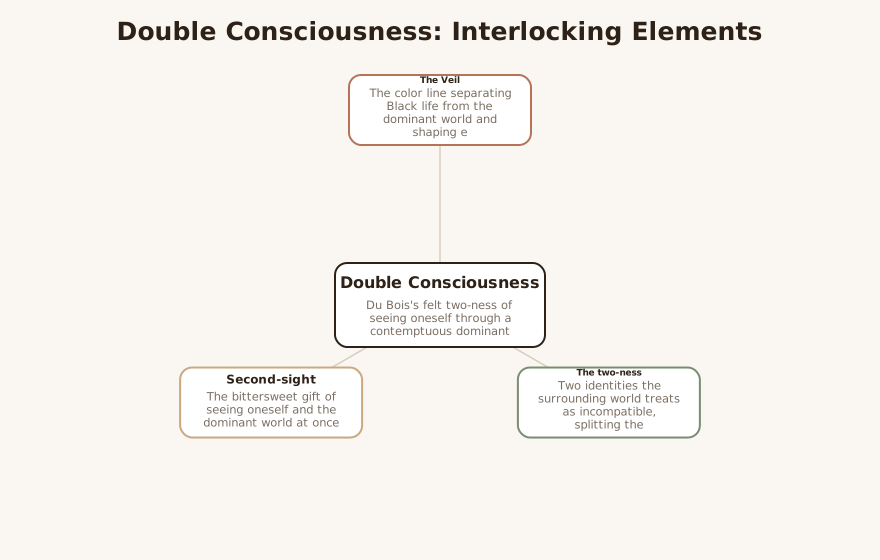
The second principle is the “two-ness” or warring ideals: the person holds two identities — for Du Bois, “an American, a Negro” — that the surrounding world treats as incompatible, so that the self is experienced as split between unreconciled strivings 2. Scholars commonly distinguish three interlocking elements in Du Bois’s formulation: the Veil (the color line that separates Black life from the dominant world and shapes how each sees the other), the twoness itself, and “second-sight” 1. Second-sight is the bittersweet “gift” the condition confers: the capacity, born of necessity, to see oneself and one’s society through the dominant group’s eyes — a clarity about how one is perceived that the privileged majority never has to develop 1.
The third principle is that double consciousness is at once internalized and structural 3. It describes a psychological state in which a subordinated group internalizes the larger society’s demeaning views of them, and it points to the concrete “double environment” — the white-dominated world and the person’s own community — that produces the split 1. The fourth principle is that the aim is not to amputate one self in favor of the other but to integrate them: Du Bois framed the goal as the longing “to merge his double self into a better and truer self,” wishing “neither of the older selves to be lost” 2. Because the engine of the experience lies in social response rather than in any inherent defect, the construct functions as a fundamentally non-pathologizing lens LLM.
Interventions & Techniques
Because double consciousness is a sociological construct rather than a therapy, there are no “double-consciousness techniques”; it works by shaping formulation and is operationalized through recognized modalities LLM. What follows is the clinical application of the construct, and these recommendations are the author’s synthesis rather than directives drawn from the source literature LLM. The first practical move is recognition — noticing when a client’s distress is organized around the felt gap between who they know themselves to be and how a contemptuous world reflects them, so that hypervigilance, self-monitoring, and chronic self-doubt can be read as the residue of the doubled gaze rather than as free-standing pathology LLM.
A second move is externalizing and naming the gaze, which maps closely onto narrative practice: helping the client locate the demeaning “tape” by which they measure themselves as an external, socially imposed standard rather than the truth of who they are, so the contemptuous voice can be examined instead of obeyed LLM. A third move is honoring second-sight as a competence rather than only a wound — validating that the client’s acute attunement to how they are perceived is a hard-won skill of survival, while working to keep that vigilance from consuming the self LLM. A fourth move follows Du Bois’s own aim of integration: supporting the client in merging their doubled selves into “a better and truer self” without disowning either, rather than pressing assimilation toward the dominant standard or a defensive rejection of one identity 2. These moves are delivered through the clinician’s primary modality; the construct supplies the why and what to look for, while the modality supplies the how LLM.
LLM-generated illustrative example (not a guideline): A Black professional describes rehearsing every email “so they won’t think I’m what they already think I am,” and feeling that at work she is “performing a version of myself for an audience that’s waiting for me to fail.” Using the double-consciousness frame, the clinician names the contemptuous gaze she is measuring herself against as an external imposition, validates her second-sight as a real and costly skill, and orients the work toward an integrated sense of self that neither erases her professional identity nor abandons her racial identity LLM.
Evidence Base
The honest appraisal is that double consciousness is an established construct — a standard, durably cited idea in the sociology and philosophy of race and in identity scholarship — but it is a conceptual and interpretive framework, not an intervention with its own outcome trials 1. Its evidentiary base is the kind appropriate to a construct of this type: the close reading of Du Bois’s texts, more than a century of scholarly elaboration, and continued use across disciplines, rather than randomized efficacy data 1. Its lineage is humanistic and qualitative — Du Bois’s own observations, and the theoretical extensions of Fanon, Gilroy, and others — which is rich for theory-building but is not experimental evidence 3.
What gives the construct clinical traction is its convergence with adjacent, better-studied phenomena LLM. The internalization of a dominant culture’s demeaning views, which double consciousness names with unusual vividness, overlaps closely with the contemporary literatures on internalized racism, minority stress, and self-stigma, which carry their own empirical support LLM. Two implications follow LLM. First, double consciousness should be offered as a map of how racial subordination can split and burden identity, not as a validated treatment for any disorder LLM. Second, its reliability is greatest as a formulation heuristic and weakest if applied as though every member of a group experiences a bifurcated self — a limitation scholars themselves press, noting that the concept may describe some experiences far better than others and has been contested as to its universality 1.
Populations & Indications
The construct’s paradigmatic population is African Americans, the group whose experience Du Bois was describing and for whom the color line produced the doubled vision he named 2. It extends naturally to racial and ethnic minorities more broadly, wherever a dominant culture reflects a contemptuous image back at a subordinated group and members must navigate that gaze 1. Scholars have explicitly expanded double consciousness beyond its original African American context to immigrant experiences and to other marginalized groups facing systematic othering 3.
The construct is also indicated for understanding the experience of people who hold more than one devalued identity at once 3. Extensions such as “triple consciousness” incorporate gender, sexuality, and ethnicity, and are taken up particularly for women of color navigating overlapping marginalization — a multiplicity later scholars describe in terms of a kaleidoscopic rather than merely doubled self 13. By the same logic the lens is clinically apt for LGBTQ+ individuals, religious minorities, and others who routinely see themselves measured against a contemptuous dominant standard LLM. The construct is most indicated when a client’s distress appears organized around being perpetually watched, measured, and split by an external gaze rather than around a freestanding symptom cluster LLM.
Problems-for-Work
Double consciousness maps onto a recognizable cluster of problems centered on the costs of the doubled, contemptuous gaze 2. Internalized racism is the core target: the construct names the precise mechanism by which a person comes to measure their soul “by the tape of a world that looks on in amused contempt,” useful when a client reports judging themselves through the eyes of those who devalue them 2. Identity confusion follows from the warring-ideals dynamic, the felt impossibility of being fully oneself and fully accepted at once, which the clinician can help reframe as a social imposition rather than a personal failure to “choose” 2.
LLM-generated illustrative example (not a guideline): A second-generation immigrant client says he is “too foreign for here and too American for home” and feels like a fraud in both worlds. Formulated through double consciousness, the clinician normalizes the twoness as the predictable product of being measured by two contemptuous standards at once, validates the second-sight that lets him read both worlds so acutely, and orients the work toward integrating the two strivings into one self rather than forcing a choice between them LLM.
Shame, low self-esteem, and demoralization are the affective residue of chronically failing to measure up to a hostile external standard, reframed by the construct as an intelligible response to contempt rather than a free-standing defect 2. Minority stress and racial trauma name the cumulative toll of living under the gaze and the Veil, which the lens situates within an unjust social order rather than within the person 1. Code-switching strain — the exhausting, vigilant self-monitoring of presenting differently across worlds — is a direct expression of second-sight turned into a daily labor, and naming it as such can relieve the self-blame that often accompanies it LLM. Across these problems the consistent therapeutic move is to honor the reality of the social source while supporting the client toward an integrated, self-authored identity LLM.
Contraindications, Cautions & Cultural Humility
The foremost caution is conceptual restraint: double consciousness is a lens for understanding how racial subordination can split identity, not a verdict to be pronounced over a client LLM. Telling someone “you have double consciousness” risks imposing the clinician’s analysis onto a person who did not ask for it and may experience their identities as whole rather than warring; the framing is most useful when offered tentatively, as a shared way of understanding a felt experience the client recognizes LLM. It must never displace differential diagnosis, risk assessment, and indicated evidence-based care LLM.
A second caution is over-generalization, a limit scholars themselves raise 1. Not every member of a marginalized group experiences a divided self; some describe their identity as integrated and affirming, and critics have questioned whether the concept applies uniformly or mainly to those navigating both worlds in particular ways 1. Applying double consciousness as though twoness were universal can pathologize identities a client experiences as coherent and can substitute the clinician’s reading for the client’s lived reality LLM. A related caution is fatalism: framing the gaze as total and inescapable can deepen the very demoralization the work aims to lift, so structural honesty must be paired with attention to agency and to second-sight as a strength LLM.
A third caution concerns cultural humility and power LLM. The construct arose from a specific history of anti-Black racism in the United States, and its meaning shifts across race, class, immigration status, gender, and context, so it should not be applied mechanically to every difference 1. A clinician from the dominant group must be especially wary of explaining a client’s experience of racism back to them, while a clinician who shares the client’s identity must guard against assuming their own experience generalizes LLM. Cultural humility requires letting the client define which parts of their experience feel doubled and which feel whole, checking the clinician’s inference rather than asserting it, and remaining alert to the therapist’s own power in framing which self counts as the “true” one LLM.
Treatment-Plan Suggestions & SMART Objectives
| Goal | SMART objective (example) | Mechanism |
|---|---|---|
| Recognize the contemptuous gaze as external, not the truth | Within 3 sessions, client will identify 2 settings where they measure themselves by others’ devaluing standards and name the process as an imposed gaze rather than fact | Relocates the source of self-judgment from inside the person to social response, reducing shame 2 |
| Externalize the “tape” by which the client measures their worth | Over 4 weeks, client will record 3 self-critical thoughts and trace each to an absorbed external standard rather than a personal verdict | Loosens the doubled gaze that fuses self-worth to others’ contempt 2 |
| Reframe second-sight as a competence | Within 6 sessions, client will name 2 situations where their attunement to how they are perceived has protected or served them | Reclaims “second-sight” as a survival skill rather than only a wound 1 |
| Reduce code-switching strain | Over 8 weeks, client will identify high-cost self-monitoring situations and rehearse 2 lower-strain ways of managing them | Eases the vigilant labor that second-sight imposes across worlds LLM |
| Integrate the doubled selves | Over 10 sessions, client will produce a self-statement that holds both identities without disowning either | Pursues Du Bois’s aim of merging the double self into “a better and truer self” without loss 2 |
| Reduce isolation in shared experience | Within 6 weeks, client will connect with 1 peer or community resource that reflects their identity back affirmingly | Counters the Veil by replacing the contemptuous gaze with an affirming mirror 1 |
| Distinguish racism from personal defect | Within 4 sessions, client will reframe 2 experiences of being devalued as products of an unjust social order rather than evidence of inferiority | Situates distress in structural conditions, supporting non-pathologizing self-understanding 1 |
Common Misconceptions
A frequent error is treating double consciousness as a synonym for ordinary self-awareness or for any feeling of being “of two minds”; the construct specifically names the contemptuous, racialized gaze through which a subordinated person is made to measure themselves, not garden-variety ambivalence 2. A second misconception is that the twoness is a defect or disorder in the individual; Du Bois located its source in the color line and the surrounding social order, which is why the construct is non-pathologizing by design 1. A third is that the goal is to choose one identity and shed the other; Du Bois’s stated aim was integration — to “merge his double self into a better and truer self” with “neither of the older selves” lost 2.
A fourth misconception is that double consciousness is purely internal; the scholarship treats it as both an internalized psychological state and a structural condition rooted in a “double environment,” so it cannot be addressed as if it were only a matter of individual cognition 13. A fifth is that the concept is dated or confined to Du Bois’s era; it has been carried forward by Fanon, Gilroy, and others to colonial, diasporic, immigrant, and intersecting-identity contexts, and remains a live framework 3. Finally, double consciousness is sometimes mistaken for a therapy one “does,” when it is a descriptive construct that informs interventions delivered through other modalities LLM.
Training & Certification
There is no certification in “double consciousness”; the construct is foundational theory studied within sociology, the philosophy of race, African American studies, and identity scholarship rather than a credentialed clinical technique 1. Clinicians typically encounter it through graduate coursework in the social context of mental health, multicultural and anti-racist practice, or the history of social thought, where Du Bois’s The Souls of Black Folk is the standard primary reference 2. Accessible secondary summaries and overviews situate the construct, its origins, and its three elements for quick orientation 46.
For applied competence, the relevant training lives in the modalities that operationalize the frame — narrative and identity-focused therapy for externalizing the gaze and re-authoring an integrated self, and culturally responsive, anti-racist, and trauma-informed approaches for the harms of living under racial subordination LLM. Generalist therapists can legitimately use double consciousness for formulation, provided they represent its evidentiary status honestly, deliver care through modalities in which they are trained, and pair the lens with sustained reflection on their own racial position and biases LLM.
Key Terms
Double consciousness — Du Bois’s term for “always looking at one’s self through the eyes of others, of measuring one’s soul by the tape of a world that looks on in amused contempt and pity” 2. Two-ness — the felt division into “two souls, two thoughts, two unreconciled strivings; two warring ideals in one dark body” 2. The Veil — the color line that separates Black life from the dominant world and shapes how each sees the other, a recurring image in The Souls of Black Folk 15. Second-sight — the bittersweet “gift” of seeing oneself and one’s society through the dominant group’s eyes, a clarity born of subordination 1. The “better and truer self” — Du Bois’s image of the integrated self that merges the doubled identities without losing either 2. Double environment — the structural condition, emphasized in Du Bois’s later work, of inhabiting both a white-dominated world and one’s own community 1. Black Atlantic — Paul Gilroy’s diasporic extension of double consciousness across the transatlantic history of slavery and migration 3. Triple / kaleidoscopic consciousness — later extensions accounting for race, gender, sexuality, and class together, especially for women of color 13.
Resources & Further Reading
▶ Watch — a video introduction to this concept:
- Double Consciousness — Stanford Encyclopedia of Philosophy
- The Souls of Black Folk — W. E. B. Du Bois (Columbia Common Core, primary text)
- Double consciousness — Wikipedia
- W. E. B. Du Bois & Double Consciousness: Definition & Examples — Study.com
- Double Consciousness Symbol in The Souls of Black Folk — LitCharts
- Du Bois Theory of Double Consciousness — YouTube
Reflective / Supervision Questions
- When a client describes feeling watched, measured, or split, am I helping them locate the contemptuous gaze as an external imposition, or am I unintentionally treating the twoness as a defect in them 2?
- Am I assuming this client experiences a divided self when they may experience their identity as whole and affirming, and have I let them lead that distinction 1?
- How am I honoring a client’s second-sight as a hard-won competence while still attending to its costs in vigilance and exhaustion 1?
- As a clinician, what is my own racial and cultural position, and how might it shape what I notice, name, or miss in this client’s experience of the gaze LLM?
- Am I helping the client move toward an integrated “better and truer self,” or am I implicitly pressing assimilation toward the dominant standard 2?
- When I name structural racism honestly, am I also attending to the client’s agency so that honesty does not slide into a fatalism that deepens demoralization LLM?