
Type & Discipline
The looking-glass self is a theory of self-concept formation, not a treatment modality or technique 2. It belongs to sociology and social psychology, and specifically to the tradition of symbolic interactionism — the view that the self and mind are built through social interaction and the exchange of meaning rather than emerging in isolation 5. Cooley summarized the core claim as: we learn who we are by observing how others perceive us 2.
For practicing clinicians, this is less a thing to “do” than a lens to think with. It supplies a mechanistic account of how a self-evaluation that feels like fixed, objective fact (“I am unlikeable,” “I am disgusting to look at”) is in fact assembled, step by step, out of imagined social information 5. That distinction — imagined versus actual appraisal — is where the clinical leverage lives LLM. The theory pairs naturally with cognitive, interpersonal, and shame-focused work, because all three concern themselves with the gap between what a person believes others think and what others actually think LLM.
Creators & Lineage
The theory was introduced by Charles Horton Cooley, an American sociologist, in his 1902 book Human Nature and the Social Order, in the chapter “The Social Self” 25. Cooley taught at the University of Michigan and, despite training in economics, took a deliberately humanistic approach, integrating history, philosophy, and social psychology rather than the objective, measurement-driven methods favored by his contemporaries 3.
Cooley drew heavily on the philosopher and psychologist William James, whose division of selfhood into material, social, and spiritual dimensions shaped Cooley’s thinking about the social self 3. Cooley’s work in turn became foundational for George Herbert Mead, who built on it to develop his distinction between the “I” and the “me” and his concept of taking the role of the other — imaginatively adopting another person’s perspective on oneself 35. Cooley and Mead together anchor the symbolic interactionist claim that “the human mind is social” and develops through interaction 5.
Cooley also contributed the related notion of the primary group — the intimate, face-to-face collectives such as family and close friends that meet expressive and emotional needs — distinguished from secondary, instrumental, goal-oriented groups 3. Clinically, this matters because the mirrors that shape a self most powerfully are usually primary-group mirrors: parents, partners, close peers LLM.
In the lineage the concept now travels with, it sits upstream of or alongside social comparison theory, self-psychology, and social identity theory, all of which share its premise that self-evaluation is fundamentally relational LLM.
Core Principles
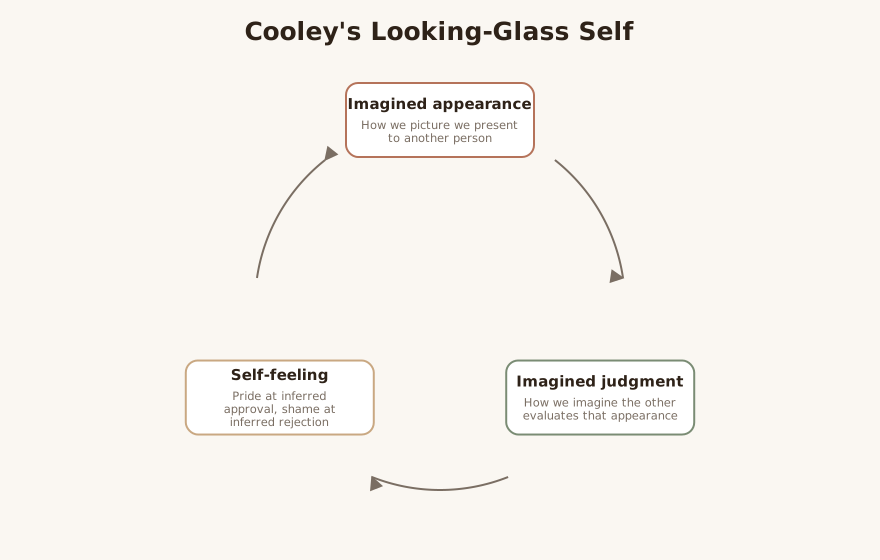
Cooley described the looking-glass self as having three principal elements 25:
- The imagined appearance. We picture how we present to another person — through our clothing, gestures, body, and words — and how that presentation looks from the outside 25.
- The imagined judgment. We imagine how the other person evaluates that appearance, reading social cues such as a smile or a frown to infer approval or disapproval 25.
- The self-feeling. We respond emotionally to the imagined judgment, feeling pride when we infer approval and shame or mortification when we infer rejection 25.
The decisive clinical point is Cooley’s own emphasis that what moves us is not the actual reflection but an imputed sentiment — an imagined, inferred judgment, not a verified one 5. We see ourselves as we believe others see us, which is not necessarily how they actually see us 2. This subjectivity is the entire mechanism: the “mirror” is constructed inside the perceiver’s mind 2.
Two further principles follow. First, the self is multiple and context-dependent: identity shifts across different social groups and relationships rather than being a single fixed object 2. Second, the process is shaped by motivation and pre-existing belief — people actively filter and interpret social signals through what they already believe about themselves, rather than passively absorbing accurate feedback 2.
Interventions & Techniques
The looking-glass self is a theory, so it generates a conceptual frame rather than a manualized protocol LLM. Several clinically useful moves follow directly from its three components, and they map cleanly onto established cognitive and interpersonal interventions LLM.
- Decompose the appraisal. Walk a client through the three steps explicitly: what did you imagine you looked like, what did you imagine they thought, and what did you then feel? Separating imagined appearance from imagined judgment from self-feeling slows an automatic shame cascade into examinable parts LLM. This is congruent with cognitive restructuring of the inference at step two LLM.
- Test the mirror. Because the judgment is imputed rather than known, it can be treated as a hypothesis 5. Behavioral experiments — asking directly, gathering feedback, or predicting versus observing a reaction — target the gap between imagined and actual appraisal LLM.
- Reattribute the self-feeling. Naming pride or shame as a response to an imagined judgment, rather than a verdict on the self, externalizes the feeling enough to work with it LLM.
- Map the primary-group mirrors. Identify whose imagined judgments carry weight, since the theory holds that not all mirrors are equal and influence depends on whether we are motivated to internalize a particular person’s view 23.
LLM-generated illustrative example (not a guideline): A client says, “Everyone at the meeting could tell I was an idiot.” The clinician separates the layers: “So you imagined how you came across (step one), you imagined they judged you as stupid (step two), and then you felt ashamed (step three). Which of those did you actually see, and which did you imagine?” The client realizes no one said anything — the judgment was imputed 5. LLM
Evidence Base
Honesty about maturity matters here. The looking-glass self is an established, foundational theory with enormous explanatory reach, but it is not a treatment with a body of randomized controlled trials behind it LLM. Its evidentiary status is that of a durable conceptual model that has been partially tested, partially supported, and meaningfully criticized 25.
Supportive findings exist. In family relationships, greater self-other agreement in personality between adolescents and parents is associated with healthier self-esteem development, consistent with the idea that accurately read appraisals support a stable self 5. The therapeutic relationship itself has been described as a mirror that reflects identity possibilities back to the client 5. In digital contexts, research has found that higher “like” counts can boost self-esteem, although individuals with a strong sense of purpose were more resilient to low engagement 2.
The criticisms are substantive and clinically relevant 2. People do not passively absorb reflected appraisals; they filter them through existing beliefs and a self-esteem motive, using selective memory to favor feedback that confirms what they already think 2. Critics also note the theory underweights in-group/out-group dynamics — people define themselves partly by diverging from out-groups, not only by mirroring others — a gap that self-categorization and social identity theory address 5. The reliance on imagined perceptions has also been called potentially solipsistic 3. Finally, the mirror operates differently across cultures, with individualist and collectivist societies using social reflection in different ways 2.
Populations & Indications
The framework is broadly applicable across the lifespan but is especially illuminating with populations whose presenting difficulty is anchored in imagined evaluation LLM.
- Adolescents, for whom identity is actively forming through peer and parental mirrors and who increasingly base self-worth on peer approval, including in online spaces 5.
- Adults navigating shifting social and occupational roles, where the multiple-selves principle helps explain context-dependent self-evaluation 2.
- People with social anxiety and fear of negative evaluation, whose distress is organized almost entirely around the imagined judgment at step two LLM.
- People with low self-esteem, in whom the self-esteem motive and selective filtering keep negative reflected appraisals dominant 2.
- Clients with body image and body dysmorphic concerns, where feminist applications of the theory have examined how cultural representations and objectification shape body consciousness and constrain selfhood 3.
- Social media users, for whom quantified appraisals (likes, shares) replace subtle social cues with measurable metrics and can make self-worth contingent on external validation 2.
Problems-for-Work
The theory turns several common presenting problems into workable targets by locating each at a specific point in the three-step process LLM.
- Shame. Cooley placed shame at step three as the self-feeling produced by an imagined negative judgment; reframing shame as a response to an imputed sentiment rather than a fact about the self gives a handhold 5. Application: track shame episodes back to the imagined judgment that triggered them LLM.
- Social anxiety disorder and fear of negative evaluation. These concentrate at step two, the imagined judgment, which the theory frames as a hypothesis rather than known fact 5. Application: design behavioral experiments to compare predicted versus observed reactions LLM.
- Low self-esteem. The self-esteem motive and selective filtering keep negative mirrors salient 2. Application: surface and weigh disconfirming feedback the client has discounted LLM.
- Body dysmorphic concerns and body image. Step one (imagined appearance) is distorted and fused with imagined cultural judgment 3. Application: separate the imagined appearance from the imagined judgment of it LLM.
- Self-consciousness and perfectionism. Chronic, automatic running of the three-step loop with a harsh imagined audience LLM. Application: identify whose judgment is being imagined and whether that mirror deserves the weight it carries 2.
- Identity disturbance. The multiple-selves principle reframes instability as context-sensitivity rather than defect 2. Application: map which relationships evoke which selves LLM.
Contraindications, Cautions & Cultural Humility
Because this is a conceptual frame rather than a procedure, the cautions concern misuse and overreach LLM.
The theory must not be wielded to imply a client’s distress is “all in their head” or simply a thinking error to be corrected LLM. Reflected appraisals are sometimes accurate; people do face real rejection, stigma, and hostile mirrors, and treating every imagined judgment as a distortion is itself a clinical error LLM. The model’s own limitation — that it can become solipsistic by overemphasizing imagined perception — is a reminder to stay anchored in the client’s actual social reality 3.
Cultural humility is essential. The looking-glass self operates differently in individualist and collectivist contexts, and the relevant mirrors, the weight of group judgment, and the meaning of shame all vary across cultures 2. In-group and out-group belonging shapes identity in ways the original theory underweights, so a clinician should attend to collective and identity-group dynamics, not only dyadic reflections 5. With feminist critiques in view, clinicians should also recognize how objectification and cultural representation, not merely individual cognition, can constrain a client’s selfhood — particularly around body image 3.
Treatment-Plan Suggestions & SMART Objectives
| Goal | SMART objective (example) | Mechanism |
|---|---|---|
| Reduce shame intensity | Over 8 weeks, client will log 3 shame episodes/week, identifying the imagined judgment behind each in at least 80% of entries | Locates shame as a step-three self-feeling tied to an imputed judgment 5 |
| Test imagined judgments | Within 6 weeks, client will complete 4 behavioral experiments comparing a predicted social reaction to the observed reaction | Targets the gap between imagined and actual appraisal 5 |
| Improve self-esteem | Over 10 weeks, client will record one piece of disconfirming positive feedback daily, reviewing patterns weekly in session | Counters the self-esteem motive’s selective filtering of negative mirrors 2 |
| Address body image distress | Within 8 weeks, client will distinguish “imagined appearance” from “imagined judgment” in 3 body-focused situations per week | Separates a distorted step one from internalized cultural judgment 3 |
| Map influential mirrors | By session 4, client will identify the 3 people whose imagined judgments most affect mood and rate the weight given to each | Tests whether specific primary-group mirrors warrant their influence 23 |
| Reduce social-evaluative avoidance | Over 6 weeks, client will enter 2 previously avoided social situations weekly and rate predicted vs. actual judgment | Disconfirms catastrophic imagined judgments through exposure LLM |
| Reframe identity instability | Within 5 weeks, client will name which relationships evoke which “self” across 4 contexts | Operationalizes the multiple-selves principle as context-sensitivity 2 |
Common Misconceptions
- “It means others actually shape your self-image.” No — Cooley’s mechanism runs on imagined and imputed judgments, not verified ones; the mirror is built inside the perceiver 52.
- “The reflection is accurate.” People filter reflected appraisals through pre-existing beliefs and a self-esteem motive, so the imagined judgment is often inaccurate in either direction 2.
- “Everyone’s mirrors matter equally.” Influence is conditional on motivation to internalize a particular person’s view, which is why primary-group mirrors dominate 23.
- “It’s a fixed, single self.” The theory explicitly holds that identity is multiple and shifts by social context 2.
- “It’s a complete account.” It underweights in-group/out-group and collective identity dynamics that social identity theory addresses 5.
Training & Certification
There is no certification in the looking-glass self; it is an academic theory taught within sociology and social psychology rather than a credentialed clinical modality LLM. Clinicians typically encounter it as part of the symbolic interactionist tradition alongside Mead’s work and James’s account of the social self 35. Practitioners who want to apply it clinically generally do so through training in the established interventions it complements — cognitive-behavioral, interpersonal, and shame- or compassion-focused approaches — rather than through any looking-glass-self–specific credential LLM.
Key Terms
- Looking-glass self — the self-image formed by imagining one’s appearance to others, imagining their judgment, and feeling pride or shame in response 25.
- Reflected appraisal — the imagined judgment others hold of us, the second step in Cooley’s process 2.
- Imputed sentiment — Cooley’s term for the imagined, inferred judgment that actually moves us to pride or shame 5.
- Self-feeling — the third element: the emotional response (pride or mortification) to the imagined judgment 5.
- Multiple selves — the principle that identity varies across social contexts and groups 2.
- Taking the role of the other — Mead’s complementary concept of imaginatively adopting another’s perspective on oneself 5.
- Primary group — intimate, face-to-face groups (family, close friends) that meet expressive needs and supply the most influential mirrors 3.
Resources & Further Reading
▶ Watch — a video introduction to this concept:
- Cooley, C.H. (1902), Human Nature and the Social Order, Ch. 5 “The Social Self” (Mead Project, Brock University)
- Charles Looking-Glass Self — Simply Psychology
- Cooley and the Looking Glass Self — EBSCO Research Starters
- Looking-glass self — Wikipedia
Reflective / Supervision Questions
- For this client, which of the three steps — imagined appearance, imagined judgment, or self-feeling — carries the most distress, and is my intervention aimed at the right one? LLM
- Am I treating the client’s imagined judgments as distortions to be corrected, or have I checked whether some reflected appraisals are accurate and the social reality genuinely harsh? LLM
- Whose mirror does this client weight most heavily, and have we examined whether that primary-group source deserves its influence? 23
- How might culture, collective identity, or objectification be shaping this client’s mirrors in ways the dyadic model misses? 25
- In what ways am I, as the clinician, functioning as a mirror in this relationship, and what self-possibilities am I reflecting back? 5