
Type & Discipline
A psychoeducational group is a structured, leader-directed group intervention whose defining purpose is to teach — to convey information and skills about a condition, a treatment, or a coping domain — rather than to facilitate open-ended interpersonal process 3. It sits within clinical psychology and counseling as a distinct format of group work, alongside process-oriented group psychotherapy, but differs from it in aim, structure, and the role of the leader 3. Where a process group treats the unfolding relationships among members as the primary therapeutic vehicle, a psychoeducational group treats the deliberate transmission of knowledge and the rehearsal of skills as the engine of change 3. The format is typically time-limited, curriculum-driven, and topic-focused, with the clinician functioning more as an educator and facilitator than as an interpreter of unconscious dynamics 4.
Because its content can be swapped while its structure stays constant, the psychoeducational group is best understood as a transdiagnostic delivery vehicle rather than a treatment for any single disorder LLM. The same architecture — a defined topic, a teaching segment, guided discussion, and skills practice — carries illness education for serious mental illness, stress-management training for anxious adults, relapse-prevention content for substance use, and structured skills modules such as those of dialectical behavior therapy 4. For the practicing clinician, the practical question is therefore less “is this an evidence-based therapy?” and more “what curriculum am I delivering, and for whom?” LLM.
Creators & Lineage
The modern psychoeducational group has more than one root, and naming them honestly matters LLM. One foundational lineage is the family-psychoeducation work of Carol Anderson, Gerard Hogarty, and Douglas Reiss, who in 1980 described a psychoeducational approach to the families of adults with schizophrenia, treating the family not as the cause of illness but as a partner to be informed and supported 1. Their model deliberately broke with earlier, blame-laden family theories: it gave families concrete information about the illness, its course, and its management, and taught practical strategies for living with it, an approach they later elaborated in their 1986 practitioner’s guide 2. This work helped establish the principle that structured education and skills, delivered to those affected by a condition, can be a clinical intervention in its own right 2.
A second major lineage runs through cognitive and behavioral therapy and, within it, the skills-training tradition exemplified by Marsha Linehan’s dialectical behavior therapy 5. Dialectical behavior therapy formalized the splitting of treatment into a process-oriented individual component and a separate, curriculum-driven group that explicitly teaches skills in mindfulness, distress tolerance, emotion regulation, and interpersonal effectiveness 5. That skills group is, in form, a psychoeducational group: it has a syllabus, homework, and a teaching agenda rather than an open agenda set by members’ material in the moment 5. A third lineage comes from health psychology and the illness-self-management movement, which applied structured group education to chronic medical conditions so that patients could learn to manage their own care 4. These threads converge on a shared insight: that teaching, done in a group, is therapeutic 4.
Core Principles
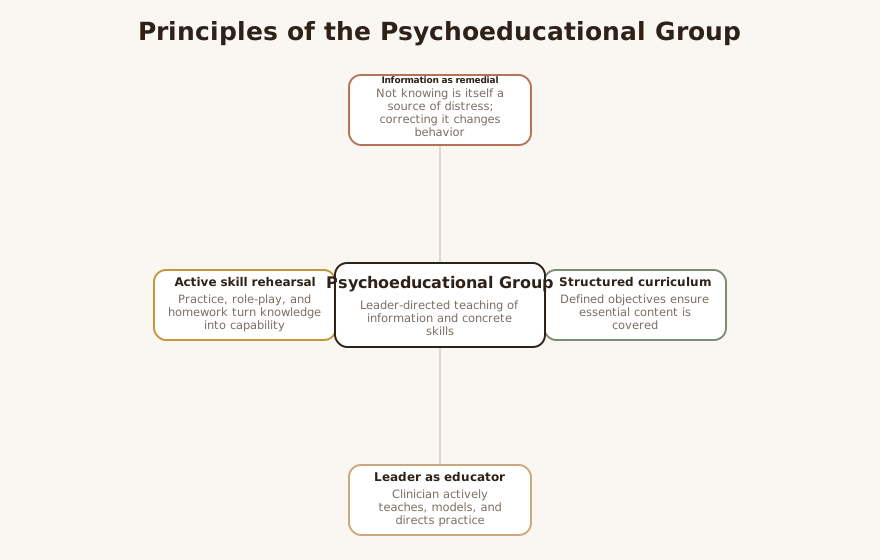
The first organizing principle is that information itself can be remedial — that not knowing how an illness works, what a treatment does, or why symptoms recur is itself a source of distress, helplessness, and poor outcomes, and that correcting it changes behavior 1. In the family-psychoeducation model this is explicit: giving families accurate knowledge about schizophrenia and concrete management strategies reduces the confusion and high-tension responses that worsen course 2. The second principle is structure: the group runs on a defined curriculum with stated objectives, so that the leader can ensure essential content is covered rather than waiting for it to emerge 4.
The third principle is the leader-as-educator stance, in which the clinician actively teaches, models, and directs practice, in contrast to the more receptive, process-tracking stance of the group psychotherapist 3. The fourth is active skill rehearsal: psychoeducational groups generally do not stop at conveying facts but build in practice, role-play, and between-session homework so that knowledge becomes capability, a feature especially pronounced in dialectical behavior therapy’s skills modules 5. A fifth principle is normalization through shared learning — members discover that others face the same condition or struggle, which reduces isolation and stigma even though peer process is not the group’s primary mechanism 4. Finally, the format is collaborative and demystifying by design, positioning members and families as informed partners rather than passive recipients of care 2.
Interventions & Techniques
In practice a psychoeducational group is built from a recurring set of components LLM. A session typically opens with a defined topic and learning objectives, moves through a didactic teaching segment — often supported by handouts, worksheets, slides, or visual aids — and then opens into guided discussion in which members relate the material to their own experience 4. Skills-oriented groups add demonstration and rehearsal: the leader models a skill, members practice it in session through role-play or exercises, and homework extends the practice into daily life, with review at the next meeting 5. Many curricula are organized into modules so that discrete domains, such as emotion regulation or distress tolerance, are taught in sequence 5.
Common content domains include education about a specific diagnosis and its treatment, medication and its role, relapse warning signs and prevention, stress and coping skills, communication and interpersonal skills, and problem-solving 4. In the family-psychoeducation tradition, sessions cover the nature of the illness, realistic expectations, and concrete strategies families can use at home to lower tension and support recovery 2. The leader’s techniques are correspondingly active: structured agenda-setting, clear explanation, eliciting and correcting misconceptions, guided practice, and assignment and review of homework 4.
LLM-generated illustrative example (not a guideline): In a six-session psychoeducational group for adults newly stabilized on a mood-stabilizing medication, week three is “early warning signs.” The facilitator teaches the concept, then hands out a worksheet on which each member maps their own personal prodrome — for one member, sleeping less and overspending; for another, withdrawing and skipping doses. Members compare notes, the facilitator corrects the common belief that “feeling good means I can stop my medication,” and everyone leaves with a written relapse-prevention plan to bring back next week LLM.
Evidence Base
The honest label for the psychoeducational group is established: it is a well-recognized, decades-old format with a real evidence base in several applications, though “psychoeducational group” names a delivery method rather than one validated protocol, so the strength of support varies by curriculum and population LLM. The format’s clinical credibility rests substantially on family psychoeducation in serious mental illness, where the structured, information-and-management approach pioneered by Anderson, Hogarty, and Reiss was developed as a deliberate intervention and described in the peer-reviewed and practitioner literature 1. Their model was elaborated into a full practitioner’s guide precisely because the approach proved clinically useful enough to systematize 2.
Within the skills-training lineage, dialectical behavior therapy — whose group component is psychoeducational in form — is an established, widely adopted treatment, and its skills group is an integral, manualized part of that package 5. This gives the format strong indirect support: where a psychoeducational group delivers an evidence-based curriculum to the population for which it was validated, it inherits that evidence LLM. The defensible caution is the converse: a generic, locally assembled psychoeducational group is only as good as its curriculum and its fit, and should not be presented as carrying the same weight as a manualized, trial-tested program LLM. Two further honest qualifiers apply: information transfer alone does not guarantee behavior change without rehearsal and follow-through, and in many settings psychoeducational groups function as an adjunct to individual treatment and medication rather than as a stand-alone cure LLM.
Populations & Indications
Patients with serious mental illness, including schizophrenia and other psychotic disorders, are a core population, both directly and through their families, who benefit from structured education about the illness and its management 1. People with chronic illness are well served, because the format gives them a way to learn self-management — understanding their condition, adhering to treatment, and coping with limitation — within a supportive group 4. Caregivers and family members are an indicated population in their own right, since the family-psychoeducation tradition treats informing and equipping the family as a clinical intervention that improves outcomes and reduces strain 2.
Adults learning coping skills — for stress, anxiety, low mood, or emotion regulation — are a natural fit for curriculum-based groups that teach and rehearse concrete techniques 4. People with substance use disorders are commonly served through psychoeducational groups covering the nature of addiction, relapse prevention, and coping skills 4. Adolescents are another frequent population, where structured, topic-focused groups can teach skills and information in a developmentally appropriate, less exposing format than open process work 4. Across all of these, the format is especially indicated when the clinical need is to build knowledge and skills efficiently, often in parallel with individual therapy LLM.
Problems-for-Work
For schizophrenia and other psychotic disorders, the psychoeducational group — particularly with families — directly addresses the information deficits and high-tension household responses that worsen course, by teaching the illness and its management 1. For medication adherence, the format targets the misunderstandings and ambivalence that drive non-adherence, correcting beliefs such as “I can stop when I feel better” and building a shared rationale for staying on treatment 4. For illness self-management in chronic conditions, the group teaches the knowledge and routines patients need to manage their own care between appointments 4.
LLM-generated illustrative example (not a guideline): A facilitator running a caregiver group for relatives of adults with a psychotic disorder notices that one daughter responds to her father’s withdrawal by escalating — arguing, pleading, raising her voice. The week’s curriculum on communication and realistic expectations gives her language for what is happening and a concrete alternative: lowering stimulation, simplifying requests, and stepping back. She practices it in a role-play and reports the next week that the evenings have grown calmer LLM.
For emotional dysregulation, skills-based psychoeducational groups teach and rehearse specific regulation and distress-tolerance strategies, as in the dialectical behavior therapy skills curriculum 5. For substance use disorders, groups address relapse prevention and coping-skills deficits through structured content and practice 4. For stress management and general coping-skills deficits, the group teaches techniques and provides a normalizing setting in which members learn that their struggles are shared 4. Caregiver burden is addressed by equipping family members with knowledge and strategies that reduce the helplessness and friction of an unsupported caregiving role 2.
Contraindications, Cautions & Cultural Humility
A psychoeducational group is poorly matched to clients in acute crisis — those who are actively suicidal, floridly psychotic, or severely unstable — for whom a teaching format cannot substitute for individual assessment, containment, and evidence-based stabilization LLM. Clients whose primary need is to explore relational dynamics, attachment, or unresolved trauma may be underserved by a didactic, curriculum-paced group and better suited to process-oriented or individual work LLM. Acutely symptomatic or cognitively overwhelmed members may be unable to absorb teaching content, so pacing, screening, and stabilization matter before placement LLM. The format also carries a characteristic failure mode: information delivered without rehearsal, relevance, or follow-through can leave members “taught but unchanged,” which is why active practice and homework are emphasized 4.
Cultural humility is essential because curricula are not neutral LLM. The illness models, coping strategies, and family roles a group teaches reflect particular assumptions, and explanatory models of mental illness, the meaning of medication, and beliefs about whether family matters are discussed openly vary widely across cultures LLM. The family-psychoeducation tradition is itself instructive here: it advanced by abandoning a blaming stance toward families and adopting a collaborative, respectful one, a posture clinicians should extend to each member’s cultural framework rather than imposing the curriculum’s defaults 2. Language, literacy, and learning style also shape access, so handouts and teaching should be adapted, and the leader should invite members to bring their own understandings into the room rather than treating the syllabus as the only valid account 4.
Treatment-Plan Suggestions & SMART Objectives
| Goal | SMART objective (example) | Mechanism |
|---|---|---|
| Increase illness knowledge in serious mental illness | Within 6 group sessions, client will correctly describe their diagnosis, its course, and 3 management strategies on a brief review | Information transfer correcting illness misconceptions 1 |
| Improve medication adherence | Over 8 weeks, client will report taking medication as prescribed on 6 of 7 days and identify 2 personal reasons for staying on it | Correcting beliefs and building rationale for adherence 4 |
| Build illness self-management in chronic illness | Within 8 weeks, client will complete a written self-management plan and apply it on at least 5 of 7 days weekly | Structured self-care education and skills 4 |
| Reduce caregiver burden | Over 6 sessions, family member will name 3 management strategies and report 1 lowered-tension interaction per week | Family education and concrete management strategies 2 |
| Strengthen emotion-regulation skills | Within a skills module, client will demonstrate 2 emotion-regulation skills in role-play and use 1 in daily life 4 of 7 days | Teaching and rehearsal of regulation skills 5 |
| Develop relapse-prevention/coping skills in substance use | Over 8 weeks, client will identify 3 personal triggers and rehearse a coping response for each in session | Structured relapse-prevention content and practice 4 |
| Improve stress-management coping | For 6 weeks, client will practice 1 taught stress-management technique 5 of 7 days and rate distress before and after | Skills acquisition plus normalization in a group 4 |
Common Misconceptions
A first misconception is that a psychoeducational group is “just a class” with no therapeutic value; in fact, structured education and skills delivered to those affected by a condition were developed and systematized precisely because they change outcomes 1. A second is conflating it with process group psychotherapy: the two differ in aim, structure, and the leader’s role, the psychoeducational group teaching to a curriculum while the process group works the relationships in the room 3. A third is assuming that delivering information is sufficient — that telling people facts will change behavior — when the format’s effectiveness depends heavily on rehearsal, homework, and follow-through 4.
A fourth misconception is that the leader is passive or merely presents slides; in reality the psychoeducational leader is actively directive, teaching, modeling, eliciting, correcting, and guiding practice 4. A fifth, in the family context, is the lingering assumption that involving families means assigning blame; the family-psychoeducation model explicitly rejects this, treating the family as an informed partner to be supported 2. Finally, some clinicians assume the format is generic and interchangeable, when its evidentiary weight tracks the specific curriculum and population — a validated skills module within an established treatment is on very different footing from an ad hoc group LLM.
Training & Certification
There is no single license called “psychoeducational group leader”; these groups are run by licensed mental health professionals — psychologists, counselors, social workers, and others — within their scope of practice, and competence comes from group-facilitation training combined with content expertise in the specific curriculum LLM. General training in group work — facilitation, structure, managing group dynamics, and the distinction between psychoeducational and process formats — provides the foundation, and the practical literature offers facilitators ready-made topics, exercises, and tools to assemble a curriculum 4.
Content-specific training is what gives a particular group its credibility LLM. A clinician delivering a manualized family-psychoeducation program should be grounded in that model’s principles and practitioner guidance 2. A clinician leading a dialectical behavior therapy skills group should be trained in that treatment, since the skills group is an integral, structured component of the larger package rather than a free-standing module 5. The general rule for practitioners is to pair group-leadership competence with validated training in the specific curriculum they intend to deliver, and to represent honestly which of the two they are offering LLM.
Key Terms
Psychoeducational group — a structured, leader-directed group whose primary purpose is to teach information and skills about a condition, treatment, or coping domain rather than to facilitate open interpersonal process 3. Family psychoeducation — a model that informs and equips the families of people with serious mental illness, treating the family as a partner to be supported rather than blamed 2. Curriculum / module — the defined sequence of topics and objectives that organizes a psychoeducational group, as in the discrete skill domains of a dialectical behavior therapy skills group 5. Skills training — active teaching, modeling, rehearsal, and homework aimed at converting knowledge into capability 5. Process group (contrast) — a group format in which the relationships and interactions among members are the primary therapeutic vehicle, distinct in aim and structure from a psychoeducational group 3. Relapse prevention — psychoeducational content that teaches members to recognize early warning signs and apply coping strategies to forestall recurrence 4. Illness self-management — the knowledge and routines that enable patients to manage their own chronic condition between appointments 4.
Resources & Further Reading
▶ Watch — a video introduction to this concept:
- Family Treatment of Adult Schizophrenic Patients: A Psycho-educational Approach (Anderson, Hogarty & Reiss, 1980, Schizophrenia Bulletin)
- Schizophrenia and the Family: A Practitioner’s Guide to Psychoeducation and Management (Anderson, Reiss & Hogarty, 1986, Guilford Press)
- Psychoeducational Groups — TherapyRoute
- Psychoeducation Groups: Topics, Examples & Tools — PositivePsychology.com
- What Is Dialectical Behavior Therapy (DBT)? — Simply Psychology
Reflective / Supervision Questions
- For this client, is the clinical need primarily to build knowledge and skills — which a psychoeducational group serves well — or to explore relational and emotional process, which it does not LLM?
- Am I delivering a validated curriculum to the population it was designed for, or have I assembled a generic group whose evidentiary weight I should represent more modestly LLM?
- Where in my group does information actually become behavior change — am I building in enough rehearsal, homework, and follow-through, or stopping at teaching LLM?
- When I involve families, am I genuinely treating them as informed partners, or has some residual blaming stance crept into how I frame their role LLM?
- Whose explanatory model of illness, medication, and family does my curriculum assume, and am I inviting members’ own cultural understandings into the room rather than overriding them LLM?
- For a member who is acutely symptomatic or in crisis, is this teaching format appropriate right now, or do they first need stabilization and individual attention LLM?