
Type & Discipline
Multifamily group / family psychoeducation is a structured, manualized modality that sits at the intersection of community psychiatry, family intervention, and rehabilitation for serious mental illness 2. It is best understood not as a single technique but as a family of treatment models in which the relatives of a person with schizophrenia or another serious illness are active participants in, and a focus of, the intervention 3. In the multifamily group (MFG) variant, several families — typically five to eight, each with an affected member — meet together over an extended period, while the single-family variant works with one family at a time 2. The shared aim across formats is patient-centered (reduced relapse, fewer hospitalizations, better functioning) and family-centered (reduced caregiver distress, improved patient-family relations, lower burden) 3.
The modality is delivered most often within community mental health, early-psychosis, and assertive-community-treatment settings rather than private outpatient practice, because it presupposes coordination with prescribers, case managers, and crisis services 2. This makes it a genuinely systemic, team-based intervention — closer in spirit to a program than a 50-minute therapy hour LLM.
Creators & Lineage
The modern lineage begins with Carol (C.M.) Anderson, who in 1980 popularized a psychoeducational approach centered on educating relatives about the symptoms of schizophrenia and on stress management 6. Anderson’s insight was a deliberate break from earlier family-systems theories that implicitly blamed families for causing psychosis; the new stance held that families do not cause schizophrenia but can substantially shape its course 3.
William McFarlane then refined and empirically validated the multifamily group format beginning in 1983, integrating psychoeducation with behavioral family therapy and reviving a multiple-family concept that had circulated decades earlier 2. McFarlane’s program of work — selected clinical trials spanning four decades, international and ethnic adaptations, and studies of the mechanisms of efficacy — is the empirical spine of the modality 1.
The intellectual roots draw on three streams: expressed emotion (EE) research, which identified relatives’ criticism, hostility, and emotional overinvolvement as potent relapse predictors; psychoeducation as a broad evidence-based practice; and community mental health / family-systems traditions that frame the family as an ally in recovery 16. Family members in this model are recognized as people who often manage medication monitoring, case management, and housing coordination — that is, as part of the care team rather than bystanders 6.
Core Principles
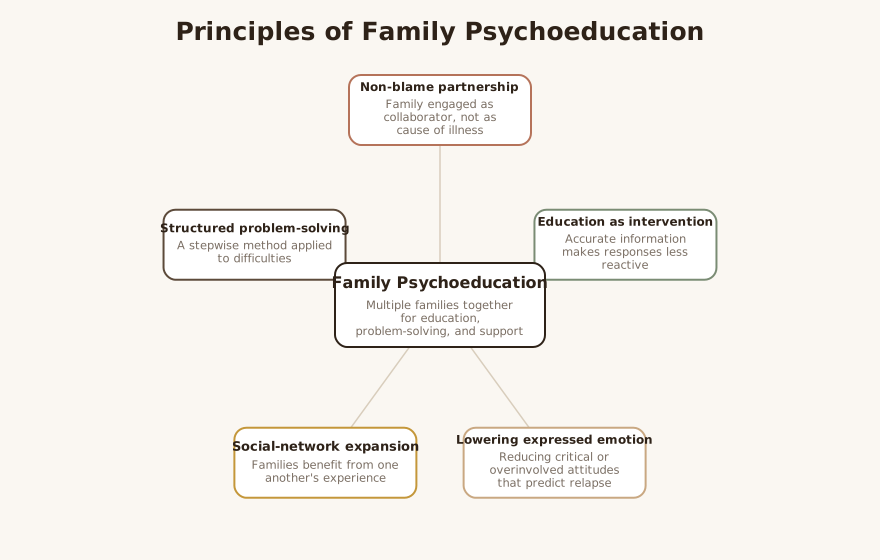
The first principle is non-blame partnership: the family is engaged as a collaborator, explicitly relieved of the implication that they caused the illness 3. The second is education as intervention — providing concrete, accurate information about the illness, its course, and its management to both patient and relatives so that responses to symptoms become less reactive and better informed 36.
The third principle concerns expressed emotion. Because high EE — relatives’ critical, hostile, or emotionally overinvolved attitudes — is an especially potent predictor of symptom relapse in people living with or in frequent contact with family, the original goal was to lower EE as a means of relapse prevention 1. Later variations went beyond EE alone to target social and role functioning and family well-being directly 1.
The fourth principle is social-network expansion. The multifamily format rests on the premise that increasing the size and support of a family’s social network — by letting families benefit from one another’s experience in solving problems — improves illness course 2. The fifth is structured problem-solving, a stepwise method applied to real difficulties families bring to the group 23. Together these principles convert generalized worry into shared, workable strategy LLM.
Interventions & Techniques
McFarlane’s MFG model proceeds through four sequential stages 2:
- Joining. Two clinicians meet separately with each patient and family across several sessions to build rapport and alliance before group work begins 2.
- Educational workshop. A psychoeducational workshop teaches families about the illness — its biology, symptoms, course, and treatment — in a structured, day-long or multi-session format 2.
- Relapse-prevention / problem-solving groups. The multifamily group convenes regularly, with patients and relatives together, applying a formal problem-solving method to current challenges 2.
- Social and vocational rehabilitation. The group’s later focus shifts toward role functioning, employment, and reintegration, continuing in the multifamily format 2.
Concrete techniques drawn from the broader family-psychoeducation toolkit include education about the disorder, assistance with crisis intervention, problem-solving training, emotional support, and communication-skills training 3. A typical McFarlane course is intensive: two clinicians, five to eight families, and roughly 36 sessions delivered over 24 months (about 24 sessions in year one and 12 in year two) 2.
LLM-generated illustrative example (not a guideline): In a problem-solving group, a mother raises that her son stops his medication whenever he “feels fine.” Rather than the clinician lecturing, another parent in the group describes the same pattern and what helped — a low-key weekly check-in tied to an activity the son values. The clinician structures the discussion into the formal steps (define the problem, brainstorm options, weigh them, choose, plan), and the family leaves with a concrete, peer-validated plan LLM.
Evidence Base
The evidence base here is established — among the strongest of any family intervention in serious mental illness. APA Division 12 (the Society of Clinical Psychology) assigns family psychoeducation for schizophrenia a status of Strong Research Support 3. McFarlane’s review reports that meta-analyses place relapse-rate reduction at roughly 50-60% over treatment as usual 1. The American Psychological Association recognized multifamily group treatment as a best practice for serious mental illness 2, and SAMHSA has packaged family psychoeducation as a formal evidence-based practice with an implementation KIT 4. The broader psychoeducation literature — more than 30 studies — indicates improved family well-being, lower relapse rates, and better recovery outcomes 6.
Honesty requires several caveats. First, much of the foundational research drew on European-American samples, though successful adaptations exist — for example, Chien and Wong (2007) adapted MFG for Chinese patients in Hong Kong with comparable outcomes, incorporating collectivist values 2. Second, the McDonnell study (2006) found MFG participants had statistically lower odds of state psychiatric hospital admission at one-year follow-up versus standard care, illustrating durability beyond the active phase 2. Third, for first-episode psychosis the literature is still developing: one randomized trial enrolled 40 individuals aged 18-35 within five years of onset, in Tucson, Arizona, comparing multifamily group with and without cognitive remediation, using weekly PANSS-based relapse criteria — but that report describes design and hypotheses rather than established outcomes 5. Finally, brief psychoeducation formats (under 10 weeks) improve medication compliance and possibly social functioning, but long-term relapse reduction from brief formats specifically still warrants further investigation 6.
Populations & Indications
The clearest indication is schizophrenia and the psychotic disorders, the population for which the modality was developed and most rigorously tested 13. It extends to people with serious mental illness broadly, and the model has been applied and discussed across bipolar disorder and recurrent major depressive disorder, where relapse prevention and family climate are similarly relevant LLM. Caregivers and family members are themselves a target population — the intervention aims explicitly to reduce their distress and burden 3.
Indications are strongest where the patient is in frequent contact with family, where high expressed emotion or family conflict is present, and where relapse and rehospitalization have been recurrent 1. First-episode psychosis is a clinically logical, increasingly studied indication, given the value of engaging families early 5. By analogy and shared mechanism, families of people with chronic illness more generally may benefit from the structure, though the strongest evidence remains in psychosis LLM.
Problems-for-Work
- Relapse prevention. The signature application: structured education plus problem-solving aimed at reducing the relapse that family stress and disorganized responses can precipitate 12.
LLM-generated illustrative example (not a guideline): A group co-develops an early-warning-sign plan — sleep disruption, social withdrawal, suspiciousness — so the family contacts the team before a full relapse rather than after LLM.
- High expressed emotion in families. Lowering criticism, hostility, and overinvolvement through education and modeled communication 1.
- Caregiver burden. Mutual support across families and skills training reduce the distress of managing a relative’s illness 3.
- Treatment nonadherence. Education and shared problem-solving address the “I feel fine, so I’ll stop” pattern of medication discontinuation 6.
- Social isolation. The multifamily format expands the social network of both patients and relatives, countering the isolation common in serious mental illness 2.
- Psychotic and mood-disorder management. Providing accurate illness models helps families respond to symptoms with less fear and more strategy 36.
Contraindications, Cautions & Cultural Humility
There are few absolute contraindications, but real cautions. The modality presupposes a coordinated care system (prescriber, crisis services, case management); attempting MFG without that infrastructure risks promising containment the team cannot deliver 2LLM. Families with active abuse, severe interpersonal violence, or relationships in which contact is itself harmful are poor candidates for a group that assumes engagement is beneficial LLM. Confidentiality and patient autonomy must be navigated carefully when relatives are brought into clinical conversations LLM.
Cultural humility is essential. The foundational evidence rested heavily on European-American samples, and uncritical transfer is inappropriate 2. Successful adaptations — such as the Hong Kong Chinese adaptation that incorporated collectivist values and family interdependence — show that the model can travel, but only when its assumptions about family roles, disclosure, and “overinvolvement” are examined against the family’s own cultural frame 2. The expressed-emotion construct in particular must be applied cautiously: what reads as “overinvolvement” in one cultural context may be normative, valued caregiving in another LLM.
Treatment-Plan Suggestions & SMART Objectives
| Goal | SMART objective (example) | Mechanism |
|---|---|---|
| Reduce relapse risk | Family will co-create and rehearse a written early-warning-sign and crisis plan within 8 weeks, reviewed monthly | Structured problem-solving; earlier care-team contact 2 |
| Lower expressed emotion | Primary caregiver will reduce frequency of critical comments (clinician-rated) across 12 weeks of group attendance | Education plus modeled communication reduces high EE 1 |
| Decrease caregiver burden | Caregiver self-reported burden score will drop by a clinically meaningful margin over 6 months of multifamily group | Mutual support and skills training 3 |
| Improve treatment adherence | Patient and family will implement a sustainable medication-support routine within 4 weeks | Shared problem-solving targeting nonadherence patterns 6 |
| Reduce social isolation | Patient will add at least one new sustained social or peer contact over the 24-month course | Social-network expansion via multifamily format 2 |
| Build illness understanding | Family will demonstrate accurate knowledge of the illness and its course after the educational workshop | Education as intervention 36 |
| Improve role functioning | Patient will set and pursue one vocational or educational goal during the rehabilitation phase | Stage-4 social/vocational rehabilitation 2 |
Common Misconceptions
“It blames the family.” The opposite is the point: the modality was a deliberate move away from family-blaming theories and engages relatives as non-culpable partners in recovery 3. “It’s just handing out information.” Education is necessary but not sufficient; the active ingredients include structured problem-solving, social-network expansion, communication training, and crisis support across an extended course 23. “Expressed emotion means the family is the problem.” EE is a predictor of relapse risk to be worked with, not a verdict on the family, and the field has long moved beyond EE alone toward functioning and well-being 1. “It’s a brief intervention.” The intensive McFarlane model runs about two years; brief formats exist and help adherence but have a thinner long-term relapse evidence base 26.
Training & Certification
There is no single licensure for this modality; it is delivered by trained mental-health clinicians, typically in pairs of two co-facilitators per multifamily group 2. Implementation has been supported at a system level — SAMHSA’s Evidence-Based Practices KIT provides materials to help agencies adopt family psychoeducation with fidelity 4. In practice, clinicians learn the model through manualized training in McFarlane’s staged structure and the problem-solving method, ideally with supervision during early groups 2LLM. Because the intervention is program-like, organizational readiness — leadership buy-in, care-team coordination, and case-flow to fill groups — is as important to “training” as individual clinician skill LLM.
Key Terms
- Multifamily group (MFG): Format in which 5-8 families with affected members meet together for education and problem-solving 2.
- Expressed emotion (EE): Relatives’ criticism, hostility, and emotional overinvolvement; a potent predictor of relapse 1.
- Joining: The initial alliance-building stage with each family before group work 2.
- Educational workshop: Structured psychoeducation session(s) teaching families about the illness 2.
- Problem-solving group: Recurring multifamily sessions applying a formal stepwise method to real challenges 2.
- Family psychoeducation (FP): Umbrella term for models in which relatives are participants in and a focus of treatment 3.
- Social-network expansion: The mechanism by which connecting families improves illness course 2.
Resources & Further Reading
▶ Watch — a video introduction to this concept:
- McFarlane WR (2016). Family Interventions for Schizophrenia and the Psychoses: A Review. Family Process.
- McFarlane WR. Multifamily Group Treatment for Schizophrenia (PMC3397389).
- APA Division 12 (Society of Clinical Psychology): Family Psychoeducation for Schizophrenia.
- SAMHSA: Family Psychoeducation Evidence-Based Practices (EBP) KIT.
- Multifamily Group Psychoeducation and Cognitive Remediation for First-Episode Psychosis: An RCT (PMC3030530).
- Psychoeducation — Wikipedia.
Reflective / Supervision Questions
- In a family I currently treat, am I implicitly attributing the patient’s course to the family, or genuinely engaging them as partners? LLM
- When I label a relative “overinvolved,” whose cultural norm am I measuring against — and have I checked it against the family’s own frame? LLM
- Does my setting actually have the care-team coordination (prescriber, crisis, case management) that a multifamily group presupposes, or would I be promising containment I cannot deliver? LLM
- Where, in my caseload, is recurrent relapse being driven by family climate or treatment nonadherence that an educational-plus-problem-solving structure could address? LLM
- Am I defaulting to brief psychoeducation because it is convenient, when the relapse-prevention evidence is strongest for the longer, structured course? LLM