
Type & Discipline
Family Psychoeducation (FPE) is a structured, evidence-based family intervention used primarily in the treatment of serious mental illness (SMI) 1. It sits at the intersection of psychiatry, family intervention, and psychosocial rehabilitation, and is delivered alongside—not in place of—pharmacotherapy and standard psychiatric care 1. The core aim is to engage, inform, and educate family members so they can help the person with SMI manage the illness, while also reducing the family’s own distress 3. FPE refers broadly to several related treatment models in which family members participate in and become a focus of the intervention, and it can be conducted with a single family or in multiple-family groups 1. It is explicitly not built on the assumption that families cause the illness; rather, it recognizes that families significantly influence a relative’s recovery and functioning 1.
A defining feature in much of the literature is the multiple-family group (MFG) format, in which several families meet together over an extended period—typically five to six families convening on a biweekly basis for at least six months 5. This group format is more than logistics; the evidence suggests it confers independent therapeutic effects beyond education alone 4. LLM
Creators & Lineage
FPE emerged in the 1980s from converging research streams rather than a single founder LLM. Carol Anderson and Gerard Hogarty at the University of Pittsburgh developed an influential psychoeducational model combining family education, social skills training, and maintenance medication 1. Ian Falloon and colleagues developed a behavioral family management approach demonstrating reduced morbidity in schizophrenia over two-year follow-up 1. William McFarlane subsequently formalized and tested the psychoeducational multiple-family group model, which became one of the most rigorously studied variants 4.
The lineage draws on family systems theory, cognitive behavioral therapy, behavioral family therapy, and—critically—expressed emotion (EE) research LLM. EE research established that high levels of critical, hostile, or emotionally overinvolved family responses predicted relapse, providing the empirical rationale for interventions that improve family communication and lower household tension LLM. FPE operationalized these findings into a teachable, replicable clinical package LLM. Over time the field accumulated a substantial trial record, with McFarlane and colleagues’ 2003 review noting more than thirty randomized controlled trials of family psychoeducation in schizophrenia 6.
Core Principles
FPE rests on several integrated principles. First, families are treated as partners and allies in care rather than as pathogenic agents, and the working alliance with the family is foundational 1. Second, accurate, jargon-free education about the illness—its biology, course, treatment, and warning signs—reduces fear and unhelpful attributions 1. Third, the intervention is sustained: effective programs typically run at least nine months, and some extend from nine months to several years, reflecting the chronic, relapsing nature of SMI 15.
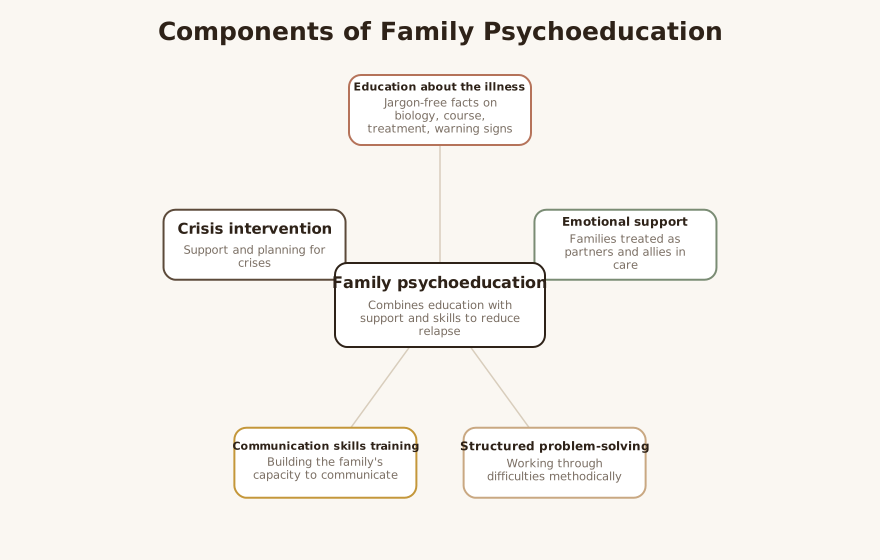
Beyond information transfer, FPE deliberately builds family capacity through emotional support, structured problem-solving, communication skills training, and crisis intervention 1. The model also attends to the family’s own well-being, aiming to reduce the burden of mental illness and improve patient–family relations 1. A strengths-and-resiliency orientation runs throughout, with the program identifying and reinforcing what families already do well rather than focusing only on deficits 1. In the multiple-family format, an additional principle is at work: social network enhancement, in which families learn from and support one another, expanding a frequently constricted support system 6.
Interventions & Techniques
The clinical components of FPE are well specified and consistent across effective programs 6. They include empathic engagement (often called a “joining” phase), education about the illness, ongoing support, access to clinical resources during crises, social network enhancement, and explicit training in problem-solving and communication 6. APA Division 12 summarizes the package as education about the illness, assistance with crisis intervention, problem-solving training, emotional support, and communication skills training 1.
Operationally, single-family FPE delivers these elements in sessions with one family unit, while the MFG format convenes several families together 1. The NCEBP description specifies multiple-family groups of roughly five to six families meeting biweekly for a minimum of six months, with full courses lasting nine months to as long as five years and tailored to the specific diagnosis 5. Coordinated treatment planning, medication management support, and crisis planning are woven in, with the clinician functioning partly as a consultant who links the family to the broader treatment system 5.
LLM-generated illustrative example (not a guideline): In a multiple-family group for early-episode psychosis, the facilitator opens with a brief “going-around” check-in, then moves to a structured problem-solving exercise. One parent raises that their adult child stops taking medication when feeling well. Rather than the clinician answering, the group brainstorms options—a shared pill organizer, a non-confrontational check-in script, an agreed early-warning sign to watch for—while another family shares what worked for them. The clinician scaffolds the process and reinforces communication that is specific and low in criticism. LLM
Evidence Base
FPE for schizophrenia carries a “Strong Research Support” designation under APA Division 12’s empirically supported treatment criteria 1. The randomized trial record is substantial: more than thirty RCTs in schizophrenia, with meta-analytic estimates placing relapse reduction in the range of roughly 50–60% relative to treatment as usual 6. McFarlane and colleagues’ four-year controlled study found four-year relapse rates of 50% for psychoeducational multiple-family groups versus 78% for single-family psychoeducation, indicating an enhanced, durable effect for the group format 4. Two-year cumulative relapse rates likewise favored the multiple-family modality (16%) over the single-family modality (27%), with both far below the 65–80% relapse expected for patients on individual treatment and medication alone 6. Beyond relapse, documented outcomes include fewer hospitalizations, improved family well-being, greater vocational participation, reduced care costs, and reduced psychiatric symptoms 5.
A formal evidence assessment in Psychiatric Services graded psychoeducation studies against high, moderate, and low benchmarks and concluded that psychoeducation—especially group and family interventions—is sufficiently supported to warrant inclusion among covered services 2. Evidence is strongest and most mature in schizophrenia 1. It is growing for bipolar disorder, and programs for parents of children and youth with mood disorders show more positive than null results, though that research remains limited 3. Evidence for application to other conditions is comparatively thin and emerging LLM.
A central honesty point: despite this strong evidence base, FPE has seen persistently minimal real-world adoption across health systems—a paradox the field has flagged repeatedly 3. Barriers span financing structures, program capacity, provider engagement, family participation, and consumer acceptance, and the field has called for empirical evaluation of implementation strategies, not just outcomes 3.
Populations & Indications
The best-established indication is schizophrenia, where FPE is recommended as an adjunct to medication and routine care, particularly following hospitalization or acute episodes 15. The intended population is broad: families and caregivers who are in contact with a relative living with mental illness, with particular benefit for those supporting someone who has been hospitalized 5. Indications extend to bipolar disorder and schizoaffective disorder, and the NCEBP description lists schizophrenia, bipolar disorder, depression, and borderline personality disorder among diagnoses for which family psychoeducation has been applied 5.
Clinically, the strength of evidence varies by population, and this should shape expectations LLM. FPE is established for schizophrenia, promising for bipolar disorder, and supported by more limited or emerging evidence for mood disorders in youth and for conditions such as major depressive disorder, schizoaffective disorder, obsessive-compulsive disorder, and eating disorders 13. Where the evidence is thinner, FPE may still be reasonable as a structured family-support framework, but clinicians should be transparent that the relapse-prevention data are concentrated in schizophrenia LLM.
Problems-for-Work
FPE targets several interlocking clinical problems. Relapse and rehospitalization are the headline outcomes, with the family equipped to recognize prodromal signs early and respond before escalation 4. Treatment nonadherence is addressed through education that demystifies medication and through family support for adherence routines 1. Expressed emotion—high criticism or emotional overinvolvement—is reduced via communication-skills work, lowering a known relapse driver LLM.
LLM-generated illustrative example (not a guideline): A clinician working with the family of a young adult with bipolar I notices the household frequently escalates into criticism during depressive episodes. Using FPE communication training, the family rehearses “I-statements” and a shared plan for what to do at the first sign of a sleep-loss prodrome. Over several months the parents report fewer conflicts and faster contact with the prescriber when warning signs appear. LLM
Caregiver burden and family conflict are direct targets: FPE aims to reduce the distress and burden of living with a relative’s illness and to improve patient–family relations 1. Functional and vocational decline is increasingly measured as an outcome, with participation in work and social activities improving for some consumers 5. The multiple-family format additionally addresses social isolation by connecting families who would otherwise cope alone 6.
Contraindications, Cautions & Cultural Humility
FPE is generally low-risk, but it is not appropriate in every configuration LLM. It presupposes a willing, available family or caregiver; where no such network exists, or where family contact is contraindicated by abuse, ongoing safety risk, or the patient’s clear and considered refusal of family involvement, FPE may be inappropriate or require substantial adaptation LLM. Engagement should respect the patient’s autonomy and consent regarding what information is shared with relatives LLM.
A foundational caution—built into the model itself—is that FPE must never be delivered as if the family caused the illness; the explicit non-blaming stance is both an ethical and a clinical requirement 1. Cultural humility is essential: the Psychiatric Services assessment specifically called for future research and practice to address individuals and families from diverse racial and ethnic backgrounds, signaling that the evidence base was generated in populations that may not represent every family a clinician serves 2. Concepts of family role, illness attribution, stigma, and appropriate emotional expression vary across cultures, and a high-EE label in one context may reflect normative caregiving in another LLM. Clinicians should adapt psychoeducational content, language, and communication norms to the family’s cultural frame rather than imposing a single template LLM.
Treatment-Plan Suggestions & SMART Objectives
| Goal | SMART objective (example) | Mechanism |
|---|---|---|
| Reduce relapse risk | Family will identify and document at least 3 individualized early-warning signs and a written response plan within 4 sessions | Early detection and crisis planning 1 |
| Improve illness knowledge | Caregiver will accurately describe the illness, its course, and the rationale for medication on a teach-back review by session 6 | Psychoeducation reduces misattribution 1 |
| Lower expressed emotion | Family will reduce critical/hostile exchanges, demonstrating 3 “I-statement” communications per session by week 12 | Communication skills training 6 |
| Support treatment adherence | Family will implement one agreed adherence-support routine and report on it weekly across 8 weeks | Family-supported adherence 1 |
| Reduce caregiver burden | Primary caregiver will report a measurable decrease in self-rated burden over a 6-month MFG course | Support, normalization, problem-solving 5 |
| Strengthen problem-solving | Family will complete the structured 6-step problem-solving method on 2 real concerns per month for 3 months | Skills generalization 6 |
| Expand support network | Family will attend at least 80% of biweekly multiple-family group sessions over 6 months | Social network enhancement 4 |
| Improve functioning | Consumer will resume one vocational, educational, or social activity within the treatment period | Reduced relapse frees capacity for recovery 5 |
Common Misconceptions
“FPE blames the family.” This inverts the model. FPE explicitly rejects the premise that families cause schizophrenia and instead enlists them as partners in recovery 1. “It’s just an information handout.” Education is necessary but not sufficient; the active ingredients also include problem-solving, communication training, crisis support, and—in the group format—social network enhancement 6. The four-year trial data show that multiple-family groups outperform single-family psychoeducation, implying the group process itself contributes beyond information 4.
“It’s a brief intervention.” Effective FPE is sustained, typically nine months or longer, distinguishing full FPE from brief family education 15. “If the evidence is strong, it must be widely used.” In reality, robust trial support coexists with sparse real-world implementation, a recognized paradox in the field 3. “The relapse benefits generalize to every diagnosis.” The strongest data are in schizophrenia, with bipolar disorder promising and other applications more limited 13.
Training & Certification
There is no single universal license required to practice FPE; it is delivered by clinicians across psychiatry, psychology, social work, nursing, and counseling who work with families LLM. Competence centers on mastering the model’s components—engagement/joining, structured education, problem-solving, communication training, and crisis planning—and, for the group format, on facilitating multiple-family groups 16. Foundational clinical resources include McFarlane’s text on multifamily groups in the treatment of severe psychiatric disorders and Falloon and colleagues’ family-management manual, both cited in the Division 12 resource list 1. Implementation-oriented toolkits and fidelity guidance exist through evidence-based-practice centers, reflecting the field’s emphasis on faithful replication of the tested model 5. Given the documented evidence-to-practice gap, organizational support and structured implementation are often as important as individual clinician training 3. LLM
Key Terms
- Family Psychoeducation (FPE): A family-focused, education-plus-skills intervention adjunctive to medication for serious mental illness 1.
- Multiple-Family Group (MFG): A format in which several families (often 5–6) meet together, typically biweekly, for at least six months 5.
- Expressed Emotion (EE): Family attitudes—criticism, hostility, emotional overinvolvement—empirically linked to relapse risk LLM.
- Relapse: Symptomatic recurrence; the primary outcome in most FPE trials 4.
- Joining/Engagement: The alliance-building phase that precedes formal education 6.
- Social network enhancement: The mutual-support mechanism distinctive to the multiple-family format 6.
Resources & Further Reading
▶ Watch — a video introduction to this concept:
- Family Psychoeducation for Schizophrenia — Society of Clinical Psychology (APA Division 12)
- Consumer and Family Psychoeducation: Assessing the Evidence — Psychiatric Services
- Recent developments in family psychoeducation as an evidence-based practice — PubMed (Lucksted et al., 2012)
- Psychoeducational Multiple Family Groups: Four-Year Relapse Outcome in Schizophrenia — Family Process (McFarlane, 1995)
- Family Psychoeducation — National Center for Evidence-Based Practice Center
- Family Psychoeducation and Schizophrenia: A Review of the Literature — JMFT (McFarlane et al., 2003)
Reflective / Supervision Questions
- When you assess a patient with SMI, do you routinely map the family/caregiver network and their level of expressed emotion—and if not, what stops you? LLM
- How do you ensure your family work stays non-blaming when a family’s behavior appears to be worsening the clinical picture? LLM
- Given that the strongest evidence is in schizophrenia, how do you communicate the more limited evidence base when offering FPE-style work for other diagnoses? LLM
- What cultural assumptions about family roles, emotional expression, and illness might you be importing into your psychoeducation, and how would you check them with this family? 2
- If full nine-month FPE is impractical in your setting, which active components (engagement, crisis planning, communication training) can you preserve, and what do you lose by shortening it? 1
- What organizational or reimbursement barriers keep you from delivering sustained family work, and what is one concrete change that would lower them? 3