
Type & Discipline
Pragmatics of Human Communication is a theory rather than a packaged treatment protocol; its home discipline is communication theory as applied to clinical and interpersonal systems 1. The work belongs to the interactional and cybernetic tradition associated with the Palo Alto group, and the broader framework is often called the “interactional view” of communication 3. Its defining move is to study the pragmatics of communication—the behavioral effects of messages on the people exchanging them—rather than the syntax (formal structure) or semantics (meaning) of language 2. For clinicians, this reframes the unit of analysis: the relevant data are not a single patient’s intrapsychic contents but the observable, repeating sequences of behavior between people 2.
Because it is a meta-theory of interaction, it functions less as a standalone therapy and more as a lens that organizes how a clinician understands relational distress, then informs technique within systemic, strategic, and couple work LLM.
Creators & Lineage
The book Pragmatics of Human Communication: A Study of Interactional Patterns, Pathologies and Paradoxes (1967) was authored by Paul Watzlawick, Janet Beavin (later Janet Beavin Bavelas), and Don D. Jackson 1. Paul Watzlawick (1921–2007) was an Austrian-American theorist with a doctorate in philosophy and philology and training in analytical psychology at the Carl Jung Institute in Zürich; in 1960 Don Jackson brought him to the Mental Research Institute (MRI) in Palo Alto, California 5. Watzlawick became one of the three founding members of the Brief Therapy Center at MRI and later taught psychiatry at Stanford 5.
The intellectual lineage runs through Gregory Bateson, whose work on the “report” and “command” aspects of messages, on schismogenesis, and on the double bind the authors explicitly build upon 2. Collaborators in the same Palo Alto circle included John Weakland and Jay Haley, situating this theory within the emergence of family therapy, strategic/brief therapy, cybernetics, and general systems theory 5. Watzlawick’s later work extended into radical constructivism and into the influential 1974 volume Change: Principles of Problem Formation and Problem Resolution 5.
Core Principles
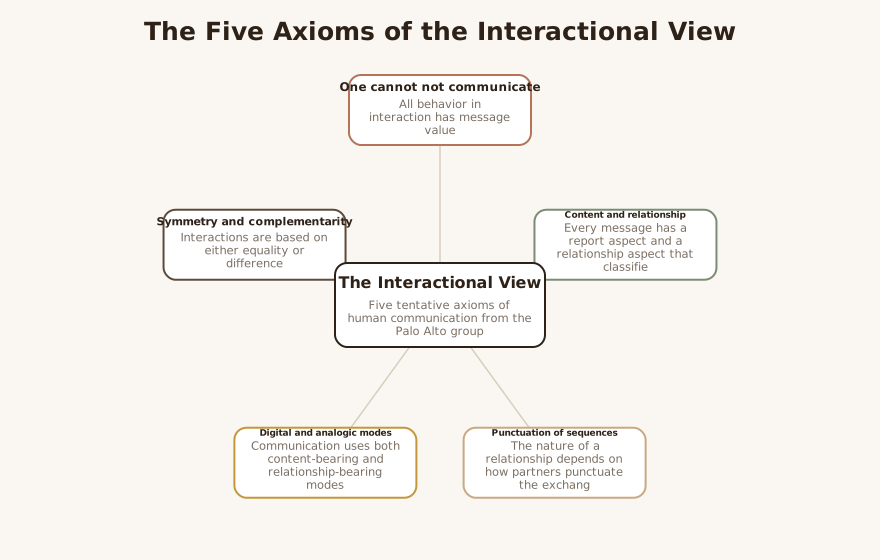
The theory is organized around five “tentative axioms” of communication 2.
Axiom 1 — One cannot not communicate. Behavior has no opposite; there is no such thing as nonbehavior, so in any interactional situation all behavior has message value 2. Activity or inactivity, words or silence—all influence others, who cannot not respond and are therefore themselves communicating 2. Communication need not be intentional, conscious, or successful to count 2. Put plainly: “one cannot not communicate” 4.
Axiom 2 — Every communication has a content and a relationship aspect, such that the latter classifies the former. Following Bateson, these are the “report” and “command” aspects of a message 2. The content conveys information; the relationship aspect specifies how that information is to be taken and thereby defines the relationship—making it communication about communication, or metacommunication 2. How a message is received is shaped by the relationship, not only by its factual content 4.
Axiom 3 — The nature of a relationship depends on the punctuation of the communicational sequences. Partners in an ongoing exchange organize the flow of events so that one or the other appears to have initiative, dominance, or dependency 2. The classic image is the wife who nags “because” the husband withdraws, and the husband who withdraws “because” the wife nags—each punctuating the loop as beginning with the other’s behavior 2. Communication thus operates as cause and effect in continuous cycles that can escalate 4.
Axiom 4 — Human beings communicate both digitally and analogically. Digital language (words) has a complex, powerful logical syntax but lacks adequate semantics for relationship; analogic language (nonverbal: posture, tone, gesture, the relationship itself) has rich semantics but no precise syntax to define relationships unambiguously 2. Content is typically conveyed digitally; the relationship aspect is predominantly analogic 2.
Axiom 5 — Interactional exchanges are either symmetrical or complementary. Symmetrical relationships are based on equality and the minimization of difference, with partners mirroring each other’s behavior; complementary relationships are based on difference, with one partner in the “one-up” (superior, primary) and the other in the “one-down” (secondary) position 2. These positions are interlocking—dissimilar but fitted behaviors evoke each other—and neither is inherently good or bad, strong or weak 2.
Interventions & Techniques
The theory itself does not prescribe a manualized protocol, but it directs attention and generates moves that clinicians use within systemic and strategic treatment LLM.
- Metacommunication. Helping partners talk explicitly about how they are communicating—the relationship-level message—rather than relitigating content, because relational definitions, not facts, often drive conflict 2.
- Re-punctuating the sequence. Because no participant has the privileged “real” starting point, the clinician can challenge each party’s “it started when you…” account and surface the circular loop they jointly maintain 2.
- Reframing. Watzlawick’s later work formalized changing the conceptual frame around a problem so the same facts take on different meaning; this grows directly from the relationship-classifies-content principle 5.
- Tracking symmetrical vs. complementary patterns. Identifying runaway symmetrical escalation (competition that feeds itself) or rigid complementary lock-in (one chronically one-up, one chronically one-down) to target the pattern rather than the persons 2.
- Attending to analogic channels. Reading the relationship message carried by tone, timing, and nonverbal behavior, especially where it contradicts the digital content 2.
LLM-generated illustrative example (not a guideline): A couple argues about whose turn it is to do dishes. The therapist notes the content (chores) is a stand-in for a relationship-level question—“Do you respect my time?”—and shifts the session to that metacommunicative level, where the actual rupture lives LLM.
Evidence Base
Maturity: established as a foundational theory; the clinical-outcome evidence is a separate and more variable matter LLM. Pragmatics of Human Communication is a cornerstone text of communication theory and a touchstone for family-systems and strategic-therapy traditions, which is the sense in which it is “established” 13. Its axioms are widely taught and have shaped how generations of clinicians conceptualize relational interaction 4.
Clinicians should be candid that the axioms are presented by the authors themselves as tentative and as elements of a “hypothetical calculus” of communication, not as empirically tested propositions 2. The theory’s strength is descriptive and heuristic—it reorganizes how problems are framed—rather than constituting an outcome-validated treatment in its own right LLM. Where it informs an evidence-supported modality (for example, structured couple or family therapy), the empirical support attaches to that modality, not to the axioms as such LLM.
Populations & Indications
The framework applies wherever two or more people are in sustained interaction, so its natural populations are couples, families, and adults presenting with relational difficulties 1. It is well suited to couple and marital distress, where content arguments mask relationship-level definition struggles 2. It extends to family work, including children and adolescents understood within their family context, since the family is treated as an interactional system 3. It is also useful for teams and groups, where punctuation disputes and symmetrical escalation drive conflict 4. Indication, in practice, is the presence of a repeating interactional pattern that the parties experience as stuck LLM.
Problems-for-Work
- Relationship conflict and conflict escalation. Symmetrical schismogenesis—boasting leading to more boasting, or criticism met with counter-criticism—names the runaway loop couples and teams describe as “it just keeps building” 2.
- Communication breakdown and misattunement. When the digital content says one thing and the analogic channel another, partners feel unheard despite “saying it clearly”; the work is to translate between modes 2.
- Dysfunctional interaction patterns. Rigid complementary lock-in (chronic pursuer/distancer, over-functioner/under-functioner) is reframed as an interlocking pattern that each behavior evokes in the other, not a trait of one person 2.
- Paradoxical communication and double-bind dynamics. The Batesonian lineage makes the theory a natural home for analyzing contradictory injunctions across logical levels—where content and relationship messages conflict and the recipient cannot comment on or escape the bind 25.
- Marital and family conflict over “who started it.” Punctuation disputes are addressed by declining to adjudicate the origin and instead mapping the circular sequence 2.
LLM-generated illustrative example (not a guideline): A parent reports their teen “won’t talk,” while the teen reports the parent “only interrogates.” The clinician maps this as a complementary pursue-withdraw loop, each move punctuated by the other as the cause, and works it as a single shared pattern LLM.
Contraindications, Cautions & Cultural Humility
The axioms are descriptive tools, not diagnostic instruments; over-applying “one cannot not communicate” can pressure clinicians to read intent into every silence, when the authors are explicit that communication need not be intentional, conscious, or successful 2. A circular, no-one-started-it stance must not be used to flatten real power asymmetries: complementary positions can be set by social and cultural context (the authors cite mother–infant, doctor–patient, teacher–student), and treating an abusive dynamic as merely “symmetrical escalation” can obscure coercion and risk 2. In situations involving intimate-partner violence or abuse, a neutral “it’s a pattern both maintain” framing is contraindicated and can be unsafe LLM.
Cultural humility is essential because the analogic channel—gesture, eye contact, tone, silence—carries meaning that varies sharply across cultures, and what one party reads as a relationship-level slight may be a culturally normative form 2. Clinicians should hold their punctuation of a couple’s sequence as one possible reading among several, mindful that the “reality” of role definitions is, in the authors’ own analogy, like the bat seen on a Rorschach card—an over-determined product of perception 2.
Treatment-Plan Suggestions & SMART Objectives
| Goal | SMART objective (example) | Mechanism |
|---|---|---|
| Reduce conflict escalation | Within 8 sessions, the couple will name their escalation loop aloud in 3 of 4 in-session disagreements before it peaks | Externalizes symmetrical schismogenesis so partners track the pattern, not the person 2 |
| Shift from content fights to relationship repair | By session 6, each partner will identify the relationship-level message (“do you respect me?”) under a content dispute in 2 logged conflicts | Targets the report-vs-command distinction so disputes are resolved at the level where they live 2 |
| Interrupt punctuation disputes | Over 4 weeks, partners will describe one recurring conflict as a circular loop rather than “who started it” in session | Removes the privileged starting point and reframes cause as mutual 2 |
| Improve digital–analogic congruence | Within 6 sessions, the client will report and check one tone/word mismatch per week with their partner | Reduces mixed messages by translating analogic relationship signals into explicit language 2 |
| Rebalance a rigid complementary pattern | By session 10, the under-functioning partner will initiate one shared decision weekly | Loosens interlocking one-up/one-down positions that evoke each other 2 |
| Build metacommunication skill | Each session, the family will pause once to comment on how they are talking, not just what about | Strengthens capacity to communicate about communication 2 |
| Increase awareness of unavoidable messages | Within 4 sessions, the client logs 3 instances where silence/withdrawal sent an unintended message | Operationalizes “one cannot not communicate” for self-monitoring 24 |
Common Misconceptions
- “One cannot not communicate” means everything is intentional. It does not; the authors stress communication need not be conscious, intentional, or successful—silence simply has message value 2.
- The content is what matters. The theory’s central claim is the reverse: the relationship aspect classifies the content, so unresolved relationship-level definitions often drive “content” arguments 2.
- Someone objectively starts the conflict. Punctuation is a perceptual organization of the sequence, not a fact; “who started it” is usually a dispute about punctuation, not history 2.
- Complementary equals unhealthy and symmetrical equals healthy. Both patterns are normal; either can rigidify destructively, and one-up/one-down positions are not synonymous with strong/weak or good/bad 2.
- It is a tested treatment. The axioms are explicitly tentative theoretical postulates, not an outcome-validated protocol 2.
Training & Certification
There is no certification in “pragmatics of human communication”; competence comes from study of the primary text and the broader interactional view, then supervised application within systemic and strategic therapy training LLM. The foundational reading is the book itself and Chapter 2, “Some Tentative Axioms of Communication” 12. Em Griffin’s chapter offers an accessible secondary overview of the interactional view for orientation 3. Clinically, the natural training pathway is family- and couple-therapy supervision in the MRI/strategic-brief lineage, where reframing and pattern-interruption are practiced and observed 5.
Key Terms
- Pragmatics: the behavioral effects of communication on the participants, as distinct from syntax and semantics 2.
- Metacommunication: communication about communication; the relationship-level message that classifies the content 2.
- Report and command aspects: Bateson’s terms for the content (report) and relationship (command) levels of any message 2.
- Punctuation: the way participants organize a continuous interactional sequence into cause-and-effect, assigning initiative or response 2.
- Digital vs. analogic communication: verbal/symbolic vs. nonverbal/relational modes of communicating 2.
- Symmetrical vs. complementary interaction: patterns based on equality (mirroring) vs. difference (one-up/one-down) 2.
- Schismogenesis: Bateson’s term for cumulative escalation of differentiation in interaction; symmetrical schismogenesis is the runaway “more of the same” loop 2.
- Double bind: contradictory injunctions across logical levels from which the recipient cannot escape or comment 5.
- Reframing: changing the conceptual frame around a situation so the same facts take on new meaning 5.
Resources & Further Reading
▶ Watch — a video introduction to this concept:
- Pragmatics of Human Communication: A Study of Interactional Patterns, Pathologies and Paradoxes (Watzlawick, Bavelas & Jackson)
- Some Tentative Axioms of Communication (Watzlawick et al., original chapter PDF)
- The Interactional View — Paul Watzlawick (A First Look at Communication Theory, Em Griffin)
- The Five Axioms of Communication (IAPM)
- Paul Watzlawick — Wikipedia
Reflective / Supervision Questions
- When a couple presents a “content” dispute, how reliably do I shift to the relationship-level message, and what keeps me adjudicating facts instead? LLM
- Whose punctuation of the conflict sequence am I implicitly endorsing, and how would the other party narrate the same loop? LLM
- Am I using a circular, “both maintain it” framing in a way that could obscure a genuine power or safety asymmetry? 2
- How do I read analogic signals (tone, silence, withdrawal) across clients whose cultural norms differ from mine, and where might I be over-reading intent? 2
- Where in my own clinical relationships am I locked into a rigid complementary (one-up/one-down) position, and how does that shape the work? LLM