
Type & Discipline
Double-bind theory is a theory of pathological communication that sits at the intersection of psychiatry, communication theory, and the systems-and-cybernetics tradition associated with the Palo Alto research group 2. It is not a treatment modality, a diagnostic category, or a manualized protocol; it is a conceptual model describing a specific relational predicament and its proposed effects on thought and behavior 2. The discipline that produced it was less interested in the individual psyche than in the pattern of messages exchanged between people, treating the family or relational unit—rather than the lone patient—as the unit of analysis 4. For practicing clinicians, the most accurate way to hold the theory is as a durable clinical lens and a piece of conceptual lineage for systemic and strategic family work, rather than as an evidence-based account of any disorder’s cause. LLM
Because the theory grew out of cybernetics—the study of feedback, regulation, and information in systems—its native vocabulary is one of “messages,” “injunctions,” and “logical levels” rather than drives, schemas, or neurotransmitters 2. One of the group’s guiding aphorisms, that information is “a difference that makes a difference,” signals this orientation toward communication and context over intrapsychic content 3. Understanding that lineage helps explain why the theory reads so differently from the cognitive and biological frameworks most clinicians are trained in today. LLM
Creators & Lineage
The theory was formulated in the mid-1950s by anthropologist Gregory Bateson together with psychiatrist Don D. Jackson and researchers Jay Haley and John H. Weakland, a collaboration centered in Palo Alto, California 2. Their foundational paper, Toward a Theory of Schizophrenia, appeared in 1956 and laid out both the concept and its proposed link to schizophrenic communication 4. Bateson, the intellectual anchor of the group, was careful to note that the contradictory communicative complexities he was describing are also common in ordinary, even creative, human life—“play, humour, poetry, ritual and fiction”—not only in pathology 2.
The double-bind concept became a seedbed for several of the systemic therapies that followed 3. Jackson went on to found the Mental Research Institute, and Haley became a central figure in the development of strategic family therapy, carrying forward the group’s interest in paradox, hierarchy, and the directive use of communication LLM. The theory shares historical DNA with the now-discredited “schizophrenogenic mother” hypothesis—both located the origins of severe mental illness in family communication—though double-bind theory framed the problem as an interactional pattern rather than the fault of a single blamed parent LLM. Later, in the 1970s, the notion was taken up in psychoanalytic circles by writers such as Didier Anzieu and Paul-Claude Racamier, extending its reach beyond the original systemic frame 4.
Core Principles
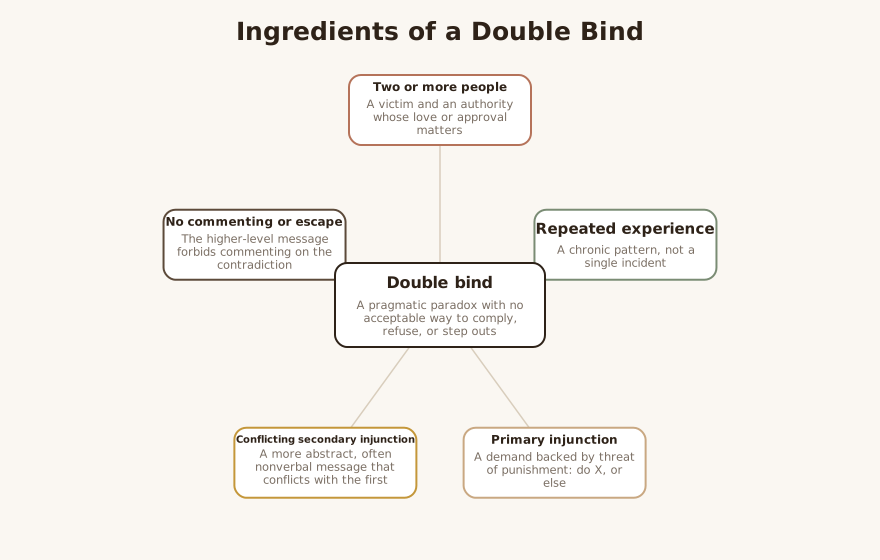
At its center, a double bind is a pragmatic paradox: a person receives conflicting demands across different levels of communication, with no acceptable way to comply, refuse, or step outside the situation 4. The conflict is not a simple contradiction between two equal statements; it is a contradiction between logical levels, drawing on Bertrand Russell’s theory of logical types, where a message and a message-about-that-message clash so that satisfying one necessarily violates the other 2. The classic trap is that the higher-level message often forbids commenting on the contradiction itself, sealing the person inside it 2.
The original formulation specified a set of necessary ingredients. There must be two or more people, one cast as the “victim” and another as an authority figure whose love or approval matters 2. The experience must be repeated, a chronic pattern rather than a single incident 2. A primary injunction imposes a demand backed by threat of punishment—often the withdrawal of love—in the form “do X, or else” or “do not do X, or else” 2. A secondary injunction, communicated more abstractly and frequently nonverbally, conflicts with the first, for example “you must do this, but only because you genuinely want to” 2. A tertiary injunction then prohibits escape from the field 2. Finally, once a person has internalized the pattern, the full set of ingredients is no longer required to evoke the panic of the bind—the world is already perceived through double-bind terms 2.
The popular illustration captures the structure economically: a mother criticizes her son no matter which of two neckties he wears; when he tries to satisfy her by wearing both, he is told he is “out of his mind” 4. Compliance, refusal, and creative compromise are all punished, and the meta-level rule forbids naming the impossibility 4.
Interventions & Techniques
Double-bind theory is descriptive rather than prescriptive, but it directly inspired a family of intervention techniques in systemic and strategic therapy LLM. The most direct derivative is the therapeutic double bind (also called the therapeutic double constraint), which deliberately inverts the pathogenic mechanism—using paradox in the service of change rather than confusion 4. A clinician might prescribe the symptom or constrain the client toward a position from which any move is therapeutic, so that the relational paradox now favors growth instead of paralysis 4.
In practice, clinical work informed by the theory tends toward several moves: mapping the contradictory injunctions a client is caught between; making the previously un-discussable contradiction discussable by naming it aloud; and restoring the client’s capacity to “meta-communicate”—to comment on the communication itself, which the tertiary injunction had forbidden LLM. Because the theory locates the problem in the system rather than the individual, interventions classically address the relational field, power dynamics, and broader context rather than the identified patient alone 3.
LLM-generated illustrative example (not a guideline): A young adult reports that their parent insists “you can always tell me anything,” yet meets every disclosure with hurt silence or withdrawal. In session, the clinician helps the client articulate both messages explicitly—the spoken invitation and the punishing response—and rehearses a meta-comment the client can offer the parent (“When I share something, I notice you go quiet, and then I feel I shouldn’t have spoken”). Naming the bind aloud is itself the intervention, because it breaks the rule against commenting. LLM
Evidence Base
Honesty about evidence is essential here: as an etiological theory of schizophrenia, the double bind has not been empirically supported and is best regarded as historical LLM. The original 1956 hypothesis proposed that chronic double-bind communication in the family produced learned patterns of confused thinking resembling schizophrenia, positing an interactional rather than organic origin 2. That causal claim has not survived; contemporary understanding of schizophrenia spectrum disorders is overwhelmingly neurodevelopmental and biological, and the family-communication etiology is no longer credible as a cause of psychosis LLM.
What endures is the descriptive value of the construct. The double bind remains a recognized and influential way of characterizing certain pathological communication patterns, and it shaped the development of family therapy as a field 3. More recent clinical writing has repurposed the concept to describe communication in borderline personality pathology, linking the no-win relational stance to the characteristic “need-fear” dilemma around closeness 2. Clinicians should treat the theory’s maturity accordingly: rich and generative as a heuristic, but not a validated mechanism of any disorder. LLM
Populations & Indications
The theory’s original population was families, particularly those containing a member with a schizophrenia spectrum or psychotic presentation, since that was the clinical puzzle the Palo Alto group set out to explain 4. Its descriptive reach, however, has always been broader. The illustrative examples that anchor the concept are drawn from ordinary family life—most famously a child caught between a parent’s spoken and unspoken demands—making it readily applicable to children and adolescents and to parent-child dynamics generally 2.
Beyond the family, the construct travels well to couples, where partners may issue contradictory relational injunctions (“be spontaneous”—then punish the spontaneity for violating an unspoken rule) 3. It has been extended to workplace and broader social dynamics, including gender and racial double binds in which a person is criticized whichever way they respond 2. For clinicians, the most useful indications are situations marked by chronic, inescapable, no-win relational messaging, which can show up across emotional-abuse histories, high-conflict relationships, and confusing family systems LLM.
Problems-for-Work
Communication problems. The theory is purpose-built for clients tangled in contradictory messaging, and its core therapeutic move—restoring the ability to comment on the communication itself—targets exactly this problem 2. A couple who each insist “just tell me how you feel” and then react punitively to the feeling can be helped to surface and name the contradictory injunctions 3.
Family conflict. Locating the bind in the pattern rather than in one blamed individual reframes recurrent family conflict as a systemic, changeable structure rather than a fixed fault 4. This reframing can lower defensiveness enough for members to examine the rules they are all enforcing LLM.
Emotional abuse and childhood trauma. Repeated, inescapable, punishing contradictions—especially where commenting on them is forbidden—describe a coercive communicative environment that overlaps with emotional abuse, and the theory names how such patterns can produce confusion and helplessness without overt coercion 2. For adults reconstructing a confusing childhood, the language of the double bind can validate a previously un-nameable experience LLM.
Confusion and disorganized thinking; anxiety. The model offers a relational account of how a person comes to feel chronically disoriented or anxious in a key relationship—not because they are irrational, but because the field itself is structured to be unsolvable 4. Naming that structure can reduce self-blame and the diffuse anxiety it generates LLM.
Contraindications, Cautions & Cultural Humility
The gravest caution is etiological overreach. Clinicians must not imply to families that their communication caused a member’s schizophrenia or psychosis; that claim is unsupported and risks inflicting exactly the kind of blame that earlier family-etiology theories caused, echoing the discredited schizophrenogenic-mother era LLM. The double bind is a description of a painful pattern, not a verdict on who is responsible for a brain disorder. LLM
A second caution concerns the therapeutic use of paradox. Paradoxical and therapeutic-double-bind techniques are powerful and can feel manipulative or coercive if used without transparency, strong alliance, and clear clinical rationale; they are not first-line tools and demand training and supervision LLM. With clients who have trauma or coercion histories, deliberately constructing binds—however therapeutic the intent—can be re-traumatizing and is generally inadvisable LLM.
Cultural humility matters because what looks like a “contradictory injunction” to an outside observer may be a coherent, valued communicative norm within a given family or culture—indirectness, deference, and the privileging of unspoken understanding are not pathology LLM. Bateson himself stressed that such communicative complexity pervades normal life, including humor, ritual, and poetry, which should restrain clinicians from labeling culturally patterned indirectness as a pathological bind 2.
Treatment-Plan Suggestions & SMART Objectives
| Goal | SMART objective (example) | Mechanism |
|---|---|---|
| Increase client’s ability to identify no-win relational patterns | Within 6 sessions, client will name at least two recurring contradictory-injunction situations and the levels at which they conflict, documented in session | Building awareness of double-bind structure to interrupt automatic helpless responses 2 |
| Restore capacity to comment on the communication (meta-communication) | Over 8 weeks, client will rehearse and deliver at least one explicit meta-comment to a key relationship partner and report the outcome | Breaking the tertiary injunction’s prohibition on naming the bind 2 |
| Reduce self-blame and confusion tied to a key relationship | By session 10, client will reframe at least three “I’m crazy” appraisals as “the situation is structured to be unsolvable” using a written log | Externalizing the problem from self to relational pattern 4 |
| Improve couple’s ability to surface contradictory demands | Within 6 joint sessions, couple will identify two spoken/unspoken injunction conflicts and practice stating each demand explicitly | Making un-discussable contradictions discussable to reduce conflict 3 |
| Strengthen family’s view of conflict as systemic rather than personal | Over 8 sessions, family members will each articulate one shared rule they enforce, rather than blaming one member, in session | Shifting from individual blame to changeable pattern 4 |
| Decrease anxiety arising from a confusing relationship | Within 8 weeks, client will rate situational anxiety before and after naming binds, targeting a self-reported reduction of two points on a 0-10 scale | Replacing diffuse helplessness with a comprehensible relational map LLM |
| Build a tolerable, non-paradoxical communication channel with a parent | Over 10 sessions, client will establish one agreed “comment is allowed” topic with the parent and use it twice | Creating an escape hatch from the inescapable field LLM |
The progress-note framing above follows the concept-within-intervention-within-modality nesting: the double bind is a construct, applied here within a strategic-therapy intervention and the larger modality of family therapy LLM.
Common Misconceptions
“The double bind causes schizophrenia.” This is the original hypothesis, but it is not supported and should not be presented to clients or families as fact 2. Treating it as established etiology repeats a serious historical error. LLM
“A double bind is just any mixed message or contradiction.” The defining feature is the conflict across logical levels combined with the inability to leave the relationship or to comment on the contradiction—an ordinary mixed message that one can question or walk away from is not a double bind in the technical sense 2.
“Double binds are always pathological.” Bateson explicitly noted that the same contradictory communicative complexity is common and even valuable in play, humor, poetry, ritual, and fiction; context determines whether it harms 2.
“It’s a therapy technique.” The double bind is primarily a descriptive model; the therapeutic double bind is a separate, deliberately inverted application, and the two should not be conflated 4.
Training & Certification
There is no certification in “double-bind theory” itself; it is a conceptual foundation rather than a credentialed modality LLM. Clinicians encounter it inside training for systemic and strategic family therapies, which descend from the Mental Research Institute and Haley’s strategic tradition, and where the related paradoxical techniques are taught LLM. Competent use of therapeutic-double-bind and other paradoxical interventions requires formal family-systems training and ongoing supervision, given their potency and the alliance demands they place on the clinician LLM. For most therapists, the appropriate “training” goal is conceptual fluency—being able to recognize and name double-bind patterns—rather than mastery of paradoxical prescription. LLM
Key Terms
- Double bind — a recurring relational situation in which a person faces contradictory injunctions at different logical levels, cannot leave the relationship, and cannot comment on the contradiction 2.
- Primary injunction — the first-level demand backed by threat of punishment, such as withdrawal of love 2.
- Secondary injunction — a conflicting, often more abstract or nonverbal demand that contradicts the primary one 2.
- Tertiary injunction — the rule that prevents escape from the situation, including the prohibition against naming the contradiction 2.
- Logical types / logical levels — the Russellian hierarchy of message and meta-message on which the contradiction depends 2.
- Pragmatic paradox — conflicting demands with no escape, the structural heart of the bind 4.
- Therapeutic double bind (double constraint) — a deliberately constructed paradox used to promote change, inverting the pathogenic mechanism 4.
- Need-fear dilemma — a later application describing the simultaneous craving for and dread of closeness, used to characterize borderline communication 2.
- Meta-communication — communicating about the communication itself; restoring it is a key therapeutic aim LLM.
Resources & Further Reading
▶ Watch — a video introduction to this concept:
- Toward a Theory of Schizophrenia — Bateson, Jackson, Haley & Weakland (1956), Behavioral Science
- Double bind — Wikipedia
- Speak Your Mind, but Not Like That: The Double Bind Theory — Psychology Today
- Double Bind — Encyclopedia.com
- Double Binds in Borderline Communication — Psychiatric Times
Reflective / Supervision Questions
- When I notice a client is in a “no-win” pattern, do I check for the three structural features—conflicting levels, inability to leave, and prohibition on commenting—or am I loosely labeling any mixed message a double bind? LLM
- Where might I be at risk of implying that a family’s communication caused a member’s psychosis, and how do I separate description from blame in my language? 2
- If I use any paradoxical or therapeutic-double-bind technique, what is my rationale, my training basis, and my plan for transparency and consent? LLM
- How do I distinguish a pathological bind from culturally patterned indirectness or valued unspoken understanding before intervening? 2
- For a client reconstructing a confusing childhood relationship, how can naming the double-bind structure validate their experience without locking them into a fixed narrative of harm? LLM
- In couples work, am I helping partners surface and state their contradictory injunctions explicitly, or am I being recruited to enforce one partner’s hidden rule? 3