
Type & Discipline
Strategic Family Therapy (SFT) is a directive, problem-focused modality within the discipline of family therapy and the broader systemic tradition. 3 It is defined by the therapist taking active responsibility for directly influencing the family toward change, rather than waiting for insight to accumulate. 1 The model treats individual psychological symptoms as manifestations of dysfunction in the family system, so the unit of treatment is the pattern of interaction rather than the identified patient alone. 3 Three features distinguish it operationally: identifying solvable problems, setting concrete goals, and designing targeted interventions whose effects are then examined and revised. 1
SFT is “here and now” in orientation, prioritizing current interactional sequences over historical or intrapsychic exploration, which sets it apart from psychodynamic methods. 3 It is pragmatic and short-term, valuing what produces change over theoretical understanding of why a problem exists. 1 For clinicians, this means SFT is less a fixed protocol and more a stance: each problem gets its own custom-designed strategy. LLM
Creators & Lineage
The model is most closely identified with Jay Haley (1923-2007) and Cloe Madanes. 3 Haley’s path into family therapy ran through Gregory Bateson’s communications research project at Stanford, the group that produced the foundational paper “Toward a Theory of Schizophrenia” and the double-bind concept. 1 In 1962 Haley became founding editor of the journal Family Process and deepened his study of the hypnotherapist Milton Erickson, whose indirect, tailored techniques he later popularized in Uncommon Therapy. 1 Erickson’s influence is visible throughout SFT’s use of directives and unconventional tasks. 1
Haley’s lineage is genuinely cross-pollinated. He worked at the Mental Research Institute (MRI), the home of the brief-therapy and communication-theory tradition that pioneered paradoxical approaches. 13 In the mid-1960s he collaborated with Salvador Minuchin and Braulio Montalvo in Philadelphia, contributing to the development of Structural Family Therapy. 1 In 1976 he and Madanes founded the Family Therapy Institute in Washington, DC, where his bestseller Problem-Solving Therapy was produced. 1 Madanes is consistently credited alongside Haley for emphasizing therapist-issued directives and active family reorganization. 3 GoodTherapy’s profile likewise frames Haley’s central contribution as moving therapy toward directive, change-focused intervention. 2
A clinically important descendant is Brief Strategic Family Therapy (BSFT), developed by José Szapocznik over nearly four decades at the University of Miami’s Center for Family Studies, which integrates Minuchin’s structural model with the strategic tradition of Haley and Madanes into a manualized, problem-focused, planful, and practical treatment. 4 Much of the modern evidence base for “strategic” family work is, in practice, the BSFT literature. LLM
Core Principles
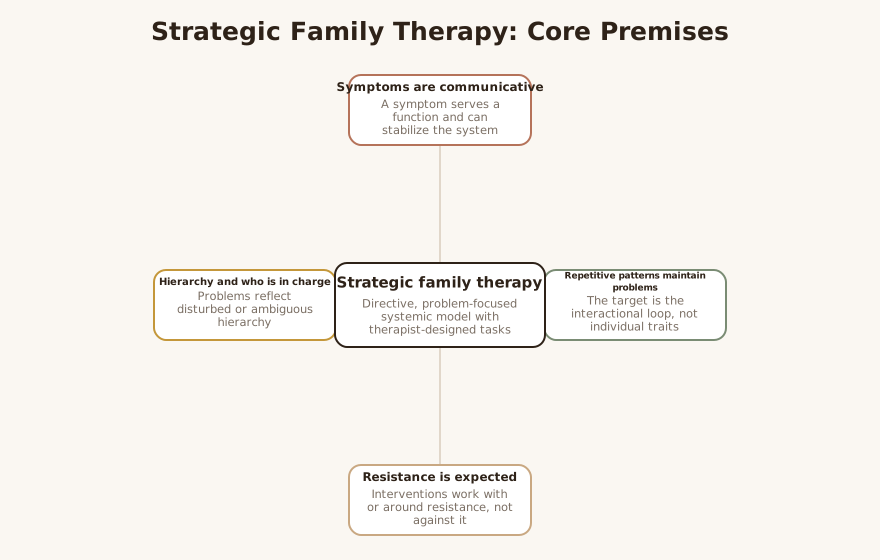
The organizing premise is that symptoms are communicative in nature and serve a function within family interaction. 3 A symptom can stabilize the system: a young adult may fail at the developmental task of leaving home in order to preserve family cohesion, or a member may express distress symptomatically when they feel trapped. 3 This reframes the “problem person” as occupying a role the system has, often unintentionally, organized around. LLM
A second principle is that repetitive, habitual interaction patterns maintain problems. 4 Family members are interdependent, so each person’s behavior affects the others, and the same maladaptive sequence tends to recur. 4 The therapeutic target is therefore the interactional loop, not the individual’s traits. 4
A third principle is that families resist change, which the strategic therapist treats as expected rather than as an obstacle to be overpowered. 3 Strategic interventions are frequently designed to work with or around that resistance rather than against it. 3 Underlying much of Haley’s thinking is attention to hierarchy and the regulation of who is in charge: many presenting problems reflect disturbed or ambiguous family hierarchy and power. 1LLM
Interventions & Techniques
SFT is best understood as a toolkit of deliberately designed tactics, each fitted to a specific problem and sequence. 13
Reframing offers an alternative interpretation of behavior, for example construing a parent’s intrusiveness as “caring and concerned” rather than “smothering,” which lowers negative affect and opens room for change. 3 In BSFT, reframing is explicitly used to reduce negativity and build motivation for change. 4
Symptom prescription asks the patient to deliberately perform the unwanted behavior, which can reduce the anxiety that fuels it and put the behavior under voluntary control. 3
Paradoxical interventions prescribe or encourage the problematic behavior itself; a child with tantrums might be instructed to have tantrums, but only in a designated place and at scheduled times. 3
Restraining discourages change—“go slow,” predicting relapse—using the family’s resistance paradoxically in the service of progress. 3
In the more structured BSFT format, the work is organized into recognizable components: joining to establish alliance with both individuals and the family unit; tracking and diagnostic enactment to surface adaptive and maladaptive patterns; reframing; and restructuring to transform problematic relations into supportive ones. 4 The clinical center of gravity in all of these is the directive—the therapist assigning concrete in-session or between-session tasks designed to interrupt the maintaining sequence. 1LLM
LLM-generated illustrative example (not a guideline): A 14-year-old refuses school; each morning becomes an escalating negotiation in which the mother pleads while the father withdraws. A strategic clinician might track the exact sequence, reframe the refusal as the teen “protecting” the parents from facing their own conflict, and assign a directive that places the father in charge of the morning routine—shifting the hierarchy and breaking the loop. LLM
Evidence Base
SFT is an established model with a long clinical history, but its strongest empirical support comes through its manualized descendant, BSFT. 34 BSFT has demonstrated efficacy for reducing adolescent conduct problems and drug use, improving family functioning, and—most reliably—engaging and retaining families. 4 A specialized BSFT engagement procedure produced 93% family engagement versus 42% under standard conditions, and the model has shown applicability across African American, Hispanic, and White American populations. 4 Therapist adherence to the model predicted better outcomes on engagement, retention, family functioning, and adolescent drug use. 4
The pivotal effectiveness study, a multisite randomized trial within the National Drug Abuse Treatment Clinical Trials Network, gives an honest picture of both strengths and limits. 5 It randomized 480 adolescent-family pairs across 49 therapists at 8 community agencies, with a multiethnic sample (213 Hispanic, 148 White, 110 Black). 5 Results were mixed: there were no overall differences between BSFT and treatment as usual in the trajectory of self-reported adolescent drug use, though median days of drug use were significantly lower in BSFT at final observation (p < .02). 5 BSFT was clearly superior for engaging families (p < .001), retaining them (p < .02), and improving parent-reported family functioning (p < .011). 5
This pattern is reflected in independent review. The federal Title IV-E Prevention Services Clearinghouse rates BSFT well-supported, with favorable effects for delinquent behavior, mixed effects for behavioral and emotional functioning, no demonstrated effect for substance use, and minimal effects for family functioning in its rated domains. 6 The honest reading for clinicians: this is a mature, well-engineered model whose most dependable contribution is getting and keeping resistant families in treatment and improving relational functioning, with more variable effects on the symptom itself. 56LLM
Populations & Indications
SFT and BSFT are indicated for families, couples, parents and caregivers, adolescents, children, and—centrally—families organized around a symptomatic member. 34 BSFT was originally developed for Hispanic adolescents, particularly Cuban families in Miami, and targets drug use, sexual risk behaviors, and delinquent behaviors. 4 The Clearinghouse describes the target population as families with children and adolescents ages 6-17 who display or are at risk for problem behaviors including drug use, antisocial peer associations, bullying, or truancy. 6
The model is delivered in English and Spanish, in community centers, clinics, health agencies, or homes, typically by master’s-level therapists in social work, marriage and family therapy, psychology, or related fields. 6 Treatment is brief by design—about 12 sessions over four months in the manual, 12 to 16 weekly sessions per the Clearinghouse—though real-world effectiveness trials saw a longer median course of around eight months. 46
Problems-for-Work
- Parent-child relational problems and family conflict. Track the recurring conflict sequence and assign a directive that reassigns roles or restructures the executive hierarchy. 41
- Oppositional defiant disorder, conduct disorder, and adolescent behavioral problems. These map directly onto BSFT’s delinquent-behavior domain, where favorable effects are documented. 6
- Communication problems. Reframing and diagnostic enactment surface and shift the maladaptive communication loop in session. 34
- Symptom maintenance cycles. Where a symptom appears to stabilize the family, symptom prescription or restraining interrupts the cycle. 3
- School refusal. A prototypical strategic target: an interactional standoff maintained by parental sequence, addressed by restructuring who is in charge of the routine. LLM
- Relationship conflict in couples. Reframing each partner’s behavior and assigning paradoxical or structured tasks can break entrenched escalation. 3LLM
Contraindications, Cautions & Cultural Humility
Paradoxical and prescriptive techniques demand care. Symptom prescription and paradox are inappropriate where the behavior carries genuine danger—active suicidality, self-harm, intimate partner violence, or abuse—because prescribing or restraining around such behavior risks harm and erodes the therapeutic relationship. LLM These techniques also rely on a degree of therapist directiveness and “covertness” that can feel manipulative if not delivered transparently and in the family’s interest; clinicians should be able to justify each directive clinically. LLM
The model’s documented strength is engagement, which matters most precisely with families who distrust services; the BSFT engagement data show this is achievable across ethnic groups. 4 At the same time, BSFT’s roots in Cuban and Hispanic families in Miami mean its assumptions about hierarchy and family structure are culturally situated, and notions of who should be “in charge” of a household vary across cultures and family forms. 4LLM Cultural humility requires checking whether the hierarchy a strategic clinician is tempted to install actually fits the family’s values rather than the model’s defaults. LLM Evidence is strongest for adolescent behavior and family functioning and weakest for substance use as an isolated outcome, so the model should not be oversold as a primary substance-use cure. 56
Treatment-Plan Suggestions & SMART Objectives
| Goal | SMART objective (example) | Mechanism |
|---|---|---|
| Engage and retain the family | Family attends at least 8 of the first 12 scheduled sessions over 4 months | Joining and alliance-building, the model’s strongest documented effect 45 |
| Improve parent-reported family functioning | Caregiver-rated family functioning improves by a clinically meaningful margin from intake to month 4 | Restructuring maladaptive interaction patterns into supportive ones 45 |
| Reduce a maintaining conflict sequence | Reduce the morning conflict episode from daily to no more than twice weekly within 6 weeks (caregiver log) | Tracking and directive task that reassigns roles 41 |
| Strengthen the parental/executive subsystem | Parents jointly set and hold one consistent limit for 3 consecutive weeks | Restructuring family hierarchy 14 |
| Reduce adolescent delinquent/oppositional behavior | Decrease documented behavioral incidents (school/home) by 50% over 12 weeks | Interrupting maladaptive interactional loop 64 |
| Lower expressed family negativity | Replace blaming statements with one reframed, lower-affect exchange per session by week 6 | Reframing to reduce negative affect and build motivation 43 |
| Restore developmentally appropriate autonomy | Adolescent independently completes one age-appropriate responsibility weekly within 8 weeks | Releasing the symptom from its system-stabilizing function 3LLM |
Common Misconceptions
- “Strategic means manipulative.” Directiveness is the point of the model, but the goal is to interrupt a maintaining pattern in the family’s interest, not to trick people; transparency about purpose preserves the alliance. 1LLM
- “Paradox is the whole model.” Paradoxical techniques are one tool among several; joining, reframing, and restructuring carry most of the clinical load, especially in BSFT. 34
- “SFT cures substance use directly.” The strongest evidence is for engagement, retention, and family functioning; direct substance-use effects are mixed to null in the multisite trial and rated as no demonstrated effect by the Clearinghouse. 56
- “It ignores the individual.” It reframes the individual’s symptom as serving a function in the system, which is an interactional lens, not a denial that the person suffers. 3
- “Strategic and structural are the same.” They share roots and are integrated in BSFT, but structural therapy centers boundaries and subsystem organization while strategic therapy centers problem-specific directives and the therapist’s responsibility for change. 14
Training & Certification
There is no single licensure for “strategic family therapy”; it is practiced by licensed clinicians within family-therapy scope. LLM For the manualized form, the Clearinghouse specifies that BSFT is delivered by trained therapists, typically master’s-level in social work, marriage and family therapy, psychology, or a related field. 6 Adherence matters: in the BSFT literature, therapist fidelity to the model predicted better outcomes, so formal training and supervision in the protocol are not optional refinements but conditions of effectiveness. 4 Foundational clinical reading includes Haley’s Problem-Solving Therapy and Uncommon Therapy, which transmit the directive, Ericksonian core of the approach. 1
Key Terms
- Directive — a concrete task assigned by the therapist, in or between sessions, to interrupt the maintaining sequence; the operational heart of SFT. 1LLM
- Symptom function — the idea that a symptom serves a stabilizing role within family interaction. 3
- Reframing — offering an alternative, lower-affect interpretation of a behavior to enable change. 3
- Symptom prescription / paradox — instructing the patient to perform the unwanted behavior, often under specified conditions, to gain control over it. 3
- Restraining — discouraging or slowing change (“go slow,” predicting relapse) to work with resistance. 3
- Joining — establishing alliance with both individuals and the family as a unit. 4
- Diagnostic enactment — having the family enact patterns in session so adaptive and maladaptive sequences become observable. 4
- Restructuring — transforming problematic relational patterns into supportive ones. 4
- Double bind — contradictory messages creating a no-win communicative situation, from the Bateson-project lineage. 3
Resources & Further Reading
▶ Watch — a video introduction to this concept:
- Strategic family therapy — EBSCO Research Starters
- Jay Haley — Wikipedia
- Jay Haley (1923-2007): Who they are and their contribution — GoodTherapy
- Brief Strategic Family Therapy: An Intervention to Reduce Adolescent Risk Behavior (PMC)
- Brief strategic family therapy versus treatment as usual: multisite randomized trial (PubMed)
- Title IV-E Prevention Services Clearinghouse: Brief Strategic Family Therapy
Reflective / Supervision Questions
- When I design a directive, can I articulate the specific maintaining sequence it is meant to interrupt, and would I be comfortable explaining its purpose to the family? LLM
- Am I treating this family’s “resistance” as pathology to be overpowered, or as information about how the system is organized? 3LLM
- What function might the identified patient’s symptom be serving in this system, and what would the family have to reorganize if it disappeared? 3
- Does the hierarchy I am inclined to reinforce reflect this family’s culture and values, or my model’s defaults? 4LLM
- Given the evidence, am I setting honest expectations—strong on engagement and family functioning, more variable on the symptom itself? 56
- Where am I on fidelity to the model, and is my drift improving or degrading outcomes for this family? 4