
Type & Discipline
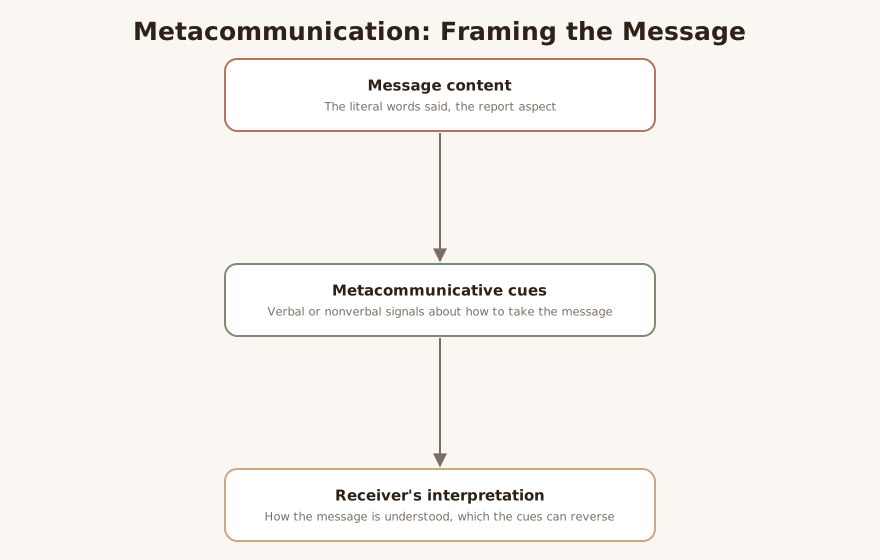
Metacommunication is a theory and descriptive construct, not a therapy or a manualized technique. LLM It belongs to communication theory and cybernetics, and within mental health it entered through psychiatry by way of Gregory Bateson and the Palo Alto group. 6 The concept is usually glossed as “communication about communication.” 46 More precisely, interaction always carries two levels at once: the concrete — the content of a message — and the abstract — a simultaneous signal about how that content is to be interpreted or framed. 4 Metacommunication is therefore best understood as a qualifier to behavior rather than simply more behavior. 4
For practicing clinicians the practical point is that every message a client or couple sends is accompanied by a second message about how the first should be taken, and much of what looks like a dispute over facts is actually a negotiation conducted on this second, relational level. LLM Because metacommunication is method-agnostic, it operates inside person-centered work, family and couples therapy, and process-oriented experiential models, and it shapes the therapist–client relationship itself. LLM
Creators & Lineage
Gregory Bateson popularized the term, while explicitly crediting Benjamin Lee Whorf with its invention. 4 Bateson introduced the concept into the psychiatric literature in 1951, in collaboration with Jurgen Ruesch in Communication: The Social Matrix of Psychiatry, defining it as “communication about communication” and extending it to encompass all exchanged cues and propositions about both codification and the relationship between communicators. 6 He elaborated the idea further in his 1955 paper “A Theory of Play and Fantasy,” a report on the paradoxes of abstraction in communication. 1 There he advanced the now-canonical example of the message “this is play,” developed in his analysis of animals at play. 6
Bateson drew on Bertrand Russell’s theory of logical types to argue for a potentially infinite hierarchy of messages, metamessages, and meta-metamessages, with each higher-order message providing the context that determines how the message below it is to be read. 6 This levels-of-abstraction framing is the conceptual backbone that later passed into the interactional view of communication associated with Paul Watzlawick and the Palo Alto / Mental Research Institute tradition, where the distinction between the report (content) and command (relationship) aspects of a message became one of the foundational axioms of human communication. LLM Downstream, the same insight informs systemic and strategic family therapies and the process commentary used in experiential and emotionally focused work, all of which treat the relational framing of messages as a legitimate target of intervention. LLM
Core Principles
The first principle is that no message stands alone: it is always accompanied by metacommunicative cues that tell the receiver how to interpret it. 46 These cues can be verbal and explicit — what is sometimes distinguished as metadiscourse, or “talk about talk” — or nonverbal and implicit, such as a touch or a smile while speaking, or a shift in intonation that signals teasing. 4 The same words, accompanied by different metacommunication, can mean something entirely different — including the opposite of their literal content. 6
The second principle is the two-level structure of interaction: people manage the concrete content of a message and an abstract message about that content simultaneously. 4 In the interactional vocabulary this is the distinction between the report aspect (what is said) and the command aspect (what the message implies about the relationship and how it should be taken). LLM When two people agree on content but are fighting over the relational frame, the argument cannot be resolved by debating facts, because the real disagreement lives one level up. LLM
The third principle is that framing can be made explicit. “Going meta” — deliberately stepping aside from the interaction to discuss what has occurred, is occurring, or will occur — turns misunderstandings into a topic that can be clarified, repaired, resolved, or even prevented. 4 This capacity to shift levels and talk about the conversation is precisely what clinicians ask of clients in conflict, and it is a skill that can be taught with the right vocabulary. 4
Interventions & Techniques
Metacommunication is a lens rather than a protocol, but it yields concrete clinical moves. LLM The most basic is naming the frame: helping a client or couple identify the unspoken instruction attached to a message — for instance, recognizing that “Fine, do whatever you want” is delivered with a command-level message of hurt or protest that contradicts its literal permission. LLM A second move is eliciting explicit metacommunication, inviting partners to talk about how they are talking — to comment on tone, timing, and the relational message — rather than relitigating the content. 4
Process commentary is the experiential version of this: the therapist comments aloud on the here-and-now relational process in the room (“I notice that every time she gets quiet, you speak faster”), surfacing the metacommunicative pattern so it can be examined. LLM Reframing interventions, drawn from strategic and systemic work, operate at the metacommunicative level by re-labeling the relationship message a behavior carries (for example, recasting nagging as an expression of caring), changing how the same content is interpreted without changing the content itself. LLM
Attending to nonverbal channels is essential, because much metacommunication is carried by body motion, facial expression, and intonation rather than words; the study of these signals as a communication system is the domain of kinesics. 6 A clinician who tracks the mismatch between a client’s words and their nonverbal framing is reading metacommunication directly. LLM
LLM-generated illustrative example (not a guideline): A partner says, “No, it’s fine, I’m not upset,” in a flat voice while turning away. The content reports “not upset”; the metacommunication — tone, posture, withdrawal — frames the message as “I am upset and I want you to notice without my having to say it.” A clinician might gently go meta: “Can we pause and look at what just happened between the two of you — the words said one thing and the body seemed to say another?” LLM
Evidence Base
Maturity is best labeled established as a foundational interactional construct, not as a treatment. LLM Metacommunication is a well-anchored descriptive concept with a clear intellectual lineage from Bateson through the interactional view, but it has no outcome or randomized-trial literature of its own, because it is a way of understanding communication rather than an intervention package to be tested. LLM Claims for its clinical utility are therefore best framed as theoretical and mechanistic rather than as efficacy data. LLM
Honesty about the scholarship requires two caveats. First, metacommunication frequently gets mentioned only briefly and rarely serves as the focus of sustained study. 4 Second, most work to date has examined the narrower, verbal category of metadiscourse, while the broader nonverbal and implicit forms of metacommunication have been comparatively slighted, and more research across contexts is still needed. 4 For the clinician, the takeaway is that the construct is conceptually robust and clinically generative, but it should be deployed as an organizing lens layered onto evidence-based modalities, not cited as an independently validated treatment. LLM
Populations & Indications
Metacommunication generalizes across populations because it targets the relational substrate of communication rather than any specific disorder. LLM It is most obviously indicated with couples, where a great deal of conflict is a negotiation of the relationship conducted through the framing of messages rather than their content. LLM It is foundational with families, where unspoken rules about who may say what, and how, are transmitted metacommunicatively across generations. LLM
The construct is directly useful with adolescents and parents, whose conflicts often hinge on the relational message (“you don’t respect me”) riding underneath an ostensibly practical dispute. LLM It applies to work teams and colleagues, where tone and framing carry the relational meaning of otherwise neutral content. LLM It is central to the therapist–client dyad itself, since the relationship between communicators is part of what every message is about. 6 And it is especially relevant for people with social communication difficulties, for whom reading and producing implicit framing cues — intonation that signals teasing, a smile that reframes a barb as play — is precisely the area of challenge. 4
Problems-for-Work
- Communication breakdown. When partners or family members repeatedly fail to connect, the breakdown is often at the command level; helping them go meta turns the misunderstanding itself into the topic so it can be clarified or repaired. 4
- Relationship conflict. Disputes that look like fights about facts are frequently negotiations of the relationship; identifying the relational frame lets the work happen on the level where the conflict actually lives. LLM
- Misunderstanding / misattunement. Because the same words plus different framing can mean opposite things, naming the intended frame directly counters the misreadings that fuel misattunement. 6
- Recurring arguments. Couples who say “we always fight like this” are already metacommunicating about a pattern; making the pattern explicit is the first step to interrupting it. LLM
- Difficulty repairing ruptures. Going meta — stepping aside to analyze what occurred — is the mechanism by which misunderstandings get clarified, repaired, or resolved, and sometimes prevented. 4
- Mixed messages. When content and framing contradict each other, the clinician’s task is to surface the contradiction so the receiver is not left to absorb an unspoken double message. LLM
LLM-generated illustrative example (not a guideline): A couple presents with the complaint, “We can’t talk about money without it blowing up.” On inquiry, the content (budgets, spending) is rarely the sticking point; the recurring rupture is a relationship-level message each hears — “you don’t trust me” / “you don’t take me seriously.” Naming this frame aloud lets them argue about the actual relational concern rather than the spreadsheet LLM.
Contraindications, Cautions & Cultural Humility
There are no contraindications to understanding communication this way, but there are real cautions in how the construct is used. LLM Going meta requires the ability to discuss behavior, and not all clients arrive with the vocabulary or the regulation to do so; pushing a dysregulated couple to “talk about how you’re talking” mid-escalation can intensify rather than de-escalate, so timing and stabilization come first. LLM Over-interpreting a client’s nonverbal framing as if the clinician has privileged access to its meaning is another risk; metacommunicative readings are hypotheses to be checked with the client, not conclusions to be announced. LLM
Cultural humility is central, because the cues that carry framing are not universal. LLM Norms around intonation, eye contact, silence, directness, and the appropriateness of teasing or of naming the relationship vary across cultures, so the same nonverbal signal can frame a message very differently for different people. LLM The interactional perspective also reminds us that the very act of opening a dialogue — including across cultural difference and even within conflict — is itself a significant metacommunicative message about a willingness to establish, maintain, or re-establish contact, which clinicians can use deliberately. 4
Treatment-Plan Suggestions & SMART Objectives
| Goal | SMART objective (example) | Mechanism |
|---|---|---|
| Build the couple’s capacity to “go meta” | Within 6 sessions, each partner can pause a conflict and name the relational message they are sending or hearing, in-session, at least twice per session | Stepping aside to discuss the interaction lets misunderstandings be clarified and repaired 4 |
| Reduce content-level arguing | By week 8, the couple identifies the relationship-level message under a recurring “factual” dispute in 3 of 4 in-session conflicts | Many conflicts are negotiations of the relationship fought on the content level LLM |
| Increase awareness of mixed messages | Client notices and names one instance per week where their words and tone/posture sent contradicting messages, logged between sessions | Different framing can reverse the meaning of identical words 6 |
| Improve rupture repair | Within 4 sessions, partners initiate one explicit “let’s talk about what just happened” repair attempt per conflict | Going meta turns ruptures into a topic that can be repaired or resolved 4 |
| Read nonverbal framing more accurately | Over 5 sessions, client correctly identifies the intended frame (teasing, serious, playful) behind a partner’s ambiguous statement, confirmed by the partner, 70% of the time | Much metacommunication is nonverbal and implicit (intonation, expression, touch) 4 |
| Make unspoken family rules explicit | By session 10, the family names two previously unspoken rules about who may say what and how | Metacommunication transmits relational rules that govern interaction LLM |
| Strengthen the therapeutic relationship through process commentary | Therapist offers and the client engages with at least one here-and-now process observation per session across 4 sessions | The relationship between communicators is part of what every message is about 6 |
Common Misconceptions
- “Metacommunication just means nonverbal cues.” It includes the nonverbal, but it is the broader category of any signal — verbal or nonverbal — about how to interpret another message; the explicitly verbal subset is more precisely called metadiscourse. 4
- “Bateson invented the term.” Bateson popularized metacommunication and brought it into psychiatry, but he himself credited Benjamin Lee Whorf with coining it. 4
- “It’s a therapy you can deliver.” Metacommunication is a descriptive construct and lens, not a manualized treatment with its own outcome evidence; it is layered onto established modalities. LLM
- “The content is what matters; framing is decoration.” The framing is itself a message about the relationship, and the same content with different framing can mean the opposite, so the framing is often the substance of the conflict. 6
- “Going meta is always calming.” Inviting clients to talk about how they are talking is a skill that requires capacity and good timing; deployed during high escalation it can backfire. LLM
Training & Certification
There is no certification in metacommunication itself; it is taught as a foundational concept within broader communication and family-systems training. LLM The skill that matters clinically — the deliberate shifting of levels to discuss the dialogue process — requires the ability to discuss behavior, and acquiring specific vocabulary to facilitate such conversations is described as useful. 4 Clinicians most often build fluency through training in interactional and systemic approaches, where the report/command distinction and the use of reframing and process commentary are taught and supervised. LLM Reading Bateson’s primary work on the paradoxes of abstraction and the “this is play” frame remains a worthwhile grounding for anyone using the concept seriously. 16
Key Terms
- Metacommunication — communication about communication; any signal about how a message is meant to be interpreted. 46
- Metadiscourse — the verbal, explicit subset of metacommunication, i.e., “talk about talk.” 4
- Content vs. relationship levels — the concrete content of a message versus the simultaneous abstract message about how to frame it (report vs. command). 4
- “This is play” — Bateson’s canonical example of a metacommunicative frame that tells the receiver how to interpret the actions that follow. 6
- Logical types / levels of abstraction — the hierarchy of messages and metamessages in which each higher level supplies the interpretive context for the one below. 6
- Going meta — deliberately stepping out of an interaction to analyze and discuss it, enabling misunderstandings to be clarified, repaired, or prevented. 4
- Kinesics — the study of body-motion communication as a carrier of (often metacommunicative) meaning. 6
Resources & Further Reading
▶ Watch — a video introduction to this concept:
- Bateson, G. (1955). A Theory of Play and Fantasy — PubMed record
- Bateson, G. A Theory of Play and Fantasy — full-text PDF
- Craig, R. T. Metacommunication — International Encyclopedia of Communication Theory (Wiley)
- Leeds-Hurwitz, W. (2014). Metacommunication — Key Concepts in Intercultural Dialogue (PDF)
- The Concept of Metacommunication: Talking About the Conversation (Pressbooks)
- Meta-communication — Wikipedia
Reflective / Supervision Questions
- In a recent stuck session, were you and the client arguing on the content level when the real disagreement lived at the relationship level? How would you know? LLM
- Where do you tend to read a client’s nonverbal framing as fact rather than as a hypothesis to check with them? 4
- When you invite a couple to “go meta,” are you doing it at a moment they have the capacity to use, or are you adding pressure mid-escalation? LLM
- Whose framing norms are you treating as the default — your own, or the client’s — when you interpret tone, silence, or directness across cultural difference? LLM
- Think of a recurring rupture with a client: what unspoken relational message might each of you be sending that neither of you has named aloud? 4
- How does your own metacommunication — your tone, pacing, and framing — shape what clients believe they are allowed to bring into the room? 6