
Type & Discipline
This is a theoretical construct, not a treatment package. It belongs to communication theory and cybernetics, and specifically to the interactional view developed by the Palo Alto group. LLM The fourth of Watzlawick’s five axioms states that human beings communicate in two modalities at once — a digital mode and an analogic mode. 34 In the original framework, these axioms describe “aspects that play a significant role in any form of interpersonal exchange,” meaning the model is meant to apply to every act of communication rather than to a diagnostic category. 3
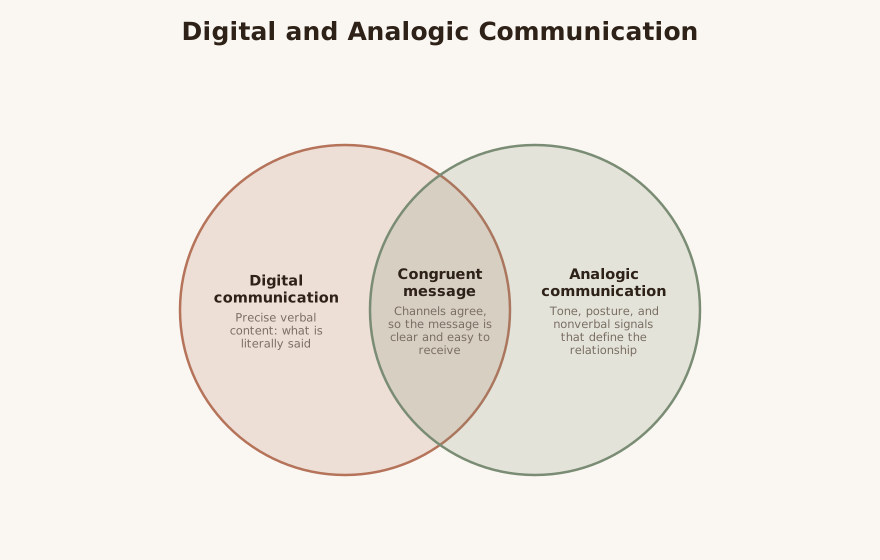
Digital communication refers to the precise, verbal, syntactic content of a message — the explicit words, framed in an unambiguous way. 34 Analogic communication refers to the nonverbal channel: tone of voice, facial expression, posture, gesture, timing, and the relational cues these carry, which admit “a multitude of possible interpretations.” 34 For the clinician, the axiom is a lens, not an intervention: it tells you where to look when a message lands wrong, not yet what to do about it. LLM
Creators & Lineage
The axiom comes from Pragmatics of Human Communication: A Study of Interactional Patterns, Pathologies, and Paradoxes, authored by Paul Watzlawick, Janet Beavin Bavelas, and Don D. Jackson and published by W. W. Norton. 1 The work was first issued in 1967 in New York. 2 Watzlawick is described as an Austrian communication scientist who set out a small set of foundational principles about how people interact. 3
The intellectual lineage runs back to Gregory Bateson and the Palo Alto / Mental Research Institute tradition, whose work on cybernetics, feedback, and paradoxical communication shaped the interactional view that Pragmatics systematized. LLM Cybernetic ideas — that meaning is carried in patterns and relationships rather than in isolated signals — are the substrate beneath the digital/analogic distinction. LLM The construct sits within a family that also includes nonverbal communication theory and systemic family therapy, fields that share the premise that the relationship, not the individual, is the unit of analysis. LLM
Core Principles
Three principles anchor clinical use of the fourth axiom. LLM
First, every message is encoded twice. The digital channel carries content — what is literally said — while the analogic channel carries relationship and affect. 4 The document emphasizes that digital communication handles content effectively, while analogic communication establishes and defines the relationship between the parties. 4
Second, the two channels can agree or disagree. When they agree, the message is congruent and easy to receive. When they conflict — when verbal content contradicts nonverbal relationship messages — the receiver faces contradictory signals and confusion about the sender’s true position. 34
Third, pathology lives in mistranslation, not in either channel alone. When individuals fail to convert messages accurately from digital to analogic form, or the reverse, communication breakdowns occur; these mismatches generate misunderstanding, relational conflict, and emotional distress, and can contribute to psychological pathology. 4 This is consistent with the broader axioms: the second axiom holds that every message has both a content and a relationship aspect, with the relationship component dominant, so a mismatch is not a minor noise problem but a contest over what the relationship is. 3
Interventions & Techniques
Because the axiom is a theory rather than a manualized therapy, the “techniques” are clinician moves derived from it rather than validated protocols. LLM
- Channel-splitting in session. Reflect back the digital content and the analogic signal separately — “The words said it’s fine; the tone said something else” — to make the mismatch visible to both parties. LLM This operationalizes the core observation that incongruence between explicit words and nonverbal cues creates confusion. 3
- Naming incongruence neutrally. Rather than asking whose reading is “right,” frame the mixed message itself as the shared problem to be solved, drawing on the principle that the relationship aspect governs how content is heard. 3
- Translation work. Help a client put analogic experience into digital words (“the sigh means I’m overwhelmed, not bored”), and help the partner check digital meaning against analogic data instead of guessing. LLM
- Slowing punctuation. Because interactions form cause-and-effect sequences where each statement triggers the next, slowing the exchange lets the dyad inspect a single mismatched turn before the loop escalates. 3
- Metacommunication. Invite the dyad to communicate about their communication — talking openly about tone and intent — which is the practical antidote to silent misreading. LLM
Evidence Base
Honesty about maturity matters here. The fourth axiom is established as foundational theory — it is a canonical, widely taught framework rooted in a major 1967 text — but “established” describes its status as theory, not the existence of a body of randomized outcome trials showing that teaching the axiom improves symptoms. 12 The construct’s strength is descriptive and heuristic: it gives clinicians a reliable vocabulary for incongruent communication. 34
What the sources support is the conceptual claim — that digital/analogic mismatch is a real and consequential feature of human exchange and is implicated in misunderstanding and distress. 4 What they do not provide is dose-response or comparative-efficacy data. LLM Treat the axiom as a well-validated map whose therapeutic use should be paired with an evidence-based modality (for example, an empirically supported couples or family therapy) rather than delivered as a standalone treatment. LLM
Populations & Indications
The axiom is presented as applying to any interpersonal exchange, which makes it broadly indicated as an assessment lens. 3 It is especially clinically useful for:
- Couples and families, where chronic conflict is frequently a digital/analogic mismatch rather than a content disagreement. 34
- People with autism spectrum disorder and individuals with social communication difficulties, for whom decoding the analogic channel may be effortful and the resulting mismatch a recurring source of friction. LLM
- People with alexithymia, who may struggle to translate analogic, bodily-affective experience into digital words, leaving partners to guess. LLM
- Cross-cultural and intercultural dyads, where analogic conventions (eye contact, proximity, tone) differ even when the digital language is shared, producing mistranslation. LLM
These indications follow from the model’s claim that breakdown occurs at the point of translation between channels, not from outcome studies in these groups. 4
Problems-for-Work
The axiom maps cleanly onto common presenting problems. LLM
- Incongruent messages / mixed signals. A partner says “go, have fun” with a flat, withdrawn tone; the contradiction between explicit words and nonverbal signal is the work. 3
- Misinterpretation of tone/intent and mistrust. A client reads neutral analogic data as hostile; channel-checking tests the inference. LLM
- Communication breakdown and misattunement. Repeated failures to convert between digital and analogic forms accumulate into a felt sense of not being understood. 4
- Emotional dysregulation in conflict. When the relationship aspect dominates and is heard as a threat, affect spikes before content is even processed. 3
- Difficulty reading nonverbal cues. For clients who miss analogic information, the axiom reframes the deficit as a translation gap to be scaffolded rather than a character flaw. LLM
LLM-generated illustrative example (not a guideline): A couple argues nightly about dishes. The husband’s digital message is logistical (“I’ll do them later”); his analogic message — eyes on his phone, sigh, turned-away shoulder — reads to his wife as “you don’t matter.” Naming the split lets them stop litigating dishes and start addressing the relationship signal. LLM
Contraindications, Cautions & Cultural Humility
The axiom carries no physical contraindications, but it can be misused. LLM Because analogic cues “admit a multitude of possible interpretations,” the clinician must resist treating their own read of a client’s tone or posture as fact; the model warns against, not toward, confident mind-reading. 3 Imposing a single “correct” decoding of nonverbal behavior risks pathologizing normal variation. LLM
Cultural humility is essential precisely because analogic conventions are culturally and neurologically variable. LLM Eye contact, silence, volume, and proximity that read as warmth in one context read as aggression or evasion in another, so apparent “incongruence” may be the clinician’s mistranslation rather than the client’s. LLM For autistic clients and clients with alexithymia, framing analogic differences as deficits can be harmful; the goal is mutual translation, not coercing one party into the clinician’s analogic norms. LLM Use the axiom to generate hypotheses to check collaboratively, never verdicts to deliver. LLM
Treatment-Plan Suggestions & SMART Objectives
| Goal | SMART objective (example) | Mechanism |
|---|---|---|
| Reduce mixed-signal conflict in the couple | Within 8 weeks, partners will identify and name at least one digital/analogic mismatch per session in real time, in 3 consecutive sessions | Makes incongruence visible so content stops being litigated 3 |
| Improve analogic-to-digital translation | Within 6 weeks, client will verbally label the felt/bodily signal behind a sigh, pause, or flat tone in 4 of 5 logged conflict moments | Converts analogic experience into checkable digital words 4 |
| Decrease hostile misreading of tone | Within 10 weeks, client will replace one assumed intent with a verification question (“Did you mean that as criticism?”) in 80% of flagged interactions | Tests inferences against the relationship channel 3 |
| Reduce escalation speed in conflict | Within 6 weeks, dyad will pause and inspect a single mismatched turn before responding in at least 3 conflicts per week | Slows punctuation so the loop can be examined 3 |
| Build metacommunication skill | Within 8 weeks, client will initiate one explicit “let’s talk about how that came across” conversation weekly | Surfaces analogic meaning rather than guessing LLM |
| Increase congruent expression | Within 6 weeks, client will align stated content and tone in role-play in 4 of 5 attempts | Reduces self-generated mixed messages 4 |
| Strengthen cross-cultural decoding | Within 10 weeks, intercultural dyad will name one analogic convention difference and a shared check for it | Treats mismatch as translation, not intent LLM |
Common Misconceptions
“Digital means technology / screens.” It does not. In this axiom, digital means precise, syntactic, verbal content — the literal words — and predates any reference to electronic media. 34
“The nonverbal channel is always the true one.” The axiom does not privilege analogic over digital as inherently honest; it says the two can conflict and that analogic cues are ambiguous, open to many readings. 3 Treating tone as automatically truer than words is itself a mistranslation. LLM
“It’s a therapy you can deliver.” It is a theoretical lens. LLM The five axioms describe how communication works; they are not a manualized intervention with an outcome evidence base. 3
“Mismatch equals dishonesty.” Incongruence usually reflects competing internal states or poor translation skill, not deception; framing it as lying forecloses the clinical work. LLM
Training & Certification
There is no certification in “the fourth axiom” specifically. LLM The foundational training is reading the primary text, Pragmatics of Human Communication, which lays out the axioms and their pathologies and paradoxes. 12 Clinically, the construct is absorbed through training in systemic and family therapies that carry the Palo Alto / interactional lineage, where metacommunication and pattern-level intervention are taught. LLM Accessible secondary explainers summarize the five axioms for quick orientation but should not substitute for the primary source or supervised systemic training. 34
Key Terms
- Digital communication — precise, verbal, syntactic content; the explicit words, delivered unambiguously. 34
- Analogic communication — nonverbal signaling (tone, posture, facial expression, timing) that defines the relationship and admits many interpretations. 34
- Mistranslation — failure to convert a message accurately between the digital and analogic modes, the locus of breakdown. 4
- Incongruence / mixed message — simultaneous digital and analogic signals that contradict each other. 3
- Content vs. relationship aspect (second axiom) — every message carries both factual content and a relationship message, with the relationship aspect dominant. 3
- Punctuation (third axiom) — the way partners segment an interaction into cause-and-effect sequences. 3
- Metacommunication — communicating about the communication itself. LLM
Resources & Further Reading
▶ Watch — a video introduction to this concept:
- Pragmatics of Human Communication: A Study of Interactional Patterns, Pathologies, and Paradoxes — W. W. Norton
- Watzlawick, Bavelas & Jackson (1967), Pragmatics of Human Communication — citation record (SCIRP)
- The 5 Axioms by Watzlawick: How to Communicate in a Team — InLoox
- Watzlawick’s Five Axioms (reading material, WSPA) — PDF
Reflective / Supervision Questions
- When I sense a “mixed message” in session, am I checking my analogic read with the client, or quietly treating my interpretation as fact? LLM
- Whose analogic conventions am I using as the baseline of “congruent” — the client’s, the couple’s, or my own cultural default? LLM
- With an autistic or alexithymic client, am I framing channel differences as a translation task or as a deficit to be corrected? LLM
- In a stuck couple, am I still litigating digital content when the live problem is the relationship signal? 3
- How do I use this lens to generate hypotheses without sliding into confident mind-reading? 3