
Type & Discipline
Appreciative Inquiry (AI) is a change framework, not a discrete psychotherapy. LLM It originated in organizational development and is most at home in organizational change, leadership development, and coaching contexts. 1 AI is best understood as a generative method — a structured way of asking questions and convening dialogue that mobilizes a system’s existing strengths toward a desired future. 2 Its discipline of origin is organizational behavior and management scholarship, and its applied home is OD consulting and the coaching profession. 3
For clinicians, the practical framing is that AI supplies a stance and a set of conversational moves rather than a standalone treatment protocol. LLM It belongs to the strengths-based family alongside positive psychology, solution-focused brief therapy, and broader strengths-based and recovery-oriented approaches. 2 Therapists most often encounter AI when working at the team, program, or systems level — supervision, clinic improvement, burnout-prevention initiatives — or when adapting its questioning style into individual coaching and goal work. LLM
Creators & Lineage
David Cooperrider and his doctoral advisor Suresh Srivastva developed Appreciative Inquiry at Case Western Reserve University during the 1980s. 2 The foundational text is their 1987 chapter, “Appreciative Inquiry in Organizational Life,” which argued that action research had become overly problem-centered and that inquiry itself shapes the systems it studies. 1 Cooperrider’s pivotal insight was to shift the focus of inquiry from what is broken to what gives a system life and energy. 2
The lineage is explicitly constructionist. LLM AI draws on social constructionism — the premise that language and shared meaning co-create social reality — and is frequently grouped with positive psychology as a sibling movement emphasizing strengths and flourishing. 3 It shares deep family resemblance with solution-focused brief therapy, which similarly attends to exceptions, competencies, and preferred futures rather than to deficits and pathology. 2 Cooperrider has continued to advance and popularize the approach, including through public talks on resilience and large-scale “summit” applications. 4
Core Principles
AI rests on a small set of founding principles, most commonly enumerated as five. 2 The constructionist principle holds that language and inquiry co-construct organizational reality, so the questions we ask are never neutral observations but acts of creation. 2 The simultaneity principle states that change begins the moment a question is asked, because inquiry and intervention are not sequential but concurrent. 2
The poetic principle treats organizations and human systems as open, co-authored stories from which any theme — strength or deficit — can be studied and amplified. 2 The anticipatory principle holds that the images of the future a system holds guide its present behavior, so cultivating compelling positive images is itself an intervention. 2 The positive principle asserts that momentum for change requires positive affect and social bonding, which broad, affirmative questions tend to generate. 2
The unifying commitment is that systems move toward what they persistently and collectively study. 3 AI therefore deliberately directs attention toward strengths, peak experiences, and life-giving forces. 2
Interventions & Techniques
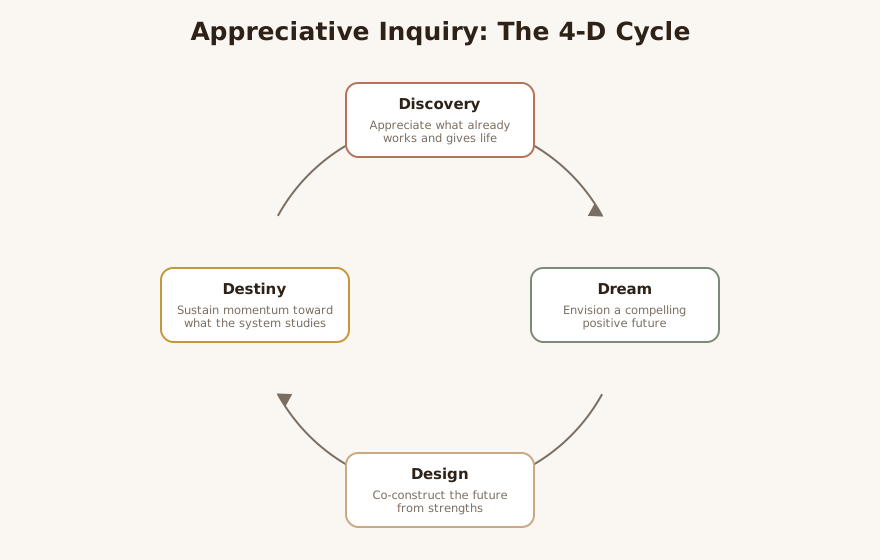
The signature method is the 4D cycle: Discovery, Dream, Design, and Destiny. 5 Discovery surfaces “the best of what is” by inviting people to recount peak experiences and identify what gives the system life through unconditional positive questions. 2 Dream invites participants to imagine “what might be,” co-creating vivid, possibility-focused images of a preferred future. 5
Design translates those aspirations into “what should be” — shared structures, relationships, and commitments arrived at through inclusive dialogue. 2 Destiny (sometimes called Delivery) sustains “what will be” through ongoing action, learning, and innovation. 5 Many practitioners prepend a Define phase, yielding a 5D model, in which an affirmative topic is chosen and framed in inspiring rather than deficit language. 2
Characteristic techniques include the appreciative (paired) interview, the affirmative topic choice, and large-group AI Summits that convene whole systems at once. 3 A widely used planning adaptation is SOAR — Strengths, Opportunities, Aspirations, Results — which reframes the deficit-oriented SWOT analysis into an affirmative one. 2
LLM-generated illustrative example (not a guideline): A clinic facing high clinician turnover might open a staff retreat with an appreciative interview pair-share — “Tell me about a week here when you left work energized; what made it possible?” — before any discussion of what is going wrong. LLM
Evidence Base
Honesty about maturity matters here. LLM AI is established as a change method within organizational development and coaching, with a substantial practitioner literature, decades of case applications, and a foundational scholarly text. 1 Its reach into healthcare organizations, schools, and communities is well documented at the level of programs and systems. 3
What is not established is AI as a clinically validated psychotherapy for individual mental-health conditions. LLM The concept has limited direct randomized-trial support in clinical populations, and the confidence clinicians place in it for individual treatment is largely extrapolated from adjacent evidence bases — positive psychology interventions and solution-focused brief therapy. 2 The “established” label thus refers to AI’s standing as an organizational and coaching method, not to demonstrated efficacy as a billable individual psychotherapy. LLM
For practice, this means AI is appropriately used as a stance and technique set layered into recognized modalities or applied at the team and systems level, rather than offered to a patient as an evidence-based standalone treatment. LLM Claims to clients and payers should reflect that distinction. LLM
Populations & Indications
At the system level, AI is indicated for organizations and teams undergoing change, leaders and managers seeking to mobilize engagement, and healthcare organizations or schools pursuing culture and quality improvement. 3 It has been applied with communities and large stakeholder groups through summit methods. 3 Coaching clients are a natural fit, since the appreciative interview maps cleanly onto strengths-based individual development. 2
For clinicians, the strongest indications are adjacent to direct symptom treatment: clinician burnout-prevention and morale work, supervision and program development, and goal-setting or motivation work where a strengths frame is more activating than a problem frame. LLM AI is best indicated where there is a capacity to build on — existing competencies, prior successes, and at least some hope to anchor the Dream phase. LLM
LLM-generated illustrative example (not a guideline): A coaching client recovering confidence after a layoff might be guided through a Discovery interview about past roles where they felt most effective, then a Dream exercise picturing their ideal next role in concrete sensory detail. LLM
Problems-for-Work
AI maps well onto several presenting concerns at the organizational and motivational level. LLM
- Low workplace morale and demoralization: Discovery interviews resurface what still works and reconnect people to purpose, countering the narrowing that demoralization produces. LLM
- Organizational change resistance: Because simultaneity means change starts with the first question, AI lowers defensiveness by inviting people to author the future rather than defend against an imposed one. 2
- Burnout: Reorienting attention from chronic deficits to life-giving forces can interrupt the depletion-focused rumination common in burnout. LLM
- Team conflict: A shared affirmative topic and inclusive Design dialogue create common ground that adversarial problem-talk often forecloses. LLM
- Low self-efficacy and lack of motivation: Recalling concrete peak experiences supplies evidence of capability, supporting the anticipatory shift toward a desired future. 2
- Goal-setting difficulties: The Dream-to-Design movement turns vague wishes into vivid images and then into concrete commitments. 5
Contraindications, Cautions & Cultural Humility
AI’s relentlessly affirmative frame is also its main caution. LLM In acute distress, trauma processing, grief, or safety-risk situations, a strengths-only stance can feel invalidating or can bypass material that needs direct attention; AI is not a substitute for risk assessment, trauma-informed care, or symptom-focused treatment. LLM Clients who experience the relentless positivity as pressure to perform optimism may disengage, so pacing and explicit permission to name what hurts are essential. LLM
Practitioners should be honest that AI does not “fix” structural injustice or material constraints by reframing them, and an uncritical positive frame can mask real power imbalances inside a team or system. LLM Cultural humility requires that the affirmative topic and the definition of “the best of what is” be co-defined with participants rather than imposed, since notions of strength, success, and a good future are culturally situated. 2 The constructionist premise itself counsels caution: whoever frames the question shapes the reality, so facilitators must hold their framing power lightly and transparently. 2
Treatment-Plan Suggestions & SMART Objectives
| Goal | SMART objective (example) | Mechanism |
|---|---|---|
| Rebuild morale on a team | Conduct paired appreciative interviews with 100% of team members within 4 weeks and identify 3 shared strengths | Discovery; positive principle 2 |
| Strengthen client self-efficacy | Client articulates 3 documented past successes and one transferable strength by session 4 | Discovery; evidence of capability 2 |
| Reduce change resistance | Co-create one affirmative future-state statement with the group within 2 sessions | Define/Dream; simultaneity 5 |
| Clarify vague goals | Convert one aspiration into a vivid Dream image and 2 concrete Design commitments in 30 days | Dream-to-Design movement 5 |
| Counter burnout depletion | Log one “life-giving” work moment daily for 2 weeks and review themes | Anticipatory + positive principles 2 |
| Improve team dialogue | Hold one inclusive Design conversation producing a shared agreement within 6 weeks | Design phase; co-construction 2 |
| Sustain a change initiative | Define 3 Destiny-phase action owners and review progress monthly for one quarter | Destiny; commitment to action 5 |
Common Misconceptions
A frequent misconception is that AI is “forced positivity” that bans any mention of problems. LLM In fact, AI reframes problems as wishes for something better and directs attention to strengths, but it does not require denying difficulty. 2 A related error is treating AI as merely a brainstorming or feel-good exercise; its founders intended a rigorous form of action research grounded in the constructionist claim that inquiry shapes reality. 1
Clinicians sometimes assume AI is an evidence-based individual psychotherapy — it is not, and presenting it that way overstates its clinical maturity. LLM Another misconception is that the 4D model is a rigid linear sequence; in practice the phases overlap and iterate, and the optional Define phase means practitioners use 4D and 5D variants interchangeably. 5 Finally, AI is not only a large-group method: while AI Summits convene whole systems, the same principles scale down to dyadic coaching and individual reflection. 2
Training & Certification
There is no single licensing body or protected credential for Appreciative Inquiry, and no clinical certification is required to use its principles within one’s existing scope of practice. LLM Foundational learning typically begins with Cooperrider and Srivastva’s original work and the broad practitioner literature. 1 Universities and OD/coaching organizations offer AI-focused courses, workshops, and certificate programs of varying length and depth. 2
The Appreciative Inquiry Commons, hosted at Champlain College, serves as a widely used open repository of educational materials, cases, and tools associated with Cooperrider’s work. 4 Clinicians integrating AI should pursue training proportional to their use case — brief workshop exposure may suffice to adopt the appreciative interview in coaching, while facilitating organizational summits warrants more substantial OD training. LLM As always, AI techniques must be practiced within the boundaries of one’s licensed scope and the modality being billed. LLM
Key Terms
- 4D / 5D cycle: The core process — Discovery, Dream, Design, Destiny, with an optional preceding Define phase. 5
- Affirmative topic: The strength-focused subject of inquiry, deliberately framed in inspiring rather than deficit language. 2
- Appreciative interview: A paired conversation eliciting peak experiences, values, and life-giving forces. 2
- Unconditional positive question: A question that assumes and seeks out what is working and valued. 2
- AI Summit: A large-group, whole-system gathering that runs the 4D cycle with many stakeholders at once. 3
- SOAR: Strengths, Opportunities, Aspirations, Results — an affirmative alternative to SWOT analysis. 2
- Constructionist principle: The premise that language and inquiry co-create social reality. 2
Resources & Further Reading
▶ Watch — a video introduction to this concept:
- Cooperrider & Srivastva (1987), Appreciative Inquiry in Organizational Life — the foundational academic text. 1
- What Is Appreciative Inquiry? (Definition, Examples & Model) — PositivePsychology.com — applied overview of principles, 4D/5D, and coaching uses. 2
- Appreciative Inquiry — Wikipedia — reference summary of history, principles, and applications. 3
- The Appreciative Inquiry Commons (Champlain College / Cooperrider) — open educational repository. 4
- What Is the 4D Model of Appreciative Inquiry? — Umbrex — concise model explainer. 5
- Appreciative Inquiry: A Conversation with David Cooperrider (video) — creator interview. 6
Reflective / Supervision Questions
- Where in my caseload or team would amplifying existing strengths be more activating than analyzing deficits, and where would it risk bypassing what needs direct attention? LLM
- When I ask a client or team about “what gives life,” whose definition of success and strength am I implicitly privileging, and have I co-defined it with them? LLM
- Am I representing AI accurately to clients and payers — as a technique layered into a recognized modality, not as a validated standalone psychotherapy? LLM
- For a given case, which billable modality genuinely contains the AI work I am doing, and does my documentation reflect that mechanism of change? LLM
- How do I notice and respond when affirmative framing is landing as pressure to perform optimism rather than as genuine support? LLM
- In organizational or supervision work, how am I holding my power to frame the question, given that the question itself shapes the reality the group will move toward? LLM