
Type & Discipline
Parasocial relationships are a construct rather than a treatment, originating in media and social psychology and the broader study of mediated relationships 1. The construct names a specific phenomenon: a one-sided relationship in which a person develops a strong sense of connection, intimacy, or familiarity with someone they do not actually know 3. The figure on the other side can be a television personality, a podcaster, a YouTuber or streamer, an influencer, a fictional character, or, increasingly, an AI companion 1.
A useful distinction within the literature separates two related terms. Parasocial interaction (PSI) is the one-sided process of media-person perception that happens during a given exposure, while a parasocial relationship (PSR) is the cross-situational bond a viewer or user carries with that media person over time 1. PSI during repeated viewing can consolidate into an enduring PSR through accumulated “illusions of intimacy, friendship, and identification” 1. For clinicians, the practical point is that this is not a fringe curiosity but an ordinary feature of how socially wired humans relate to a media-saturated environment, and one that increasingly shows up in the consulting room LLM.
Creators & Lineage
The concept was introduced in 1956 by the anthropologist Donald Horton and the sociologist R. Richard Wohl in their article “Mass Communication and Para-Social Interaction: Observations on Intimacy at a Distance” 2. They observed that television personalities cultivate a sense of intimacy through engaging appearance, gesture, and direct address to the camera, generating what they called an “illusion of intimacy” with on-screen figures 3. Most theoretical development of the idea occurred across the latter half of the twentieth century 2.
The construct’s measurement lineage runs through the uses-and-gratifications tradition in mass communication. Early-1970s work identified two core functions parasocial bonds serve for audiences: companionship and personal identity 1. The most widely used assessment instrument, the PSI-Scale, was developed by Rubin, Perse, and Powell in 1985, with a later EPSI-Scale proposed as a refinement 1. Subsequent scholarship has linked parasocial engagement to psychological attachment theory: Jonathan Cohen and others found that people more attached to certain programs and media figures tend to be more invested in parasocial relationships, drawing on “similar psychological thought processes” as real relationships 1.
The construct has also been revisited empirically to clarify the original observations. A study by Hartmann and Goldhoorn, “Horton and Wohl Revisited,” returned to the 1956 concept to examine how viewers subjectively experience parasocial interaction 5. This thread of work matters because it situates the construct alongside neighboring frameworks clinicians already use, including attachment theory and Bandura’s social cognitive theory, the latter informing how viewers model behavior on admired media figures 1.
Core Principles
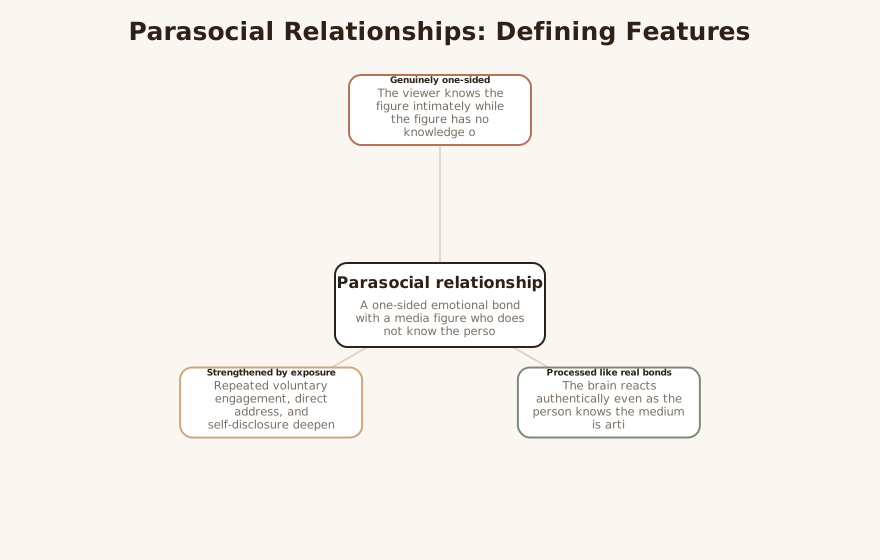
First, the relationship is genuinely one-sided. The viewer or user knows the figure intimately, while the figure has no knowledge of the individual at all 3. A fan differs here from a parasocial participant: a fan admires a celebrity for their talent and may view them as superior, whereas in a parasocial relationship the bond feels peer-to-peer, as if the person actually knows the celebrity 3.
Second, the brain processes these bonds much like real ones. Human brains appear to process parasocial interactions in much the same way as real-life interpersonal interactions; people consciously recognize the artificiality of the medium yet still experience authentic psychological and emotional reactions 2. This dual awareness, knowing it is not real while feeling that it is, is central to the construct 2.
Third, repeated, voluntary exposure strengthens the bond. Parasocial relationships intensify through regular engagement, direct address, conversational tone, and the persona’s self-disclosure, all of which reduce uncertainty and increase liking 1. Talk-show hosts speaking to the camera as if in conversation, sitcoms set in familial spaces, and podcasts adopting the informal tone of a gathering of friends all exploit this mechanism 2.
Fourth, the bonds serve real psychological functions, principally companionship and the construction of personal identity 1. Because they require no conflict, no favors, and no maintenance, they offer access to admired figures at very low interpersonal cost, which is part of their appeal 3.
Interventions & Techniques
There is no “parasocial relationship therapy,” and clinicians should not expect one LLM. The construct functions as a formulation lens that can be folded into established modalities rather than as a stand-alone intervention LLM. In practice, a clinician uses the construct to understand a presenting concern and then works it through whatever evidence-based modality fits.
- Assessment and normalization. Naming the bond as a parasocial relationship, and explaining that such bonds are common and not inherently pathological, can reduce a client’s shame about the intensity of feeling for someone who does not know them 3.
- Functional analysis. The clinician examines what the bond does for the client, since the construct’s recognized functions are companionship and identity, and whether it supplements or substitutes for reciprocal relationships 1.
- Within interpersonal psychotherapy. Where a parasocial bond is filling an interpersonal void, the construct can be addressed through an interpersonal inventory and role work that builds reciprocal connection LLM.
- Within cognitive behavioral therapy. Where parasocial comparison drives distress, cognitive and behavioral techniques can target the comparison process and the idealized standards it generates LLM.
- Grief work at parasocial breakup. When a figure dies, retires, or goes off the air, grief-oriented techniques borrowed from bereavement work can validate and process the loss 3.
LLM-generated illustrative example (not a guideline): A socially isolated young adult describes a streamer as “the only person who feels like a friend.” Rather than dismissing the bond, the clinician validates the companionship it provides, then collaboratively maps what reciprocal connection the client wants but avoids, using the parasocial relationship as a bridge toward, not a replacement for, in-person contact. LLM
Evidence Base
The honest characterization is twofold. The construct itself is well established: it has a clear 1956 origin, decades of theoretical development, and validated measurement scales such as the PSI-Scale and EPSI-Scale 12. The clinical-application evidence, by contrast, is emerging rather than settled LLM.
On the constructive side, a 2022 study in Scientific Reports tested the parasocial contact hypothesis, the idea that parasocial interaction may reduce prejudice in ways similar to face-to-face contact theory 4. In 320 participants, watching a YouTube creator with whom viewers had built rapport disclose experiences of borderline personality disorder significantly reduced explicit prejudice, with lower fear-and-avoidance scores, and the strength of the parasocial relationship correlated with the reduction 4. Two caveats temper the result: implicit prejudice did not change, and follow-up extended only one week 4. The authors frame parasocial relationships as a scalable, low-cost complement to traditional prejudice-reduction approaches, not a replacement 4.
Broader observational findings cut both ways. Parasocial bonds can improve well-being by providing companionship and can enrich the limited social worlds of marginalized people, and contemporary research has largely discarded the view that they are inherently unhealthy 3. At the same time, “parasocial comparison” with idealized figures can foster poor body image, and comparison with unrealistically curated lives is linked to lowered self-esteem and depressive feelings in some viewers 12. Most foundational research comes from mass-communication scholars rather than clinical psychologists, which is itself a noted limitation when translating the construct to treatment 1.
Populations & Indications
Children and teens engage in parasocial relationships perhaps the most, and adolescence in particular may predispose toward parasocial crushes 3. Educational children’s television deliberately leverages parasocial bonds with friendly hosts to encourage participation and develop empathy, an indication where the construct is used constructively 2. For LGBTQ+ youth, parasocial relationships can enrich a limited social world by supplying connection and representation otherwise hard to access 3.
Among adults, the evidence on loneliness is genuinely mixed: some research suggests lonely individuals seek parasocial bonds as connection substitutes, while other work indicates highly social people form them just as readily, so the construct should not be read as a simple marker of social deficit 3. During COVID-19, quarantined individuals increased parasocial relationships to manage isolation, illustrating their role as a coping resource under constraint 2. Bereaved fans facing a “parasocial breakup” are a further indicated population, as are the growing number of users forming bonds with AI companions that offer customized, ever-present, non-judgmental companionship 13.
Problems-for-Work
- Loneliness and social isolation. Use the construct to understand a bond that supplies companionship, then assess whether it supplements or substitutes for reciprocal relationships and work toward the former 13.
- Grief and bereavement (parasocial breakup). When a beloved figure dies, retires, or a show ends, clients may grieve as they would a real breakup or death, and this grief can be validated and processed rather than dismissed 3.
- Body image disturbance and low self-esteem. Address parasocial comparison with idealized or curated figures as a driver of distorted self-perception 12.
- Identity development. In adolescents, parasocial bonds with admired figures can scaffold identity and values, and the work is to support healthy modeling while monitoring rigidity 3.
- Celebrity worship and fixation. In rare cases a bond becomes consuming and impairs functioning, warranting more focused clinical attention 3.
LLM-generated illustrative example (not a guideline): After a long-running podcast ends, a client reports tearfulness and disrupted sleep and feels “ridiculous for grieving people who never knew me.” The clinician normalizes parasocial-breakup grief, frames the loss as real because the relational function was real, and uses brief bereavement-style processing within the client’s ongoing therapy. LLM
Contraindications, Cautions & Cultural Humility
The central caution is against pathologizing a normal, common phenomenon. Parasocial relationships are typically harmless and, in fact, quite common, and treating every such bond as a symptom risks shaming clients and missing the genuine companionship the bond provides 3. The clinical threshold is functional impairment: a bond becomes a concern when it grows consuming, when the client ceases to maintain real-life relationships, or when daily functioning is impaired 3.
The often-cited extreme case of John Hinckley Jr., whose obsessive fixation on the actress Jodie Foster preceded his attempt on President Reagan, should be framed exactly as it is in the source, as a rare instance occurring alongside serious co-occurring psychiatric illness, and not as evidence that parasocial relationships generally cause harm 3. Overgeneralizing from such cases is itself a clinical error LLM.
Cultural humility is warranted in two directions. First, the meaning and value of media bonds vary across communities and life circumstances, and for some marginalized clients these bonds are a vital source of connection rather than a deficit to be corrected 3. Second, clinicians should attend to the burden on the figures themselves: content creators describe real perils in being the object of parasocial relationships, and female streamers in particular report harassment and “romantic and sexual entitlement” from viewers, a reminder that the construct has an ethical dimension beyond the individual client 16.
Treatment-Plan Suggestions & SMART Objectives
| Goal | SMART objective (example) | Mechanism |
|---|---|---|
| Normalize the bond and reduce shame | Within 3 sessions, client will name the bond as a parasocial relationship and report reduced shame about it, rated 0-10 | Psychoeducation that the bond is common and not inherently pathological 3 |
| Clarify the bond’s function | Within 4 sessions, client will identify whether the bond supplies companionship, identity, or both | Maps the construct’s recognized functions 1 |
| Shift substitution toward supplementation | Over 6 weeks, client will initiate 1 reciprocal social contact per week while keeping valued media engagement | Reduces reliance on one-sided bonds as a sole connection source 3 |
| Process parasocial-breakup grief | Within 6 sessions, client will complete a bereavement-style processing exercise for the lost figure and report reduced acute distress | Validates and metabolizes grief at the loss of a media bond 3 |
| Reduce parasocial comparison | Over 8 weeks, client will track comparison episodes and reduce idealized-figure comparison, rated weekly | Targets parasocial comparison driving body-image and self-esteem distress 12 |
| Support healthy identity modeling | Within 2 months, adolescent client will articulate which values they draw from admired figures and which are self-authored | Channels parasocial bonds toward adaptive identity development 3 |
| Address consuming fixation | Within 8 sessions, client will reduce time and behavior tied to the bond that impairs daily functioning, tracked weekly | Restores functioning where the bond has become consuming 3 |
Common Misconceptions
- “Parasocial relationships are inherently unhealthy.” Contemporary research has mostly discarded this view; the bonds are typically harmless and quite common 3.
- “Only lonely or socially deficient people form them.” Evidence is mixed, and highly social people form them just as readily, so the bond is not a reliable marker of social deficit 3.
- “Being a fan and being parasocial are the same thing.” Fandom admires talent from a distance, whereas a parasocial relationship feels peer-to-peer, as if the client knows the figure personally 3.
- “Grieving a media figure is irrational.” Parasocial-breakup grief is real because the relational function was real, and people grieve it much as they would a real loss 3.
- “Parasocial bonds are always passive and harmless to the figure.” The figures themselves can carry real costs, including harassment and entitlement, especially women creators 16.
Training & Certification
There is no certification in parasocial relationships, consistent with its status as a research construct rather than a modality LLM. Clinicians typically encounter it within graduate coursework in media or social psychology, developmental psychology, and continuing education on technology and mental health, and apply it through credentials in their host modalities such as interpersonal psychotherapy, cognitive behavioral therapy, and bereavement counseling LLM. The foundational literacy is the Horton and Wohl 1956 article and the measurement tradition that followed, including the PSI- and EPSI-Scales 12. Empirical refinements such as “Horton and Wohl Revisited” and applied studies like the parasocial-contact work are useful for clinicians wanting to ground the construct in current research 45.
Key Terms
- Parasocial interaction (PSI): the one-sided perception of a media person during a given exposure 1.
- Parasocial relationship (PSR): the enduring, cross-situational bond a viewer or user holds toward a media person 1.
- Illusion of intimacy: the felt closeness created by direct address, disclosure, and repeated exposure despite the absence of real acquaintance 3.
- Parasocial breakup: the loss of the figure from public view through death, retirement, or cancellation, often producing grief similar to a real loss 13.
- Parasocial contact hypothesis: the proposal that parasocial interaction can reduce prejudice much as face-to-face contact does 4.
- Parasocial comparison: social comparison with idealized media figures that can foster poor body image and lowered self-esteem 12.
Resources & Further Reading
▶ Watch — a video introduction to this concept:
- Parasocial interaction — Wikipedia
- Parasocial interaction — Encyclopaedia Britannica
- Parasocial Relationships — Psychology Today
- Parasocial relationships on YouTube reduce prejudice towards mental health issues — Scientific Reports (Nature, 2022)
- Horton and Wohl Revisited: Exploring Viewers’ Experience of Parasocial Interaction — ResearchGate
- The perils of parasocial relationships as a content creator — YouTube
Reflective / Supervision Questions
- When a client describes an intense bond with a media figure, how do I distinguish a benign, companionship-serving parasocial relationship from one that has become consuming and impairing? 3
- Where might my own assumptions lead me to pathologize a parasocial bond that is, for this client, a genuine and valued source of connection? 3
- Am I treating parasocial-breakup grief as real and workable, or am I implicitly dismissing it because the relationship was one-sided? 3
- For clients forming bonds with AI companions, how do I weigh the companionship they provide against the risk of substitution for reciprocal human connection? 1
- Within which established modality am I actually delivering this work, and does my formulation make the parasocial construct an explicit lens rather than a vague theme? LLM