
Type & Discipline
The Evolutionary Theory of Loneliness (ETL) is a theory and explanatory model, not a manualized treatment, situated at the intersection of social psychology and social neuroscience 1. It is an account of what loneliness is for — why an aversive, motivationally potent state of perceived isolation would have been preserved by natural selection — and of the cognitive, behavioral, and physiological cascade that this state sets in motion 1. Its central claim is that loneliness is the subjective experience of perceived social isolation, an evolved aversive signal analogous to hunger, thirst, or pain that flags a threat to the social connections on which human survival and reproduction historically depended 1.
Because ETL is a theory of mechanism rather than a discrete protocol, it operates at the level that explains why social pain hurts and why lonely people so often behave in ways that deepen their isolation, rather than prescribing a fixed sequence of sessions 1. Clinicians most often encounter it as a conceptual lens layered onto existing modalities — cognitive-behavioral, interpersonal, and relational work — supplying a parsimonious rationale for why simply increasing a client’s social contact frequently fails, and why the maladaptive social cognition that accompanies loneliness is itself the lever for change 2. This distinction matters for treatment planning: ETL informs how you conceptualize and target loneliness within an evidence-based therapy, but it is not itself a standalone treatment LLM.
Creators & Lineage
ETL is most closely associated with the social neuroscientist John T. Cacioppo, whose program of research over roughly two decades reframed loneliness from a vague emotional complaint into a measurable, biologically grounded regulatory state 4. His 2008 trade book with William Patrick, Loneliness: Human Nature and the Need for Social Connection, popularized the core argument that humans are an obligatorily social species for whom isolation is a genuine biological liability 4. The theory was given its fullest formal statement in the 2018 chapter “Loneliness in the Modern Age: An Evolutionary Theory of Loneliness,” co-authored with Stephanie Cacioppo and Dorret Boomsma 1.
The lineage runs through earlier sociological and clinical work on loneliness, most notably Robert Weiss, whose foundational distinction between social loneliness (the absence of an engaging social network) and emotional loneliness (the absence of a close, intimate attachment figure) anticipated the idea that loneliness is about the felt quality of connection rather than the raw count of contacts LLM. ETL also draws on attachment theory’s premise that humans are built to seek and maintain protective bonds, recasting that need in explicitly evolutionary and regulatory terms LLM. Cacioppo’s collaborator Louise Hawkley contributed much of the empirical scaffolding on the health and physiological consequences of loneliness, and the later neuroscience of the model was advanced through work on the brain mechanisms of perceived isolation 23. The theory’s signature move is to treat loneliness not as a personality flaw but as an adaptive alarm that, like physical pain, is unpleasant by design 1.
Core Principles
The first principle is that loneliness is the discrepancy between desired and actual social connection — a perception, not an objective head-count 2. A person can be lonely in a crowd or content in solitude; what matters is whether felt connection meets the individual’s needs and expectations 2.
The second principle is that loneliness is an evolved, aversive signal with adaptive value 1. Just as hunger motivates eating and pain motivates withdrawal from harm, loneliness is theorized to motivate reconnection — a “social pain” that prompts repair of frayed or insufficient bonds, which for ancestral humans living in interdependent groups had direct survival consequences 1. On this view the capacity to feel lonely was selected for precisely because it pushed individuals back toward the protective group 1.
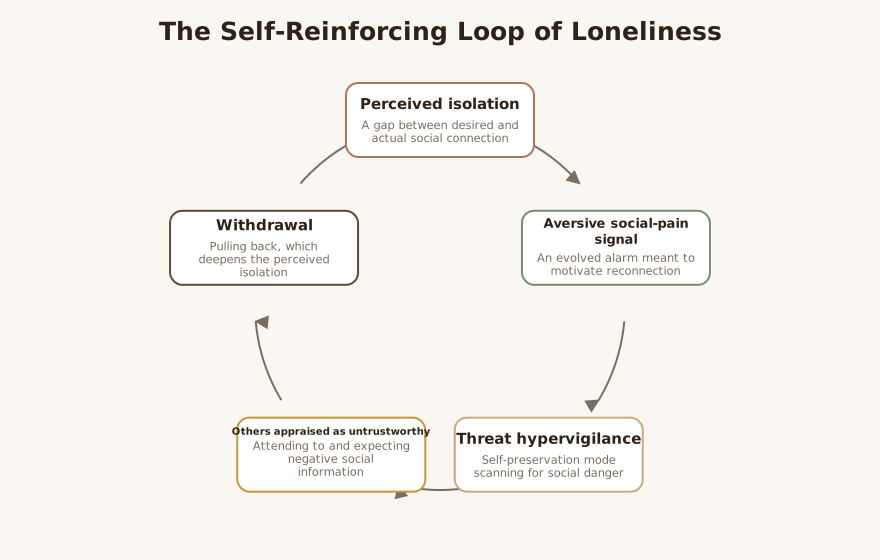
The third and clinically pivotal principle is that loneliness biases social cognition toward threat. The lonely brain enters a self-preservation mode marked by heightened, often nonconscious vigilance for social danger — a tendency to attend to, expect, and remember negative social information and to appraise others as less trustworthy 5. Research on visual attention indicates that lonely individuals more rapidly detect and dwell on socially threatening cues 5.
The fourth principle is the self-reinforcing loop, and it is what makes loneliness so clinically stubborn 4. Threat-biased cognition leads the lonely person to behave more guardedly, defensively, or withdrawn; others perceive this and reciprocate the distance; the resulting rejection confirms the original expectation of social danger; and loneliness deepens 4. The very state meant to drive reconnection can, when chronic, drive the opposite — a paradox at the heart of the model 4. A fifth principle is embodiment: chronic loneliness is accompanied by altered stress physiology, disrupted sleep, and elevated health risk, marking it as a whole-organism state rather than a purely emotional one 2.
Interventions & Techniques
ETL does not supply a discrete technique manual; it reframes loneliness so that clinicians target the right mechanism 2. Its most important clinical implication is counterintuitive: because loneliness is driven by maladaptive social cognition rather than a simple shortage of contact, interventions that merely increase social opportunity or teach surface social skills tend to underperform 2. The leverage point is the threat-biased appraisal system — the expectations, attention, and interpretations that make the lonely person experience neutral or ambiguous social cues as rejecting 5.
Accordingly, the work most consonant with ETL resembles cognitive restructuring applied to the social domain: helping clients notice and test the automatic expectation of rejection, surface and re-appraise hostile or self-deprecating social interpretations, and gradually disconfirm the prediction that connection is unsafe LLM. Psychoeducation is itself an intervention here — reframing loneliness as a normal, evolved signal (akin to hunger) rather than a shameful personal defect can reduce the self-blame that fuels withdrawal 1. Behavioral experiments that re-engage avoided social situations, paced to keep threat appraisals testable rather than overwhelming, follow naturally from the model LLM. Attention to sleep and physiological dysregulation is also warranted, given the embodied consequences the theory describes 2.
LLM-generated illustrative example (not a guideline): A recently widowed client declines repeated invitations from a long-standing friend group, reporting that “they’re just being polite — they don’t really want me there.” Rather than pushing more invitations (more contact), the clinician treats the prediction itself as the target: they map the automatic “they don’t want me” appraisal, examine the evidence, and design a small, low-stakes test (accepting one coffee invitation and noting what actually happens), working to disconfirm the threat expectation that is sustaining the withdrawal LLM.
Evidence Base
ETL is best characterized as an established and influential theory, well-cited and integrated across social psychology, behavioral medicine, and neuroscience, rather than a standalone treatment with its own randomized-trial base 1. The core consequence-and-mechanism claims — that loneliness predicts poorer mental and physical health and operates through identifiable cognitive and physiological pathways — are anchored in a substantial review literature 2. Hawkley and Cacioppo’s review synthesizes evidence that perceived isolation is associated with adverse health outcomes and dysregulated stress and cardiovascular physiology 2. The neuroscience of loneliness has been surveyed in work mapping the brain systems implicated in perceived social isolation, supporting the claim that loneliness is a genuine biological state and not merely a mood 3.
Honesty about maturity is warranted. The theory is “established” in the sense of being well-developed, broadly disseminated, and grounded in a strong base of observational, longitudinal, and experimental findings on mechanisms and consequences 2. Much of the supporting evidence is correlational and longitudinal rather than experimental, so directionality — how much loneliness causes poor health versus accompanies it — remains an area of active inference rather than settled fact 2. Crucially, ETL is a model of why loneliness arises and persists, not an outcome-validated treatment package; the clinical claim that targeting maladaptive social cognition outperforms contact-only or skills-only approaches derives from intervention reviews in this tradition and should be delivered through, and evaluated within, established therapies 2. Clinicians should therefore treat ETL as a powerful explanatory and organizing model, while grounding measurable claims of efficacy in the evidence-based modalities through which its principles are operationalized LLM.
Populations & Indications
ETL is broadly relevant wherever perceived social isolation is a presenting or maintaining factor, and it is especially illuminating for populations facing disrupted or diminished connection 2. Older and socially isolated adults are a central group, given the elevated rates of loneliness and its links to morbidity and mortality risk in later life 2. Bereaved and widowed individuals face emotional loneliness — the loss of a specific attachment figure — that contact with a wider network may not relieve LLM.
The model is clinically useful for adults with social anxiety and for those with depression, where threat-biased social cognition and withdrawal overlap with, and can be intensified by, the loneliness loop 4. Recently relocated, divorced, or separated individuals encounter abrupt drops in felt connection that the theory frames as an active alarm state rather than a passing adjustment LLM. People with chronic illness or disability may experience both reduced opportunity for connection and heightened sensitivity to perceived social rejection LLM. Adolescents and young adults, navigating identity and belonging during a developmentally sensitive period, are an important indication, and accessible framings of the social-neuroscience account have been written specifically to help younger audiences understand that loneliness is common and not a personal failing 7.
Problems-for-Work
ETL is organized around perceived social isolation — loneliness itself — as the core clinical problem, defined by the gap between desired and actual connection rather than by objective network size 2. From this it identifies a set of maintaining problems that become natural targets of treatment 4.
Hypervigilance to social threat is the cognitive engine of the loop: clients scan for, expect, and over-weight signs of rejection, so a therapeutic aim is to make this bias visible and testable 5. Negative self- and other-appraisals — “I’m a burden,” “people can’t be trusted” — are the appraisal content that sustains the threat bias and a direct target for re-evaluation 4. Social withdrawal and avoidance are the behavioral output that confirms the client’s predictions and that behavioral re-engagement is meant to interrupt 4. Depressed mood frequently co-occurs and can be both a cause and a consequence of the loneliness loop 4. Grief and bereavement present as emotional loneliness requiring restoration of intimate connection, not merely social activity LLM. Sleep disturbance and dysregulated stress physiology mark the embodied face of chronic loneliness and warrant direct clinical attention 2.
LLM-generated illustrative example (not a guideline): A client who relocated for work describes scrolling past colleagues’ group photos and concluding “they left me out on purpose,” then declining the next team lunch. The clinician frames this aloud as the loneliness alarm doing its job too well — flagging threat where there is ambiguity — and they collaboratively design a behavioral test of the “left out on purpose” appraisal rather than treating the deficit as a lack of invitations LLM.
Contraindications, Cautions & Cultural Humility
ETL is a conceptual lens rather than a procedure, so it carries no formal contraindications of its own; cautions instead attach to how it is used LLM. The most important caution is overreach: the framework should not be presented to clients or in records as an empirically validated standalone treatment, because it is a mechanistic theory delivered through other modalities 2. A second caution is invalidation — using the “perception, not reality” framing in a way that implies a client’s loneliness is “all in their head.” The threat bias is real and consequential, and some clients genuinely do face hostile, rejecting, or unsafe social environments; the clinician must distinguish a maladaptive appraisal from an accurate read of a harmful context before treating it as a distortion LLM.
A theory built on evolved norms for connection also risks importing culturally specific assumptions about what “enough” connection looks like. Desired levels and forms of social engagement, norms around solitude, family interdependence, and the meaning of belonging vary substantially across cultures, so the discrepancy at the heart of loneliness must be defined against each client’s own expectations rather than a presumed universal standard LLM. Structural drivers of isolation — poverty, discrimination, disability access, displacement, ageism — can produce loneliness that is not primarily a matter of biased cognition, and the model should not be used to individualize what are in part social and material problems LLM. Finally, framing loneliness as an evolved alarm should reduce shame, not pathologize a normal human signal 1.
Treatment-Plan Suggestions & SMART Objectives
| Goal | SMART objective (example) | Mechanism |
|---|---|---|
| Reduce perceived social isolation | Within 12 weeks, client’s self-reported loneliness (e.g., a validated brief loneliness measure) decreases by a clinically meaningful margin from baseline | Closing the desired-vs-actual connection gap by targeting appraisal and behavior, not just contact 2 |
| Identify the threat bias | Within 6 weeks, client names the automatic “expect rejection” pattern in 4 of 5 sessions when reviewing a recent social event | Making nonconscious hypervigilance to social threat explicit and observable 5 |
| Re-appraise hostile social interpretations | Over 10 weeks, client generates an alternative, non-rejecting interpretation for an ambiguous social cue in 3 of 4 logged instances | Cognitive re-evaluation of negative self/other appraisals that sustain the loop 4 |
| Reverse social withdrawal | Within 8 weeks, client completes one pre-planned behavioral test of an avoided social situation per week | Disconfirming the prediction that connection is unsafe; interrupting avoidance 4 |
| Normalize loneliness (reduce shame) | By session 4, client can describe loneliness as an evolved signal rather than a personal defect, in their own words | Psychoeducation that lowers self-blame and reduces shame-driven withdrawal 1 |
| Strengthen one close (emotional) bond | Over 12 weeks, client increases the depth/frequency of contact with one intimate confidant, tracked weekly | Addressing emotional loneliness, which network size alone does not relieve LLM |
| Address embodied consequences | Within 6 weeks, client implements a consistent sleep-hygiene routine and reports improved sleep on 4 of 7 nights | Mitigating the disrupted sleep and stress physiology of chronic loneliness 2 |
Common Misconceptions
A frequent misconception is that loneliness is simply a shortage of people and that the cure is more contact; ETL holds that loneliness is a perceived discrepancy and that the lonely person’s threat-biased cognition can blunt or even sabotage the benefit of added contact 2. A related error is conflating loneliness with objective isolation or with introversion — one can be objectively isolated yet content, or surrounded by people yet acutely lonely 2.
A third misconception is that loneliness is a character weakness or a sign of being unlikeable; the theory’s whole thrust is that loneliness is an evolved, adaptive alarm shared across an obligatorily social species, no more a flaw than hunger is 1. A fourth is treating the model as a validated therapy you can be “certified in” and deliver as such; its strength is explanatory, and its clinical claims are realized through established modalities 2. Finally, the threat-bias finding is sometimes misread as meaning lonely people are paranoid or irrational, when it describes an automatic, nonconscious self-protective shift in attention and appraisal that made adaptive sense in environments where social exclusion was dangerous 5.
Training & Certification
There is no single credentialing body or formal certification in the Evolutionary Theory of Loneliness, consistent with its status as a theory rather than a manualized treatment 1. Clinicians typically acquire it through primary reading — most directly Cacioppo’s formal statement of the theory and the trade book Loneliness: Human Nature and the Need for Social Connection — alongside the peer-reviewed review literature on its mechanisms and consequences 14. Hawkley and Cacioppo’s review and the neuroscience survey provide the empirical and biological grounding clinicians need to use the model responsibly 23.
Accessible secondary material can support both clinician understanding and client psychoeducation: feature pieces on how lonely individuals perceive threat and on the broader nature of loneliness translate the science for general audiences, and a plain-language article written for younger readers conveys the core ideas without jargon 567. In practice, therapists operationalize ETL by integrating it into training in cognitive-behavioral and interpersonal therapies, where the model’s emphasis on appraisal, attention, and behavioral re-engagement maps onto established techniques LLM.
Key Terms
- Perceived social isolation: The subjective experience of a gap between desired and actual social connection; the operational definition of loneliness in the model 2.
- Social pain / evolved aversive signal: Loneliness conceived as an unpleasant-by-design alarm, analogous to hunger or physical pain, that motivates reconnection 1.
- Hypervigilance to social threat: The lonely brain’s heightened, often nonconscious bias toward detecting, expecting, and remembering negative social information 5.
- Self-reinforcing loop: The cycle in which threat-biased cognition prompts guarded or withdrawn behavior, which elicits distance from others, which confirms the expectation of rejection and deepens loneliness 4.
- Social vs. emotional loneliness: Weiss’s distinction between lacking an engaging network (social) and lacking an intimate attachment figure (emotional) LLM.
- Self-preservation mode: The defensive, self-protective cognitive-physiological state into which chronic loneliness shifts the organism 5.
Resources & Further Reading
▶ Watch — a video introduction to this concept:
- Loneliness in the Modern Age: An Evolutionary Theory of Loneliness (ETL)
- Loneliness Matters: A Theoretical and Empirical Review of Consequences and Mechanisms (PMC)
- Toward a Neurology of Loneliness (PMC)
- Loneliness: Human Nature and the Need for Social Connection (W. W. Norton)
- How the Lonely Perceive Threats (Cognitive Neuroscience Society)
- The Nature of Loneliness (University of Chicago Magazine)
- Do You Feel Lonely? You Are Not Alone: Lessons from Social Neuroscience (Frontiers for Young Minds)
Reflective / Supervision Questions
- When a client reports being rejected, how do I distinguish a maladaptive threat appraisal from an accurate read of a genuinely hostile or unsafe social environment? LLM
- Am I targeting the maladaptive social cognition that sustains loneliness, or defaulting to “just get out more” advice that the model predicts will underperform? 2
- How do I use the “loneliness as evolved signal” framing to reduce a client’s shame without invalidating the reality of their pain? 1
- Where might my assumptions about how much connection is “enough” reflect culturally specific norms rather than this client’s own expectations? LLM
- For a bereaved or recently isolated client, am I attending to emotional loneliness (one intimate bond) and not only social loneliness (network size)? LLM
- Am I representing ETL honestly in my formulation — as a mechanistic rationale delivered through an evidence-based modality, rather than as a validated standalone treatment? 2