
Type & Discipline
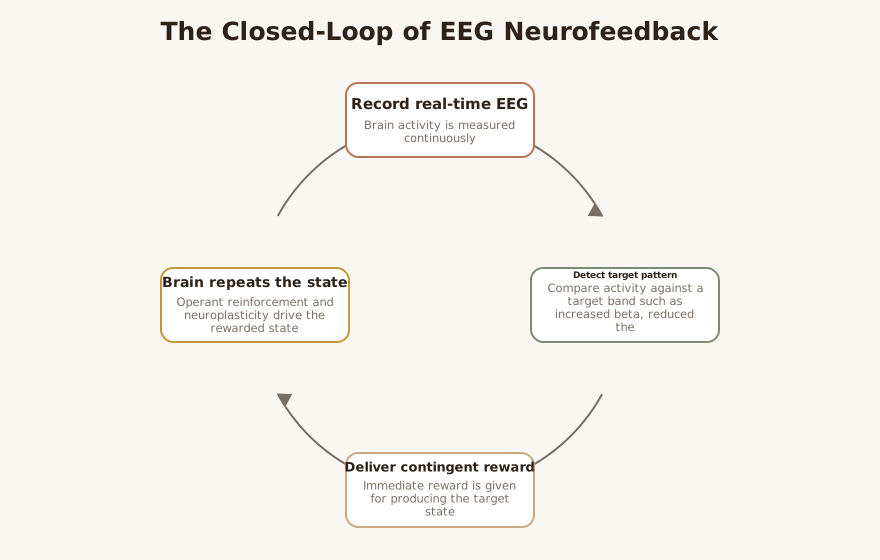
Neurofeedback (also called EEG biofeedback) is a technology-mediated, adjunctive technique rather than a freestanding school of psychotherapy, situated within the broader family of biofeedback 1. Procedurally, sensors on the scalp detect cortical electrical activity, software amplifies and decodes that signal, and the system delivers visual or auditory feedback so that the client can learn to shift their own brain patterns 1. The defining mechanism is operant conditioning: because the feedback follows the brain’s signal almost immediately, the brain tends to repeat the patterns that produce the reward, usually a sound or a moving video 1.
It is most accurate to describe neurofeedback as a self-regulation training procedure layered on top of conventional care, not a replacement for it 5. The technique trains voluntary modulation of brainwave patterns thought to be linked to attention, arousal, and cognitive control, on the premise that repeated practice produces durable, neuroplastic change 5. For clinicians, the honest framing is that neurofeedback is an established and widely used technique whose procedure is well specified, but whose specific efficacy beyond placebo is genuinely contested 6 2.
Creators & Lineage
The intellectual scaffolding predates the technology. Edward Thorndike’s 1898 “law of effect” established that behavior is shaped by satisfying or discomforting consequences, supplying the operant-conditioning logic neurofeedback runs on 6. Hans Berger made the technique possible in 1924 by attaching electrodes to the scalp and detecting brain currents, founding electroencephalography (EEG) 6. Joe Kamiya reported the first neurofeedback study in 1962, training subjects to distinguish their own alpha states through auditory feedback 6.
The figure most associated with clinical neurofeedback is M. Barry Sterman, who trained cats to enhance a sensorimotor rhythm (SMR) and then made the field’s defining serendipitous observation: SMR-trained cats were markedly more resistant to chemically induced seizures than untrained cats, and in 1971 he reported similar improvement in an epileptic patient 6. Joel Lubar extended Sterman’s EEG-biofeedback work from epilepsy into hyperactivity and ADHD, which is why ADHD remains the most heavily studied indication today 6. The lineage therefore runs through operant conditioning and behavioral therapy, the development of EEG, and self-regulation theory, and the modern field is organized professionally around bodies such as the International Society for Neuroregulation & Research 6 1.
Core Principles
The first principle is closed-loop operant learning of brain states. The client is not passively stimulated; they receive contingent reward for producing a target EEG pattern, and the immediacy of that reward is what drives the brain to repeat the rewarded state 1. Neurofeedback is grounded in operant conditioning and is theorized to modify dysfunctional brainwave patterns through repeated reinforcement and neuroplasticity 5.
The second principle is that specific frequency bands map onto specific clinical states, most famously in ADHD. The classic model holds that many people with ADHD show cortical hypoarousal in frontal areas, with excess theta and a deficit of beta, so training aims to increase beta and reduce theta to improve attention 2. This theta/beta framework remains the canonical target, but clinicians should hold it loosely: recent research questions the reliability of the theta/beta ratio as an ADHD biomarker, with only roughly 30% of patients with ADHD actually showing an elevated ratio 5.
The third principle is that ADHD is neurophysiologically heterogeneous, which motivates personalization. Quantitative EEG (qEEG) clustering can sort patients into distinct subtypes — broadly hypoarousal, delayed maturation, and hyperarousal — which supports matching protocol to profile rather than applying one protocol to everyone 5. The fourth, and the one most easily oversold, is durability: proponents argue that because neurofeedback teaches a skill, gains can persist or even grow after training ends, in contrast to medication’s purely symptomatic action 3. This durability claim is supported in some long-term data but should be presented as a hypothesis, not a settled fact 5 LLM.
Interventions & Techniques
Three standard protocols dominate the ADHD literature and define the technique in practice. Theta/Beta training targets cortical hypoarousal by reducing theta and increasing beta over a course commonly described as 20–40 sessions 5. Sensorimotor Rhythm (SMR) training, the protocol descended directly from Sterman’s seizure work, addresses delayed maturation through reduction of slow-wave activity, typically over 30–40 sessions 5. Slow Cortical Potential (SCP) training targets hyperarousal subtypes and is delivered over 30 or more sessions 5. A full course of neurofeedback of any protocol generally runs 20–40 sessions or more, which is a substantial commitment of time and cost 1 2.
Beyond these fixed protocols, the more sophisticated approach is personalization via qEEG: the protocol is individually adjusted to the patient’s baseline EEG signal rather than applied generically, and pooled data suggest this substantially outperforms non-personalized training 3. The other major refinement is multimodal delivery, in which neurofeedback is combined with counseling on sleep and nutrition, parent training, or behavioral therapy rather than used in isolation 3.
LLM-generated illustrative example (not a guideline): A clinician working with an 11-year-old with inattentive-presentation ADHD obtains a qEEG, identifies a hypoarousal profile with elevated frontal theta, and selects a theta/beta protocol delivered twice weekly. During each session the child plays a video game that advances only while they sustain the target beta state; the clinician simultaneously coaches the parents on consistent sleep timing and homework routines, treating the neurofeedback as one component of a multimodal plan rather than the whole treatment. LLM
Evidence Base
The evidence base is best described as established but genuinely contested, and clinicians should be able to hold both halves of that statement at once. On the supportive side, a systematic review and meta-analysis classified standard EEG neurofeedback protocols (theta/beta, SMR, and SCP) as “well-established” and “efficacious and specific,” with remission rates of 32–47% in randomized trials, and reported that effect sizes remained stable or even increased over long-term follow-up without additional treatment — a pattern that distinguishes it from medication’s symptomatic action 3. That same review found that personalized, qEEG-informed protocols reached a 57% remission rate with an effect size near 1.97, comparable to medication monotherapy, and that multimodal packages outperformed neurofeedback alone 3. A second systematic review of neurofeedback protocols in ADHD reflects this continued, serious academic interest in which protocols work and for whom 4.
The contesting evidence is equally important and concerns blinding. In the same body of work, sham-neurofeedback control groups produced large effects of their own — in one trial roughly 1.28 pre-post — which means much of the apparent benefit is non-specific 3. The 2025 review estimates that placebo effects account for roughly 40% of acute improvement, dropping to about 15% at six-month follow-up, and concludes that long-term efficacy and comparability to medication remain inconclusive 5. CHADD’s Professional Advisory Board judges “possibly efficacious” a more accurate label than “probably efficacious” and argues the treatment is better classified as an “Option” than a “Clinical Guideline,” because the underlying studies are weakened by missing control groups, small samples, absent placebo controls, and inadequate blinding 2. Reflecting this, summaries outside the advocacy literature describe the clinical benefits of EEG neurofeedback as “tenuous,” with ADHD findings “controversial” and “mixed” once methodological quality is accounted for 6. The honest synthesis for a clinician is that neurofeedback reliably improves proximal, often unblinded outcomes and has decades of use behind it, but its specific efficacy over a credible sham is the live and unresolved question 3 5 6 LLM.
Populations & Indications
The population with by far the most research is children and adults with ADHD, the indication Lubar opened and where the standard protocols were developed and tested 6 5. People with epilepsy are the original clinical population, tracing directly to Sterman’s SMR seizure-resistance work, and seizure disorders remain a historically grounded application 6. Beyond these, neurofeedback is applied to anxiety disorders, mood disorders including depression, trauma and PTSD, insomnia, traumatic brain injury, pain and migraine, and to athletic and academic peak performance 1.
The strength of evidence falls off sharply outside ADHD and epilepsy. PTSD work is described as promising but limited by methodological concerns that prohibit firm conclusions, and depression effectiveness is characterized as uncertain and controversial with at most some symptom reduction 6. Trauma survivors, people with anxiety, and people with insomnia are therefore reasonable populations to consider neurofeedback for as an adjunct, but the clinician should frame these as extrapolations from a thinner literature rather than established indications 6 LLM. Athletes and others seeking performance enhancement are a common real-world population, but this use sits almost entirely outside the controlled clinical evidence and should be presented as such 1 LLM.
Problems-for-Work
Attention-deficit/hyperactivity disorder is the central problem-for-work, where theta/beta, SMR, or qEEG-personalized protocols map onto the presenting attention and arousal dysregulation, ideally within a multimodal plan 5 3. Concentration and attention deficits more broadly — including subclinical or comorbid attentional complaints — are a natural extension of the same training logic, with the caveat that the evidence concerns diagnosed ADHD 5 LLM. Epilepsy and seizures are the historically validated target for SMR training, though contemporary management is firmly medical and neurofeedback is at most adjunctive 6 LLM.
For emotional dysregulation, the self-regulation framing is intuitive — training voluntary control over arousal-linked rhythms — but clinicians should treat this as a mechanism-plausible, evidence-light application 5 LLM. Generalized anxiety, PTSD, insomnia, and migraine are each presentations for which neurofeedback is offered and for which some signal exists, but where the controlled evidence is thin enough that it should be positioned as a complement to first-line care, not a substitute 6 LLM. Across all of these, the defensible stance is that ADHD carries the strongest case and everything else is more provisional 3 6 LLM.
LLM-generated illustrative example (not a guideline): An adult client with longstanding generalized anxiety and persistent insomnia has plateaued on cognitive behavioral therapy and asks about neurofeedback. The clinician explains that the evidence here is preliminary, frames a trial of training as an adjunct to continued CBT-I and stimulus-control work rather than a replacement, sets a concrete review point at session 10, and agrees in advance to discontinue if no functional change in sleep onset is observed. LLM
Contraindications, Cautions & Cultural Humility
Neurofeedback is generally considered safe, and a standard course is described as 20–40 sessions or more, so the dominant risks are not physiological but practical: substantial time, substantial cost, and the opportunity cost of deferring better-supported care 1 2. CHADD explicitly advises parents to proceed cautiously, precisely because multimodal treatment for ADHD currently enjoys substantially greater research support 2. The clearest clinical caution is therefore one of sequencing and consent: neurofeedback should not displace first-line, guideline-supported treatments, and clients should be told plainly that much of the expected benefit may be non-specific 2 3 LLM.
A specific caution concerns home and direct-to-consumer kits, which lack professional supervision and research validation and should not be equated with clinician-delivered training 2. There is also a technical pitfall worth informed clinical respect: the direction of conditioning can in principle be reversed if feedback thresholds are set incorrectly, which underscores that competent setup matters 6. Finally, because the theta/beta-ratio model holds for only a minority of patients with ADHD, clinicians should avoid presenting a generic protocol as if it were individually validated for the person in front of them 5 LLM. Cultural humility here means resisting the technology’s halo: the EEG screen and “brain-training” language can lend an unearned aura of scientific certainty, and the clinician’s job is to translate honestly across literacy, language, and belief, neither overselling the neuroscience nor dismissing a client’s hope 6 LLM.
Treatment-Plan Suggestions & SMART Objectives
| Goal | SMART objective (example) | Mechanism |
|---|---|---|
| Reduce ADHD inattention | Over 30 sessions, reduce parent- and teacher-rated inattention by a clinically meaningful margin on a standardized scale | Theta/beta operant training of arousal-linked rhythms 5 3 |
| Personalize the protocol to the client | Obtain a baseline qEEG and select a profile-matched protocol before training begins | qEEG-informed personalization outperforming generic protocols 3 |
| Embed training in multimodal care | Pair neurofeedback with sleep, nutrition, and parent/behavioral counseling for the full course | Multimodal packages outperforming neurofeedback alone 3 |
| Improve sustained attention in session | Increase the proportion of session time spent in the target EEG state across successive sessions | Contingent reinforcement of the rewarded brain state 1 |
| Support emotional self-regulation | Client reports and demonstrates improved capacity to down-regulate arousal by end of course | Trained voluntary modulation of arousal-linked rhythms 5 |
| Set honest expectations and a stop rule | Define a review point (e.g., session 10–15) and discontinue if no functional change is observed | Guarding against time and cost in a partly non-specific treatment 2 |
| Confirm and consolidate gains | Re-administer the primary outcome measure at follow-up to test durability | Re-evaluation of trained targets and durability check 3 |
| Coordinate with first-line care | Document that guideline-supported treatments remain in place alongside training | Adjunctive positioning consistent with current evidence 2 |
Common Misconceptions
A first misconception is that neurofeedback “rewires the brain” in a way that is established and specific; the more defensible statement is that it trains self-regulation through operant conditioning, and that how much of the benefit is specific to the brain training versus shared with placebo remains contested 1 5. A second is that the theta/beta ratio is a validated ADHD biomarker for everyone; in fact only about 30% of patients with ADHD show an elevated ratio, and its reliability as a biomarker has been questioned 5. A third is that the strong remission rates reported in some reviews settle the efficacy question, when sham-neurofeedback groups can produce large effects of their own and placebo accounts for a substantial share of acute improvement 3 5.
A fourth misconception is that neurofeedback is interchangeable across conditions; the evidence is concentrated in ADHD and epilepsy, and applications to PTSD, depression, anxiety, and insomnia are more preliminary 6. A fifth is that home or consumer “brain-training” kits are equivalent to clinician-delivered protocols, when they lack supervision and validation 2. Finally, the impression that neurofeedback is a fast or one-and-done intervention is wrong: a typical course is 20–40 sessions or more, a real burden for families 1 2.
Training & Certification
Neurofeedback is delivered by licensed professionals, and the field’s own guidance is that practitioners should demonstrate competency through proper training on the specific equipment and software by the manufacturer, plus neurofeedback-specific training from a qualified licensed professional 1. The field is organized around professional societies such as the International Society for Neuroregulation & Research, which articulate these competency expectations 1. In the ADHD context, CHADD notes that clinician-delivered neurofeedback typically requires doctoral-level psychologists and is correspondingly expensive, which is part of the access and cost picture clinicians should be transparent about 2.
Because the technique involves contingent EEG feedback whose direction depends on correct threshold setup, competent training is not a formality — incorrect parameters can in principle reinforce the wrong direction 6. Clinicians weighing a neurofeedback credential should evaluate it as they would any technology-mediated method: confirm what the training actually authorizes, scrutinize the proprietary equipment and its claims, and keep promotional language about “brain optimization” out of their own informed-consent process given the contested specificity of the evidence 1 5 LLM.
Key Terms
- EEG biofeedback: Another name for neurofeedback, reflecting that the feedback signal is derived from the electroencephalogram 1.
- Operant conditioning: The learning principle, descended from Thorndike’s law of effect, by which contingent reward shapes the brain toward the rewarded state 1 6.
- Theta/beta training: The canonical ADHD protocol aimed at reducing theta and increasing beta to address frontal cortical hypoarousal 2 5.
- Sensorimotor rhythm (SMR): The rhythm Sterman trained in cats and the protocol descended from his seizure-resistance work 6 5.
- Slow cortical potentials (SCP): A protocol targeting hyperarousal subtypes through training of slow EEG shifts 5.
- Quantitative EEG (qEEG): A baseline EEG analysis used to identify ADHD subtypes and personalize the training protocol 5 3.
- Sham neurofeedback: A placebo-control condition that delivers non-contingent feedback and is essential for testing specific efficacy 3.
- Possibly vs. probably efficacious: APA-style evidence labels; CHADD favors “possibly efficacious” for neurofeedback in ADHD 2.
Resources & Further Reading
▶ Watch — a video introduction to this concept:
- What is Neurofeedback? — International Society for Neuroregulation & Research (ISNR)
- Neurofeedback (EEG Biofeedback) — CHADD
- Treatment Efficacy and Clinical Effectiveness of EEG Neurofeedback as a Personalized and Multimodal Treatment in ADHD (PMC)
- Clinical efficacy of neurofeedback protocols in treatment of ADHD: A systematic review (ScienceDirect)
- Neurofeedback for ADHD: Exploring the Role of Quantitative EEG and Brainwave Modulation (Brain and Behavior, 2025, PMC)
- Neurofeedback (Wikipedia)
Reflective / Supervision Questions
- For this client, can I justify neurofeedback over a first-line, guideline-supported treatment for ADHD on grounds beyond client preference or my familiarity with the equipment? 2 LLM
- How am I describing the role of placebo and non-specific effects to clients, given that sham-controlled signal is the unresolved question? 3 5
- Am I treating the theta/beta-ratio model as if it applied to this client when it holds for only a minority of patients with ADHD? 5 LLM
- Have I set a concrete review point and stop rule so a 20–40-session course does not drift on without functional change? 1 2 LLM
- When I extend neurofeedback to anxiety, PTSD, or insomnia, am I framing it honestly as an under-evidenced adjunct rather than an established treatment? 6 LLM
- How do I keep the technology’s scientific halo from overstating certainty in my informed-consent conversation? 6 LLM