
Type & Discipline
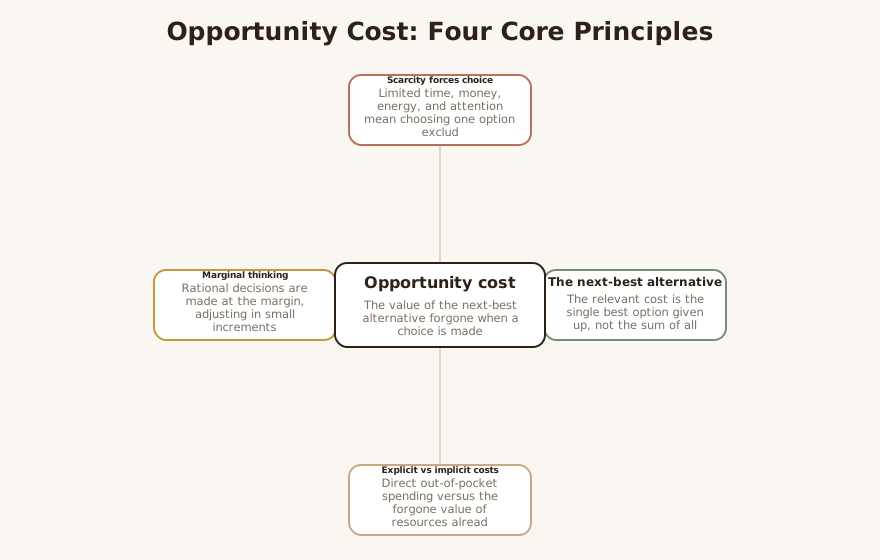
Opportunity cost is a construct drawn from economics, not a therapy in its own right. 1 It belongs to the family of microeconomic decision theory, where it functions as one of the foundational principles for understanding how rational agents allocate scarce resources. 3 Formally, it is defined as “the value of the best alternative forgone where, given limited resources, a choice needs to be made between several mutually exclusive alternatives.” 1 More plainly, it is the value of the next-highest-valued use of a resource that you give up when you commit that resource elsewhere. 3
For clinicians, the relevance is not that we treat economics but that opportunity cost names a cognitive operation our clients perform constantly, often invisibly and often badly. LLM Every choice to do one thing is simultaneously a choice not to do everything else, and the felt weight of those forgone alternatives shapes procrastination, avoidance, rumination, and regret. LLM Because the construct is rigorously defined and intuitively graspable, it travels well into psychoeducation, motivational work, and values clarification. LLM
Creators & Lineage
The provided reference material treats opportunity cost as established microeconomic theory and does not attribute it to a single originator, instead presenting it as a settled organizing principle of how scarcity forces choice. 1 The construct is inseparable from the economic premise that resources are limited: because we face “limits to what we can do” and “every time we do one thing we necessarily have to forgo doing something else desirable,” opportunity costs are unavoidable and apply to every decision. 3
Within healthcare and clinical contexts, opportunity cost has been carried into applied decision-making literature as a way of reasoning about how finite time, attention, and resources are deployed. 6 In psychotherapy, the construct has no formal lineage of its own; rather, it has been absorbed informally into several evidence-based traditions. LLM Its conceptual cousins in the clinical world include behavioral economics, which studies how people actually (rather than ideally) weigh costs and benefits; cognitive behavioral therapy, which examines the appraisals and predictions driving behavior; motivational interviewing, which explicitly weighs the costs and benefits of change; and acceptance and commitment therapy, which reframes the “cost” of avoidance against the value of committed action. LLM
Core Principles
The first principle is scarcity forces choice. 3 Because no one has unlimited time, money, energy, or attention, selecting any option necessarily excludes others, and the cost of the chosen path is the value of the best path not taken. 3 This is captured in the maxim that “there’s no such thing as a free lunch”: even ostensibly free goods carry hidden costs, such as the time and attention an internet service consumes. 3
The second principle is that the relevant cost is the next-best alternative, not the sum of all alternatives. 1 Opportunity cost is singular and comparative; it asks only “what is the single best thing I am giving up,” which keeps the calculus tractable. LLM The third principle distinguishes explicit from implicit costs. 1 Explicit costs are direct, out-of-pocket expenditures, while implicit costs are the forgone value of resources one already owns, such as one’s own unpaid time. 1 When a person leaves an hour of paid work to run an errand, the explicit cost is the cash spent and the implicit cost is the wage forgone. 1
The fourth principle is marginal thinking: rational decisions are made at the margin, where a person adjusts behavior until the benefit of one more unit equals the opportunity cost of the alternative forgone. 3 The fifth principle is the firm exclusion of sunk costs: costs already incurred and irrecoverable should not influence present decisions, because they cannot change future outcomes. 1 This sunk-cost distinction is clinically potent, because much human suffering comes from honoring sunk costs (“I’ve already put years into this”) rather than weighing forward-looking opportunity costs. LLM
Interventions & Techniques
Opportunity cost itself is not a technique but a frame that can be operationalized inside existing techniques. LLM The most direct application is psychoeducation: making the invisible cost visible by naming what a behavior is “buying” and what it is costing in forgone alternatives. LLM In behavioral activation for depression, this often means helping a client see that a day spent in bed is not “free” but purchased at the cost of mastery, pleasure, and connection that the alternative activities would have produced. 3
A second technique is the decisional balance, native to motivational interviewing, in which the costs and benefits of changing versus not changing are made explicit, including the opportunity costs of staying the same. LLM A third is values clarification and the cost of avoidance, central to acceptance and commitment therapy, where the clinician helps the client price out what experiential avoidance is costing them in terms of valued living. LLM
A fourth, more cognitive technique addresses distorted opportunity-cost appraisals. LLM Anxious and perfectionistic clients frequently overestimate the opportunity cost of imperfect or “wrong” choices, treating every decision as if a vastly better alternative were being squandered, which fuels indecision. LLM Reality-testing these inflated forgone alternatives is a recognizable cognitive restructuring move. LLM A fifth technique targets the sunk-cost fallacy directly, coaching clients to disregard irrecoverable past investments and decide based on the best alternative available now. 1
LLM-generated illustrative example (not a guideline): A client with generalized anxiety spends ninety minutes each evening “researching” the optimal choice before any purchase, terrified of the better deal they might miss. The clinician reframes: the ninety minutes is itself the cost — time forgone from sleep, partner, and rest — and the “perfect choice” rarely outperforms a good-enough one by enough to justify the spent hours. LLM
Evidence Base
Honesty requires a split assessment. LLM As an economic construct, opportunity cost is established: it is a settled, non-controversial pillar of microeconomic theory, treated as foundational across reference, academic, and applied sources. 1 3 Its validity within economics does not depend on clinical trials; it is a definitional and logical principle about choice under scarcity. 3
As a psychotherapeutic application, however, opportunity cost is not an evidence-based treatment with its own trial literature. LLM It is a borrowed conceptual lens embedded within modalities that do have evidence bases of their own — cognitive behavioral therapy, behavioral activation, motivational interviewing, and acceptance and commitment therapy. LLM Clinicians should therefore present it as a useful heuristic and psychoeducational frame, not as an empirically validated intervention in its own right. LLM Its applied use in healthcare decision-making is documented, reinforcing that the construct transfers usefully into clinical reasoning, but that is a different claim than demonstrating therapeutic efficacy. 6 The appropriate stance is that opportunity cost earns its place by sharpening the delivery of established techniques, not by carrying independent evidentiary weight. LLM
Populations & Indications
The construct is most useful for clients whose presenting problems hinge on choice, action, and the felt weight of alternatives. LLM Individuals with depression and avolition benefit because opportunity-cost framing reframes inactivity as a costly choice rather than a neutral default, supporting behavioral activation. 3 Procrastinators and perfectionists benefit because much of their distress comes from miscalculating the cost of starting versus the mounting cost of delay. LLM
People facing major life decisions — career changes, relationships, relocations, education — are working explicitly in the currency of forgone alternatives, as in the classic comparison of attending college versus entering the workforce, where each path sacrifices the distinctive gains of the other. 2 Adults with executive functioning difficulties and people with ADHD often struggle to make future opportunity costs feel salient against immediate options, so externalizing the trade-off can aid planning. LLM Clients in values-based therapy use the frame to weigh the cost of avoidance against valued action. LLM The construct is broadly applicable across adult outpatient populations and requires the cognitive capacity for abstract comparison, which is worth assessing before leaning on it. LLM
Problems-for-Work
Procrastination and avoidance behavior. The clinician helps the client see that postponement is not cost-free; the comfort of avoidance is purchased at the price of the forgone valued activity and of compounding future stress. 3 For example, naming that “another week of not calling the doctor” costs reassurance, early treatment, and reduced dread reframes avoidance as an active, costly choice. LLM
Indecision and avoidant decision-making. Here the client typically inflates the opportunity cost of choosing “wrong,” paralyzed by the imagined superior alternative. LLM Work focuses on right-sizing the actual gap between options and accepting that any choice forecloses others, which is the normal condition of all decisions, not a failure. 1
Anhedonia and behavioral activation deficits in major depressive disorder. Opportunity-cost framing supports activation by pricing the cost of withdrawal in lost mastery and pleasure. 3 Worry and rumination in generalized anxiety disorder. The clinician highlights that time spent ruminating is time forgone from living, treating worry itself as a costly activity competing with valued alternatives. LLM Perfectionism. Work targets the inflated belief that anything short of optimal squanders a vastly better forgone outcome. LLM Relapse in substance use disorder. Decisional-balance work makes explicit what continued use costs in forgone health, relationships, and goals. LLM
Contraindications, Cautions & Cultural Humility
Opportunity-cost reasoning can backfire if applied clumsily. LLM With anxious, ruminative, or obsessional clients, dwelling on everything being forgone can intensify rather than relieve distress, turning the frame into fresh fuel for maximizing and regret. LLM The clinician should watch for clients who weaponize the construct against themselves, treating every ordinary choice as a tragic loss. LLM
The construct carries an individualistic, agentic assumption — that the person has meaningful freedom to choose among alternatives — which may not fit clients facing structural constraints, poverty, discrimination, or coercive circumstances where “alternatives” are largely theoretical. LLM Framing a person’s situation as a matter of weighing forgone options can feel invalidating when real choice is constrained, so cultural humility means first assessing the actual menu of options a client has. LLM In collectivist contexts, the relevant “best alternative” may be defined by family or community obligation rather than individual benefit, and the clinician should let the client define value rather than imposing an individualist calculus. LLM Finally, because opportunity cost is “hard to quantify” and based on hypothetical outcomes, it should be held loosely as a heuristic, never as a precise ledger that produces a single correct answer. 2
Treatment-Plan Suggestions & SMART Objectives
| Goal | SMART objective (example) | Mechanism |
|---|---|---|
| Reduce procrastination | Client will initiate one avoided task within 10 minutes of a planned start time, 5 of 7 days per week, for 3 weeks | Makes the cost of delay salient against the value of action 3 |
| Improve decision-making | Client will make and act on 3 low-stakes decisions per week within a self-set 15-minute limit, over 4 weeks | Right-sizes inflated opportunity cost of “wrong” choices 1 |
| Increase behavioral activation | Client will schedule and complete 4 mastery/pleasure activities weekly for 4 weeks, rating cost of withdrawal afterward | Reframes inactivity as a costly forgone choice 3 |
| Reduce rumination | Client will redirect from worry to a valued activity within 5 minutes, logging 4 instances weekly for 3 weeks | Treats rumination time as competing with valued alternatives LLM |
| Counter perfectionism | Client will submit 2 “good-enough” work products without revision past a set deadline each week for 4 weeks | Tests the inflated value of the forgone “perfect” alternative LLM |
| Strengthen relapse prevention | Client will complete a written decisional balance weekly, listing forgone goals tied to use, for 6 weeks | Surfaces opportunity cost of continued use LLM |
| Disrupt sunk-cost reasoning | Client will identify one decision per week made forward-looking rather than on past investment, for 4 weeks | Excludes irrecoverable sunk costs from present choice 1 |
Common Misconceptions
A first misconception is that opportunity cost is the sum of all forgone alternatives; in fact it is the value of only the single next-best alternative given up. 1 A second is conflating opportunity cost with sunk cost: sunk costs are already incurred and irrecoverable and should be excluded from decisions, whereas opportunity cost is forward-looking and decision-relevant. 1
A third misconception is that opportunity cost involves only money; time, attention, and energy are equally subject to it, and indeed the largest cost of attending college is often the forgone earnings rather than tuition. 3 A fourth is the assumption that some choices are truly free; the principle that there is no free lunch holds that even apparently free goods carry hidden costs in time or attention. 3 A fifth, clinically important misconception is that opportunity cost yields a precise, calculable answer; because it rests on hypothetical outcomes, it is genuinely hard to quantify and functions as a directional heuristic rather than an exact figure. 2
Training & Certification
There is no certification in “opportunity cost,” because it is a conceptual construct rather than a credentialed modality. LLM Clinicians acquire fluency through the evidence-based modalities that house it: training in cognitive behavioral therapy provides the cognitive-restructuring scaffolding for addressing distorted cost appraisals, training in motivational interviewing supplies the decisional-balance method, and training in acceptance and commitment therapy supplies the values-and-avoidance framing. LLM Foundational economic literacy in the construct can be developed directly from accessible reference and explainer sources on opportunity cost. 1 2 3 The practical training task for a therapist is not learning new economics but learning to translate the construct into plain, non-shaming language at the bedside, which is best developed through supervision and deliberate practice. LLM
Key Terms
Opportunity cost — the value of the best (next-highest-valued) alternative forgone when a choice is made among mutually exclusive options. 1 Scarcity — the fundamental condition of limited resources that forces trade-offs and makes opportunity cost unavoidable. 3 Explicit cost — a direct, out-of-pocket expenditure of cash or resources. 1 Implicit cost — the forgone value of a resource one already owns, such as one’s own time, which involves no cash exchange. 1
Marginal analysis — decision-making at the margin, adjusting behavior until marginal benefit equals marginal opportunity cost. 3 Sunk cost — a cost already incurred and irrecoverable, which should be excluded from present and future decisions. 1 Trade-off — the relationship between mutually exclusive options whereby gaining one means forgoing another. 2 “No free lunch” — the principle that apparently free goods still carry hidden costs in time, attention, or forgone alternatives. 3
Resources & Further Reading
▶ Watch — a video introduction to this concept:
- Opportunity cost — Wikipedia
- Opportunity Cost: Definition, Examples, & Practical Application — Britannica Money
- Opportunity Cost — Econlib / Library of Economics and Liberty
- Real-Life Examples of Opportunity Cost — Federal Reserve Bank of St. Louis
- Opportunity cost — American Journal of Health-System Pharmacy
Reflective / Supervision Questions
- When I introduce opportunity-cost language with a client, am I clarifying their choices or inadvertently amplifying their regret and self-criticism? LLM
- For this particular client, is “choice among alternatives” an accurate description of their situation, or do structural and material constraints make their menu of options far narrower than the frame assumes? LLM
- How do I distinguish, in session, between a client honoring a sunk cost (“I’ve already invested so much”) and a client genuinely weighing a forward-looking opportunity cost? 1
- Whose definition of “value” am I using when I help a client price their forgone alternatives — theirs, their family’s, or my own culturally situated assumptions? LLM
- Am I presenting opportunity cost honestly as a heuristic embedded in evidence-based modalities, rather than overselling it as a validated intervention on its own? LLM
- Where in my own caseload management am I ignoring opportunity cost — spending time on low-yield activities at the expense of higher-value clinical work? 6