
Type & Discipline
Biofeedback is a technique rather than a freestanding school of psychotherapy: a process that enables an individual to learn how to change physiological activity for the purposes of improving health and performance.1 It belongs to behavioral medicine and applied psychophysiology, fields concerned with the trainable links between mind, nervous system, and body.1 The defining move is instrumentation — sensors rapidly measure a bodily function and “feed back” that information to the person, who then uses it to alter the response.1 Signals commonly tracked include brainwaves (electroencephalography, EEG), heart function, breathing, muscle activity (electromyography, EMG), and skin temperature.1
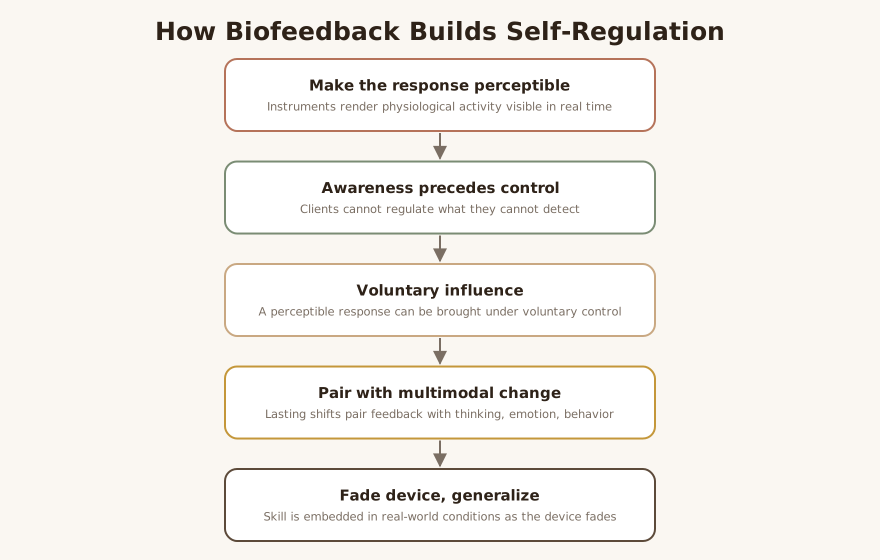
What makes biofeedback distinct from a relaxation script is the closed loop: the body’s own activity becomes the teacher, and the instrument simply makes an otherwise invisible process perceptible. LLM Over time, the learned change can persist without ongoing instrument use, which is the clinical goal — transfer of the skill from the device to daily life.1 In practice the device is a training wheel, not a permanent prosthesis. LLM
Creators & Lineage
Biofeedback has no single inventor; it crystallized from mid-twentieth-century psychophysiology and learning theory into an organized field in 1969 with the founding of the Biofeedback Research Society (BRS).4 That body was renamed the Biofeedback Society of America in 1976 and became the Association for Applied Psychophysiology and Biofeedback (AAPB) in 1989, the name it carries today.4 Barbara Brown served as its first president (1969–1970), and Neal Miller — whose work on the instrumental conditioning of autonomic responses helped establish that “involuntary” physiology could be trained — was a central figure, later urging creation of the AAPB Foundation in 1985 to support student research.4
The lineage runs through behavioral medicine, psychophysiology, and relaxation training, and it branches into neurofeedback as a specialized offshoot focused on cortical activity.14 The field’s standard definition was approved in 2008 jointly by AAPB, the Biofeedback Certification International Alliance, and the International Society for Neurofeedback and Research, reflecting an explicit commitment to evidence-based practice and practitioner standards.14 AAPB publishes the peer-reviewed journals Applied Psychophysiology and Biofeedback and Biofeedback: A Clinical Journal.4
Core Principles
The central principle is operant: a physiological response that is made perceptible can be brought under voluntary influence through feedback and practice.1 Several ideas follow from this. First, awareness precedes control — clients cannot regulate what they cannot detect, and the instrument supplies the missing perception. LLM Second, change is multimodal: lasting shifts come not from the sensor alone but from pairing feedback with adjustments in thinking, emotion, and behavior.1 Third, the aim is generalization, so sessions are structured to fade the device and embed the skill in real-world conditions. LLM
Heart-rate-variability (HRV) biofeedback illustrates the underlying physiology especially clearly.2 Breathing at roughly six breaths per minute (about 4.5–6.5/min) synchronizes cardiac, respiratory, and blood-pressure rhythms and drives heart-rate oscillations toward a low-frequency band near 0.1 Hz, the system’s resonance frequency arising from baroreflex delay.2 Regular practice produces large-scale increases in baroreflex gain and engages vagal (parasympathetic) tone, which can be non-invasively indexed by HRV parameters.2 Each person’s resonance frequency varies somewhat around the 0.1-Hz / six-breath benchmark, which is why careful protocols assess an individual’s coherence frequency rather than assuming one fixed pace fits everyone.3
Interventions & Techniques
Biofeedback is delivered through modality-specific protocols matched to the target physiology.1 EMG biofeedback trains muscle relaxation or recruitment and underlies treatment of tension headache and pelvic-floor protocols for incontinence.1 Thermal (skin-temperature) biofeedback uses peripheral warming as an index of sympathetic arousal and vasodilation, classically applied to migraine.1 HRV biofeedback trains paced, slow resonance-frequency breathing to maximize beat-to-beat heart-rate variability and baroreflex function.2 EEG biofeedback (neurofeedback) targets cortical rhythms and is the basis for emerging work in ADHD, PTSD, and related conditions.1 Electrodermal and respiratory feedback round out the common toolkit.1
A typical course of treatment moves from assessment and baseline measurement, to demonstrating the signal so the client sees the link between an inner state and the readout, to guided practice with shaping (rewarding successive approximations of the target), to home practice and device fading. LLM HRV protocols add an explicit resonance-frequency assessment step, sweeping breathing pace to find the rate that maximizes the individual’s coherence before training is consolidated at that rate.3
LLM-generated illustrative example (not a guideline): A clinician places a finger photoplethysmography sensor and walks an anxious client through paced breathing at several rates while watching the live HRV trace together. When the trace shows the largest, smoothest oscillations at about 5.5 breaths/min, that becomes the client’s training pace, and the client practices it for ten minutes twice daily with a phone app between sessions. LLM
Evidence Base
Biofeedback is an established intervention with decades of clinical use, though the strength of evidence varies sharply by application.12 AAPB and allied organizations cite established effectiveness for migraine headache, tension headache, urinary incontinence, high blood pressure, and anxiety.1 Neurofeedback is described as having growing — not yet established — evidence for ADHD, autism spectrum conditions, brain injury, PTSD, seizures, and depression, a distinction clinicians should preserve when setting expectations.1
For HRV biofeedback specifically, a neuromodulation review rated the evidence high for coronary heart disease, hypertension, and chronic pain, moderate for cancer-related symptom clusters, and poor for diabetes and dementia.2 Reported effects include increased HRV and reduced hostility with fewer hospital readmissions in cardiac patients, significant systolic and diastolic blood-pressure reductions in hypertension, and lower pain than controls.2 Importantly, the same review notes that effects are generally stronger on subjective outcomes (anxiety, pain perception, sleep) than on objective biomarkers, that many studies used small samples, and that long-term durability and hard clinical endpoints remain understudied.2 Honest framing for clients should therefore promise skill-building and symptom relief, not biomarker cures. LLM
Populations & Indications
Biofeedback is used across the lifespan — with adults, children, and older adults — and the non-invasive, drug-free profile makes it attractive where medication is limited or undesired. LLM Established indications point to several core populations: people with migraine or hypertension, people with anxiety disorders, and people with pelvic-floor dysfunction underlying urinary or fecal incontinence.1 People with chronic pain are a well-supported population for HRV biofeedback in particular.2
Performance enhancement is a recognized, non-clinical application: athletes, musicians, artists, and executives use biofeedback to optimize performance, which extends naturally to performance anxiety.1 For children, the concrete, game-like quality of a live readout can make self-regulation tangible in a way verbal coaching cannot, though developmental fit and attention span shape protocol selection. LLM
Problems-for-Work
- Generalized anxiety and stress: HRV biofeedback targets autonomic over-arousal directly; AAPB lists anxiety among conditions with established effectiveness.12 Application: slow resonance-frequency breathing as a portable down-regulation skill for between-session use. LLM
- Tension and migraine headache: EMG (tension-type) and thermal (migraine) protocols are classic established indications.1 Application: forehead/neck EMG feedback to interrupt the bracing pattern that precedes tension headaches. LLM
- Hypertension: Blood-pressure reductions are among the better-supported HRV outcomes.12 Application: daily paced breathing as an adjunct to medical management. LLM
- Chronic pain: Rated high-evidence for HRV biofeedback, with improved pain and social functioning.2 Application: combining HRV training with pacing and attention skills. LLM
- Urinary and fecal incontinence: Pelvic-floor EMG biofeedback is an established application.1 Application: feedback-guided pelvic-floor strengthening and coordination. LLM
- PTSD, panic, insomnia, ADHD: Plausible targets where neurofeedback or HRV training show growing but not established support; frame as adjunctive and experimental.1 Application: HRV practice to improve sleep onset by lowering pre-sleep arousal. LLM
Contraindications, Cautions & Cultural Humility
Biofeedback is low-risk and non-invasive, but it is not a stand-alone cure and should be positioned within a broader treatment plan, especially for conditions where it has only growing rather than established evidence.1 HRV biofeedback’s documented limitations — small samples, stronger effects on subjective than objective measures, and uncertain long-term durability — mean clinicians should avoid overselling physiological outcomes.2 Paced slow breathing should be introduced cautiously with clients who have cardiopulmonary disease, and any device-based work must remain coordinated with the client’s medical care rather than substituting for it. LLM
Cultural humility matters in two ways. First, access: equipment and app-based protocols presume resources and digital literacy that not all clients share, and the clinician should adapt to the client’s context rather than assume a tech-forward starting point. LLM Second, framing: rendering the body as a measured signal can feel clinical or alienating to clients whose traditions hold different models of breath, energy, or emotion, so language and rationale should be offered collaboratively, not imposed. LLM Informed consent should state plainly which targets have established support and which are exploratory.1
Treatment-Plan Suggestions & SMART Objectives
| Goal | SMART objective (example) | Mechanism |
|---|---|---|
| Reduce physiological anxiety | Client will practice resonance-frequency breathing 10 min twice daily for 4 weeks, logging 80% of sessions | Vagal/baroreflex engagement via ~0.1 Hz breathing2 |
| Lower headache frequency | Client will use EMG feedback to relax target muscles to baseline within 5 min in 4 of 5 sessions over 6 weeks | Reduced muscle bracing (tension-type)1 |
| Support blood-pressure control | Client will complete daily paced-breathing practice for 8 weeks alongside medical care | Increased baroreflex gain2 |
| Improve pain self-management | Client will rate pain interference and apply HRV breathing during 3 flare episodes weekly for 6 weeks | Autonomic down-regulation; improved coping2 |
| Establish individualized training pace | Client and clinician will identify the client’s coherence frequency within 2 assessment sessions | Resonance-frequency individualization3 |
| Improve pelvic-floor control | Client will perform feedback-guided contractions per protocol 5 days/week for 8 weeks | EMG-guided muscle coordination1 |
| Reduce pre-sleep arousal | Client will apply HRV breathing for 10 min at bedtime nightly for 4 weeks, tracking sleep onset | Lowered sympathetic arousal1 |
| Manage performance anxiety | Client will rehearse paced breathing before 3 performance/exposure tasks over 4 weeks | Self-regulation of arousal1 |
Common Misconceptions
A frequent misconception is that biofeedback controls the client’s physiology for them; in fact the client does the regulating, and the device only makes the signal visible so the skill can be learned and eventually exercised without it.1 A second is that the equipment is the treatment — the lasting effect comes from pairing feedback with changes in thinking, emotion, and behavior, not from the sensor alone.1 A third is that all biofeedback applications are equally proven; AAPB itself separates established indications from those with merely growing evidence, and clinicians who blur that line risk over-promising.1 Finally, “one breath rate fits all” is wrong for HRV work, where resonance frequency varies between individuals and benefits from assessment.3
Training & Certification
Biofeedback is practiced within an explicit standards framework. AAPB collaborates with the Biofeedback Certification International Alliance (formerly the Biofeedback Certification Institution of America, BCIA) on professional credentialing, and the two organizations — together with the International Society for Neurofeedback and Research — jointly authored the field’s formal definition.14 AAPB has positioned itself around evidence-based practice and legitimate practitioner standards since its origins as the Biofeedback Research Society in 1969.14 Clinicians seeking to add biofeedback typically pursue BCIA certification and supervised practice in their chosen modality (general biofeedback, neurofeedback, or pelvic-muscle dysfunction). LLM AAPB’s journals are a primary continuing-education resource for the field.4
Key Terms
- Biofeedback: A process enabling a person to learn to change physiological activity to improve health and performance.1
- HRV biofeedback: Training of slow paced breathing to maximize heart-rate variability and baroreflex function.2
- Resonance / coherence frequency: The individualized breathing rate (near 0.1 Hz, ~6 breaths/min) that maximizes cardiovascular oscillation.23
- Baroreflex gain: The vagally controlled feedback loop regulating blood pressure via heart rate; increased by HRV practice.2
- Vagal tone: Parasympathetic activity indexed non-invasively by HRV parameters.2
- Neurofeedback (EEG biofeedback): Biofeedback targeting cortical brainwave activity.1
- EMG biofeedback: Feedback of muscle activity, used for tension headache and pelvic-floor work.1
Resources & Further Reading
▶ Watch — a video introduction to this concept:
- About Biofeedback — Association for Applied Psychophysiology and Biofeedback (AAPB)
- Neuromodulation Applied to Diseases: The Case of HRV Biofeedback — PMC
- Heart rate variability biofeedback and a global study of coherence frequencies — Scientific Reports (Nature)
- Association for Applied Psychophysiology and Biofeedback — Wikipedia
Reflective / Supervision Questions
- For this client, which physiological signal most directly indexes the target problem, and does the available evidence for that modality justify framing biofeedback as primary or adjunctive? LLM
- How will I distinguish, in my informed-consent conversation, between established indications and those with only growing evidence? LLM
- What is my plan to fade the device so the client owns the regulation skill rather than depending on the equipment? LLM
- How might this client’s cultural model of breath, body, or emotion shape how I introduce the rationale and the readout? LLM
- Am I tracking outcomes that the evidence actually supports (subjective symptom change) rather than over-indexing on biomarkers? LLM