
Type & Discipline
Gratitude interventions are a family of structured behavioral exercises drawn from positive psychology, designed to cultivate the deliberate noticing and acknowledgment of benefits in one’s life 5. They are best classified as techniques rather than as a freestanding modality: brief, replicable practices that are typically embedded within a broader therapeutic frame 4. The defining feature is intentional attention to goodness that is recognized as coming, at least in part, from sources outside the self 5. Within clinical practice they sit alongside other positive psychology interventions such as savoring, signature-strengths work, and best-possible-self exercises 4. They are also compatible with the behavioral-activation logic of cognitive behavioral therapy, in that they prescribe a concrete, repeatable behavior expected to shift affect over time LLM. For therapists, the practical appeal is low cost, low barrier to entry, and high acceptability across populations 6.
Creators & Lineage
The modern gratitude-intervention literature emerged from the positive psychology movement that Martin Seligman helped launch, which sought to study what makes life worth living rather than only what makes it go wrong 7. Robert Emmons, working with Michael McCullough, conducted the seminal experimental work establishing that deliberately counting blessings could raise wellbeing relative to counting hassles or neutral events 1. This early randomized design moved gratitude from a moral or devotional concept into a testable behavioral manipulation 1. Seligman’s group subsequently folded gratitude exercises, including the gratitude letter and gratitude visit, into positive psychotherapy and into widely studied web-based intervention packages 7. The lineage therefore runs from the construct of gratitude, through positive psychology interventions broadly, into positive psychotherapy as a named treatment approach LLM. Its kinship with cognitive behavioral therapy’s behavioral activation is conceptual rather than historical, but clinically useful LLM.
Core Principles
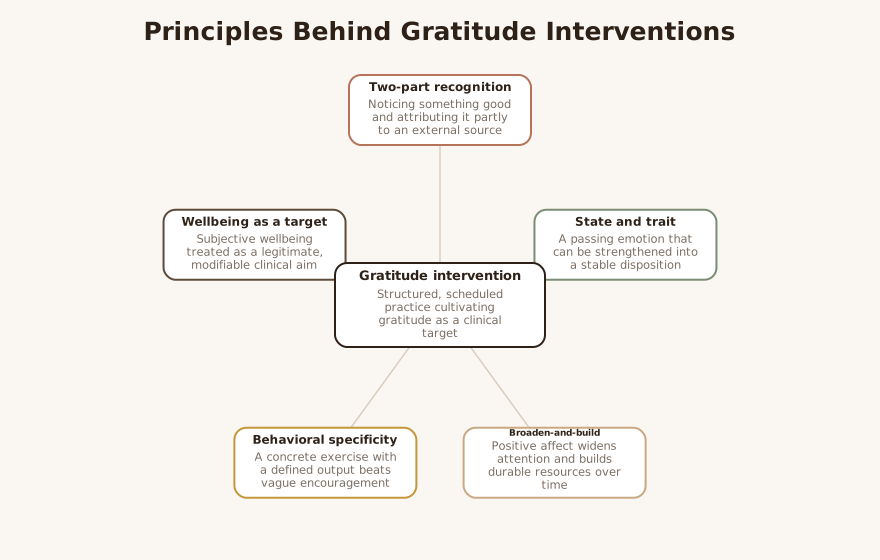
The first principle is that gratitude has two components: recognizing that something good has occurred, and attributing that good at least partly to an external source, whether another person, circumstance, or a transcendent source 5. The second principle is that gratitude operates both as a transient emotional state and as a more stable dispositional trait that can be strengthened through repeated practice 5. The third is the broaden-and-build logic of positive emotion: cultivating positive affect is hypothesized to widen attention and build durable psychological and social resources over time LLM. A fourth principle is behavioral specificity: vague encouragement to “be grateful” is far less effective than a concrete, scheduled exercise with a defined output, such as a written list 4. Finally, gratitude interventions assume that subjective wellbeing is a legitimate, modifiable clinical target in its own right, not merely a byproduct of symptom reduction 3.
Interventions & Techniques
Several discrete techniques have accumulated evidence. The gratitude journal (often “three good things”) asks clients to write down several things they are grateful for daily or weekly, sometimes with a brief note on why each occurred 5. The gratitude letter is a written expression of appreciation to a specific person who has affected the client’s life 5. The gratitude visit extends the letter by having the client deliver and read it aloud to the recipient, a practice associated with larger short-term gains in happiness and reductions in depressive symptoms than writing alone 5. Counting blessings is the daily enumeration format used in the original Emmons and McCullough work, contrasted experimentally with counting burdens 1. Gratitude contemplation or meditation directs sustained attention toward people or things one appreciates 5. A recent comparative study tested a broader menu including a mental-subtraction variant and a gratitude-to-God practice, confirming that distinct formats can yield wellbeing gains 4. Combining formats tends to outperform any single exercise 3.
LLM-generated illustrative example (not a guideline): A clinician introduces a once-weekly “three good things” log to a client recovering from a depressive episode, asking them to note each event and one reason it happened, then reviews the entries in session to surface attributional patterns. LLM
Evidence Base
The evidence base for gratitude interventions is established and mature, with multiple randomized trials and several meta-analyses 2. The headline finding, however, requires honesty: effects on wellbeing are reliably positive but small on average 3. The most recent large cross-cultural meta-analysis reported an overall effect of Hedges’ g = 0.19 (95% CI [0.15, 0.22]) on wellbeing, a magnitude the authors compared to modest everyday medical effects 3. That analysis found significant between-country variation, from non-significant in Japan (g = 0.04) to substantial in Hong Kong (g = 0.60), yet none of the seven tested cultural variables, including individualism and religiosity, significantly moderated the effect after correction 3. Positive affect responded more strongly (g = 0.27) than negative affect (g = 0.12), and combined interventions outperformed single ones 3. Encouragingly, the pooled effect appeared robust to publication bias 3.
The crucial nuance, established earlier by Davis and colleagues, is that effect size depends heavily on the comparison condition 2. Against neutral or measurement-only controls, gratitude practices show meaningful gains, but against active alternative-activity controls the advantage shrinks markedly and is often not statistically distinguishable for psychological wellbeing 2. In plain terms, doing a structured positive activity helps, and gratitude is one good option among several rather than a uniquely powerful one LLM. A 2025 head-to-head comparison of seven gratitude formats similarly found that multiple variants produced subjective-wellbeing benefits without one format dramatically dominating 4. Clinicians should therefore present gratitude work as a credible, evidence-supported lever with modest, dependable returns, not a panacea LLM.
Populations & Indications
Gratitude interventions have been tested across a wide range of populations and are generally well tolerated 6. They are most clearly indicated for adults seeking improved wellbeing and life satisfaction, where the construct-to-target match is direct 3. They are commonly used adjunctively with people experiencing depression, particularly within positive psychotherapy, where building positive affect complements symptom-focused work 7. Older adults, caregivers, and people with chronic illness are frequent beneficiaries, since the practice requires little energy or mobility and can reframe attention away from loss LLM. Students have shown gains in academic motivation and goal-directed behavior following gratitude journaling 5. Because the exercises are brief and self-administered, they translate readily to between-session homework and to digital or low-resource settings 6. The intervention is best understood as a wellbeing-promotion and relapse-buffering tool rather than a primary treatment for acute, severe psychopathology LLM.
Problems-for-Work
Gratitude interventions map onto several common clinical problems-for-work. For low subjective wellbeing and low life satisfaction, the practice directly targets the affective and evaluative dimensions the outcome literature measures 3. For anhedonia, gratitude exercises function much like behavioral activation, scheduling attention toward rewarding experiences to re-engage positive affect LLM. For rumination, the structured shift of attention toward benefits can interrupt repetitive negative thought cycles 7. For stress and burnout, regular gratitude practice is associated with reduced psychological distress and improved coping 5. For loneliness and relationship dissatisfaction, the gratitude letter and visit explicitly strengthen social bonds by making appreciation visible to others 5. For sleep problems, an evening gratitude log is a low-risk adjunct that some clients find settles pre-sleep cognition LLM. In major depressive disorder, gratitude work is best positioned as an adjunct within a broader plan rather than a standalone treatment 2.
Contraindications, Cautions & Cultural Humility
There are no strong medical contraindications, but several cautions matter. Forced or premature gratitude can invalidate genuine distress, so clinicians should avoid deploying it in a way that implies a client should simply feel better or stop complaining LLM. For clients in acute grief, trauma, or crisis, gratitude prompts may feel dismissive and should be timed carefully or deferred LLM. Because effects against active controls are modest, gratitude work should not displace evidence-based primary treatments for moderate-to-severe disorders 2. Cultural humility is essential: the construct includes recognizing goodness from sources outside the self, which for some clients is interpersonal and for others is spiritual or religious, and a gratitude-to-God framing will fit some worldviews while alienating others 4. The cross-cultural meta-analysis found unexplained country-level variation in effectiveness, a reminder that responsiveness is not uniform and warrants individualized framing 3. Clinicians should collaboratively tailor the format, recipient, and language to the client’s values LLM.
Treatment-Plan Suggestions & SMART Objectives
| Goal | SMART objective (example) | Mechanism |
|---|---|---|
| Increase subjective wellbeing | Client completes a three-good-things journal 5 of 7 evenings per week for 4 weeks, logging each entry. | Repeated attention to benefits raises positive affect 3 |
| Reduce anhedonia | Client identifies and records one savored positive experience daily for 2 weeks, reviewed in session. | Activation of reward-attention parallels behavioral activation LLM |
| Strengthen a key relationship | Client writes and delivers one gratitude letter to a chosen person within 3 weeks. | Expressed appreciation reinforces social bonds 5 |
| Interrupt rumination | Client substitutes a 5-minute gratitude reflection when nightly rumination begins, 4+ nights/week. | Attentional redirection competes with repetitive negative thought 7 |
| Improve life satisfaction | Client completes a weekly written gratitude list of 5 items for 6 consecutive weeks. | Cumulative noticing shifts global life evaluation 1 |
| Lower stress and distress | Client practices a brief gratitude contemplation 3x/week for 4 weeks and rates distress before and after. | Positive-emotion induction reduces psychological distress 5 |
| Buffer depressive relapse | Client maintains a gratitude practice of choice during the maintenance phase, reviewed monthly. | Sustained positive affect supports relapse prevention 7 |
Common Misconceptions
A frequent misconception is that gratitude interventions are uniquely or dramatically powerful; the aggregate evidence shows small average effects on wellbeing that shrink against active comparison activities 3. A second is that gratitude requires suppressing or denying negative feelings, when in fact the practice is about adding attention to benefits, not subtracting acknowledgment of hardship 5. A third is that more is always better, whereas some studies suggest very frequent journaling can lose potency and that format and dose should be tailored LLM. A fourth is the assumption that gratitude is culturally universal in its effect; observed cross-country variation cautions against that view 3. Finally, claims that gratitude permanently “rewires the brain” outrun the data, which support measurable but modest psychological change rather than sweeping neural transformation 7.
Training & Certification
No formal certification is required to deliver gratitude interventions; they are accessible techniques that any appropriately licensed clinician can integrate 6. The most relevant structured training is in positive psychology and positive psychotherapy, where gratitude exercises are taught within a coherent framework alongside strengths and savoring work 7. Familiarity with the underlying outcome literature is the practical competency that matters, so that clinicians can frame expectations honestly and recognize when an active control activity would serve the client equally well 2. Self-experimentation with the exercises before assigning them helps clinicians anticipate client reactions and tailor the practice LLM. Reputable summaries from university and clinical sources offer ready-made protocols and psychoeducation handouts that can be adapted to practice 5.
Key Terms
Gratitude — recognizing goodness in one’s life and attributing it at least partly to a source outside the self 5. Three good things — a journaling exercise in which clients record several positive events, often with a reason each occurred 5. Gratitude letter — a written expression of appreciation addressed to a specific person 5. Gratitude visit — delivering and reading a gratitude letter aloud to its recipient 5. Counting blessings — the daily enumeration of benefits used in foundational experimental work 1. Subjective wellbeing — a person’s own evaluation of their life, typically combining positive affect, low negative affect, and life satisfaction 3. Active control — a comparison condition involving a real alternative activity, which provides a stricter test than a no-treatment control 2.
Resources & Further Reading
▶ Watch — a video introduction to this concept:
- Emmons & McCullough (2003), “Counting blessings versus burdens” (seminal RCT)
- Thankful for the Little Things: A Meta-Analysis of Gratitude Interventions (Davis et al., 2016)
- A meta-analysis of the effectiveness of gratitude interventions on well-being across cultures (PNAS, 2025)
- The efficacy of seven gratitude interventions for promoting subjective well-being (2025)
- What is Gratitude and Why is It So Important? (PositivePsychology.com)
- Giving thanks can make you happier (Harvard Health)
- How Gratitude Changes You and Your Brain (Greater Good, UC Berkeley)
Reflective / Supervision Questions
- When I assign a gratitude exercise, am I matching it to a clearly defined problem-for-work, or defaulting to it as a generic feel-good task? LLM
- How do I frame realistic expectations with clients given that average effects are small and depend on the comparison? LLM
- Could an active alternative activity serve this particular client as well as or better than gratitude, and how would I decide? LLM
- Am I attending to a client’s cultural and spiritual framing when choosing the recipient or language of a gratitude practice? LLM
- How do I distinguish authentic gratitude work from inadvertently pressuring a client to suppress legitimate distress? LLM
- For clients in acute grief or crisis, how do I judge the right timing to introduce, defer, or withhold a gratitude intervention? LLM