
Type & Discipline
Posttraumatic growth (PTG) is a psychological construct, not a treatment modality in itself. 1 It sits at the intersection of clinical psychology and positive psychology, describing the positive psychological changes some people report after struggling with highly challenging life circumstances. 1 Because it is a construct rather than a protocol, clinicians do not “do PTG” to a client; they create conditions in which growth may emerge as a byproduct of meaning-making after adversity. LLM PTG belongs to the broader family of trauma-and-growth frameworks and is operationalized primarily through the Posttraumatic Growth Inventory. 2 Understanding it as a measurable outcome and a clinical lens, rather than a goal to be imposed, is essential to using it responsibly. LLM
Creators & Lineage
The construct was developed and named in the 1990s by Richard Tedeschi and Lawrence Calhoun at the University of North Carolina at Charlotte. 2 Their 1996 paper introducing the Posttraumatic Growth Inventory formalized what earlier writers had described loosely as “positive life changes” or “growing in the aftermath of suffering.” 7 In their 2004 conceptual review, Tedeschi and Calhoun laid out the theoretical model that anchors the field, framing growth as the product of a cognitive struggle with adversity rather than the adversity itself. 1
PTG draws on several older traditions. LLM Its existential roots are ancient, with Hebrew, Greek, Christian, Hindu, Buddhist, and Islamic teachings all containing elements of the potentially transformative power of suffering. 7 More immediately, PTG emerged within the positive psychology movement of the 1990s, which shifted attention toward positive adaptation and human flourishing rather than pathology alone. 7 It is therefore often described as a subcategory of positive psychology that bridges existential philosophy and contemporary strengths-based clinical approaches. 7 Logotherapy and existential therapy, with their emphasis on meaning and the human capacity to find purpose in suffering, are clear conceptual predecessors. LLM
Core Principles
The central premise is that growth arises from the struggle with a crisis, not from the trauma itself. 1 Tedeschi and Calhoun describe highly challenging events as “seismic,” because they shatter the fundamental cognitive structures and assumptions a person holds about the world, the self, and the future. 1 When these assumptive worlds are nullified, the person is forced into significant cognitive processing, and rumination about the shattered assumptions plays a central role in whether growth emerges. 1
A second principle is that growth and distress coexist. 1 PTG does not replace suffering or signal that the trauma was somehow beneficial; the presence of growth and the presence of distress are not mutually exclusive. 7 In fact, some degree of distress appears necessary, because without the disruption that drives rumination there is little to rebuild around. LLM A meta-analytic literature even describes a curvilinear relationship between growth and posttraumatic stress symptoms, suggesting that moderate distress may be more fertile ground for growth than either very low or very high distress. 7
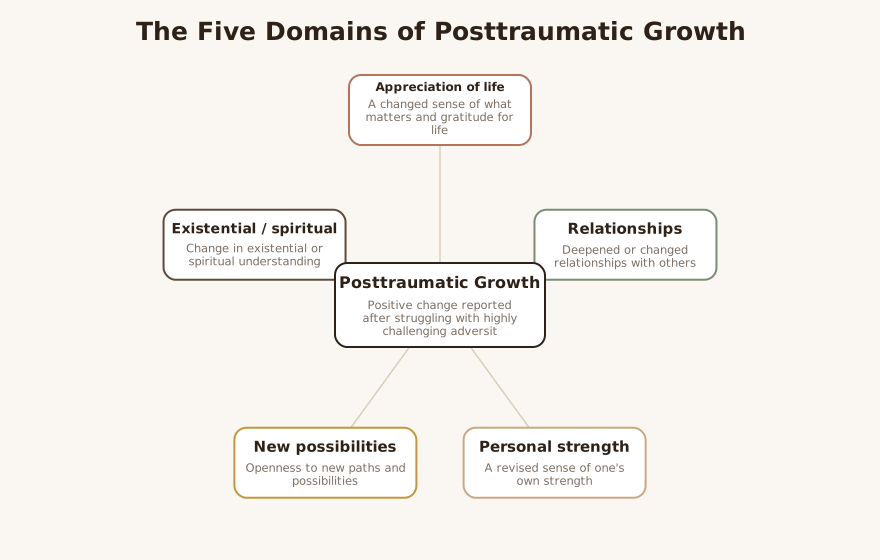
Tedeschi and Calhoun identify five domains in which growth is typically reported: a greater appreciation of life, more meaningful relationships with others, an increased sense of personal strength, the recognition of new possibilities or life paths, and a richer existential or spiritual life. 1 These five domains map directly onto the subscales of the Posttraumatic Growth Inventory. 2
Interventions & Techniques
Because PTG is a construct, the relevant “interventions” are the clinical postures and processes that make growth possible, drawn primarily from trauma-focused and existential work. LLM Tedeschi describes the clinician’s stance as expert companionship rather than expert authority: the therapist accompanies the client through the rebuilding of a shattered worldview rather than directing it. 3 This means listening for and gently amplifying emerging themes of strength, connection, and meaning without prescribing them. LLM
Practically, the work centers on facilitating the cognitive processing of disrupted assumptions. 1 Clinicians help clients move from intrusive, repetitive rumination toward more deliberate, reflective rumination, often through narrative reconstruction, meaning-making, and the deliberate examination of “stuck points” where old beliefs no longer fit lived experience. 1 Psychoeducation about the coexistence of growth and distress can normalize a client’s experience and reduce the secondary distress of feeling that one “should” be over it. LLM The Posttraumatic Growth Inventory itself can be used clinically as a structured prompt for reflection, inviting clients to notice changes across the five domains. 4
LLM-generated illustrative example (not a guideline): A bereaved client who has rebuilt her week around volunteering at a hospice might be invited to notice, without being told what to feel, how her priorities and sense of what matters have shifted since her loss. LLM
Timing matters. LLM Premature talk of “growth” or “silver linings” while a client is still in acute distress can feel invalidating and is contraindicated. 4 Growth-oriented language is most appropriate once safety is established and the client begins, on their own, to articulate shifts in perspective. LLM
Evidence Base
The evidence base for PTG is established in the sense that it is large, sustained, and internationally replicated, but it is far from uncontested. 7 The construct has been studied for nearly three decades, the Posttraumatic Growth Inventory is among the most widely used measures in trauma research, and growth has been documented across many populations. 2 A Handbook of Posttraumatic Growth consolidating research and practice was published in 2006, reflecting the maturity of the field. 5
Honesty requires naming the central controversy: whether self-reported growth reflects genuine, durable change or a perceived, partly illusory coping narrative. 7 Critics have noted that objectively measurable evidence of growth is limited and have questioned whether reported growth is real or illusory. 7 Maercker and Zoellner proposed a two-component model in which PTG has both a transformative, constructive side and an illusory, self-deceptive side that functions as a coping mechanism rather than indicating genuine improvement. 7 Boals went further, introducing the category of “perceived PTG” and arguing that illusory growth is more common than genuine growth among those who report it. 7
Measurement is the crux of the problem. LLM The standard inventory asks people to retrospectively judge how much they have changed because of the event, which is a difficult cognitive task and is vulnerable to bias; some research concludes that such self-report measures are unreliable, and Frazier and colleagues argued the inventory could be improved to better capture actual change. 7 The fact that growth often correlates positively with ongoing stress symptoms also sits uneasily with the original definition. 7 None of this means PTG is fictional, but it does mean clinicians should treat a client’s reported growth as a meaningful subjective experience rather than as proof of objective psychological repair. LLM
Populations & Indications
PTG has been reported across a wide range of trauma-exposed groups, which is part of why it has held clinical interest. 7 Documented populations include trauma survivors broadly, bereaved individuals, cancer survivors and people facing chronic or life-threatening illness, veterans and military personnel, refugees and displaced persons, and survivors of natural disasters. 4 The breadth of these groups suggests that the capacity for growth is not tied to any one kind of adversity but to the shared experience of having one’s assumptive world disrupted. 1
Indications for attending to PTG clinically are less about a diagnosis and more about a moment in the work. LLM It becomes relevant once a client is past acute crisis, has established safety, and begins to engage in reflective processing of what the event has meant. LLM It is especially salient for clients wrestling with existential questions, loss of meaning, or demoralization, where a strengths-oriented lens can complement symptom-focused treatment. 3
Problems-for-Work
PTG as a lens is applied alongside, not instead of, treatment for trauma-related problems. LLM Relevant problems-for-work include posttraumatic stress disorder, acute stress disorder, complex trauma, grief and bereavement, adjustment disorder, existential distress, demoralization, loss of meaning, depression secondary to trauma, and survivor guilt. 7
For a veteran with survivor guilt, the clinician might help process the shattered assumption of a just and predictable world, then attend to an emerging sense of responsibility-to-the-living that can become a source of renewed purpose. LLM For a client with loss of meaning following a life-threatening diagnosis, reflective work across the five domains can surface a reordering of priorities that the client experiences as genuine even while distress persists. 1 For a bereaved client with adjustment difficulties, normalizing the coexistence of grief and growth can relieve the pressure to “choose” between mourning and moving forward. 7
Contraindications, Cautions & Cultural Humility
The clearest caution is timing: introducing growth language during acute distress risks invalidating the client’s suffering and implying the trauma was a gift. 4 PTG should never be used to minimize harm, rush recovery, or hold a client responsible for failing to “grow.” LLM Because the construct’s empirical status is contested, clinicians should hold a client’s reported growth as a respected subjective truth, not weaponize it as a benchmark of successful treatment. 7
Cultural humility is essential. LLM The five domains, and especially their spiritual and existential content, are shaped by cultural and religious meaning systems, and what counts as “growth” varies across worldviews. 1 A clinician should let the client define growth in their own terms rather than importing a Western, individualistic template of personal strength and new possibilities. LLM For clients from collectivist or communal traditions, relational and spiritual domains may carry meanings that the standard inventory captures only partially. LLM Finally, PTG is not universal: many people endure profound adversity without reporting growth, and that absence is not a failure or a sign of poor coping. 7
Treatment-Plan Suggestions & SMART Objectives
| Goal | SMART objective (example) | Mechanism |
|---|---|---|
| Reduce secondary distress about “not coping right” | Within 6 sessions, client will verbalize understanding that growth and distress can coexist on at least 2 occasions | Psychoeducation normalizing coexistence of growth and distress |
| Shift from intrusive to reflective rumination | Over 8 weeks, client will use a structured reflection log 3x/week to process disrupted beliefs | Deliberate cognitive processing of shattered assumptions |
| Reconstruct a coherent trauma narrative | Within 10 sessions, client will produce a written account integrating the event into their life story | Narrative reconstruction and meaning-making |
| Identify shifts in personal strength | Within 4 sessions, client will name 2 concrete ways they have handled adversity since the event | Reflection across the personal-strength domain |
| Re-engage valued relationships | Over 6 weeks, client will initiate 1 meaningful contact per week with a supportive person | Reflection across the relating-to-others domain |
| Clarify reordered priorities and possibilities | Within 8 sessions, client will articulate 1 new life direction aligned with current values | Reflection across new-possibilities domain |
| Address existential or spiritual questions | Over 12 weeks, client will explore meaning of the event in 4 structured sessions | Existential processing within the spiritual-change domain |
Common Misconceptions
The most common misconception is that PTG means the trauma was good or that suffering is necessary for a better life; the model holds only that growth can arise from the struggle with adversity, not that the adversity was beneficial. 1 A second misconception is that growth replaces distress, when in fact the two routinely coexist and growth can sit alongside ongoing posttraumatic stress symptoms. 7 A third is that PTG is universal or expected, when many trauma survivors report no growth at all, and pressuring them to find some is harmful. LLM A fourth is that a high score on the inventory proves objective psychological repair, when the measure captures perceived change and may partly reflect a coping narrative rather than verified transformation. 7 Finally, some assume PTG is a standalone therapy; it is a construct and clinical lens applied within trauma-focused and existential treatment, not a protocol on its own. LLM
Training & Certification
There is no single licensure or required credential to “practice PTG,” because it is a construct rather than a regulated modality. LLM Tedeschi and Calhoun and their collaborators have developed training and consultation, and the Handbook of Posttraumatic Growth: Research and Practice serves as a foundational reference for clinicians seeking to apply the model. 5 Clinicians typically integrate PTG awareness into existing trauma training rather than pursuing a separate certificate. LLM Familiarity with the Posttraumatic Growth Inventory and its five domains, along with grounding in trauma-focused and existential approaches, is the practical entry point. 2 Continuing-education content and accessible overviews, including the American Psychological Association’s interview with Tedeschi, can orient practitioners to the model and the expert-companionship stance. 3
Key Terms
Posttraumatic growth (PTG): positive psychological change experienced as a result of struggling with highly challenging life circumstances. 7
Seismic event: a crisis severe enough to shatter the fundamental assumptions a person holds about the world, the self, and the future. 1
Assumptive world: the core cognitive structures and beliefs that a traumatic event can nullify, triggering the rebuilding process. 1
Rumination: repeated cognitive processing of the event, which can move from intrusive and automatic to deliberate and reflective, the latter being more associated with growth. 1
Expert companionship: the clinician’s stance of accompanying the client through meaning-making rather than directing the outcome. 3
Posttraumatic Growth Inventory (PTGI): a 21-item self-report measure of growth across five domains, with a 10-item short form using two items per subscale. 7
Perceived (illusory) growth: reported growth that may function as a self-protective coping narrative rather than reflecting verified change. 7
Resources & Further Reading
- Posttraumatic Growth: Conceptual Foundations and Empirical Evidence (Tedeschi & Calhoun, 2004)
- The Posttraumatic Growth Inventory: Measuring the Positive Legacy of Trauma (Tedeschi & Calhoun, 1996)
- Transformation after trauma, with Richard Tedeschi, PhD (APA Speaking of Psychology)
- What Is Post-Traumatic Growth? (+ PTG Inventory & Scale)
- Handbook of Posttraumatic Growth: Research and Practice (Calhoun & Tedeschi, Eds., 2006)
- Transformation after trauma, with Richard Tedeschi, PhD (APA Speaking of Psychology, YouTube)
- Post-traumatic growth (Wikipedia)
Reflective / Supervision Questions
- When a client reports growth, how do I distinguish a meaningful subjective shift from a coping narrative I may be eager to reinforce, and does that distinction change how I respond? LLM
- Am I attending to the coexistence of growth and distress, or am I implicitly nudging the client toward a “redemptive” story before they are ready? LLM
- Whose definition of growth is operating in the room, and how might my cultural or spiritual assumptions differ from the client’s? LLM
- How do I hold an expert-companionship stance when I feel pressure to demonstrate progress or outcomes? LLM
- With clients who report no growth after significant adversity, how do I ensure I am not pathologizing the absence of growth? LLM