
Type & Discipline
The self-fulfilling prophecy is a theoretical construct from social psychology and the sociology of interpersonal expectations, not a treatment modality in itself LLM. Its sociological root is Robert K. Merton’s 1948 formulation, and its experimental backbone is the interpersonal-expectancy research tradition associated with Robert Rosenthal 37. It belongs to the family of expectancy and interpersonal-influence phenomena, which also includes the Pygmalion effect (positive expectations raising performance) and its negative counterpart, the golem effect 24. For clinicians, it functions less as a diagnosis or technique and more as a transdiagnostic lens on how beliefs—held by the client, the therapist, the family, or the wider system—become behaviorally enacted and thereby “proven true” LLM.
The construct sits at the intersection of several familiar clinical lineages: labeling theory, cognitive distortions as understood in cognitive behavioral therapy, and attribution theory LLM. It is worth holding the construct loosely as a mechanism rather than a guaranteed outcome; the expectancy can be interrupted at every stage, which is precisely where therapeutic leverage lives LLM.
Creators & Lineage
Sociologist Robert K. Merton coined the term in 1948, defining a self-fulfilling prophecy as “a false definition of the situation evoking a new behavior which makes the originally false conception come true” 37. The emphasis on false is important: Merton’s interest was in how an initially inaccurate belief could generate the very reality it predicted, creating an illusion that the belief had been valid all along 7.
The experimental lineage runs through Robert Rosenthal and Lenore Jacobson, whose 1968 study Pygmalion in the Classroom operationalized other-imposed expectancy in a real-world setting 13. Building on Rosenthal’s earlier work on experimenter-expectancy effects—how a researcher’s hypotheses can subtly bias the behavior of subjects and even animals—they extended the logic to teachers and pupils 1. The “Pygmalion” label, drawn from the Greek myth of a sculptor whose statue came to life, captures the idea that one person’s expectation can shape another into its image 2.
Clinically, the construct connects to labeling theory (how a diagnostic or social label reorganizes both self-perception and others’ treatment), to the cognitive model’s account of distorted expectations driving behavior, and to attribution theory’s focus on how causal explanations shape subsequent action LLM.
Core Principles
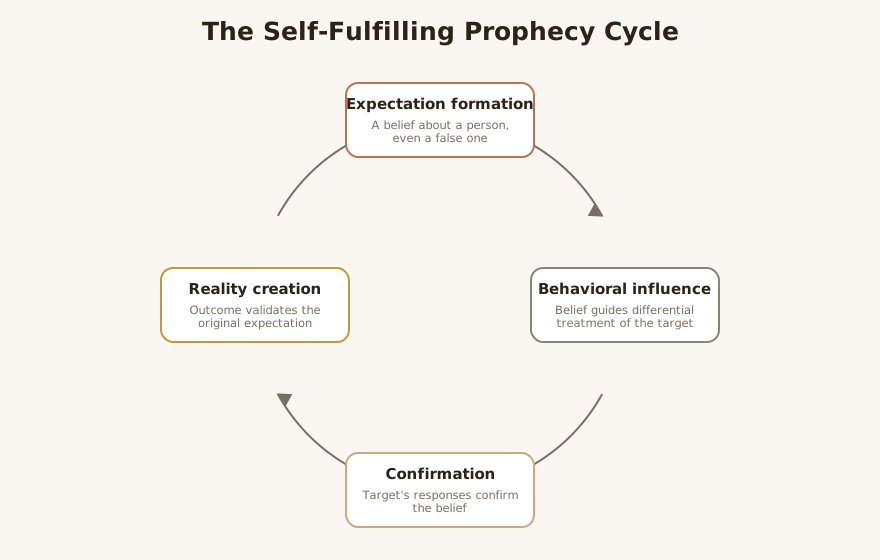
The central principle is a causal loop: an expectation, whether self-generated or imposed by others, guides behavior in ways that pull confirming responses from the environment, which then validate the original expectation 37. Simply Psychology describes the cycle in four stages—expectation formation, behavioral influence, confirmation, and reality creation—and notes that once initiated the cycle becomes self-perpetuating and difficult to interrupt 3.
A key distinction is between self-imposed prophecies, where one’s own expectations drive one’s behavior (a socially anxious person anticipating rejection who then withdraws and is indeed ignored), and other-imposed prophecies, where another person’s expectations shape one’s outcomes (the “bloomer” students treated differently by teachers) 3. Both run on the same loop; the difference is the locus of the originating belief LLM.
Rosenthal’s account of how an expectation gets transmitted is especially useful clinically. Differential treatment operates through four channels: a warmer socio-emotional climate (more smiling, nodding, warmth toward those held in high expectation); more challenging input (harder material, higher goals); more output opportunities (more chances to respond, more patience waiting for an answer); and richer feedback (more detailed, genuine praise and constructive guidance) 4. These are largely nonverbal and unintentional, which is what makes the mechanism so quietly powerful—and so relevant to the therapeutic relationship 4LLM.
Interventions & Techniques
Because the self-fulfilling prophecy is a mechanism rather than a packaged protocol, “interventions” mean deliberately interrupting or reversing the loop within an established modality LLM. Within cognitive behavioral therapy, this maps onto identifying the prophecy as an automatic prediction, examining the evidence, and—crucially—running behavioral experiments that break the confirmation step by having the client act as if the prediction were false 3LLM. Simply Psychology explicitly notes that cognitive behavioral therapy interrupts negative thought cycles (thought → feeling → action → thought) by changing behavior at the action point 3.
Therapist-side techniques are equally important. Because expectancy is transmitted through climate, input, output, and feedback, clinicians can audit their own delivery of these channels toward clients they have implicitly “written off” 4LLM. Concretely: noticing reduced warmth toward a “difficult” client, catching oneself offering them fewer or easier therapeutic challenges, giving them less airtime, or thinning out genuine praise 4LLM.
LLM-generated illustrative example (not a guideline): A clinician reviewing session recordings notices she interrupts a client labeled “resistant” within seconds, gives him fewer reflective pauses, and rarely affirms his insights. She deliberately rebalances all four expectancy channels—warmer attunement, a genuine therapeutic challenge, more response time, and specific praise—and over six sessions the client’s engagement and disclosure increase markedly. LLM
Systemic techniques apply the lens to couples and families: surfacing the prediction one partner holds about the other (“he never listens”), tracking how that belief shapes their bids and responses, and designing interactions that disconfirm it LLM.
Evidence Base
The maturity of this construct is best described as established: the existence of the mechanism is well supported and rarely disputed, while the magnitude of any given expectancy effect is typically small and highly context-dependent 27. EBSCO notes that the prophecy’s existence is rarely questioned; debate centers instead on whether such predictions help or, more often, entrench negative attributes and prejudices 7.
The foundational evidence is the Rosenthal & Jacobson study, in which all students in a California elementary school were given an IQ-style test, after which teachers were told that roughly 20% of randomly selected children were “intellectual bloomers” poised to surge 12. On retesting, first- and second-graders in the labeled group showed statistically significant IQ gains over controls, despite the labels having been assigned at random—evidence that teacher expectation alone moved real outcomes 12.
Honesty about limitations is essential. The original study drew methodological criticism, including concerns about measurement validity and the use of an IQ instrument whose scores in one class fell into an implausibly low range, suggesting measurement error 2. A 2005 meta-analysis concluded that expectancy effects in the classroom are usually small and temporary, with later work finding a very weak effect concentrated in a small minority (roughly 5–10%) of students, sometimes resetting within weeks 2. Subsequent classroom research on teacher-expectancy effects on math achievement continues to find real but bounded effects, underscoring that this is a genuine phenomenon of modest average size rather than a deterministic force 6LLM. Related effects—the golem effect (low expectations depressing performance) and the galatea effect (self-expectations driving one’s own performance)—are documented but similarly context-bound 24.
Populations & Indications
The construct is broadly applicable rather than condition-specific LLM. The most studied population is children and adolescents in educational settings, where teacher and parental expectations shape achievement and self-concept 13. Simply Psychology notes that children internalize parental expectations about their intelligence and capability 3.
In adult clinical work, the lens applies to clients in psychotherapy (where therapist expectations and client self-predictions both operate), couples and families (where partners’ expectations about each other become enacted), and workplace or organizational groups, where manager expectations measurably influence worker performance 347. It is particularly indicated for stigmatized groups, where societal stereotypes function as widely shared, other-imposed prophecies—linking directly to stereotype threat, in which awareness of a negative group stereotype induces anxiety that degrades performance and thereby confirms the stereotype 3. EBSCO emphasizes the strong tie between self-fulfilling prophecies and stereotyping, where associating traits with demographic groups leads to confirming behavior 7.
Problems-for-Work
The expectancy lens is most useful when a presenting problem appears to be self-perpetuating LLM.
- Social anxiety and interpersonal difficulties. A client predicts rejection, behaves in withdrawn or guarded ways, and elicits the cool responses that confirm the fear—Simply Psychology’s example of a shy person who expects a party to go badly and withdraws, ensuring it does 3.
- Underachievement. A student or client who has absorbed a low-expectation label may receive thinner challenge and feedback and underperform accordingly, consistent with the golem dynamic 4LLM.
- Relationship conflict and communication problems. Partners holding fixed negative predictions about each other enact behaviors that confirm them, calcifying conflict 3LLM.
- Depression and negative cognitive distortions. Hopeless predictions (“nothing I do will help”) shape passive behavior that produces the predicted lack of improvement, a loop cognitive behavioral therapy targets directly 3.
- Stereotype-threat effects in stigmatized clients. Internalized group stereotypes raise performance anxiety that degrades the very performance in question 37.
Contraindications, Cautions & Cultural Humility
The largest caution is overreach: the self-fulfilling prophecy is a real but modest-magnitude mechanism, not an all-purpose explanation, and treating it as one risks unfalsifiable formulation 2LLM. Effects are usually small, sometimes temporary, and not universal, so a clinician should not assume that simply “expecting more” will reliably transform outcomes 2.
There is also an ethical hazard in the framing itself. EBSCO notes that prophecies more often reinforce negative attributes and prejudices than help, so the construct must not slide into blaming clients for “manifesting” their own adversity 7LLM. Structural and material realities—poverty, discrimination, trauma—are not dissolved by adjusted expectations, and presenting them as such would be both clinically wrong and culturally harmful LLM.
Cultural humility is central because expectancy effects are a primary pathway through which bias operates. Clinician expectations shaped by stereotypes about race, gender, age, or diagnosis can produce differential treatment that disadvantages exactly the clients already most marginalized 7LLM. The honest application turns the lens first on the clinician and the system, auditing one’s own climate, input, output, and feedback, rather than locating the prophecy solely in the client 4LLM.
Treatment-Plan Suggestions & SMART Objectives
| Goal | SMART objective (example) | Mechanism |
|---|---|---|
| Reduce anxiety-driven social withdrawal | Within 6 weeks, client completes 3 behavioral experiments that test (and disconfirm) a predicted rejection, logging actual outcomes each time | Breaks the confirmation step of the self-imposed loop 3LLM |
| Restructure hopeless predictions in depression | Over 8 sessions, client identifies one outcome-predicting thought per day and rates predicted vs. actual results | Interrupts the thought→action→confirmation cycle targeted by cognitive behavioral therapy 3 |
| Shift a partner’s fixed negative expectation | Within 4 weeks, each partner names one prediction about the other and runs a disconfirming interaction weekly | Disrupts other-imposed expectancy enacted in the dyad 3LLM |
| Counter internalized stereotype threat | Across 6 sessions, client rehearses a self-affirmation script before 3 performance situations and rates anxiety | Reduces threat-related anxiety that degrades performance 37 |
| Improve self-concept / reduce low self-esteem | Within 8 weeks, client records 2 daily disconfirmations of a global negative self-label | Weakens the self-imposed prophecy and its behavioral output 3LLM |
| Clinician audit of differential treatment | Within 2 weeks, clinician reviews 1 session for climate, input, output, and feedback toward a “difficult” client | Rebalances the four expectancy-transmission channels 4 |
| Reduce underachievement framing in adolescents | Over a school term, caregiver replaces 1 low-expectation statement per week with a specific high-expectation, supportive one | Counters the golem dynamic and models bloomer-type input 14 |
Common Misconceptions
A frequent misconception is that the self-fulfilling prophecy is “just positive thinking” or willpower—that wanting an outcome strongly enough produces it LLM. The mechanism is interpersonal and behavioral, not magical: expectations matter because they change concrete behavior (warmth, challenge, opportunity, feedback) that elicits responses, not because belief directly alters reality 4LLM.
A second misconception is that the effect is large and deterministic; the evidence points to typically small, context-dependent, and sometimes temporary effects 2. A third is that it is always benign or motivational—Pygmalion-style uplift—when in fact the same loop produces golem effects and entrenches prejudice when expectations are negative 47. Finally, many assume the originating belief must be accurate to “work”; Merton’s whole point was that a false definition can still generate confirming reality 37.
Training & Certification
There is no certification in the self-fulfilling prophecy itself, since it is a foundational construct rather than a branded therapy LLM. Competence comes through training in the modalities that operationalize it—cognitive behavioral therapy for self-imposed prophecies and behavioral experiments, and systemic or couples training for dyadic and family-level expectancy work 3LLM. Grounding readings include Merton’s original formulation, Rosenthal and Jacobson’s Pygmalion in the Classroom, and encyclopedic treatments of the Pygmalion effect 157. Supervision focused on therapist bias and the relational transmission of expectation is the most direct route to applying the construct responsibly LLM.
Key Terms
- Self-fulfilling prophecy — A false definition of a situation that evokes behavior making the original conception come true 37.
- Pygmalion effect — Higher expectations placed on a person leading to improved performance 24.
- Golem effect — The negative counterpart: low expectations depressing performance 24.
- Galatea effect — Performance driven by a person’s own self-expectations, independent of others’ expectations 2.
- Experimenter-expectancy effect — A researcher’s hypotheses subtly biasing subjects’ behavior 1.
- Climate / input / output / feedback — The four channels through which expectations are transmitted via differential treatment 4.
- Stereotype threat — Anxiety from a negative group stereotype that degrades performance and confirms the stereotype 3.
Resources & Further Reading
▶ Watch — a video introduction to this concept:
- Rosenthal & Jacobson — “What you expect is what you get” (PDF)
- Pygmalion effect — Wikipedia
- Self-Fulfilling Prophecy: Definition & Examples — Simply Psychology
- Pygmalion Effect: Definition & Examples — Simply Psychology
- Pygmalion Effect — Rosenthal, Corsini Encyclopedia of Psychology (Wiley)
- Teacher expectancy effects on math achievement — ScienceDirect
- Self-fulfilling prophecy — EBSCO Research Starters
Reflective / Supervision Questions
- Which of my current clients have I quietly labeled, and how might that label be shaping the warmth, challenge, response time, and praise I offer them 4LLM?
- When a client makes a self-defeating prediction, do I help them test it behaviorally, or do I inadvertently collude with it 3LLM?
- Where might my expectations be transmitting bias along lines of race, gender, age, or diagnosis, and what would an honest audit of my sessions reveal 7LLM?
- How do I hold the expectancy lens without sliding into blaming clients for “manifesting” structural adversity they did not choose 7LLM?
- In couples and family work, whose prophecy about whom is currently driving the system, and what disconfirming interaction could I help them design 3LLM?