
Type & Discipline
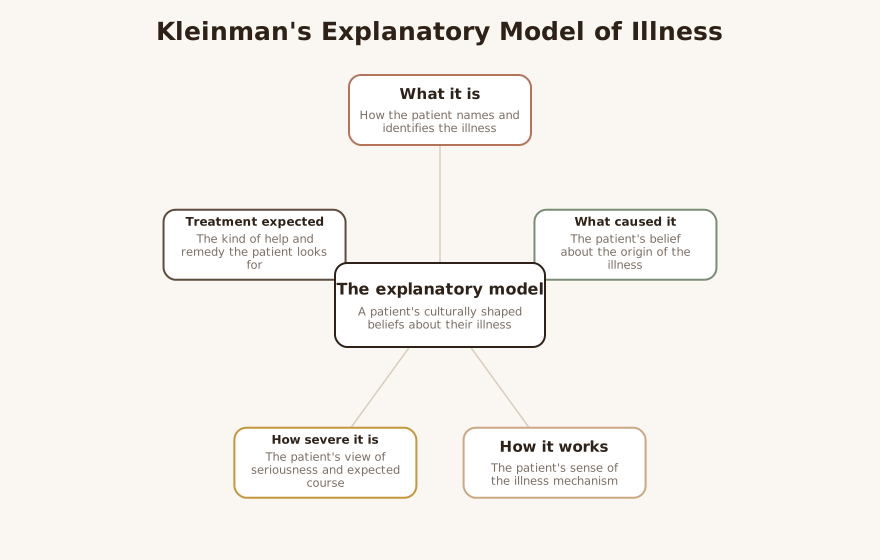
An explanatory model (EM) is a construct from medical anthropology and cultural psychiatry, not a treatment modality 2. It names the set of beliefs a person holds about a specific episode of sickness — what the illness is, what caused it, why it started when it did, how it works inside the body, how severe it is and how long it will last, and what treatment they expect and want 25. Everyone involved in a clinical encounter carries an explanatory model: the patient, the family, and the clinician, whose biomedical training is itself one culturally patterned model among several 26. The construct’s companion tool is Kleinman’s eight questions, a short structured interview that elicits the patient’s model so it can be made explicit, compared with the clinician’s, and worked with 1. The framework sits within medical anthropology and is closely allied with the biopsychosocial model, patient-centered and shared-decision-making care, and the DSM-5 Cultural Formulation Interview, which operationalizes explanatory-model thinking for psychiatric assessment 3LLM. For psychotherapists it functions as an interviewing stance and an assessment lens applied inside whatever modality they already practice, rather than as a freestanding therapy LLM.
Creators & Lineage
The explanatory-model construct was developed by the psychiatrist and anthropologist Arthur Kleinman and given its enduring formulation in his 1980 book Patients and Healers in the Context of Culture 2. Working across anthropology, medicine, and psychiatry, Kleinman argued that sickness is never only a biological event but is always interpreted through cultural meaning systems, and that the clinical encounter is a meeting — and often a collision — between the explanatory models of patient, family, and practitioner 2. From this came the practical claim that clinicians should elicit the patient’s model deliberately rather than assume it, and the eight questions are the instrument built for that purpose 12. The lineage runs squarely out of medical anthropology and feeds forward into cultural psychiatry, where assessing explanatory models is framed as an essential but frequently neglected clinical competency 3. It also underwrites the biopsychosocial model’s insistence that meaning and social context bear on illness, and it is institutionalized in the DSM-5 Cultural Formulation Interview, which carries Kleinman’s elicitation logic into standardized psychiatric assessment 3LLM. The construct has since been extended, including work on meta-explanatory questions that probe not just what a person believes about their illness but how they hold and revise those beliefs 7. Decades on, the explanatory-model approach remains a standard teaching point across clinical disciplines 45.
Core Principles
The first principle is that illness is interpreted, not merely undergone: a person’s beliefs about cause, mechanism, severity, and remedy shape how they experience symptoms and what they do about them 26. A second is that these beliefs are culturally shaped — patterned by ethnicity, religion, family, migration history, and prior encounters with healthcare — so that the same biomedical condition generates very different explanatory models in different people 25. A third is the recognition that the clinician holds a model too, and that the biomedical model has no automatic claim to be the patient’s reality; it is one frame meeting another 26. A fourth, central to clinical use, is divergence: patient and clinician models frequently disagree about what is wrong and what should be done, and that gap — not the disease alone — drives much of what we see as nonadherence, dissatisfaction, and rupture 23. A fifth principle is negotiation: the work is not to overwrite the patient’s model with the biomedical one but to surface both, compare them respectfully, and arrive at a shared, workable plan 26. Underlying all of this is the stance that the patient’s explanatory model is legitimate clinical data to be elicited, not error to be corrected 3. The model is specific to an episode of illness, which is why it is elicited fresh rather than assumed from demographics 5.
Interventions & Techniques
There is no “explanatory-model therapy”; the construct is operationalized through interviewing technique and clinical stance delivered inside existing modalities LLM. Its central tool is the explanatory-model interview, most widely transmitted as Kleinman’s eight questions, which the HHS Office of Minority Health distributes as a free clinical resource 1. The canonical eight are: (1) What do you call your problem? What name does it have? (2) What do you think has caused the problem? (3) Why do you think it started when it did? (4) What does your sickness do to you? How does it work? (5) How severe is it? Will it have a short or long course? (6) What do you fear most about your sickness? (7) What are the chief problems your sickness has caused for you? and (8) What kind of treatment do you think you should receive? What are the most important results you hope to get? 1. The technique is to ask these as genuine inquiry, listen for the model and the meanings and fears attached to it, then negotiate — acknowledging the patient’s model, offering the clinical one, and finding a plan both can endorse 12. A complementary move is to make the clinician’s own model explicit, since naming the biomedical frame as one perspective rather than the truth invites comparison rather than submission 26. More recent practice adds meta-explanatory questions that ask how confident the person is in their model, where the belief came from, and whether it could change, which can loosen rigidly held explanations 7. These skills map onto the assessment and Socratic repertoire clinicians already use and are delivered inside cognitive behavioral, acceptance-based, psychodynamic, or supportive frames 3LLM.
LLM-generated illustrative example (not a guideline): A therapist meeting a recently arrived refugee with insomnia and chest tightness opens with the eight questions rather than a symptom checklist. He names the problem as “a sickness of the heart from too much thinking,” attributes it to spirits disturbed by the deaths he witnessed, and says the treatment he wants is prayer and a community ritual, not pills. That explanatory model — not the provisional diagnosis of an anxiety disorder — becomes the ground on which any plan must be negotiated LLM.
Evidence Base
The maturity label here describes the construct and its interview, not a manualized treatment LLM. The explanatory-model framework is established and influential: foundational to medical anthropology, embedded for decades in cross-cultural clinical training, and carried into mainstream psychiatry through the DSM-5 Cultural Formulation Interview 23. Kleinman’s 1980 formulation is a landmark, and assessing explanatory models is now framed in the psychiatric literature as a core, if under-taught, clinical competency 23. What the framework is not is a standalone intervention with its own randomized-controlled-trial base; there is no large trial literature showing that “using the eight questions” produces measurable symptom change in isolation LLM. Its demonstrated value lies upstream of symptom outcomes — in improving understanding, alliance, adherence, and the fit between care and the patient’s reality, benefits that overlap with the broader evidence on therapeutic alliance and patient-centered care 3LLM. The honest framing for clinicians is that this is a well-established conceptual and interviewing framework that improves the cultural fit and quality of care, not an empirically validated therapy with effect sizes of its own 3LLM. Its principal documented risk is non-use: clinicians routinely fail to elicit explanatory models at all, defaulting to their own 3.
Populations & Indications
The framework is most useful wherever the distance between the clinician’s frame and the patient’s is wide, or where unspoken beliefs about illness are driving behavior LLM. Patients from diverse cultural backgrounds are the paradigm case, since the entire construct was built to surface culturally patterned beliefs the clinician cannot read off demographics 25. Immigrants and refugees often carry explanatory models grounded in idioms of distress, spiritual causation, or pre-migration medical systems that diverge sharply from Western psychiatry, making elicitation essential rather than optional 56. People with serious mental illness may hold models — of possession, moral failing, or external persecution — that powerfully shape engagement and adherence, and that stigma can keep hidden unless asked about directly 46. People with chronic illness and patients with medically unexplained symptoms live inside long, meaning-saturated illness experiences where the patient’s model of cause and mechanism is often where the distress concentrates 5LLM. Older adults may hold generationally and culturally distinct understandings of mental and physical decline LLM. Caregivers carry their own explanatory models of a relative’s condition that can conflict with both patient and clinician and warrant separate eliciting 5LLM. Across these groups the eight questions are an adjunct assessment lens, not a diagnosis-specific protocol LLM.
Problems-for-Work
In treatment nonadherence, the work is locating the divergence between the patient’s explanatory model and the clinical one — a clash that the construct identifies as a leading driver of patients declining or abandoning treatment — and negotiating it rather than insisting 23. In diagnostic disagreement / explanatory mismatch, the eight questions make the two competing models visible so the clinician can address the gap directly instead of relabeling the patient as resistant 26. In therapeutic misattunement / poor alliance, eliciting the model communicates respect and corrects the clinician’s assumptions early, before the working relationship frays 35. In somatic symptom disorder and illness anxiety disorder, the questions surface the catastrophic causal and severity beliefs the patient holds, which become explicit targets for work without dismissing the felt experience as unreal 15. In stigma around mental illness, asking what the person calls the problem and what they fear most can reveal shame-laden models — “madness,” “weakness,” “punishment” — that block help-seeking 16. In acculturative stress and health disparities, the framework names how a mismatch between a patient’s healthcare expectations and the system’s assumptions reproduces inequity, and positions the clinician to bridge rather than widen it 56. In chronic illness adjustment, the work attends to the patient’s evolving model of what the illness means for their life and identity, which a symptom-focused plan would miss 5LLM.
LLM-generated illustrative example (not a guideline): A man with type 2 diabetes and depression has quietly stopped his antidepressant. The eight questions reveal his model: depression is “low willpower,” a pill “means I’m weak,” and the result he wants is to “be stronger on my own.” Surfacing that model — rather than re-explaining serotonin — lets the clinician separate the felt insult from the medical rationale and renegotiate a plan he can accept LLM.
Contraindications, Cautions & Cultural Humility
Because this is a construct and interview rather than a procedure, the cautions concern misapplication, not patient selection LLM. Eliciting an explanatory model must never delay appropriate medical or psychiatric workup; honoring a patient’s beliefs does not license ignoring genuine pathology that needs treatment LLM. A second caution is false symmetry: respecting the patient’s model does not mean endorsing every belief as a basis for treatment, and the clinician’s task is negotiation, not capitulation, particularly where a belief is dangerous 2LLM. A third is the seductive misuse of the framework to exoticize — treating explanatory models as something only ethnic-minority or immigrant patients have, while leaving the clinician’s own biomedical model unexamined as “just the facts” 6LLM. The construct insists the clinician’s model is also culturally situated, which is the heart of cultural humility here rather than an add-on 26. A fourth caution is mechanical delivery: asked as a checklist, the eight questions can feel like an interrogation and produce thin, guarded answers rather than the meaning they are meant to surface 1LLM. Finally, the framework should not become a vehicle for stereotyping — explanatory models are elicited from the individual precisely because culture predicts tendencies, not the specific beliefs of the person in the room 56.
Treatment-Plan Suggestions & SMART Objectives
| Goal | SMART objective (example) | Mechanism |
|---|---|---|
| Elicit the patient’s explanatory model | Within 2 sessions, clinician completes Kleinman’s eight questions and documents the client’s named cause, feared outcome, and desired treatment | Surfaces culturally patterned beliefs as clinical data and reveals divergence from the clinical model 1 |
| Make the clinical model explicit and comparable | Within 3 sessions, clinician states the biomedical/clinical model in plain language and names one point of agreement and one of difference with the client’s model | Frames both views as perspectives to compare, enabling negotiation rather than override 2 |
| Reduce model-driven nonadherence | Within 4 weeks, client and clinician negotiate one shared treatment decision after explicitly comparing explanatory models | Resolving the divergence between patient and clinical models addresses a known driver of nonadherence 2 |
| Address feared meanings | Over 6 weeks, client identifies and examines the single most feared consequence of the illness in 4 of 6 sessions | Targets the meaning and fear the eight questions surface, where anxiety and demoralization live 1 |
| Examine stigma-laden beliefs | Over 6 weeks, client articulates and tests one self-stigmatizing model of their mental illness (e.g., “weakness”) in session | Naming the model reduces shame-driven avoidance and supports engagement 6 |
| Loosen rigidly held explanations | Within 4 sessions, clinician uses meta-explanatory questions to map the client’s confidence in and source of one key belief | Probing how a belief is held, not just its content, opens room for revision 7 |
| Bridge a cross-cultural mismatch | Within 3 sessions, clinician documents how the client’s healthcare expectations differ from the service’s assumptions and one accommodation made | Aligning expectations counters a mechanism of health disparities and misattunement 5 |
Common Misconceptions
The first misconception is that an explanatory model is just the patient’s “opinion” to be corrected; in this framework it is structured clinical data about beliefs that govern behavior, and eliciting it is assessment, not indulgence 3. A second is that the eight questions are only for cross-cultural or immigrant encounters; every patient, including those who share the clinician’s background, holds an explanatory model worth surfacing 25. A third is that eliciting a model commits the clinician to accepting it — in fact the model directs negotiation between divergent views, not surrender to the patient’s 26. A fourth is that the clinician has no model, only objective facts; the framework’s defining move is to recognize biomedicine as one culturally situated model among others 26. A fifth is treating the eight questions as a validated psychometric test with a score; they are a structured way to listen, not an instrument that yields a number 1LLM. A sixth is conflating the explanatory model with a fixed cultural trait — it is specific to an episode of illness and elicited from the individual, not predicted from group membership 5. A seventh is assuming a model, once stated, is stable; meta-explanatory work shows beliefs are held with varying conviction and can shift over the course of treatment 7.
Training & Certification
There is no certification in explanatory models or the eight questions, because these are scholarly and clinical concepts rather than a proprietary modality LLM. Clinicians typically encounter them through medical-anthropology and cultural-competence curricula, through Kleinman’s primary writing, and through accessible clinical translations such as the HHS eight-questions handout and cultural-health organization explainers 125. The U.S. Office of Minority Health distributes the eight questions as a free clinical tool within its cultural-competence resources 1. In psychiatry, the most formal training vehicle is the DSM-5 Cultural Formulation Interview, which embeds explanatory-model elicitation in a structured, teachable protocol 3. The practical path is to learn the construct as background theory and the explanatory-model interview as a concrete skill, then apply both within whatever evidence-based modality the clinician is already credentialed in LLM. No new scope of practice is created; competence in the host modality and in culturally responsive interviewing remains the relevant qualification 3LLM.
Key Terms
Explanatory model (EM) — the culturally shaped set of beliefs a person holds about a specific episode of sickness: its name, cause, onset, mechanism, severity and course, and the treatment they expect and want 2. Kleinman’s eight questions — a structured interview that elicits a patient’s explanatory model and the fears and meanings attached to the illness 1. Negotiation — the clinical process of making patient and clinician models explicit, comparing them, and arriving at a shared, workable plan rather than overriding the patient’s view 2. Divergence / explanatory mismatch — the gap between patient and clinician models that drives much nonadherence, dissatisfaction, and rupture 23. Cultural Formulation Interview (CFI) — the DSM-5 structured interview that operationalizes explanatory-model elicitation for psychiatric assessment 3. Meta-explanatory questions — inquiries into how a person holds a belief — its source, conviction, and openness to change — rather than only its content 7. Clinician’s explanatory model — the recognition that the biomedical frame is itself one culturally situated model, not a neutral baseline 26.
Resources & Further Reading
▶ Watch — a video introduction to this concept:
- Arthur Kleinman’s Eight Questions (Think Cultural Health, HHS Office of Minority Health)
- Patients and Healers in the Context of Culture (Kleinman, University of California Press, 1980)
- Assessing explanatory models and health beliefs: an essential but overlooked competency for clinicians (BJPsych Advances)
- Explanatory models in psychiatry (Harvard DASH)
- The Arthur Kleinman Explanatory Model (Centre for Culture, Ethnicity & Health)
- Kleinman’s Explanatory Model (Culturally Connected)
- Meta-Explanatory Questions (Springer)
Reflective / Supervision Questions
- When you meet a new client, do you reliably elicit their explanatory model, or do you default to the clinical framing you already hold? LLM
- In which recent case did a divergence between the client’s model and yours drive nonadherence or rupture, and how did you handle it? LLM
- When you use the eight questions, how do you keep them a genuine inquiry rather than a checklist the client can feel? LLM
- Where might your own biomedical explanatory model be operating invisibly as “just the facts”? LLM
- How do you tell the difference between respectfully negotiating with a client’s model and colluding with a belief that is keeping them stuck or endangering them? LLM
- When does attention to a client’s cultural model tip into stereotyping the individual from their group? LLM
- How would you fold meta-explanatory questions into your assessment to learn not just what a client believes but how firmly they hold it? LLM
- What would tell you that honoring a client’s explanatory model has begun to delay care they actually need? LLM