
Type & Discipline
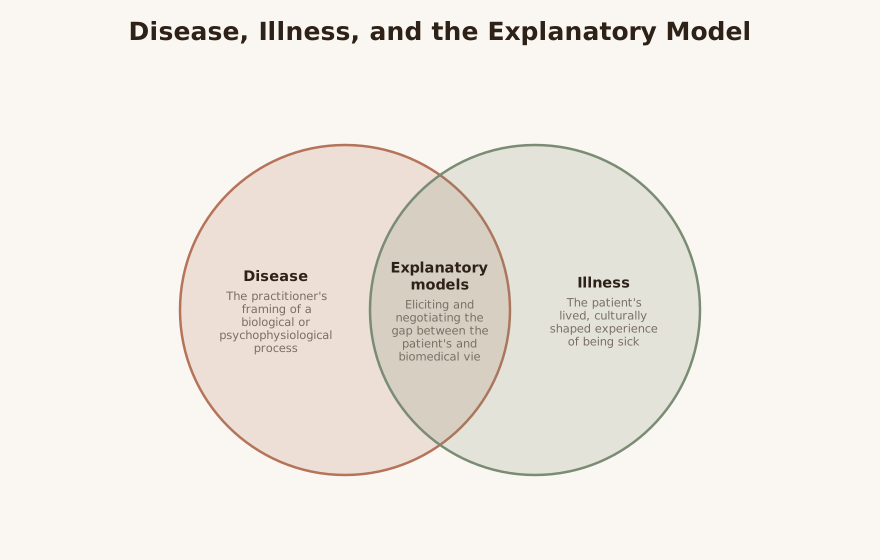
“Illness versus disease” is a conceptual distinction from medical anthropology, not a treatment modality 1. It separates two things ordinary language collapses: disease, the practitioner’s framing of a problem as an abnormality in the structure or function of organs and systems, and illness, the patient’s lived experience of being unwell — the symptoms, suffering, meanings, and disruptions as the person and family actually undergo them 16. Disease is what the clinician treats; illness is what the patient brings into the room 2. The framework belongs to the phenomenology of illness and is closely allied with narrative medicine and the biopsychosocial model LLM. Its practical extension — the illness narrative — holds that the patient’s story of their suffering is not merely background to care but a site of care in its own right 5. For psychotherapists, the distinction functions as an interviewing stance and a meaning-making lens applied within whatever modality they already practice, rather than as a freestanding therapy LLM.
Creators & Lineage
The disease/illness distinction was given its enduring clinical formulation by psychiatrist and anthropologist Arthur Kleinman, internist Leon Eisenberg, and anthropologist Byron Good in their 1978 paper in the Annals of Internal Medicine 1. They argued that biomedicine, by attending only to disease, systematically neglects illness — and that this neglect produces poor adherence, patient dissatisfaction, and clinical failure even when the disease is correctly treated 1. The same paper introduced the explanatory model: the set of beliefs a person holds about an episode of sickness — its cause, timing, mechanism, expected course, and appropriate treatment 1. Kleinman extended these ideas in his 1988 book The Illness Narratives, which placed the patient’s story at the center and recast the clinician’s task as the empathic interpretation of suffering 5. The lineage runs through medical anthropology and into narrative medicine and narrative therapy, which share the conviction that stories organize experience and can be worked with therapeutically LLM. The framework also underwrites, and is reinforced by, George Engel’s biopsychosocial model, which insists that biological, psychological, and social dimensions all bear on sickness LLM. Decades later the distinction remains a standard teaching point for clinicians across disciplines 2.
Core Principles
The first principle is the disease/illness split itself: disease names a biological or psychophysiological process, while illness names the human experience of and response to that process, including its personal and social meanings 16. The two can vary independently — there can be disease without much illness (an asymptomatic abnormality) and illness without demonstrable disease (medically unexplained symptoms), and the same disease produces very different illnesses in different people 12. A second principle is that illness is culturally and socially shaped: how a person perceives, labels, explains, and responds to symptoms is patterned by culture, family, and context, not read directly off the body 16. A third is the explanatory model — every patient (and every practitioner) carries a model of what is wrong, why, and what should be done, and these models often diverge 1. The clinical work is to elicit the patient’s explanatory model, compare it with the biomedical one, and negotiate the gap rather than override it 14. A fourth principle, from the narrative extension, is that telling and witnessing the story of an illness can itself be reparative: the act of giving suffering coherent form is part of healing, not a preliminary to it 5. Underlying all of this is a stance of respect for the patient’s framing as legitimate clinical data 2.
Interventions & Techniques
There is no “illness-narrative therapy”; the framework is operationalized through interviewing technique and clinical stance applied within existing modalities LLM. Its central tool is the explanatory-model interview, most widely transmitted as Kleinman’s eight questions, which ask the patient what they call the problem, what they think caused it, why it started when it did, what they believe it does to them, how severe they think it is, what they fear most about it, what problems it has caused in their life, and what treatment they think they should receive 3. A streamlined version is taught in palliative care as a way to surface the patient’s model quickly: what do you call this, what do you think caused it, how does it affect your body and your life, how severe is it, and what do you most fear 4. The technique is to ask these questions genuinely, listen for the explanatory model and the meanings attached, and then negotiate — acknowledging the patient’s model, offering the clinical one, and finding a workable shared plan 14. A second technique is narrative elicitation: inviting the full story of the illness — onset, turning points, losses, and what it has come to mean — and treating that account as material to be witnessed and interpreted rather than corrected 5. A third is empathic witnessing, Kleinman’s term for the moral and clinical act of acknowledging a patient’s suffering as real and meaningful 5. These map naturally onto psychotherapeutic skills already in a clinician’s repertoire and are delivered inside CBT, ACT, psychodynamic, or supportive frames LLM.
LLM-generated illustrative example (not a guideline): A therapist seeing a man newly diagnosed with multiple sclerosis opens not with coping skills but with the eight questions. He answers that he calls it “my body turning on me,” believes it was triggered by years of overwork, and most fears becoming “a burden who can’t provide.” That explanatory model — not the neurology — becomes the focus of the work, because it is where his demoralization lives LLM.
Evidence Base
The maturity label here describes the framework, not a treatment LLM. The disease/illness distinction and the explanatory-model approach are established and influential, foundational to medical anthropology and embedded in cross-cultural clinical training and cultural-competence curricula for decades 12. The 1978 paper is a landmark, and the concepts are routinely taught to physicians, nurses, and mental-health clinicians as standard practice 12. As an explanatory and pedagogical framework, the model is well-developed and durable 5. What it is not is a manualized intervention with a randomized-controlled-trial evidence base of its own LLM. There is no large body of trials demonstrating that “using the eight questions” produces measurable symptom change as an isolated technique; the framework’s value is in improving understanding, alliance, adherence, and the fit between care and the patient’s reality, outcomes that overlap with the broader literatures on therapeutic alliance and patient-centered care 1LLM. Clinicians should present it honestly as a well-established conceptual and interviewing framework that improves the quality and cultural fit of care, not as an empirically validated standalone therapy LLM.
Populations & Indications
The framework is most useful wherever the gap between biological problem and lived experience is wide, or where the patient’s meaning-world drives distress and behavior LLM. People with chronic illness are the paradigm case: they live inside an illness for years, and the meanings, losses, and identity disruptions of that life are where therapy has the most to offer 5. People with chronic pain and patients with medically unexplained symptoms benefit especially, because biomedicine often has little to say about their disease while their illness experience is intense and frequently dismissed 25. Cancer patients carry illness narratives saturated with mortality, meaning, and altered identity that the disease label alone cannot hold 5. Older adults and people with disability navigate long arcs of functional change in which the lived experience and its social meaning are central LLM. Caregivers have their own illness narratives — of a loved one’s sickness and of their own depletion — that warrant eliciting LLM. Across these groups the framework is an adjunct lens that sharpens engagement, not a diagnosis-specific protocol LLM.
Problems-for-Work
In chronic illness adjustment, the work is eliciting the patient’s explanatory model and helping them author a livable illness narrative as identity and function change — for instance, surfacing the private belief that a diagnosis means “I am now a defective person” and working that meaning directly 15. In chronic pain and somatic symptom disorder, the work is taking the illness experience seriously as real while gently widening the explanatory model beyond pure mechanical damage, without ever implying the pain is imagined 25. In illness anxiety disorder, the work is examining the catastrophic explanatory model the patient holds and the fears the eight questions reliably surface 3LLM. In demoralization and loss of meaning, the work is narrative reconstruction — helping the person find coherence and value in a disrupted story 5. In grief related to loss of health or function and depression secondary to medical illness, the work attends to the meanings of loss the disease frame ignores 5. In treatment nonadherence, the work is locating the divergence between the patient’s explanatory model and the biomedical one — a clash the 1978 paper identifies as a leading cause of nonadherence — and negotiating it rather than insisting 1. In disrupted self-identity, the work is re-authoring who the person is in light of, but not reduced to, their illness 5.
LLM-generated illustrative example (not a guideline): A woman with fibromyalgia has stopped taking a prescribed antidepressant because, in her explanatory model, “a pill for depression” implies her doctors think the pain is in her head. Eliciting that model — rather than re-explaining the pharmacology — lets the clinician separate her felt experience from the perceived insult and renegotiate a plan she can accept LLM.
Contraindications, Cautions & Cultural Humility
Because this is a framework rather than a procedure, the cautions concern misapplication, not patient selection LLM. The framework must never delay or replace appropriate biomedical workup; honoring the illness narrative does not license ignoring the disease, and a compelling story can coexist with serious untreated pathology 2LLM. A second caution is false symmetry: respecting the patient’s explanatory model does not mean treating every belief as equally valid for guiding treatment, and the clinician’s task is negotiation, not capitulation 1LLM. A third is the seductive misuse of the distinction to dismiss — reframing a patient’s suffering as “just their illness experience” can reproduce exactly the invalidation the framework was built to prevent, a particular danger with medically unexplained symptoms, contested chronic illnesses, and within disability communities 2LLM. Cultural humility is intrinsic here rather than an add-on: explanatory models are culturally patterned, and the entire point of eliciting them is to avoid imposing the clinician’s cultural frame as universal 16. Even so, the clinician’s own explanatory model is also culturally situated, and the framework should not be used to exoticize patients from other cultures while leaving biomedicine’s assumptions unexamined 6LLM. The eight questions are a starting structure, not an interrogation; asked mechanically they can feel intrusive rather than caring LLM.
Treatment-Plan Suggestions & SMART Objectives
| Goal | SMART objective (example) | Mechanism |
|---|---|---|
| Elicit the explanatory model | Within 2 sessions, clinician completes Kleinman’s eight questions and documents the client’s named cause, feared outcome, and desired treatment | Surfaces the patient’s framing as clinical data and reveals divergence from the biomedical model 3 |
| Author a coherent illness narrative | Over 8 weeks, client constructs a written or spoken account of the illness’s onset, turning points, and current meaning, reviewed in session | Giving suffering coherent form supports meaning-making and healing 5 |
| Reduce model-driven nonadherence | Within 4 weeks, client and clinician negotiate one shared treatment decision after explicitly comparing explanatory models | Resolving the divergence between patient and biomedical models addresses a known driver of nonadherence 1 |
| Address feared meanings | Over 6 weeks, client identifies and examines the single most feared consequence of the illness in 4 of 6 sessions | Targets the meaning, not the mechanism, where demoralization and anxiety live 3 |
| Re-author disrupted identity | Over 10 weeks, client articulates 3 valued roles or identities that persist alongside the illness | Counters reduction of self to diagnosis and supports identity continuity 5 |
| Validate the illness experience | In each session over 6 weeks, clinician reflects back the client’s lived experience before any reframing | Empathic witnessing affirms suffering as real and meaningful 5 |
| Integrate family meaning | Within 3 sessions, clinician elicits one caregiver’s explanatory model and notes points of conflict with the client’s | Illness meanings are socially shaped; aligning them reduces relational strain 1 |
Common Misconceptions
The first misconception is that “illness” and “disease” are interchangeable words; in this framework they name two distinct objects — the lived experience versus the biological process — and the whole point is to keep them apart 16. A second is that honoring the illness narrative means doubting the disease or going soft on diagnosis; the framework adds a layer of attention, it does not subtract biomedical rigor 2. A third is that eliciting a patient’s explanatory model commits the clinician to accepting it as correct — in fact the model directs negotiation between divergent views, not surrender to the patient’s 1. A fourth is that this is a niche concern for cross-cultural encounters only; every patient, including those who share the clinician’s culture, carries an explanatory model and an illness narrative 14. A fifth is treating the eight questions as a validated test with a score; they are a structured way to listen, not a psychometric instrument 3LLM. A sixth, clinically corrosive, misconception is that calling something an “illness experience” implies it is less real than a “disease” — the framework was built precisely to dignify experience, not to demote it 5.
Training & Certification
There is no certification in the illness/disease framework, the explanatory model, or illness-narrative work, because these are scholarly and clinical concepts rather than a proprietary modality LLM. Clinicians typically encounter them through medical-anthropology and cultural-competence curricula, through Kleinman and Eisenberg’s primary writing, and through accessible clinical translations such as the eight-questions handout and palliative-care fast facts 134. Government and professional cultural-competence resources distribute the eight questions as a free clinical tool 3. The practical path is to learn the framework as background theory and the explanatory-model interview as a concrete skill, then apply both within whatever evidence-based modality the clinician is already credentialed in LLM. No new scope of practice is created; competence in the host modality and in basic clinical interviewing remains the relevant qualification LLM.
Key Terms
Disease — the practitioner’s framing of a problem as an abnormality in the structure or function of organs and systems; what biomedicine names and treats 1. Illness — the patient’s lived experience of being unwell, including symptoms, suffering, meanings, and life disruption as the person and family undergo it 16. Explanatory model — the set of beliefs a person holds about an episode of sickness: its cause, onset, mechanism, expected course, and appropriate treatment 1. Kleinman’s eight questions — a structured interview that elicits the patient’s explanatory model and the meanings and fears attached to the illness 3. Illness narrative — the story a person tells of their illness experience, treated as a site of care and a vehicle for healing 5. Empathic witnessing — Kleinman’s term for the clinician’s moral and clinical act of acknowledging a patient’s suffering as real and meaningful 5. Negotiation — the clinical process of comparing patient and biomedical explanatory models and arriving at a shared, workable plan 1.
Resources & Further Reading
▶ Watch — a video introduction to this concept:
- Culture, Illness, and Care: Clinical Lessons from Anthropologic and Cross-Cultural Research (Kleinman, Eisenberg & Good, 1978)
- Disease versus illness: what do clinicians need to know? (Ventriglio, Torales & Bhugra, 2017)
- Arthur Kleinman’s Eight Questions (Think Cultural Health, HHS Office of Minority Health)
- The Explanatory Model — Fast Fact (Palliative Care Network of Wisconsin)
- The Illness Narratives: Suffering, Healing, and the Human Condition (Arthur Kleinman, 1988)
- Illness vs disease and tools of medical anthropology (FutureLearn / University of Basel)
Reflective / Supervision Questions
- When you meet a new client with a medical condition, do you reliably elicit their explanatory model, or do you default to the biomedical framing you already hold? LLM
- How do you tell the difference between honoring an illness narrative and colluding with a belief that is keeping the client stuck? LLM
- In which recent case did a divergence between the client’s explanatory model and the medical one drive nonadherence or rupture, and how did you handle it? LLM
- When you use the eight questions, how do you keep them a genuine inquiry rather than a checklist the client can feel? LLM
- Where might your own cultural explanatory model be operating invisibly as “just the facts”? LLM
- What would tell you that validating a client’s illness experience has tipped into minimizing real disease that needs medical attention? LLM
- How do you make room for the meanings of loss and identity change that a purely symptom-focused plan would miss? LLM