
Type & Discipline
The ADDRESSING Framework is an assessment and self-reflection model within multicultural counseling and clinical psychology, not a freestanding treatment modality 4. It functions as a structured mnemonic that organizes the major cultural influences a clinician should consider when forming an intersectional understanding of a client 2. The acronym stands for Age and generational influences, Developmental and acquired Disability, Religion and spiritual orientation, Ethnicity and racial identity, Socioeconomic status, Sexual orientation, Indigenous heritage, National origin, and Gender 3.
Its purpose is to make culture a routine, systematic part of case conceptualization rather than an afterthought triggered only when a client appears visibly different from the clinician 1. The model is explicitly bidirectional: clinicians are encouraged to apply the same nine domains to themselves to surface their own identities, areas of privilege, and blind spots 6. In contemporary usage it is framed as an intersectional approach, attending to how these influences combine rather than treating each as a separate checkbox 2.
Creators & Lineage
The framework was developed by clinical psychologist Pamela A. Hays, who introduced an early version in a 1996 article in the Journal of Counseling & Development addressing the complexities of culture and gender in counseling 1. Hays subsequently expanded the model across multiple editions of her book Addressing Cultural Complexities in Counseling and Clinical Practice, published by the American Psychological Association, with the fourth edition framing the work around intersectionality 2. Her broader body of work, including practitioner-oriented writing and assessment tools, is catalogued on her official publications site 5.
The model sits within the lineage of multicultural counseling and therapy, which sought to move competence with diverse clients from the margins to the center of clinical training LLM. It is closely allied with cultural humility, the stance of lifelong self-examination and openness rather than achieved mastery, and with intersectionality theory, which holds that identity categories interact to produce distinct experiences LLM. The framework is also frequently paired in practice with the DSM-5 Cultural Formulation approach, sharing the goal of systematic cultural assessment LLM.
Core Principles
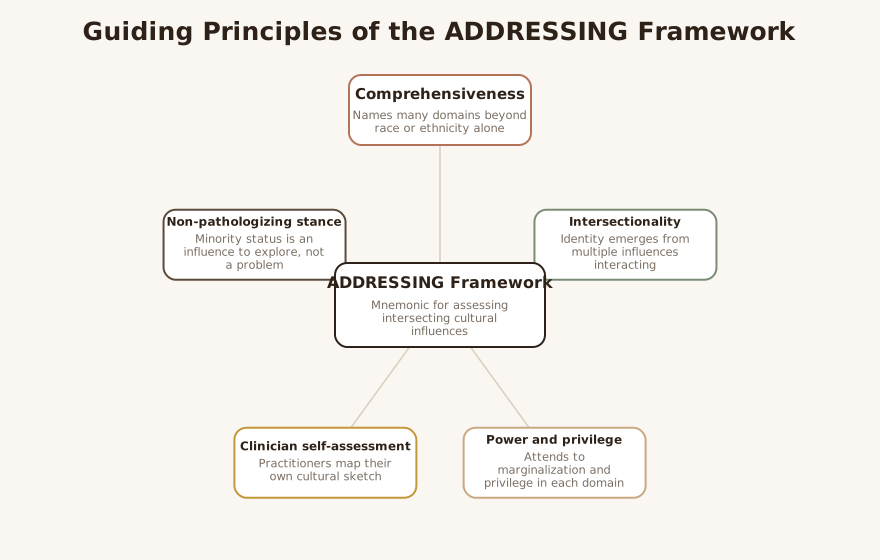
The first principle is comprehensiveness: by naming nine domains, the model counters the tendency to reduce “culture” to race or ethnicity alone and prompts attention to often-overlooked influences such as age, disability, and religion 1. The second is intersectionality, the recognition that a client’s experience emerges from the interaction of multiple identities simultaneously rather than from any single one in isolation 2.
A third principle is attention to power, privilege, and oppression embedded in each domain 4. Hays organizes the nine influences in relation to groups that have historically held more or less social power, so the framework helps clinicians notice both marginalization and privilege in a client’s profile 4. The fourth principle is clinician self-assessment: practitioners are directed to construct their own cultural sketch using the same domains to identify where their experience may diverge from the client’s and where unexamined assumptions could intrude 6.
A fifth principle is that minority or non-dominant status in any domain is not assumed to be pathological or central; the framework is a map of influences to explore collaboratively, not a list of presumed problems LLM.
Interventions & Techniques
The primary technique is structured cultural assessment, in which the clinician moves through each of the nine ADDRESSING domains to build a picture of the client’s salient identities and their interaction 3. This can be woven into a standard intake or biopsychosocial assessment so that cultural inquiry becomes routine rather than exceptional LLM.
A companion technique is the clinician’s own “culture sketch,” in which the therapist documents their own ADDRESSING profile, noting domains of relative privilege and minority status to anticipate areas of potential misattunement 6. Hays frames this self-assessment as ongoing work that supports cultural humility rather than a one-time exercise 6.
The framework also supports collaborative meaning-making, in which the clinician asks the client which identities feel most central and how each relates to the presenting concern, rather than presuming salience 2. In documentation and case formulation, the domains can be used to organize a cultural section of the conceptualization and to flag influences relevant to engagement, diagnosis, and treatment planning 4.
LLM-generated illustrative example (not a guideline): A clinician treating a 70-year-old immigrant for depression uses ADDRESSING to notice the interaction of Age (cohort attitudes toward mental health), National origin and Ethnicity (language and acculturation), Religion (a faith community that is both a stressor and a support), and Socioeconomic status (fixed income limiting medication access) — then asks the client which of these feels most tied to the low mood, rather than assuming. LLM
Evidence Base
The maturity of the ADDRESSING Framework is best described as established as a teaching and clinical-organizing tool, not as an empirically validated treatment with outcome trials LLM. It has been widely adopted in counselor and psychologist training and is documented in academic, reference, and institutional sources, including the Journal of Counseling & Development, an APA-published book across four editions, the SAGE multicultural encyclopedia, and university psychology curricula 1 2 4 3.
The framework’s evidentiary status rests on its conceptual grounding in multicultural and intersectional scholarship and its durability across editions and settings, rather than on randomized comparisons of clients assessed with versus without it LLM. Clinicians should therefore present it as a structured assessment heuristic that improves the thoroughness and equity of cultural assessment, while being candid that its incremental effect on symptom outcomes has not been the subject of a robust controlled evidence base LLM. Its longevity, repeated revision by its author, and incorporation into reference works are reasonable indicators of professional acceptance 2 5.
Populations & Indications
Because the model is designed to be applied with every client, it is broadly indicated rather than restricted to a narrow group 1. It is especially salient when working with populations whose experiences are shaped by non-dominant status in one or more domains, including racial and ethnic minorities, immigrants and refugees, and LGBTQ+ individuals individuals 2. The disability and age domains make it particularly useful with older adults and with people with developmental or acquired disabilities, identities that mainstream multicultural discussion sometimes neglects 1.
The framework is also well suited to work with Indigenous peoples, given its dedicated Indigenous heritage domain, and with religious and spiritual minorities, given its explicit attention to religion and spiritual orientation 3. It is indicated whenever a clinician suspects that cultural distance, intersecting identities, or differential power between client and therapist may shape engagement, the presenting problem, or the treatment relationship LLM.
Problems-for-Work
The framework directly supports work on cultural mistrust in therapy by prompting the clinician to acknowledge identity differences and power dynamics rather than ignore them, which can support engagement and rupture repair 4. It is useful in conceptualizing acculturative stress and minority stress, because mapping National origin, Ethnicity, Sexual orientation, and related domains clarifies the social stressors contributing to distress 2.
LLM-generated illustrative example (not a guideline): With a client presenting acculturative stress after migration, the clinician uses the National origin, Ethnicity, and Religion domains to distinguish grief over lost community from a primary mood disorder, shaping a more accurate formulation. LLM
The model helps in addressing experiences of discrimination and racism by naming the relevant domains as legitimate clinical material rather than minimizing them 1. It assists with identity development and intersectional identity conflict by giving client and clinician shared language for how multiple identities interact and sometimes pull against one another 2. It supports recognition of health and mental health disparities by foregrounding socioeconomic status and access 4. And by structuring the clinician’s self-assessment, it helps prevent and repair therapeutic misattunement and rupture rooted in unexamined assumptions 6.
Contraindications, Cautions & Cultural Humility
The framework has no clinical contraindications in the usual sense, but it carries cautions in how it is used LLM. The chief risk is reductionism: treating the nine domains as a checklist that yields a fixed cultural “profile” rather than as prompts for collaborative inquiry can stereotype the client and substitute categories for the person LLM. Hays positions the model within an intersectional, humility-oriented stance precisely to guard against this, emphasizing that influences interact and that salience must be explored, not assumed 2.
A second caution is that completing the mnemonic does not confer cultural competence; the model is a starting structure that depends on the clinician’s ongoing self-examination and openness 6. Clinicians should attend to their own ADDRESSING profile and the power differentials it reveals, since unacknowledged privilege can quietly shape the work 4. Finally, the framework should complement, not replace, direct, respectful questions to the client about how they understand their identities and their concern LLM.
Treatment-Plan Suggestions & SMART Objectives
| Goal | SMART objective (example) | Mechanism |
|---|---|---|
| Strengthen the therapeutic alliance across cultural difference | Within 4 sessions, clinician and client will name and discuss at least 2 relevant ADDRESSING domains, with client-rated alliance maintained or improved on a brief alliance measure | Acknowledging identity and power difference reduces cultural mistrust and supports engagement 4 |
| Clarify cultural contributors to the presenting problem | By session 3, complete an ADDRESSING-organized cultural assessment identifying the 2-3 domains the client rates as most salient to their distress | Comprehensive, intersectional mapping prevents reduction of “culture” to a single dimension 1 |
| Reduce acculturative or minority stress | Over 8 weeks, client will identify 3 specific stressors linked to National origin, Ethnicity, or Sexual orientation and apply 2 coping strategies, with weekly distress ratings | Naming social stressors supports targeted, validating coping work 2 |
| Repair a cultural rupture | Within 2 sessions of a noted misattunement, clinician will name the rupture, link it to an identity domain, and collaboratively agree on a repair, with client confirming repair | Clinician self-assessment surfaces assumptions driving misattunement 6 |
| Support intersectional identity integration | Over 12 weeks, client will articulate how 2 intersecting identities relate to a values-based goal, rated on a session-by-session basis | Shared intersectional language clarifies competing identity demands 2 |
| Improve clinician cultural self-awareness | Before case formulation, clinician will complete a personal ADDRESSING culture sketch and document 2 domains of potential bias relevant to this client | Structured self-assessment grounds cultural humility 6 |
| Reduce barriers tied to disparities | Within 4 sessions, identify socioeconomic and access barriers via the SES domain and connect client to at least 1 concrete resource | Foregrounding SES surfaces disparity-driven obstacles to care 4 |
Common Misconceptions
One misconception is that ADDRESSING is itself a form of therapy; it is an assessment and reflection model applied within other treatments 4. A second is that “culture” means race and ethnicity alone, which the breadth of the nine domains is specifically designed to correct 1. A third is that the framework applies only to clients who look different from the clinician; Hays intends it to be used with every client and with the clinician’s own identities 6.
A fourth misconception is that completing the mnemonic produces cultural competence as a finished state; the model is oriented toward ongoing humility rather than mastery 6. A fifth is that each domain stands alone, when the contemporary framing is explicitly intersectional, focused on how the influences combine 2.
Training & Certification
There is no formal certification in the ADDRESSING Framework; it is taught as part of multicultural and clinical training rather than credentialed separately LLM. The primary learning resources are Hays’s APA-published book, now in its fourth edition, which provides the authoritative treatment of the model, and her official publications site, which catalogues related books, articles, and practitioner materials 2 5.
The model is also disseminated through reference and educational channels, including the SAGE multicultural encyclopedia and university psychology departments that teach it in their curricula 4 3. Clinicians can develop applied skill by completing their own culture sketch and integrating the domains into routine assessment, supported by APA division materials such as Hays’s “Your Culture Sketch” guide 6.
Key Terms
ADDRESSING: The mnemonic for Age and generational influences, Developmental and acquired Disability, Religion and spiritual orientation, Ethnicity/racial identity, Socioeconomic status, Sexual orientation, Indigenous heritage, National origin, and Gender 3.
Intersectionality: The recognition that multiple identities interact to shape experience, the lens organizing the framework’s fourth-edition treatment 2.
Cultural humility: A stance of ongoing self-examination and openness rather than achieved mastery, which the clinician self-assessment component supports 6.
Culture sketch: The clinician’s own ADDRESSING profile, used to surface privilege, minority status, and potential bias 6.
Cultural assessment: The structured exploration of cultural influences relevant to engagement, diagnosis, and treatment, which the model is designed to systematize 1.
Resources & Further Reading
▶ Watch — a video introduction to this concept:
- Hays, P.A. (1996). Addressing the Complexities of Culture and Gender in Counseling. Journal of Counseling & Development
- Addressing Cultural Complexities in Counseling and Clinical Practice, Fourth Edition (APA)
- The ADDRESSING Model (Ohio University, Department of Psychology)
- ADDRESSING Model — SAGE Encyclopedia of Multicultural Counseling, Social Justice, and Advocacy
- Books and Articles by Dr. Pamela A. Hays (author’s official site)
- Your Culture Sketch — Pamela A. Hays (APA Division 45 PDF)
Reflective / Supervision Questions
- Which of the nine ADDRESSING domains do I most often overlook in my own assessments, and why? LLM
- When I complete my personal culture sketch, where do I hold privilege relative to this client, and how might that shape the work? LLM
- Am I treating these domains as prompts for collaborative inquiry, or sliding into a checklist that risks stereotyping? LLM
- How do I ask a client which identities feel most central, rather than assuming salience from visible characteristics? LLM
- When a rupture occurs, can I trace it to an identity domain and an unexamined assumption of my own? LLM
- How do I document cultural assessment so that it informs the treatment plan rather than sitting inert in the chart? LLM