
Type & Discipline
Microaggressions is a construct within multicultural psychology, not a treatment modality in its own right LLM. The term names a class of brief, everyday verbal, behavioral, and environmental exchanges that transmit denigrating, hostile, or invalidating messages to people because of their group membership 1. It belongs to counseling and clinical psychology’s broader vocabulary for understanding how chronic, low-grade discrimination contributes to psychological distress 3. For practicing clinicians, the construct functions less as an intervention and more as a lens: a way of recognizing how identity-based slights accumulate in a client’s life, and how they can surface inside the therapy room itself 5.
The construct sits at the intersection of multicultural counseling, the minority stress tradition, and cultural-competence frameworks 3. It is conceptually downstream of broader critical and sociocultural accounts of how everyday interactions reproduce structural disadvantage 2. Clinicians most often encounter the term in the context of cultural humility training, alliance management, and case conceptualization for clients carrying identity-based distress LLM.
Creators & Lineage
The term microaggression was coined in 1970 by Harvard psychiatrist Chester M. Pierce, who used it to describe the routine insults and dismissals he observed non-Black Americans inflicting on African Americans 6. For roughly three decades the concept remained relatively peripheral in the clinical literature LLM. It was psychologist Derald Wing Sue and colleagues who, in the early 2000s, brought it into mainstream counseling psychology and broadened its scope beyond race to other marginalized groups, including LGBTQ+ individuals, people with disabilities, and economically disadvantaged populations 6.
The landmark synthesis is Sue et al.’s 2007 American Psychologist paper, “Racial Microaggressions in Everyday Life: Implications for Clinical Practice,” which proposed a working taxonomy and argued explicitly for the construct’s relevance to therapy 1. That paper remains the most-cited articulation of the framework and the reference point for both its proponents and its critics 7. Its intellectual lineage runs through multicultural counseling, the minority stress model, critical race theory, and cultural-competence frameworks 3.
More recently, Monnica Williams has defended and refined the construct, proposing an expanded empirically informed taxonomy and arguing that microaggressions can be linked to individual prejudice in offenders and to mental-health outcomes in targets 2. On the critical side, the late Scott Lilienfeld authored an influential 2017 challenge to the research program’s scientific maturity, which has shaped how cautious clinicians weigh the construct 4.
Core Principles
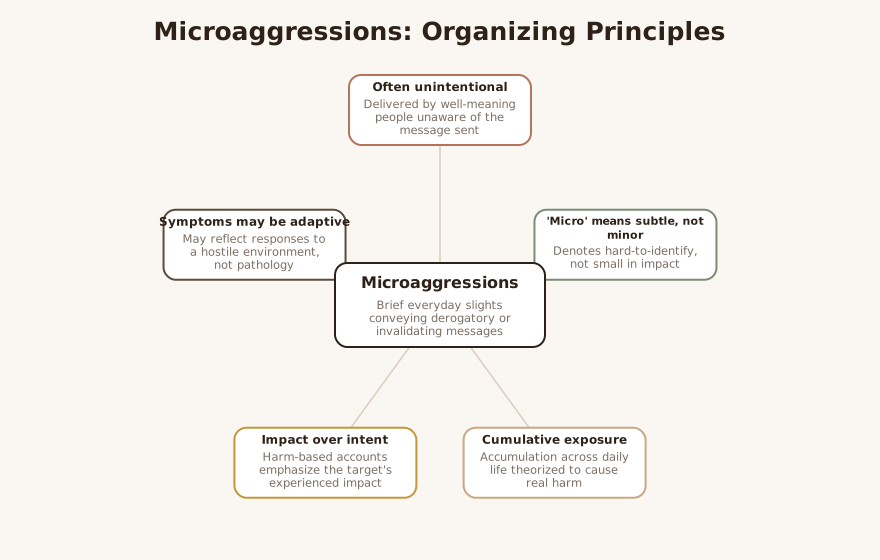
Several principles organize the framework LLM. First, harm is often unintentional: many microaggressions are delivered by well-meaning people who are unaware of the message they are sending, which distinguishes them from overt, deliberate bias 1. Second, the “micro” prefix denotes not small impact but the subtle, hard-to-identify nature of these exchanges; the cumulative toll can be substantial even when any single incident looks trivial 6.
Third, much of the construct’s clinical weight rests on cumulative exposure: individual incidents may seem minor, but their accumulation across daily life is theorized to produce meaningful psychological and physical consequences 1. Fourth, more recent harm-based accounts shift the emphasis from the offender’s intent toward the target’s experienced impact, treating microaggressions as observable events that can occur independently of intent 3. Fifth, the framework holds that a client’s symptoms may sometimes reflect adaptive responses to a hostile environment rather than intrinsic pathology, which has direct implications for how clinicians formulate cases 1.
Interventions & Techniques
Because microaggressions is a construct rather than a manualized treatment, “interventions” here mean the clinical practices the framework recommends rather than a standalone protocol LLM. The foundational move is making the invisible visible: naming and surfacing dynamics that clients and clinicians might otherwise leave unexamined for fear of appearing biased 5. Avoidance of race and identity topics has been likened to a “conspiracy of silence” that leaves harms unrepaired, so the framework pushes toward intentional, non-defensive dialogue 5.
Within the therapy relationship, the central clinical skill is rupture detection and repair LLM. When a clinician unknowingly commits a microaggression, communication clarity and credibility suffer, and a rupture or impasse can form in the alliance; the recommended response is to recognize the tension, pursue understanding, and repair rather than avoid 5. Validation of the client’s lived experience of discrimination is treated as a core therapeutic stance, alongside ongoing clinician self-examination of one’s own assumptions and communication patterns 1.
The 2007 framework also articulates broader practice commitments: learning directly from marginalized communities, studying the experiential reality and resilience of community members, maintaining vigilance toward one’s own biases, and committing to action against discrimination 5. These map cleanly onto cultural-humility practices that many clinicians already use within established relational and cognitive-behavioral modalities LLM.
LLM-generated illustrative example (not a guideline): A clinician, intending warmth, tells an Asian American client, “Your English is so good.” The client falls quiet. Rather than moving on, the clinician notices the shift, names it (“I want to check — did something I said just land wrong?”), and the client describes being repeatedly treated as a perpetual foreigner. The clinician acknowledges the impact, repairs the rupture, and the moment becomes data about the client’s everyday experience LLM.
Evidence Base
The honest summary is that the framework is established and clinically influential, but its empirical base is genuinely contested LLM. Proponents point to a literature now spanning psychology, education, and philosophy, documented across multiple countries, with reported links between microaggressions and adverse mental-health, physical-health, and quality-of-life outcomes 3. Williams argues that the term is well defined and can be decisively linked to individual prejudice in offenders and to mental-health outcomes in targets, and that recent research has begun to address earlier critiques 2.
The critical case is equally important for an honest clinician to hold LLM. Lilienfeld’s influential critique held that the research program relied heavily on small, non-randomized, non-representative collections of anecdotal testimony rather than experimental validation, lacked base-rate data on how often microaggressions occur and to whom, and underexamined how perception of and response to microaggressions varies within and between minority populations 4. He also flagged conceptual problems: the taxonomy lumps deliberate microassaults together with typically inadvertent microinsults and microinvalidations, and the “aggression” framing assumes negative intent that may not be present 4. His policy recommendation was conservative — implement cautiously until prevalence and harm are better substantiated, rather than abandoning the concept outright 4.
Even sympathetic reviews concede unresolved problems: the original taxonomies were theoretical rather than empirically derived, measurement and intersectional assessment remain underdeveloped, and the field still needs empirically tested interventions 3. For clinical purposes, the defensible position is that microaggressions is a useful organizing construct with face validity and real-world resonance for many clients, but causal and dose-response claims should be made cautiously LLM.
Populations & Indications
The construct was developed first in relation to racial and ethnic minorities and remains best articulated there 1. Sue and colleagues explicitly extended it to other marginalized groups, and clinicians now apply it with LGBTQ+ individuals, women, people with disabilities, immigrants, and religious minorities 6. It is most indicated when a client’s presenting distress appears entangled with chronic, identity-based experiences of being slighted, excluded, or invalidated LLM.
Common indications include presentations of minority stress, chronic stress, anxiety, depression, low self-esteem, hypervigilance, identity-based distress, and internalized oppression, as well as the more severe end captured by the concept of racial trauma 3. The framework is also indicated intra-therapeutically: any time a clinician suspects an identity-based rupture in the alliance, the construct provides language for understanding and repairing it 5. Multiply marginalized clients — those holding several stigmatized identities at once — are an area of active development, since intersectional measurement remains underdeveloped 3.
Problems-for-Work
The construct translates into several discrete problems-for-work LLM:
- Minority stress and chronic stress. When a client describes a steady drip of small slights at work or in public, the clinician can frame these as cumulative stressors rather than isolated overreactions, validating the pattern while building coping resources 1.
- Racial trauma. For clients with trauma-level sequelae from racism, the framework supports formulating symptoms as adaptive responses to a hostile environment rather than as intrinsic pathology 1.
- Hypervigilance. A client who scans every interaction for disrespect can be helped to distinguish protective vigilance from costly over-monitoring, without dismissing the reality that produced it LLM.
- Internalized oppression and low self-esteem. Repeated microinvalidations can be internalized as self-doubt; naming the external source helps externalize and reattribute it 1.
- Identity-based distress in the alliance. When the rupture is between clinician and client, the problem-for-work is the repair itself 5.
LLM-generated illustrative example (not a guideline): A disabled client reports exhaustion from strangers praising her as “inspiring” for ordinary activities. In session, the problem-for-work is reframed from “I’m too sensitive” to “I’m carrying the cumulative load of being constantly singled out,” and coping is built around boundary-setting and selective disengagement LLM.
Contraindications, Cautions & Cultural Humility
The construct is a lens, not a diagnosis, and it can be misapplied LLM. A central caution is the “mind-reading” risk: assuming hostile intent behind an ambiguous remark without verification can distort a client’s appraisals and, in some cases, increase distress or interpersonal friction 4. Critics have also warned that an overbroad application can create no-win interactional standards and may have chilling effects on cross-group dialogue — concerns a clinician should weigh when deciding how to frame events for a client 6.
Clinically, the framework should never be used to override a client’s own meaning-making LLM. Responses to the same event vary widely within and between minority populations, so imposing a “this was a microaggression” interpretation a client does not share is itself an invalidation 4. Cultural humility is therefore not optional decoration but the operating posture: clinicians are urged to interrogate their own biases continually, learn from the client’s experiential reality rather than from assumptions, and remain alert to committing microaggressions themselves within the session 5. The most demanding caution is reflexive — the clinician is a potential source of harm, not merely an observer of it 5.
Treatment-Plan Suggestions & SMART Objectives
| Goal | SMART objective (example) | Mechanism |
|---|---|---|
| Reduce minority-stress burden | Client will identify and log 3 identity-based stressors weekly for 6 weeks, distinguishing event from appraisal | Externalizing chronic, cumulative stressors so they are not internalized as pathology 1 |
| Lower hypervigilance cost | Within 8 weeks, client will reduce self-reported scanning behavior by half on a daily rating scale | Differentiating protective vigilance from costly over-monitoring LLM |
| Counter internalized oppression | Client will generate and rehearse 2 reattributing self-statements per identified slight over 4 weeks | Reattributing the source of self-doubt from self to external message 1 |
| Repair identity-based alliance ruptures | Clinician and client will name and process any in-session rupture within the same or next session, 100% of occurrences | Making the invisible visible; rupture-repair restores credibility 5 |
| Strengthen validation and coping | Client will practice one boundary-setting or disengagement skill in vivo weekly for 6 weeks | Validation plus active coping reduces distress maintenance 1 |
| Process discrimination-related distress | Client will complete a structured narrative of one significant discriminatory experience within 4 sessions | Reappraising symptoms as adaptive responses to a hostile environment 1 |
| Build accurate appraisal skills | Over 5 weeks, client will use a check-the-evidence step before assigning intent to ambiguous remarks | Reducing mind-reading error while honoring real harm 4 |
Common Misconceptions
A frequent misconception is that “micro” means minor or harmless; in the framework, the prefix refers to subtlety and difficulty of detection, not to low impact 6. A second is that microaggressions require conscious hostility — in fact, many are delivered without awareness by well-intentioned people, which is part of what makes them clinically tricky to surface 1.
A third misconception is that the construct is settled science; the more accurate picture is an established and influential framework whose measurement, base rates, and causal claims remain debated 4. A fourth, in the opposite direction, is that the critiques “debunk” microaggressions entirely — the leading critic recommended cautious implementation, not abandonment, and proponents marshal cross-national evidence of harm 4. Finally, clinicians sometimes assume the construct licenses interpreting events on a client’s behalf; in practice, imposing the label against a client’s own appraisal is itself invalidating LLM.
Training & Certification
There is no certifying body or credential specific to “microaggressions” as a standalone competency LLM. The construct is instead embedded within multicultural counseling and cultural-competence training, where clinicians learn to recognize, surface, and repair identity-based dynamics 3. The 2007 framework’s practice commitments — learning from marginalized communities, studying experiential reality and resilience, maintaining bias vigilance, and committing to anti-discriminatory action — function as informal training targets 5.
Because measurement instruments and empirically tested interventions are still maturing, training in this area should emphasize cultural humility and ongoing self-examination over rote checklists 3. Clinicians are well served by pairing this construct with supervision and consultation, particularly for managing in-session ruptures where the clinician may be the source of harm 5.
Key Terms
- Microassault. A deliberate, conscious expression of bias — essentially overt discrimination delivered in contemporary form 1.
- Microinsult. A rude or insensitive communication, often unintentional, that conveys that someone does not belong or is inferior 1.
- Microinvalidation. A communication that excludes, negates, or dismisses the lived experience or reality of a marginalized person 1.
- Environmental microaggression. A systemic-level manifestation expressed through policies, norms, or settings rather than individual remarks 6.
- Cumulative impact. The theorized aggregation of many small slights into meaningful psychological and physical burden 1.
- Concept creep. A critique that the construct has expanded so broadly that almost any interaction could qualify, threatening measurement validity 3.
- Cultural humility. A stance of ongoing self-examination and openness to the client’s experiential reality, treated here as the operating posture for the construct 5.
Resources & Further Reading
▶ Watch — a video introduction to this concept:
- Sue et al. (2007), Racial Microaggressions in Everyday Life: Implications for Clinical Practice (full text PDF)
- Sue et al. (2007), Racial microaggressions in everyday life: implications for clinical practice (PubMed record)
- Williams (2020), Microaggressions: Clarification, Evidence, and Impact (PubMed record)
- Williams (2021), Racial Microaggressions: Critical Questions, State of the Science, and New Directions (PMC full text)
- Lilienfeld, Microaggressions: Strong Claims, Inadequate Evidence (Heterodox Academy)
- Microaggressions and their effects on the therapeutic process (APA Division 32)
- Microaggression (Wikipedia)
Reflective / Supervision Questions
- When a client describes an ambiguous slight, how do I help them hold both the reality of possible harm and the uncertainty of intent, without either dismissing or mind-reading? 4
- What is my own pattern of avoidance around identity topics, and where might a “conspiracy of silence” be operating in my caseload? 5
- How would I recognize and repair a microaggression I committed in session, and what would keep me from noticing it in the first place? 5
- For this client, where is the line between a symptom to treat and an adaptive response to a hostile environment to validate? 1
- How do I communicate the construct’s clinical usefulness to a client while staying honest about the limits of the evidence? 3
- Whose appraisal governs the meaning of an event in this room — and how do I keep the answer the client’s? LLM