
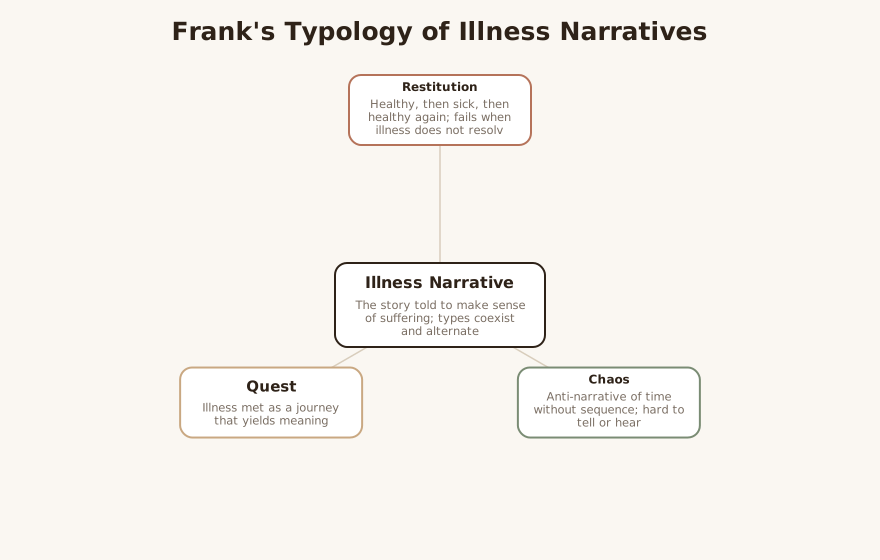
An illness narrative is the story a person tells — to themselves, to clinicians, to family — that organizes the disordered experience of being sick into something coherent enough to live with 1. It is not the medical chart and it is not the diagnosis; it is the patient’s own account of what the illness means, where it came from, and what it is doing to their life 5. For therapists working with medically ill, traumatized, or grieving clients, the illness narrative is the raw material of the work: the form a client’s story takes tells you a great deal about where they are in adjusting to suffering, and the form you help it take can change the course of that adjustment LLM.
Type & Discipline
The illness narrative is a theoretical construct, not a treatment protocol LLM. Its home discipline is medical anthropology and the broader field of narrative medicine, which study how culture, body, and biography shape the experience of sickness 1. The construct sits within the family of narrative approaches to suffering and overlaps with the biopsychosocial model’s insistence that illness is more than pathology LLM. For clinicians, it functions less as a diagnosis to be made and more as a lens — a way of hearing what a client is doing with their illness when they speak about it 5.
Creators & Lineage
The most cited framework belongs to the medical sociologist Arthur W. Frank, whose 1995 book The Wounded Storyteller: Body, Illness, and Ethics introduced the three-part typology of restitution, chaos, and quest narratives 1. Frank wrote partly from his own experience of heart attack and cancer, and gathered stories from people living with cancer, chronic fatigue syndrome, and disability, arguing that these accounts carry moral choices and point toward a social ethic 1. A second edition appeared in 2013 with a new preface and afterword 1.
Frank’s work is itself downstream of the psychiatrist and anthropologist Arthur Kleinman, whose earlier scholarship distinguished disease (the practitioner’s biomedical object) from illness (the lived, meaning-laden experience of the sufferer) and made the patient’s explanatory model a legitimate clinical concern LLM. The lineage runs further back into phenomenology — the study of lived bodily experience — and forward into narrative therapy, which treats problems as stories that can be re-authored LLM. Frank’s particular contribution is the insistence that the ill person is not merely a case but a witness whose story functions as testimony, and that listening well is an ethical act 5.
Core Principles
Frank’s central move is to treat illness as a narrative wreck: serious illness interrupts the story a person was living and demands that a new one be told 1. He describes three recurring shapes that story can take, though he is explicit that they coexist and alternate within the same person rather than sorting individuals into fixed boxes 5.
The restitution narrative runs: “Yesterday I was healthy, today I am sick, but tomorrow I will be healthy again.” It is the culturally dominant arc — the plot of advertising, of acute medicine, of the get-well card — and it works beautifully when recovery is genuinely on offer 6. Its limit is that it has no place for illness that does not resolve 6.
The chaos narrative is the story with no narrative order — what Frank calls “the anti-narrative of time without sequence,” telling without reflection, speaking about oneself without being able to stand outside oneself 6. Because lived chaos overwhelms the speaker, it often cannot be told coherently at all and tends to go unheard; listeners find it threatening because it exposes vulnerability and the absence of control 6. Frank’s clinically vital claim is that chaos cannot be transcended by being argued away — it “must be accepted” before any movement is possible 6.
The quest narrative is the story that meets suffering head-on and uses it: illness becomes a journey from which the sufferer returns with something to give, having been changed 1. Quest is not a denial of suffering but a metabolizing of it LLM.
Two further principles matter for practice. First, people produce multiple narratives shaped by audience and context — the story told to a physician differs from the one told to a spouse — so the clinician hears only one rendering of a heteroglossic whole 5. Second, the body is not incidental to the story; the narrative is how bodily experience gets translated into emotional and linguistic form, and Frank maps recurring problems of control, body-relatedness, relation to others, and desire 5.
Interventions & Techniques
The construct does not prescribe techniques, but it disciplines how a therapist listens and responds LLM. The foundational skill Frank points to is radical listening or witnessing: hearing the story, especially a chaos story, without rushing to redirect it toward resolution 6. Pushing a client out of chaos and toward a restitution arc — “you’ll beat this” — is the most common and most damaging error, because it abandons the person where they actually are 6.
Practically, a clinician can LLM:
- Identify the narrative type currently in use. Listen for the implicit arc — is the client narrating a return to normal, a formless present-tense suffering, or a transformation? 1
- Match the response to the form. Restitution invites collaborative problem-solving; chaos invites containment, presence, and tolerating not-knowing; quest invites meaning-making and consolidation 6.
- Honor the chaos before inviting the quest. Premature meaning-making is felt as dismissal; acknowledgment is what eventually frees movement 6.
- Track narrative shifts over time as a clinical signal — movement from chaos toward quest, or relapse from quest into chaos, marks the actual progress of adjustment LLM.
LLM-generated illustrative example (not a guideline): A 54-year-old man with metastatic cancer opens sessions by reciting scan results and treatment plans — a restitution narrative. As progression becomes undeniable, his speech fragments: half-finished sentences, “I don’t even know what day it is,” long silences. The therapist resists the urge to reassure and instead reflects the disorientation back (“there’s no shape to any of this right now”). Weeks later he begins to speak of what he wants his daughter to remember — the first thread of a quest narrative. LLM
Evidence Base
Maturity here is best described as established as a descriptive construct, not as a tested treatment LLM. Frank’s typology is among the most widely cited frameworks in narrative medicine and medical sociology and has been taken up across decades of qualitative research 5. Its empirical support is the kind appropriate to a descriptive theory: studies repeatedly find that patients’ accounts do organize into recognizable restitution, chaos, and quest forms 4.
Whitehead’s 2006 study in Social Science & Medicine is a representative test, applying the typology to people living with chronic fatigue syndrome/ME and finding that all three narrative forms appeared, with quest narratives in particular helping sufferers reconstruct a sense of self in a condition that medicine could neither cure nor fully validate 4. Such work also refines Frank — showing the types blend and shift rather than holding as pure categories — which is consistent with Frank’s own caveat that they coexist 45.
What the literature does not offer is randomized evidence that “applying the illness-narrative framework” improves clinical outcomes, because it is a way of understanding, not a manualized intervention LLM. Clinicians should present it to clients and supervisors as a useful map, not as an evidence-based therapy in the way CBT or EMDR are LLM.
Populations & Indications
The framework is most directly indicated wherever illness disrupts a life story over time LLM. Frank drew his stories from people with cancer, chronic fatigue syndrome, and disability 1. It maps cleanly onto people with chronic illness and chronic pain, where the cultural pressure toward restitution collides with a body that will not be restored 6. It is highly relevant to people with terminal illness and to anticipatory grief, where restitution is foreclosed and the work is often helping a client tolerate chaos and, where possible, find a quest 4.
Older adults negotiating accumulating loss, caregivers carrying a secondhand illness narrative of their own, and trauma survivors whose interruption of self resembles the narrative wreck Frank describes all fit the lens LLM. The construct is broadly applicable rather than population-specific, which is both its strength and a reason to use it as orientation rather than as a stand-alone plan LLM.
Problems-for-Work
- People with chronic illness adjustment and adjustment disorder — naming the client’s stuckness in a restitution narrative that the body no longer supports, and gently widening the available stories 6.
- Demoralization and loss of meaning — quest-narrative work consolidates a usable meaning without minimizing the suffering it grew from 1.
- Existential distress and identity disruption — when illness has shattered who the person took themselves to be, the work is rebuilding a coherent self-story 4.
- Grief and anticipatory grief — distinguishing the chaos of acute loss (to be witnessed) from later meaning-making (not to be rushed) 6.
- Chronic pain — surfacing the restitution narrative that drives an exhausting “cure-hunting” cycle and the chaos beneath it 6.
- Health anxiety — examining a catastrophizing narrative whose plot always bends toward worst-case chaos LLM.
LLM-generated illustrative example (not a guideline): A client with fibromyalgia recounts a years-long search for the doctor who will finally fix her — a rigid restitution narrative. Therapy does not strip the hope away; it makes room for a parallel story in which a meaningful life is possible alongside, not after, the pain. LLM
Contraindications, Cautions & Cultural Humility
The framework carries real risks if misapplied LLM. The first is typing the person: labeling a client “a chaos patient” reifies a momentary narrative state into an identity and contradicts Frank’s own insistence that the types coexist and rotate 5. The second is narrative coercion — valorizing the quest narrative as the “mature” or “correct” endpoint and subtly shaming clients who remain in chaos or who simply want restitution 6. Some people will not, and need not, find redemptive meaning in their illness, and demanding a quest is its own harm LLM.
Culturally, the restitution-chaos-quest schema is shaped by Western, individualist, biomedically literate storytelling conventions; the very expectation that suffering should be narrated and resolved is not universal LLM. Clinicians should hold the typology loosely against clients whose cultural or religious frameworks organize illness through collective, fatalistic, or spiritual meanings that the model does not anticipate 4. Finally, chaos work demands clinician tolerance for helplessness; therapists who cannot sit in not-knowing may unconsciously push restitution to relieve their own distress 6.
Treatment-Plan Suggestions & SMART Objectives
| Goal | SMART objective (example) | Mechanism |
|---|---|---|
| Reduce distress from a foreclosed restitution narrative | Within 8 sessions, client will identify 2 sources of value/meaning available alongside ongoing illness, rated weekly | Loosening the restitution-only plot; broadening available narratives 6 |
| Tolerate the chaos phase without premature resolution | Over 6 sessions, client will verbalize the unstructured experience of illness for ≥5 minutes while remaining within window of tolerance, 3 of 4 sessions | Witnessing/acceptance of chaos as precondition for movement 6 |
| Consolidate a coherent self-story (identity disruption) | Within 10 sessions, client will produce a 1-paragraph “who I am now” statement integrating illness, reviewed and revised twice | Quest-narrative meaning-making 1 |
| Reduce demoralization | Within 8 weeks, client will report a ≥30% reduction on a demoralization/meaning measure | Restoring narrative coherence and purpose 1 |
| Address anticipatory grief (terminal illness) | Over 6 sessions, client will articulate one legacy/relational intention and take one concrete step toward it | Quest-oriented meaning under foreclosed restitution 4 |
| Support a caregiver’s secondhand narrative | Within 6 sessions, caregiver will distinguish their own illness narrative from the patient’s in session, ≥2 examples | Differentiation; reducing narrative fusion LLM |
| Interrupt cure-hunting in chronic pain | Within 8 sessions, client will reduce reassurance/second-opinion-seeking behaviors by 50%, tracked weekly | Surfacing and revising the rigid restitution plot 6 |
Common Misconceptions
- “The three types are stages a patient passes through in order.” They are not stages; Frank treats them as coexisting forms that alternate by moment and audience 5.
- “Quest is the goal and chaos is failure.” Quest is one possible outcome, not a mandate; demanding it can retraumatize 6.
- “A chaos story means the client isn’t ready for therapy / is being unproductive.” Chaos is itself the clinical reality to be witnessed, and acceptance of it is what eventually permits movement 6.
- “The illness narrative is just the patient’s version of the medical history.” It is a meaning-making account, not a chronology of symptoms, and a single person carries several versions depending on the listener 5.
- “Applying this framework is an evidence-based treatment.” It is a well-established descriptive lens, not an outcome-validated protocol 4.
Training & Certification
There is no certification in “illness narrative” as such; it is a scholarly construct rather than a credentialed therapy LLM. Familiarity is built through the primary literature — most directly Frank’s The Wounded Storyteller, available from the University of Chicago Press and as a borrowable full text via the Internet Archive — and through the wider field of narrative medicine and medical humanities 12. Clinicians wanting a delivery vehicle should seek training in narrative therapy, ACT, or narrative-medicine programs, which provide the techniques and (for the modalities) the credentialing that the construct itself lacks LLM.
Key Terms
- Illness vs. disease — illness is the lived, meaning-laden experience; disease is the biomedical object LLM.
- Restitution narrative — the “sick today, well tomorrow” recovery plot; culturally dominant, fails when cure is unavailable 6.
- Chaos narrative — the anti-narrative of disordered, unreflective, present-tense suffering that often cannot be told and must be accepted 6.
- Quest narrative — illness met as a journey from which one returns changed and with something to give 1.
- Wounded storyteller — Frank’s figure of the ill person as a witness whose story is testimony 1.
- Witnessing / radical listening — hearing the story, especially chaos, without redirecting it toward resolution 6.
- Narrative wreck — the interruption of a life story that serious illness imposes 1.
Resources & Further Reading
▶ Watch — a video introduction to this concept:
- The Wounded Storyteller: Body, Illness, and Ethics — University of Chicago Press
- The Wounded Storyteller — borrowable full text (Internet Archive)
- Illness and Narrative — keynote by Arthur W. Frank (PDF)
- Whitehead (2006), Quest, Chaos and Restitution: Living with CFS/ME — Social Science & Medicine
- Investigating Illness Narratives — Arthur Frank resources
- The Chaos of Illness: When Life Doesn’t ‘Get Better’ — Toronto Stories of Health & Illness
Reflective / Supervision Questions
- When a client tells a chaos story, do I stay with it, or do I notice an urge to move them toward reassurance and resolution — and whose distress is that urge serving? 6
- Which of the three narrative forms do I personally find hardest to tolerate, and how does that shape what I reinforce in session? LLM
- Am I implicitly treating the quest narrative as the “healthy” endpoint, and is that pressure visible to my client? 6
- For this client, which narrative is being told to me versus to their family or physician, and what am I therefore not hearing? 5
- Where does this client’s cultural or spiritual framing of illness exceed or contradict the restitution-chaos-quest model, and am I honoring that? 4