
Type & Discipline
Opponent-process theory of motivation is a theoretical framework in behavioral psychology, not a treatment modality or a technique 1. It belongs to the family of motivation and addiction theory, sitting at the intersection of affective science, learning theory, and reward neuroscience 5. The theory describes how affective and motivational states evolve over time and across repeated exposures, rather than prescribing a set of clinical procedures 1. For the practicing clinician, its value is explanatory: it offers a parsimonious account of why initial pleasures fade, why withdrawal states deepen, and why people pursue stimuli that no longer feel good 5. It is best understood as a conceptual lens that can be layered onto established interventions, not as a stand-alone therapy LLM.
Creators & Lineage
The theory was introduced by Richard L. Solomon and John D. Corbit in 1974 in their paper “An opponent-process theory of motivation: I. Temporal dynamics of affect,” published in Psychological Review 3. Solomon extended and consolidated the framework in a widely cited 1980 article, “The opponent-process theory of acquired motivation: the costs of pleasure and the benefits of pain,” which broadened the model to acquired motivation across hedonic and aversive domains 1. The theory draws on the broader traditions of classical and operant conditioning, treating affective states as responses that can be acquired, strengthened, and habituated through experience 5. Its lineage runs forward into modern addiction neuroscience and reward-and-motivation theory, where the core idea of an opposing, repetition-strengthened counter-response anticipates later allostatic and hedonic-dysregulation models of dependence LLM.
Core Principles
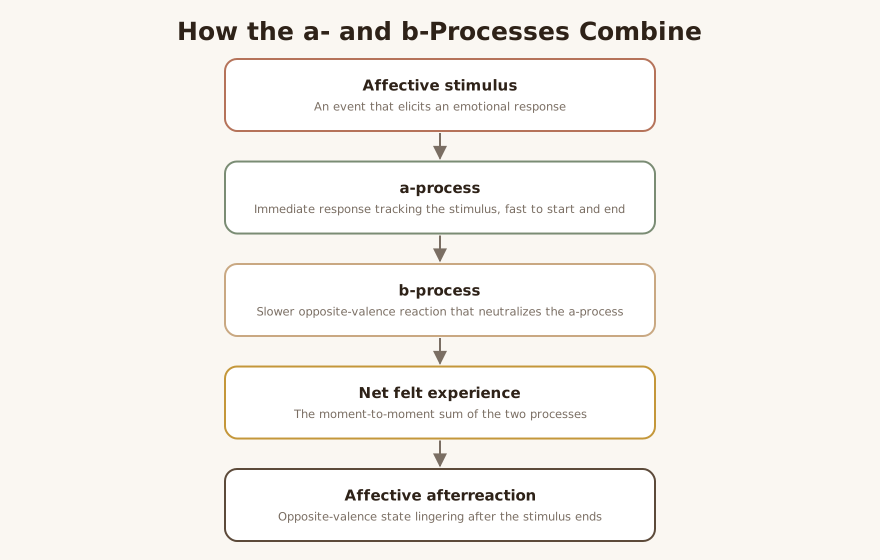
The central claim is that every affective response automatically triggers an opposing reaction 5. The initial, directly elicited response is the a-process: an immediate, intense state that follows the valence of the stimulus, whether the euphoria of a drug or the terror of a first parachute jump 4. The opposing response is the b-process: a slower, opposite-valence reaction that emerges to neutralize the a-process and restore emotional equilibrium 4. The observed feeling at any moment is the net of these two processes 5.
The two processes have different dynamics. The a-process is fast to start and fast to end, tracking the stimulus closely 5. The b-process is sluggish: slow to recruit, slow to peak, and slow to decay once the stimulus is gone 4. Because the b-process lingers after the a-process has faded, the dominant experience after a stimulus ends is an affective afterreaction of opposite valence to the original state 5.
The most clinically important principle is that the b-process strengthens with repeated stimulation 4. With repetition, the a-process weakens while the b-process grows larger and lasts longer 5. This shifting balance is the engine of the theory: it explains why the same dose, the same jump, or the same relationship produces less of the original feeling and more of its opposite over time 4. The a-process is generally assumed to be stable across exposures; it is the b-process that is acquired and amplified through experience LLM.
Interventions & Techniques
Opponent-process theory does not come packaged with proprietary techniques; it is a model that informs how a clinician conceptualizes and sequences existing interventions LLM. Used psychoeducationally, the theory reframes tolerance and withdrawal as predictable, learned dynamics rather than personal weakness, which can reduce shame and increase a client’s willingness to engage in treatment LLM. Clinicians can translate the a-process / b-process language into accessible metaphors so clients can anticipate the deepening of withdrawal and the shrinking of reward that the model predicts LLM.
The framework maps cleanly onto several established behavioral strategies LLM. Because the b-process is conditionable and strengthens with cue exposure, cue-exposure and stimulus-control work within behavioral and cognitive-behavioral treatments can be framed as attempts to weaken acquired opponent responses and the craving they drive 5. Because the b-process is slow to decay, the model supports a treatment rationale for tolerating the protracted discomfort of early abstinence, pairing distress-tolerance skills with the expectation that the opponent state will eventually subside LLM. And because the model predicts that relief-seeking, not pleasure-seeking, sustains repeated use, motivational and relapse-prevention work can target the negative-reinforcement loop the theory describes 5.
LLM-generated illustrative example (not a guideline): A clinician treating a client with alcohol use disorder draws the a-process and b-process curves on a whiteboard, showing how the early “warm glow” has shrunk while the morning anxiety and dysphoria have grown. The client recognizes that they now drink to quiet the b-process rather than to feel good, which reframes their craving as a learned counter-response and supports a relapse-prevention plan built around tolerating early-abstinence distress. LLM
Evidence Base
The maturity of opponent-process theory is best described as established as a theory rather than as an evidence-based treatment LLM. It is a foundational and highly influential explanatory framework in motivation and addiction science, and its core proposition that affective states elicit repetition-strengthened opposing reactions has shaped subsequent neuroscientific models of reward and dependence 5. Empirical discussion of the theory spans the affective dynamics it predicts across domains such as drug use, thrill-seeking, and love and attachment 4.
Several honest caveats belong in any clinical use of the model LLM. The theory is descriptive and somewhat difficult to falsify, because the b-process is inferred from net affect rather than measured directly LLM. Critics note that it oversimplifies emotional life: it does not account well for multiple simultaneous emotions, for external and contextual factors that shape affect, or for individual and cultural variation in emotional response 4. The model assumes broad, near-universal applicability that may not hold across people or situations 5. Importantly, “established” here refers to the theory’s standing and influence, not to a body of randomized trials of an opponent-process therapy, because no such manualized treatment exists LLM. Clinicians should therefore treat it as a conceptual aid that complements evidence-based interventions, not as a substitute for them LLM.
Populations & Indications
The theory is most directly applicable to people with substance use disorders, where its account of tolerance, withdrawal, and relief-driven use fits clinical observation closely 5. It extends naturally to individuals with behavioral addictions, including gambling disorder, where the same shift from reward-seeking to relief-seeking can be observed without a pharmacological agent 5. People in early recovery are a key indication, since the model directly addresses the protracted dysphoria and craving that drive relapse in the first weeks and months LLM.
Beyond addiction, the framework has been applied to thrill-seeking and risk-taking individuals, in whom the initial fear (a-process) gives way to a sought-after exhilaration or relief (b-process) that grows with repetition 4. It has also been used to conceptualize grief and loss, where the warmth of attachment is followed by the deepening pain of separation, an opponent afterreaction that the theory predicts 4. Clinicians working with nonsuicidal self-injury have invoked similar logic, framing the relief that follows self-harm as a b-process that can become a powerful negative-reinforcer over time LLM.
Problems-for-Work
Craving and relapse. The theory frames craving as the felt pull of a strengthened b-process and reframes relapse as relief-seeking rather than pleasure-seeking, which sharpens relapse-prevention planning 5. A clinician can help a client identify the cues that recruit the opponent state and build skills to ride it out LLM.
Tolerance and withdrawal. Psychoeducation grounded in the model normalizes escalating use and worsening withdrawal as predictable learned dynamics, reducing shame and supporting realistic expectations during detoxification and early abstinence 5.
Anhedonia in early recovery. The model predicts a period of blunted reward and persistent dysphoria as the b-process slowly decays, giving clinician and client a rationale for patience and behavioral activation while baseline hedonic tone recovers LLM.
Grief. The opponent afterreaction offers a way to discuss why the depth of loss tracks the depth of attachment, validating the intensity of grief without pathologizing it 4.
LLM-generated illustrative example (not a guideline): A client three weeks into stimulant abstinence reports feeling “flat and pointless.” The clinician uses the model to explain that the b-process has not yet decayed, that the flatness is expected and time-limited, and that scheduled rewarding activities can help re-establish baseline mood while the opponent state fades. LLM
Contraindications, Cautions & Cultural Humility
Because opponent-process theory is a conceptual model rather than a treatment, it carries no direct contraindications, but its misuse does LLM. The most important caution is not to let an elegant theory substitute for assessment or for evidence-based care; the model should sit alongside established interventions, never replace them LLM. Clinicians should also avoid over-applying a single mechanism, since the theory itself oversimplifies affect and ignores the multiple simultaneous emotions and contextual factors that shape any individual’s experience 4.
Cultural humility matters here in two ways LLM. First, the theory assumes a broad universality of emotional dynamics, yet emotional expression and the meaning of states like craving, grief, or thrill vary across cultures, and the framework does not capture that variation 5. Second, framing addiction in purely mechanistic, learned-response terms can be helpful for reducing shame, but for some clients it may feel reductive or may collide with spiritual, communal, or moral understandings of their struggle LLM. The clinician should offer the model tentatively, check how it lands, and abandon it as a frame whenever it does not fit the person in the room LLM.
Treatment-Plan Suggestions & SMART Objectives
| Goal | SMART objective (example) | Mechanism |
|---|---|---|
| Reduce relapse risk in early abstinence | Client will identify 3 personal cues that trigger craving and pair each with a coping skill within 4 sessions LLM | Targets cue-conditioned b-process / relief-seeking 5 |
| Normalize tolerance and withdrawal | Client will explain the a-process/b-process model in their own words and apply it to their use history by session 3 LLM | Psychoeducation reduces shame and corrects expectations 5 |
| Tolerate protracted dysphoria | Client will use a distress-tolerance skill on 5 of 7 days during weeks 2-6 of abstinence LLM | Bridges the slow decay of the opponent state 4 |
| Counter anhedonia | Client will schedule and complete 4 rewarding activities per week for 4 weeks LLM | Behavioral activation while hedonic baseline recovers LLM |
| Disrupt the negative-reinforcement loop | Client will track each urge with antecedent, relief sought, and outcome daily for 2 weeks LLM | Makes relief-driven use visible and interruptible 5 |
| Build relapse-prevention plan | Client and clinician will complete a written plan naming 3 high-risk cue situations and responses by session 6 LLM | Pre-empts strengthened opponent craving states 5 |
| Process attachment-related grief | Client will articulate the link between depth of attachment and depth of loss in 3 sessions LLM | Reframes grief as an expected affective afterreaction 4 |
Common Misconceptions
A frequent misreading is that the b-process is simply “the opposite emotion” a person chooses to feel; in the theory it is an automatic, slow, physiologically grounded counter-response, not a deliberate reappraisal 4. Another is that addiction in this model is driven by chasing pleasure, when the theory’s distinctive claim is the reverse: over time, repeated use is sustained by escaping the strengthened opponent state, so people continue using to feel less bad rather than to feel good 5.
A third misconception is that “the a-process gets weaker” means the drug or activity is doing less; in the standard account the a-process is relatively stable, and the felt loss of effect comes from the growing b-process subtracting from it 5. Finally, clinicians sometimes treat the theory as a validated treatment protocol; it is an explanatory framework, and its support concerns affective dynamics, not the outcomes of any branded therapy LLM.
Training & Certification
There is no certification, credential, or formal training pathway specific to opponent-process theory, because it is a theoretical model rather than a practice modality LLM. Clinicians typically encounter it within graduate coursework in learning, motivation, or the psychology of addiction, and through the primary literature 3. Accessible explainer summaries are widely available and are sufficient for most clinical conceptual use 4.
For applied competence, the relevant training is in the established interventions the theory informs, such as cognitive-behavioral relapse prevention, motivational interviewing, and contingency management, each of which has its own evidence base and training routes LLM. The most useful preparation is therefore to learn the model well enough to use it as psychoeducation and case formulation, while building credentialed skill in the treatments it complements LLM.
Key Terms
A-process: the primary, fast affective response directly elicited by a stimulus, following the stimulus’s valence 4.
B-process (opponent process): the slower, opposite-valence reaction that emerges to counter the a-process and restore equilibrium, strengthening with repeated exposure 4.
Affective afterreaction: the opposite-valence state experienced after a stimulus ends, produced by the lingering b-process once the a-process has faded 5.
Acquired motivation: motivation arising from experience-dependent changes in affective dynamics rather than from innate drives, the focus of Solomon’s 1980 extension 1.
Tolerance (in this model): the apparent loss of a stimulus’s effect as the growing b-process increasingly offsets a stable a-process 5.
Withdrawal (in this model): the intensified opponent state that dominates once the stimulus is removed, deepening with repeated prior exposure 5.
Resources & Further Reading
- Solomon & Corbit (1974) — An opponent-process theory of motivation: I. Temporal dynamics of affect (PubMed)
- Solomon (1980) — The opponent-process theory of acquired motivation: the costs of pleasure and the benefits of pain (PDF)
- Opponent Process Theory of Emotion and Motivational States — Simply Psychology
- Opponent Process Theory — iResearchNet (Social Psychology)
- The opponent process theory and affective reactions — Motivation and Emotion (Springer)
- Opponent Process Theory — YouTube intro
Reflective / Supervision Questions
- When you explain tolerance and withdrawal to a client, do you frame continued use as pleasure-seeking or as relief-seeking, and how might shifting that framing change the client’s self-narrative LLM?
- How do you guard against letting an elegant mechanistic model crowd out assessment of the contextual, relational, and cultural factors the theory leaves out 4?
- Where in your current caseload would naming the slow decay of an opponent state help a client tolerate early-abstinence dysphoria without concluding that treatment is failing LLM?
- How do you decide when the a-process / b-process frame is helping a particular client versus when it feels reductive and should be set aside LLM?
- For clients in grief, how might the idea that the depth of loss tracks the depth of attachment validate their pain rather than pathologize it 4?