
Type & Discipline
Hope Theory is a cognitive-motivational theory within positive psychology, not a freestanding psychotherapy 3. Its central claim is counterintuitive for many clinicians: hope is not primarily an emotion or a mood, but a thinking style — a goal-directed cognitive set that can be assessed and, in principle, modified 2. Snyder formalized hope as “a positive motivational state that is based on an interactively derived sense of successful (a) agency (goal-directed energy), and (b) pathways (planning to meet goals)” 2. Because the construct is defined cognitively rather than affectively, it slots naturally into goal-focused and cognitive frameworks therapists already use, and it provides a vocabulary for the kind of stuckness clinicians see in demoralized, depressed, and low-motivation clients LLM.
The discipline matters for expectations: positive psychology constructs are generally strong as measurement and prediction tools and more variable as intervention targets LLM. Hope Theory’s correlational base is mature and replicated; its causal-intervention base is thinner, a distinction this article keeps explicit throughout 4LLM.
Creators & Lineage
The theory was developed by C. R. (Rick) Snyder, a psychologist at the University of Kansas, whose 1991 paper “The Will and the Ways” introduced both the conceptual model and its measurement instrument 12. Snyder’s framing of hope as “the will and the ways” captures the two components cleanly: the will (agency) and the ways (pathways) 1LLM.
Hope Theory sits within the broader positive psychology movement and shares conceptual DNA with several adjacent models 3. It overlaps with Bandura’s self-efficacy theory (belief in one’s capacity to execute action) and Seligman’s work on learned optimism, yet Snyder argued hope is distinct: it is explicitly goal-bound and requires both motivation and route-generation, where optimism is closer to a generalized expectancy that good things will happen 3. Goal-setting theory supplies the structural backbone — hope is inert without concrete goals — and solution-focused brief therapy is a close clinical cousin, sharing an emphasis on routes forward and exceptions to the problem rather than excavation of its origins 3LLM.
Core Principles
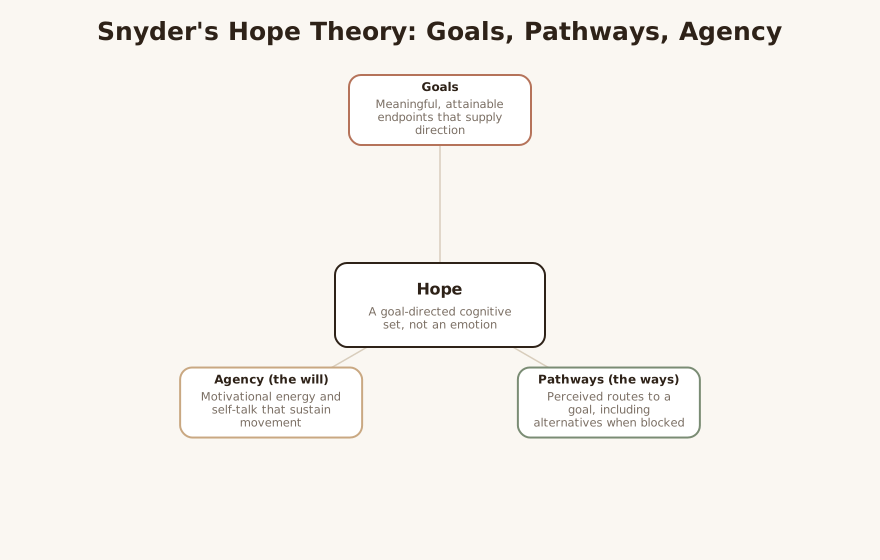
Snyder’s model rests on three interlocking elements 35:
-
Goals. Hope requires an object — a meaningful, attainable endpoint, which may be concrete (“I want to return to work”) or imagistic (visualizing a future state) 5. Goals supply direction; without them, agency and pathways have nothing to organize around 3.
-
Pathways thinking (the “ways”). This is the perceived capacity to generate workable routes to a goal — and, critically, to generate alternative routes when the first is blocked 3. Snyder held that the ability to produce multiple pathways is essential to durable hopeful thought, because obstacles are inevitable and a single-route plan collapses at the first barrier 3.
-
Agency thinking (the “will”). This is the motivational component: the goal-directed energy and self-talk (“I can do this,” “I won’t give up”) that initiates and sustains movement toward the goal 23.
Two principles follow. First, the components are interactive and reciprocal — agency and pathways feed each other, and high hope requires both; a client with vivid plans but no drive, or fierce drive but no perceived route, is not hopeful in Snyder’s sense 2LLM. Second, hope is a survival mechanism for navigating adversity rather than a fair-weather disposition, and it is framed as trainable rather than fixed 53. More recent extensions of the model add an intrapersonal “Why Power” (meaning aligned with identity) and an interpersonal “We Power” (social connectedness), expanding the original dyad toward purpose and relational support 3.
Interventions & Techniques
Hope-focused work is procedural and collaborative. Common techniques drawn from the hope literature include 35:
- Goal clarification and SMART framing. Convert vague wishes into specific, attainable, time-bound goals, and break large goals into milestones so progress is visible 53.
- Pathways generation. Explicitly brainstorm multiple routes to each goal rather than one, so a blocked path triggers a pivot instead of a collapse 3.
- Barrier anticipation and contingency planning. Name likely obstacles in advance and pre-build “if blocked, then” backup routes 53.
- Agency-building self-talk and visualization. Use motivational self-statements, affirmations, and mental rehearsal of successful goal pursuit to strengthen willpower 53.
- Milestone celebration and positive emotion. Mark sub-goal completion to generate the positive affect that refuels agency 3.
- Hope storytelling. Elicit narratives of past resilience and prior successful goal pursuit as evidence the client can draw on 3.
- Collaboration and social support. Recruit relationships and shared resources, consistent with the “We Power” extension 3.
LLM-generated illustrative example (not a guideline): A client recovering from a stroke says, “I’ll never drive again.” A hope-oriented therapist reframes the goal (“regain independent local transportation”), then generates pathways together — adaptive-driving evaluation, paratransit, rideshare, a relocation closer to amenities — and names the first barrier (cost) with a contingency (county subsidy). Pathways thinking turns a closed door into a corridor of options, and each scheduled appointment becomes an agency-feeding milestone LLM.
Evidence Base
The evidence for Hope Theory is best described as established on the measurement and correlational side, and emerging on the causal-intervention side 4LLM. The Adult Hope Scale is a well-validated, widely used 12-item instrument, and the construct predicts a broad range of outcomes including academic achievement, resilience, and psychological adjustment after adversity 23.
The strongest recent synthesis is a 2023 meta-analysis (Corrigan & Schutte) of 40 published studies plus 5 dissertations 4. Pooling roughly 11,000 participants for depression (50 samples) and nearly 8,000 for anxiety (26 samples), it found that both hope components were inversely associated with distress 4. For depression, agency thinking showed a stronger association (r = -.391) than pathways thinking (r = -.328), with non-overlapping confidence intervals — meaning the difference was reliable, and agency may be the more clinically salient lever for depressed clients 4. For anxiety, the two components were similar and weaker (agency r = -.259; pathways r = -.206) 4. The authors recommended developing strategies to strengthen agency-related appraisals in clinical practice 4.
The honest caveat: these are cross-sectional correlations, not causal demonstrations 4LLM. They establish that hope and distress travel together and that agency tracks depression especially closely, but they do not by themselves prove that raising hope lowers depression LLM. Therapists should treat hope-building as a plausible, theory-consistent, low-risk adjunct rather than a proven standalone cure LLM.
Populations & Indications
Hope Theory is most useful where the clinical problem is fundamentally about blocked or absent goal pursuit LLM. Indicated populations include people with depression, where low agency is a defining feature and the meta-analytic signal is strongest 4; clients facing chronic or terminal illness, where demoralization and “hope fatigue” — exhaustion from sustaining hope under prolonged adversity — are common 3; trauma survivors, for whom higher hope is associated with better psychological adjustment after adversity 3; adolescents and at-risk youth, where hope predicts academic achievement and resilience 3; people experiencing grief; and clients in rehabilitation, where concrete goals and multiple pathways map directly onto recovery 3LLM.
The framework is also a natural fit anywhere motivation and planning need scaffolding — it gives the clinician a shared model for why a stuck client is stuck (no goal, no route, or no will) and which lever to pull LLM.
Problems-for-Work
- Major depressive disorder / low agency. Target agency directly, given its stronger meta-analytic link to depression — behavioral activation framed as agency-building (small goals completed = restored “I can”) 4LLM.
- Hopelessness and suicidal ideation. Hopelessness is, in Snyder’s terms, the simultaneous failure of agency and pathways; therapeutic work rebuilds a single small attainable goal with at least one visible route. (Use within a formal safety/risk protocol, not as a substitute for one) 3LLM.
- Learned helplessness. Pathways work counters the belief that no route exists; agency work counters the belief that effort is futile 3LLM.
- Goal-setting difficulties and low motivation. SMART goal-setting plus milestone celebration externalizes structure the client cannot yet supply internally 53.
- Adjustment disorder and demoralization in chronic illness. Reframe goals around what remains controllable and generate alternative pathways as the illness narrows options 3LLM.
- Grief. Rebuild goals and meaning (“Why Power”) after a loss has dismantled the client’s prior goal structure 3LLM.
- Low self-efficacy. Agency self-talk and rehearsal of past successes supply the willpower component 35LLM.
Contraindications, Cautions & Cultural Humility
Hope Theory has no formal contraindications as a conceptual lens, but several cautions apply LLM. Hope is not a substitute for safety planning. With suicidal or high-risk clients, hope-building supplements — never replaces — structured risk assessment and crisis protocols LLM. Avoid premature positivity. Snyder’s hope is effortful and route-based, explicitly not wishful thinking or passive optimism; pushing “stay hopeful” without concrete pathways can read as invalidating and resembles toxic positivity 53LLM. With grieving or terminally ill clients, goal reframing must follow, not bypass, acknowledgment of real loss LLM.
Cultural humility: the model is individualistic in its original framing — goals, personal agency, self-generated routes — which may not map onto collectivist value systems where goals are familial or communal and “agency” is distributed across a network LLM. The “We Power” extension toward relational and shared resources partially addresses this and should be foregrounded with clients for whom autonomy-centric framing fits poorly 3LLM. Clinicians should also recognize that constrained pathways are sometimes a function of real structural barriers (poverty, discrimination, illness), not a thinking deficit, and that locating the problem entirely “in the client’s head” risks blaming people for systemic obstacles LLM.
Treatment-Plan Suggestions & SMART Objectives
| Goal | SMART objective (example) | Mechanism |
|---|---|---|
| Increase agency thinking | Client will record one agency self-statement (“I am making progress”) daily for 4 weeks, reviewed in session | Strengthens goal-directed willpower; agency is the strongest correlate of reduced depression 4 |
| Build pathways thinking | For each stated goal, client will generate at least 3 alternative routes within 3 sessions | Multiple-route capacity sustains hope when a path is blocked 3 |
| Establish a concrete goal | Client will define one specific, attainable, time-bound goal by session 2 | Goals give agency and pathways an object to organize around 53 |
| Anticipate barriers | Client will name the top 2 obstacles per goal and a contingency for each, within 2 weeks | Pre-built “if blocked, then” plans prevent collapse at first barrier 5 |
| Restore motivation via milestones | Client will break one large goal into 4 milestones and mark each completed | Milestone-linked positive affect refuels agency 3 |
| Reduce demoralization in illness | Client will identify 2 value-aligned goals that remain controllable, by session 3 | “Why Power” / meaning preserves direction as options narrow 3 |
| Mobilize support | Client will identify 2 people or resources to recruit toward a goal within 2 weeks | “We Power” / social connectedness adds pathways and agency 3 |
| Track hope over time | Client will complete the Adult Hope Scale at intake and every 6 weeks | Provides a validated, repeatable index of agency and pathways 2 |
Common Misconceptions
- “Hope is just an emotion.” In Snyder’s model hope is a cognitive set — agency plus pathways — that produces emotion as a byproduct of goal pursuit, not the reverse 23.
- “Hope equals optimism.” Optimism is a generalized expectancy that good things will happen; Snyder’s hope is goal-specific and demands active route-generation and willpower 35.
- “Hope is wishful thinking.” It is explicitly effortful and plan-based; wishing without pathways or agency is not hope in this framework 5.
- “More agency is always the answer.” Agency without pathways yields frustrated striving; the components are interactive and both are required 2LLM.
- “Raising hope cures depression.” The evidence is correlational — agency tracks depression strongly, but causation is not established, and hope work is an adjunct, not a proven cure 4LLM.
Training & Certification
There is no certification or licensure in “Hope Theory” — it is a research-grounded conceptual model, not a credentialed therapy LLM. Clinicians acquire it through the primary literature (Snyder’s 1991 paper and subsequent work) and applied positive psychology training resources 13. The Adult Hope Scale is freely available for research and practice through the Penn Positive Psychology Center, requires no special certification to administer, and takes only a few minutes to complete 2. Practically, competence comes from integrating hope targets into an existing evidence-based modality the clinician is already trained and credentialed in (e.g., CBT) LLM.
Key Terms
- Hope: a positive motivational state combining a sense of successful agency and pathways toward goals 2.
- Agency thinking (“the will”): the motivational energy and self-talk that initiate and sustain goal pursuit 23.
- Pathways thinking (“the ways”): the perceived capacity to generate one or more workable routes to a goal 3.
- Goals: the meaningful, attainable endpoints that organize agency and pathways 53.
- Adult Hope Scale (AHS): Snyder’s 12-item self-report measure (4 agency, 4 pathways, 4 filler items) on an 8-point scale 2.
- Hope fatigue: exhaustion from sustaining hope through prolonged adversity 3.
- Why Power / We Power: later extensions adding intrapersonal meaning and interpersonal connectedness to the model 3.
Resources & Further Reading
▶ Watch — a video introduction to this concept:
- Snyder et al. (1991). The Will and the Ways: Development and Validation of an Individual-Differences Measure of Hope
- Adult Hope Scale — Penn Positive Psychology Center
- The Relationships between Agency and Pathways Thinking with Depression and Anxiety: A Meta-Analysis (Springer, 2023)
- Hope Theory: How Pathways Thinking Can Help Your Clients — PositivePsychology.com
- Snyder’s Hope Theory — MindTools
Reflective / Supervision Questions
- When a client presents as “hopeless,” can you distinguish whether the deficit is in goals, pathways, agency, or all three — and does your intervention target the right one? LLM
- Given that agency tracks depression more strongly than pathways, where are you currently placing your therapeutic emphasis, and is it aligned with the evidence? 4LLM
- How do you hold hope-building and validation of real loss in the same session without one undermining the other? LLM
- For clients from collectivist backgrounds, how might you reframe “agency” and “goals” in relational or communal terms? LLM
- Where might your encouragement of hope risk sliding into toxic positivity, and what concrete pathways would convert it back into Snyder’s effortful hope? 5LLM
- How are you measuring hope over the course of care, and what would a flat or declining Adult Hope Scale trajectory prompt you to change? 2LLM