
Type & Discipline
Goal-Setting Theory is a theory of motivation and task performance rather than a standalone psychotherapy 1. It originated in industrial-organizational and motivation psychology, where Edwin Locke and Gary Latham studied why some performance goals drive effort and persistence while others do not 1. The theory sits within the broader family of motivation theories and is frequently grouped with expectancy, social-cognitive, and self-regulation frameworks 7. Its central, empirically durable claim is deceptively simple: conscious goals regulate human action, and the attributes of those goals predict how hard and how long a person will work 1.
For clinicians, the relevance is practical rather than diagnostic LLM. Goal-Setting Theory does not name a disorder or prescribe a treatment, but it supplies a tested set of principles about how to construct the goals that already appear in nearly every treatment plan, behavioral contract, and homework assignment LLM. It is best understood as a “mechanism layer” that can be embedded inside recognized modalities such as cognitive-behavioral therapy or behavioral activation LLM.
Creators & Lineage
The theory is overwhelmingly associated with Edwin A. Locke and Gary P. Latham, whose collaborative program of research spans more than three decades 1. Locke’s early laboratory work in the 1960s established that specific hard goals produced higher performance than vague exhortations, and Latham’s field studies (famously with logging crews and other work settings) replicated the effect outside the lab 1. Their 1990 book, A Theory of Goal Setting & Task Performance, integrated this evidence into a formal theory 2. Their 2002 American Psychologist paper, subtitled “A 35-Year Odyssey,” is the most cited synthesis and the one clinicians should treat as the canonical statement 1.
The theory’s intellectual lineage connects closely to Albert Bandura’s social cognitive theory, particularly the construct of self-efficacy, which Locke and Latham incorporate as both a determinant and a consequence of goal pursuit 1. Within clinical practice, Goal-Setting Theory shares conceptual territory with behavioral activation, which schedules and grades activity toward valued outcomes, and with motivational interviewing, which attends to commitment and the resolution of ambivalence before goals are set LLM. The popular “SMART goals” heuristic (Specific, Measurable, Achievable, Relevant, Time-bound) is a downstream, simplified application of the same principles, though it is a practitioner mnemonic rather than part of the original theory 7.
Core Principles
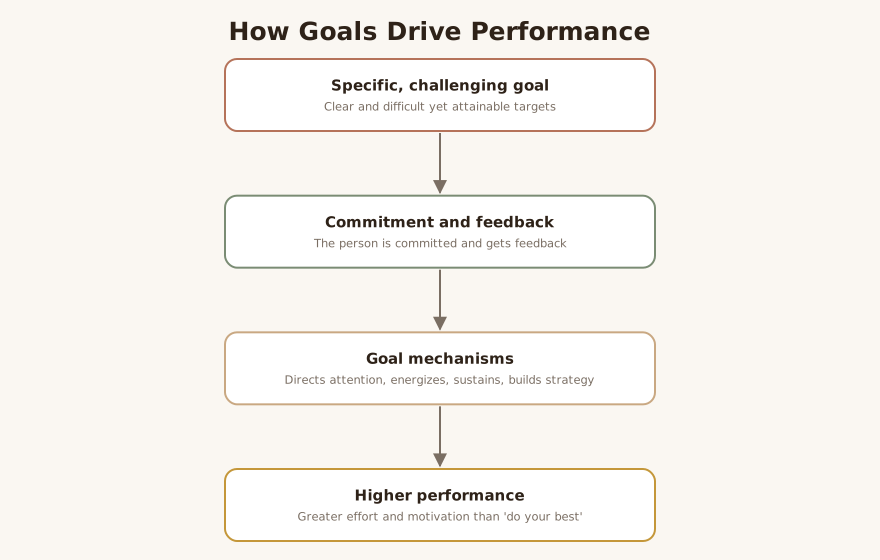
Locke and Latham identify two foundational goal attributes: specificity and difficulty 1. Specific goals direct attention and effort toward goal-relevant activities and away from irrelevant ones, whereas vague “do your best” goals permit a wide range of acceptable performance and therefore fail to mobilize maximal effort 1. Difficulty matters because, within the limits of ability, there is a positive linear relationship between goal difficulty and performance: harder goals produce higher performance than easy goals, provided the person is committed and has the requisite ability 1.
The theory specifies four mechanisms through which goals affect performance 1. Goals direct attention and effort toward goal-relevant activities 1. Goals have an energizing function, so that higher goals lead to greater effort 1. Goals affect persistence, prolonging effort over time 1. And goals lead to the discovery and use of task-relevant knowledge and strategies, an effect that becomes especially important on complex tasks 1.
Several moderators determine whether goals actually produce these effects 1. Goal commitment is critical; difficult goals only enhance performance when the person is genuinely committed to them, and commitment is strengthened by importance and self-efficacy 1. Feedback is essential, because people need information about their progress to adjust effort and strategy 1. Task complexity moderates the relationship, since on complex tasks the path from goal to performance runs heavily through strategy discovery, and overly specific high performance goals can backfire if the person lacks the strategies to reach them 1. Ability and situational resources set the ceiling on what goals can achieve 1.
The theory also distinguishes goal content from goal type 1. On complex or novel tasks where the person has not yet acquired the relevant skills, learning goals (focused on acquiring strategies or knowledge) often outperform pure outcome or performance goals, which can induce anxiety and narrow attention prematurely 1. This distinction is directly useful in therapy, where many clients face genuinely novel behavioral challenges LLM.
Interventions & Techniques
Translating the theory into clinical technique centers on how goals are co-constructed and tracked LLM. The first move is to make goals specific and, where possible, quantifiable, replacing “I want to feel less anxious” with a concrete, observable target 5. Specificity allows both clinician and client to know unambiguously whether the goal was met 4.
The second move is calibrating difficulty so that goals are challenging yet attainable for the individual’s current capacity 4. Goals that are too easy fail to engage effort, while goals far beyond present ability erode commitment and self-efficacy 4. MindTools and other applied summaries frame this as setting goals that stretch the person without overwhelming them 5.
The third move is securing commitment, often by involving the client in setting the goal rather than imposing it, and by linking the goal to outcomes the client genuinely values 5. Participation in goal setting and a clear rationale both support ownership 5. The fourth move is building in feedback, so that progress is visible and goals can be revised; without feedback the motivational benefits of a goal largely disappear 4. The fifth consideration is task complexity, which for clinical work means breaking large behavior-change targets into graded sub-goals and, on genuinely novel tasks, favoring learning goals over rigid outcome targets 1.
LLM-generated illustrative example (not a guideline): A clinician working with a client who is socially isolated reframes the vague aim “be more social” into a specific, moderately challenging goal: “Initiate one brief conversation with a coworker, three workdays this week, and note in a log how it went.” The log supplies feedback, the client helped choose the target (commitment), and because initiating conversation is a skill the client is still building, the clinician frames it partly as a learning goal (“notice what openers feel manageable”) rather than a pure outcome goal (“make a new friend”) LLM.
Evidence Base
The evidence base for Goal-Setting Theory is mature and unusually robust by the standards of motivation research 1. Locke and Latham describe it as among the most validated theories in industrial-organizational psychology, built on hundreds of studies spanning laboratory and field settings, multiple countries, and a wide range of tasks and populations 1. The core findings (specific hard goals outperform vague or easy goals, moderated by commitment, feedback, ability, and task complexity) have replicated consistently 1.
That maturity should be read with discipline-aware caution LLM. The bulk of the foundational research was conducted in organizational and performance contexts (work output, productivity, task completion), not in psychotherapy outcomes such as symptom reduction or relapse prevention 1. A systematic review of goal-setting interventions in sport found that, despite the theory’s strong general standing, its principles were often applied loosely or incompletely in applied sport settings, and that adherence to the actual specifications of the theory varied widely across studies 3. That review is a useful corrective: it shows that “goal setting” as practiced in the field is frequently a diluted version of the theory, which can muddy effectiveness claims 3.
For clinicians, the honest summary is that the underlying motivational mechanism is very well established, while the direct evidence for goal-setting-theory-based interventions producing clinical outcomes is far thinner and largely inferential, borrowed from adjacent modalities like behavioral activation that already embed graded goal pursuit LLM. Use the theory as a principled scaffold, not as an evidence-based treatment in its own right LLM.
Populations & Indications
Goal-Setting Theory was developed and validated most extensively with employees and teams in work settings 1. Applied summaries and reviews have extended it to students and to athletes, where structured goal setting is a staple of performance psychology 3. In health contexts, the same principles underpin self-management programs for people with chronic illness, where specific, monitored behavioral targets support adherence LLM.
In general psychotherapy, the theory is indicated whenever change requires sustained, self-directed effort between sessions LLM. This includes adults in therapy pursuing concrete behavior change, clients enrolled in structured behavior-change programs, and anyone for whom the gap between intention and action is the clinical problem LLM. It is particularly apt when a client expresses a desire to change but cannot translate that desire into consistent action, because the theory offers a precise diagnosis of which goal attribute (specificity, difficulty, commitment, feedback) is missing LLM.
Problems-for-Work
Motivation deficits and procrastination. When a client repeatedly fails to start or finish tasks, the theory points first to specificity and difficulty: vague or overwhelming goals fail to energize action 1. Reframing the target into a specific, moderately challenging, time-bound step often restores momentum 5.
Low self-efficacy. Because self-efficacy both supports commitment and is built by mastery experiences, setting attainable graded goals that produce early successes can raise self-efficacy in a virtuous cycle 1.
LLM-generated illustrative example (not a guideline): A client with depression who believes “I can’t get anything done” is given a deliberately small, specific morning goal (make the bed and take a five-minute walk) so that the early win provides feedback and a mastery experience, gradually rebuilding the sense that effort produces results LLM.
Treatment nonadherence and avoidance. Where homework or behavioral plans go undone, examining commitment (was the goal the client’s or the clinician’s?) and feedback (does the client see progress?) frequently locates the breakdown 5. Avoidance can be addressed by grading goals so that the next step is challenging but not threatening LLM.
Behavioral activation needs in depression. Goal-Setting Theory and behavioral activation are highly compatible; activity scheduling becomes more effective when activities are framed as specific, attainable, monitored goals tied to values LLM. Performance anxiety and poor self-regulation. For anxious performers, the theory’s distinction between learning and outcome goals is useful, since shifting from a high-stakes outcome goal to a process or learning goal can reduce the self-evaluative pressure that fuels anxiety 1.
Contraindications, Cautions & Cultural Humility
Goal setting is not universally beneficial, and clinicians should watch for predictable failure modes LLM. On complex tasks for which the client lacks strategies, an aggressive specific outcome goal can increase anxiety, narrow attention, and impair performance; learning goals are safer in that situation 1. Goals that are set too high relative to ability undermine commitment and damage self-efficacy when they are repeatedly missed 4. There is also a documented risk that narrow goals crowd out unmeasured but important behaviors and, in some contexts, incentivize shortcuts; the theory’s own literature acknowledges that goal specificity directs attention away from non-goal activities, which is a benefit only if the goal is well chosen 1.
A clinical caution specific to mental health is that perfectionistic, rigid, or self-critical clients may weaponize goals, treating any shortfall as evidence of failure LLM. With such clients, building in flexible feedback, learning-goal framing, and explicit permission to revise goals is protective LLM.
Cultural humility matters because Goal-Setting Theory emerged from largely Western, individualistic, performance-oriented organizational research LLM. Assumptions about individual autonomy, self-directed achievement, and the desirability of “challenging” personal goals are not culturally universal, and for some clients collective, relational, or harmony-oriented framings of goals will be more congruent and more effective LLM. Clinicians should co-construct goals in the client’s own value language rather than importing a productivity frame, and should remain alert to the ways structural barriers, not motivation, may be blocking progress LLM.
Treatment-Plan Suggestions & SMART Objectives
The theory maps cleanly onto treatment-plan writing, because a well-specified objective is essentially a goal that satisfies the theory’s attributes of specificity, measurability, attainable difficulty, and feedback 5. The SMART format is the practical bridge 7.
| Goal | SMART objective (example) | Mechanism |
|---|---|---|
| Reduce avoidance / behavioral activation | Client will complete 3 of 5 scheduled valued activities per week and log mood before/after, for 4 weeks | Specificity + feedback direct effort and make progress visible 1 |
| Improve treatment adherence | Client will take prescribed medication at the same daily time 6 of 7 days/week and bring a tracking sheet to each session | Specific, measurable target plus feedback supports persistence 4 |
| Raise self-efficacy via graded mastery | Client will complete one small attainable task daily for 2 weeks before increasing difficulty | Attainable difficulty produces early wins that build self-efficacy 1 |
| Reduce procrastination on a project | Client will work on the task for 20 focused minutes, 4 days/week, tracked in a log | Specific, time-bound goal energizes effort and overrides vagueness 5 |
| Manage performance anxiety | Client will set one process/learning goal per practice session rather than an outcome goal, for 3 weeks | Learning-goal framing lowers evaluative pressure and aids strategy use 1 |
| Increase social engagement | Client will initiate one brief social contact on 3 days/week and rate difficulty 0-10 each time | Specificity + self-monitored feedback support directed, persistent effort 4 |
| Strengthen goal commitment | Client and clinician will collaboratively write and sign one weekly goal the client rates as personally important (>=7/10) | Participation and perceived importance increase commitment 5 |
Common Misconceptions
A frequent misconception is that any goal motivates better than no goal; in fact, vague “do your best” goals function much like having no goal, because they fail to define a clear standard 1. Another is that harder is always better without limit; the difficulty-performance relationship holds only within the bounds of ability and commitment, and impossible goals demotivate 1. A third is that “SMART goals” are the theory itself; SMART is a useful applied mnemonic, but the theory is broader and includes commitment, feedback, task complexity, and the learning-versus-outcome distinction that SMART omits 7.
Clinicians sometimes assume goal setting is automatically therapeutic, when poorly chosen goals can increase anxiety, encourage tunnel vision, or damage self-efficacy through repeated failure 1. Finally, the existence of a large, mature evidence base for the theory is sometimes mistaken for evidence that goal-setting interventions reliably improve clinical outcomes; the systematic review in sport shows that real-world applications often deviate from the theory and produce mixed results 3.
Training & Certification
There is no certification in Goal-Setting Theory, because it is a research theory rather than a proprietary treatment model LLM. Competence comes from reading the primary sources, principally Locke and Latham’s 1990 book and their 2002 synthesis, and from understanding the moderators rather than just the headline finding 12. Accessible secondary explainers from applied psychology outlets and instructional videos can orient practitioners to the model quickly before they go to the primary literature 46.
For clinical application, the relevant training is in the host modalities that the goal structure plugs into, such as CBT, behavioral activation, and motivational interviewing, each of which has its own established training pathways LLM. A clinician who is competent in those modalities can apply Goal-Setting Theory’s principles without additional credentialing LLM.
Key Terms
Goal specificity — the degree to which a goal defines a precise, unambiguous target rather than a vague aim 1. Goal difficulty — how demanding the goal is relative to ability; harder goals raise performance within ability limits 1. Goal commitment — the person’s determination to reach the goal, a necessary condition for difficult goals to work, strengthened by importance and self-efficacy 1. Feedback — information about progress that lets the person adjust effort and strategy 1. Self-efficacy — belief in one’s capability to perform, both a determinant and a consequence of goal pursuit 1. Task complexity — a moderator; on complex tasks, performance depends heavily on discovering the right strategies 1. Learning goal vs. performance/outcome goal — a learning goal targets skill or strategy acquisition, often superior on novel tasks, whereas an outcome goal targets an end result 1.
Resources & Further Reading
▶ Watch — a video introduction to this concept:
- Building a Practically Useful Theory of Goal Setting and Task Motivation: A 35-Year Odyssey (Locke & Latham, 2002, American Psychologist)
- A Theory of Goal Setting & Task Performance (Locke & Latham, 1990)
- The application of Goal Setting Theory to goal setting interventions in sport: a systematic review
- What is Locke’s Goal Setting Theory of Motivation? (PositivePsychology.com)
- Locke’s Goal-Setting Theory (MindTools)
- Locke’s Goal-Setting Theory | Organizational Behavior (video, From A Business Professor)
- Goal setting (Wikipedia)
Reflective / Supervision Questions
- When a client’s behavioral homework goes undone, do I reflexively read it as “low motivation,” or do I check which specific goal attribute (specificity, difficulty, commitment, or feedback) actually broke down? LLM
- Whose goal is it? How often am I setting goals for clients rather than co-constructing them in the client’s own value language, and how might that affect commitment? LLM
- For this client’s task, is an outcome goal appropriate, or would a learning goal reduce anxiety and support strategy discovery on a genuinely novel challenge? LLM
- Am I building visible feedback into the plan, or expecting the goal to motivate without any mechanism for the client to see progress? LLM
- Where might my goal framing carry culturally specific, individualistic, or productivity-oriented assumptions that do not fit this client’s context, and how would I notice if it did? LLM
- With perfectionistic or self-critical clients, am I inadvertently handing them a new yardstick for self-punishment, and have I built in flexibility and permission to revise? LLM