
Type & Discipline
Existential-Humanistic (E-H) therapy is a depth-oriented, relational, experiential psychotherapy belonging to the humanistic (“third force”) tradition in psychology, distinct from psychoanalysis and behaviorism 3. It is best understood not as a manualized treatment package but as an attitude and a way of being with clients, organized around therapeutic presence rather than a fixed catalogue of techniques 2. Its disciplinary home is humanistic psychology, and its philosophical scaffolding is drawn from existential and phenomenological thought 2. Within the broader existential field it represents the specifically American synthesis — fusing European existential philosophy with the homegrown humanistic emphases on growth, subjectivity, and the healing relationship LLM. For practicing clinicians, the practical implication is that E-H is closer to a relational orientation that can inform many forms of talk therapy than to a discrete intervention protocol LLM.
Creators & Lineage
James F. T. Bugental (1915–2008) is the figure most associated with naming and articulating E-H psychotherapy; an American psychologist trained at Ohio State, he was a founding member of the humanistic movement alongside Abraham Maslow and served as the first president of the Association for Humanistic Psychology in 1962 3. His 1963 American Psychologist article introduced humanistic psychology’s core assumptions to the wider discipline, and he co-created existential-humanistic psychotherapy in dialogue with Rollo May 3. Bugental’s books — The Search for Authenticity (1965), The Art of the Psychotherapist (1987), and Psychotherapy Isn’t What You Think (1999) — form much of the clinical canon and place therapeutic presence at the center of effective work 3. Rollo May contributed the existential frame, with the 1958 Existence volume (May, Angel, and Ellenberger) anchoring the existential orientation that E-H later integrated with Carl Rogers’s 1951 humanistic contributions 2.
The lineage is genuinely hybrid: existential therapy supplies the confrontation with the “givens” of existence, person-centered therapy supplies the relational and growth assumptions, and humanistic psychology supplies the overarching faith in subjectivity and self-actualization LLM. Gestalt therapy is a sibling within the experiential family, sharing E-H’s emphasis on present-moment, embodied process LLM. The tradition has been carried forward by clinicians such as Irvin Yalom — frequently paired with Bugental as a master of cultivating presence in the encounter — and by contemporary leaders including Kirk Schneider and Orah Krug, with the Existential-Humanistic Institute serving as a training and dissemination hub 45.
Core Principles
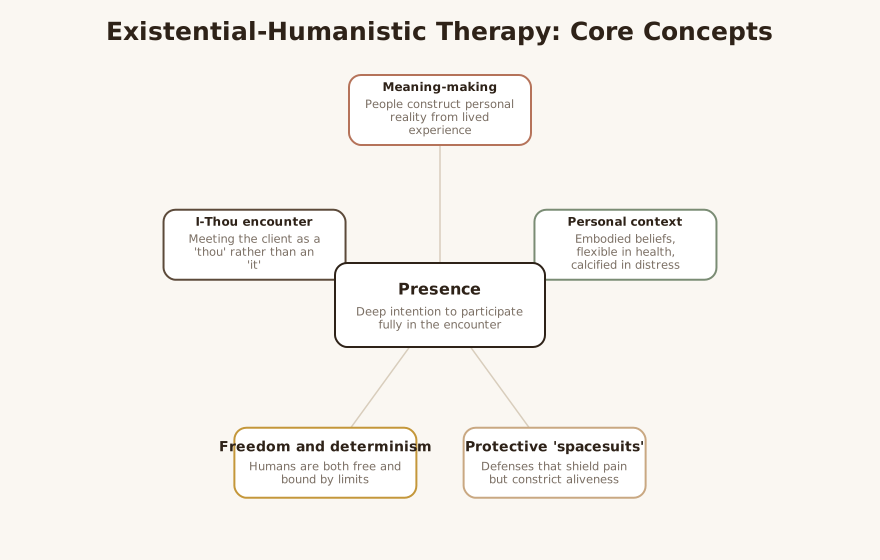
E-H rests on the premise that human beings are meaning-makers who construct their personal reality from lived experience, and that this meaning-making embeds agency, freedom, responsibility, and the capacity for change 5. People develop embodied beliefs about self, others, and world — a “personal context” — that is fluid and flexible in health but rigid or “calcified” in distress 5. Bugental described the defensive adaptations people build as protective “spacesuits”: structures that shield against overwhelming pain while simultaneously constricting the person’s aliveness and range of living 5. A foundational tension runs through the model: humans are paradoxically both free (in their subjective meaning-making) and determined (by natural limits and context) 5.
Presence is the organizing concept. Bugental defined it as “the quality of being in a situation or relationship in which one intends at a deep level to participate as fully as one is able,” and E-H treats it as both the ground of genuine encounter and itself a method of transformational change 25. Drawing on Buber’s I-Thou framework, presence transforms the client from an “it” into a “thou,” replacing a hierarchical expert-patient stance with two “fellow travelers” on life’s journey 5. The approach privileges a phenomenological epistemology — knowing the person directly rather than projecting abstract models onto them — and asks therapists to bracket their own worldview to enter the client’s experiential world 5. Anxiety, in this frame, is not merely a symptom to suppress but often a signal of confrontation with freedom, finitude, and the demand to make meaning LLM.
Interventions & Techniques
Because E-H is defined by attitude rather than technique, its “interventions” are better described as practiced ways of working 2. The Krug articulation names four 5:
- Cultivate presence. Treat the client as a person rather than a diagnosis, and wonder about the meaning of a symptom rather than rushing to eliminate it 5.
- Attune to process over content. Attend to the implicit dimensions — vocal tone, affect, posture, relational stance — the “music” beneath the words, which often reveals more than the explicit narrative 5.
- Illuminate protective patterns. Mirror self-limiting patterns back to the client, helping them move from unconscious enactment to reflective awareness, and invite embodied experiencing rather than purely cognitive understanding 5.
- Facilitate new meanings and behaviors. Support the client in constructing alternative self-concepts (for example, “I am worthy; I can rely on others”) that open more functional ways of relating 5.
The therapeutic relationship functions as a “living laboratory” — a microcosm of the client’s relational world in which old patterns surface concretely and can be worked in real time 5. The method that EHI calls “experiential liberation” gently challenges the client toward deeper spheres of freedom by working with the constriction and expansion of lived experience 2. Resistance is reframed not as obstruction but as the protective pull of constancy — “a powerful counterweight to freedom and change” — and is therefore worked with rather than against 5. Bugental and Yalom are paired as exemplars precisely because both make the disciplined use of the therapist’s own presence the central instrument of change 4.
LLM-generated illustrative example (not a guideline): A client narrates a job loss in a flat, rapid monotone. Rather than moving immediately to coping skills, the E-H therapist slows the moment, names the deadness in the voice, and wonders aloud what it protects against — opening into the client’s dread of being seen as a failure and, beneath that, a buried question about what their life is now for LLM.
Evidence Base
Honesty about maturity matters here. E-H is an established and clinically influential tradition with a deep theoretical literature and decades of training infrastructure, but its controlled-outcome evidence base is comparatively thin 32. Proponents acknowledge openly that E-H “still suffers from a lack of support from the academic community,” partly because its phenomenological method resists the standardization that randomized controlled trials require 5. None of the foundational E-H sources are outcome trials; the strongest empirical claim available is indirect — that the broader humanistic-experiential family performs on par with, and sometimes better than, more programmatic approaches across many therapy problems 5.
The fairest summary for a clinician is therefore this: E-H’s empirical support largely rides on the wider humanistic-experiential and common-factors literatures (the centrality of the relationship, presence, and alliance) rather than on modality-specific E-H trials LLM. Where it is on firm ground is in its convergence with robust findings that the therapeutic relationship is itself a powerful agent of change; where it is weaker is in modality-specific, condition-specific efficacy data of the kind CBT can marshal LLM. Clinicians integrating E-H should hold its principles as a relational orientation supported by general process research, not as a first-line, trial-validated treatment for a specific disorder LLM.
Populations & Indications
E-H is most naturally indicated for adults grappling with the kind of concerns that resist purely symptom-focused work: people in major life transitions, those seeking personal growth and authenticity, and clients in the grip of a meaning crisis LLM. It is well-suited to demoralization, self-alienation, identity confusion, and the diffuse “what is my life for” distress that does not map cleanly onto a diagnostic category LLM. Because it foregrounds finitude and freedom, it can be especially resonant for people facing chronic or life-limiting illness and for bereaved individuals confronting loss, mortality, and the reorganization of meaning LLM. The EHI framework’s “ultimate concerns” — self and society, love and transience, freedom and responsibility, meaning and absurdity, fear and transcendence, belief and faith — map directly onto these clinical presentations 2.
The model presumes a client with enough ego strength, reflective capacity, and tolerance for ambiguity to do present-moment, depth-oriented work LLM. Clients who explicitly want insight, who feel unseen by checklist-driven care, and who are motivated by questions of authenticity and choice tend to engage well LLM.
Problems-for-Work
- Existential anxiety and demoralization. Work centers on helping the client metabolize anxiety as information about freedom and finitude rather than as a defect to be eliminated 2. Application: naming the dread underneath a presenting “stress” complaint and exploring the choice it points to LLM.
- Meaninglessness and self-alienation. The therapist illuminates the protective patterns (“spacesuits”) that have walled the client off from their own aliveness and invites re-engagement with what matters 5. Application: tracking moments of deadened affect in session as live data LLM.
- Grief and adjustment difficulties. E-H holds loss as a confrontation with transience and uses presence to accompany rather than fix 2. Application: sitting with the unbearable without prematurely reframing it LLM.
- Identity confusion and low self-esteem. The relationship becomes a living laboratory in which calcified self-constructs surface and can be revised toward “I am worthy; I can rely on others” 5. Application: mirroring a self-diminishing relational pattern as it happens with the therapist LLM.
- Depression with an existential coloring. Where low mood is entangled with hopelessness about meaning, E-H targets the meaning crisis directly rather than only the mood symptoms LLM.
Contraindications, Cautions & Cultural Humility
E-H’s open-ended, present-moment, ambiguity-tolerant style is poorly matched to clients in acute crisis, active psychosis, or severe disorganization who need structure, stabilization, and risk management first LLM. Clients with limited reflective capacity, strong preference for concrete skills, or pressing symptom relief on a short timeline may experience the approach as frustratingly unstructured LLM. Its lack of modality-specific outcome data means it should not be offered as a stand-alone, evidence-validated treatment for conditions where trial-supported protocols exist, such as severe OCD or acute PTSD LLM.
The phenomenological commitment to bracketing one’s own worldview and “knowing the person directly” is, properly practiced, an engine of cultural humility — but it is not automatic 5. The tradition’s vocabulary of authenticity, autonomy, and self-actualization carries individualist, Western assumptions that may not fit clients from collectivist or interdependent cultural frames, where meaning is held communally rather than self-authored LLM. Clinicians should treat “the givens of existence” as starting questions, not universal truths, and remain alert to how class, culture, religion, and oppression shape what freedom and choice even mean for a given client LLM. Therapist self-knowledge is built into the model precisely because the clinician’s own personal context shapes the encounter bidirectionally 5.
Treatment-Plan Suggestions & SMART Objectives
| Goal | SMART objective (example) | Mechanism |
|---|---|---|
| Reduce existential anxiety to a workable level | Within 8 sessions, client will identify and verbalize 3 specific situations in which anxiety signals a meaningful choice, rated weekly on a 0–10 distress scale | Reframing anxiety as a confrontation with freedom and finitude 2 |
| Increase present-moment awareness | Over 6 weeks, client will name in-session shifts in affect or body sensation in at least 2 of every 3 sessions | Attuning to process over content; embodied experiencing 5 |
| Loosen rigid self-constructs | Within 12 sessions, client will articulate one alternative self-statement (e.g., “I can rely on others”) and test it in one real relationship | Illuminating and revising calcified personal context 5 |
| Re-engage with personal meaning | Within 10 sessions, client will identify 2 valued life domains and take one concrete action in each | Meaning-making and experiential liberation 2 |
| Reduce self-alienation / “deadness” | Over 8 weeks, client will track and report moments of constriction vs. aliveness in a between-session log | Mapping protective patterns (“spacesuits”) 5 |
| Process grief and transience | Within 12 sessions, client will tolerate sitting with loss-related affect for a full session without avoidance, self-rated | Presence-based accompaniment of mortality and loss 2 |
| Strengthen authentic relating | Over the course of therapy, client will name one recurring relational pattern as it emerges with the therapist | Therapeutic relationship as living laboratory 5 |
Common Misconceptions
A frequent misconception is that E-H is “just talking” or simply being warm and supportive; in fact it is a disciplined, depth-oriented practice in which presence is a trained instrument and process is tracked rigorously 25. A second is that it is interchangeable with classic existential therapy — E-H is the specifically American, humanistically inflected synthesis, more relational and growth-oriented than its European forebears LLM. A third is that the absence of a manual means the absence of method; E-H has an articulated method (experiential liberation, working with protective patterns, process attunement) even though it resists standardization 25. Finally, some assume E-H ignores symptoms — but it works through meaning toward symptom change rather than dismissing distress 5.
Training & Certification
E-H is learned primarily through immersive, experiential, mentored training rather than through a single credential, reflecting its claim that presence cannot be reduced to a protocol 2. Bugental himself shaped generations through training programs, and the Existential-Humanistic Institute serves as a central training organization carrying the tradition forward 32. Foundational reading typically includes Bugental’s The Art of the Psychotherapist and Psychotherapy Isn’t What You Think, alongside study of May and Yalom 3. Recorded clinical demonstrations — such as the Bugental psychotherapy video — are used as teaching material to convey what presence actually looks like in the room 6. Because there is no universal licensing pathway specific to E-H, clinicians generally hold a standard mental-health license and pursue E-H as a post-graduate specialization LLM.
Key Terms
- Presence: deep, intentional participation in the relationship; both the ground of encounter and a method of change 25.
- Personal context: the embodied set of beliefs about self, others, and world, fluid in health and “calcified” in distress 5.
- Protective patterns (“spacesuits”): Bugental’s metaphor for defenses that shield against pain while constricting life 5.
- Process over content: attending to the implicit “music” of communication — tone, affect, posture — beneath the explicit words 5.
- Experiential liberation: EHI’s term for gently expanding the client’s constricted lived experience 2.
- Ultimate concerns / givens of existence: the fundamental predicaments (freedom, meaning, transience, mortality) the work confronts 2.
- I-Thou encounter: Buber-derived stance treating the client as a “thou,” not an “it,” among fellow travelers 5.
Resources & Further Reading
▶ Watch — a video introduction to this concept:
- Approaching Terra Incognita with James F. T. Bugental: An Interview and Overview of Existential-Humanistic Psychotherapy
- Existential-Humanistic Institute — Existential Psychotherapy
- James Bugental: Existential-Humanistic Psychology (bugental.com)
- James Bugental and Irvin Yalom: Two Masters of Existential Psychotherapy Cultivate Presence in the Therapeutic Encounter
- Existential-Humanistic Therapy: Principles, Method and Practice — Krug Counseling
- James Bugental: Existential-Humanistic Psychotherapy (video) — Psychotherapy.net
Reflective / Supervision Questions
- Where in my last session did I retreat from presence into technique, and what was I protecting myself from LLM?
- Am I treating this client’s anxiety as a problem to eliminate or as information about a confrontation with freedom and meaning LLM?
- What “spacesuit” is this client wearing, and what would it cost them to take it off 5?
- How do my own cultural assumptions about authenticity, autonomy, and self-authored meaning fit — or fail to fit — this client’s world LLM?
- Given the thin modality-specific evidence base, can I articulate why an E-H orientation is the right fit for this client rather than a more structured, trial-supported approach LLM?
- When resistance shows up, am I working against it or honoring it as the protective pull of constancy 5?