
Type & Discipline
Hebbian plasticity is a construct in cellular and systems neuroscience, not a treatment modality LLM. It names a rule of learning at the level of the synapse: when one neuron repeatedly and persistently takes part in firing another, the connection between them strengthens 4. The popular shorthand — “neurons that fire together wire together” — captures the associative core of the idea, though it simplifies and slightly distorts Hebb’s original, directional formulation 6. Long-term potentiation (LTP) is the best-characterized physiological phenomenon that realizes a Hebbian rule: a long-lasting increase in synaptic strength following correlated pre- and postsynaptic activity, first demonstrated in the hippocampus 7. Together they sit within the family of synaptic plasticity, the broad set of mechanisms by which experience changes the brain’s wiring 3. For the clinician, this is foundational background theory rather than a protocol — a lens for understanding why repetition, association, and timing shape learning, habit, trauma, and recovery, not a technique you deliver LLM.
Creators & Lineage
The principle is named for Donald O. Hebb, a Canadian psychologist whose 1949 book The Organization of Behavior: A Neuropsychological Theory introduced what became known as Hebb’s postulate 4. Hebb proposed that learning is encoded by changes in the strength of connections between neurons and developed the related idea of the “cell assembly” — a group of neurons that, through repeated co-activation, become functionally linked and can sustain a representation 1. The book took Hebb seventeen years to write and synthesized ideas circulating in early-twentieth-century neuropsychology rather than springing fully formed from one insight 1. The famous slogan “cells that fire together wire together” was a later condensation by other authors, not Hebb’s own phrasing 6.
The lineage runs forward from Hebb’s behavioral postulate to its cellular vindication LLM. The discovery of long-term potentiation in the hippocampus gave Hebbian learning a concrete synaptic mechanism, and decades of work established LTP — and its counterpart, long-term depression — as leading candidate substrates of memory 7. The framework also connects backward to classical conditioning, since Pavlovian association is, in modern terms, a Hebbian strengthening of co-active pathways, and forward to memory reconsolidation, the finding that reactivated memories become transiently labile and can be re-encoded LLM. Spike-timing-dependent plasticity (STDP) refined the rule still further, showing that the precise millisecond order of pre- and postsynaptic spikes determines whether a synapse strengthens or weakens 2.
Core Principles
The foundational claim is associative and activity-dependent: synapses that are reliably co-active become stronger, and the strengthening depends on the participating neurons actually firing in a correlated way 4. Hebb’s own statement specified a direction — neuron A must repeatedly help to fire neuron B — so the relationship is causal and ordered, not merely simultaneous 4. This directionality is what the “fire together, wire together” gloss tends to obscure 6.
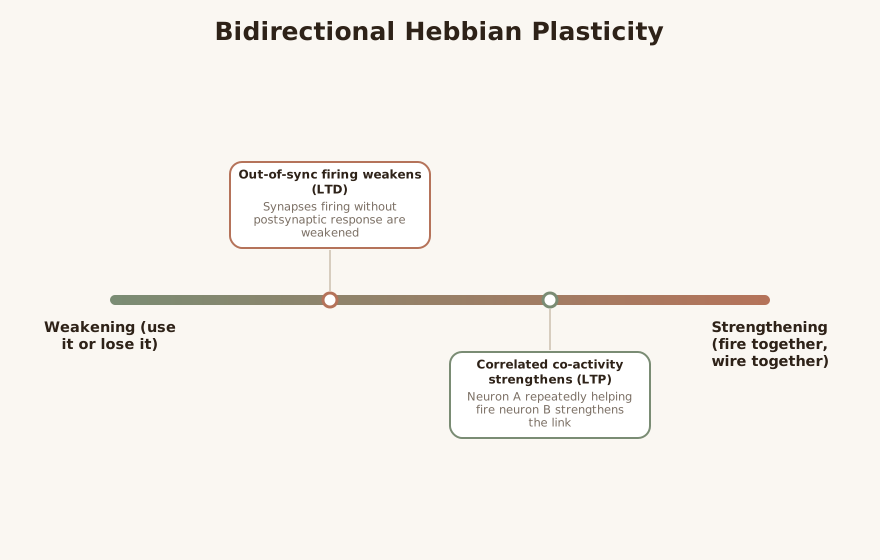
A second principle is that learning is distributed across populations, not stored in single cells LLM. Hebb’s cell assemblies are networks whose coordinated activity carries a memory or representation, so strengthening individual synapses scales up into reorganized circuits 1. A third principle, made explicit by later work, is that plasticity is bidirectional: the same machinery that strengthens co-active synapses (LTP) can weaken those that fire out of sync or without postsynaptic response (long-term depression) 7. This “use it or lose it” symmetry matters clinically, because it means disused associations can fade as well as form LLM.
A fourth principle is timing. Spike-timing-dependent plasticity demonstrates that when the presynaptic neuron fires just before the postsynaptic one, the synapse strengthens, whereas the reverse order weakens it — plasticity is exquisitely sensitive to the temporal order of activity on a scale of tens of milliseconds 2. Finally, a purely additive Hebbian rule would be unstable, driving synapses to ever-increasing strength; real systems therefore include stabilizing constraints, and accounting for this stability is part of why STDP and homeostatic mechanisms were developed 2. The cellular hallmark of LTP — its persistence over hours, days, or longer — is what makes it a plausible memory substrate rather than a transient signal 7.
Interventions & Techniques
There is no “Hebbian therapy” LLM. The construct informs why certain therapeutic strategies work and how a clinician sequences and spaces them, rather than supplying a freestanding technique LLM. The most direct application is to repetition and rehearsal: skills, coping behaviors, and corrective experiences strengthen with repeated, attentive practice, consistent with activity-dependent strengthening of the underlying circuits 3. A second application is association: pairing a feared cue with a new, safe outcome — as in exposure therapy — can be understood as building competing associations rather than erasing old ones, since the original Hebbian links are not simply deleted LLM.
A third application is spacing and timing LLM. Because plasticity is sensitive to the pattern and timing of activity, distributed practice and well-timed reactivation are expected to consolidate learning more durably than massed, one-off exposure 2. A fourth is the rehabilitation principle that drives neurorehabilitation: repeated, task-specific use of an impaired function recruits and strengthens surviving or alternative circuits, the logic behind constraint-induced and intensive practice-based therapies after stroke or brain injury LLM. A fifth draws on bidirectionality: maladaptive associations and habits, being products of strengthened synapses, are in principle weakenable through nonreinforcement and competing learning rather than treated as fixed 7. These are delivered inside recognized modalities — exposure-based cognitive behavioral therapy, behavioral activation, skills training, occupational and physical rehabilitation — not as Hebbian techniques in their own right LLM.
LLM-generated illustrative example (not a guideline): A clinician explains to a client with a long-standing avoidance habit that the urge-then-avoid sequence has been “rehearsed” thousands of times, strengthening a well-worn pathway. The plan is not to delete that pathway but to repeatedly practice a new urge-then-approach sequence until the competing connection becomes the stronger, more automatic one. The point of daily practice is the repetition itself, framed as wiring change rather than willpower LLM.
Evidence Base
The maturity label here applies to the science, not to a therapy LLM. Hebbian plasticity as a theoretical principle is established and historically central; Hebb’s postulate has organized decades of learning research and remains a cornerstone of neuropsychology 1. Long-term potentiation is an established, replicable physiological phenomenon, extensively characterized since its hippocampal discovery, and is the dominant candidate cellular mechanism for at least some forms of memory 7. Spike-timing-dependent plasticity is likewise a well-supported refinement with a large experimental literature 2. As cellular and systems neuroscience, this body of work is mature and mainstream LLM.
What is not established is any direct clinical claim of the form “this therapy works because it produces Hebbian change in your patient” LLM. The link between LTP measured in slice and rodent preparations and memory in the intact human brain, while strong, is still partly inferential, and the precise mapping between synaptic plasticity and specific psychotherapeutic outcomes is not something clinicians can measure at the bedside 7. The therapies that the framework rationalizes — exposure, skills practice, constraint-induced movement therapy — have their own independent human evidence bases; that evidence supports the therapies, not the neuroscientific story told about them LLM. Clinicians should therefore treat Hebbian plasticity as well-grounded basic science that motivates and explains evidence-based practice, not as a clinically validated mechanism they can claim to engage or measure in a given patient LLM.
Populations & Indications
The construct is relevant wherever learning, relearning, or unlearning is central to the work LLM. Learners and students are the most general case: the principle underwrites why spaced, repeated, active rehearsal beats cramming 3. Stroke survivors and people with brain injury are a major clinical population, since neurorehabilitation is built on driving plasticity through intensive, task-specific repetition to recruit alternative circuits LLM. People in rehabilitation more broadly — motor, cognitive, speech — share this logic LLM.
Adults presenting with anxiety, trauma, or entrenched habits are relevant insofar as their difficulties involve strongly learned associations that can be competed with through new learning LLM. People with addiction are a particularly clear case: cue-reward pairings strengthen craving-related circuitry, and the plasticity frame helps explain both the persistence of craving and the rationale for cue exposure and new-habit formation LLM. Across all of these, the framework is an explanatory and motivational lens applied within diagnosis-appropriate, evidence-based treatment, not a population-specific protocol LLM.
Problems-for-Work
In learning and memory consolidation, the work is structuring practice for durability — spaced rehearsal, active retrieval, and timely review — so that gains are encoded rather than crammed and lost; for a student with test anxiety, this pairs study-skills restructuring with the rationale that distributed practice strengthens recall 3. In neurorehabilitation after stroke or brain injury, the work is intensive, repetitive, task-specific practice that drives circuit reorganization, with the plasticity rationale used to sustain the patient’s motivation through high-repetition regimens LLM. In trauma-related conditioned associations and PTSD, the work is building strong new safety associations through repeated exposure so they outcompete the original threat learning, framed honestly as new learning layered over — not erasure of — the trauma memory LLM.
In addiction and craving, the work is identifying the strengthened cue-reward associations, reducing reinforcement, and rehearsing competing responses until the new pathway dominates LLM. In maladaptive habit formation, the work is the same bidirectional logic applied to everyday behavior: a habit is an over-rehearsed link, and change comes from consistently practicing an alternative while withholding reinforcement of the old one 7. In chronic pain (central sensitization), the lens helps explain how repeated nociceptive signaling can strengthen pain-processing pathways so that pain becomes “learned,” supporting graded, reassurance-based retraining approaches while taking care never to imply the pain is imaginary LLM. In cognitive impairment, the work is structured, repeated cognitive practice aimed at strengthening or recruiting available circuits LLM.
LLM-generated illustrative example (not a guideline): A clinician working with a stroke survivor on hand function frames the daily home-exercise program as literal rewiring: each repetition is a small deposit toward strengthening the circuits that can take over the lost function. Reframing tedious drills as “building the pathway” improves adherence to the high-repetition schedule that the rehabilitation evidence requires LLM.
Contraindications, Cautions & Cultural Humility
Because Hebbian plasticity is a construct rather than a procedure, the cautions concern how it is invoked, not whom it is applied to LLM. The first risk is overclaiming: telling a patient that a therapy is “rewiring your brain” implies a measured, mechanistic certainty that the clinician does not actually have, since synaptic change cannot be observed in the consulting room LLM. This neuro-flourish can lend false authority and should be used as honest metaphor, not as evidence LLM. A second risk is the “neurons that fire together wire together” slogan itself, which omits the directionality and timing-dependence of the real rule and can mislead both clinicians and clients into oversimplified thinking 6.
A third caution is fatalism: framing maladaptive patterns as “wired in” can imply they are permanent, when the bidirectional nature of plasticity actually supports the opposite, more hopeful message that what was learned can be relearned 7. A fourth, clinically important in chronic pain and functional presentations, is that explaining symptoms as “learned” or “central sensitization” must never slide into implying the suffering is not real or is the patient’s fault; learned circuits produce genuine, felt experience LLM. Cultural humility applies to the demands the framework implicitly makes: high-repetition rehabilitation and spaced practice presume time, energy, and access that many clients — shift workers, caregivers, people with limited resources — may not have, and “just practice more” can be tone-deaf to those realities LLM. The neuroscience should empower clients, not pathologize them or impose regimens detached from their circumstances LLM.
Treatment-Plan Suggestions & SMART Objectives
| Goal | SMART objective (example) | Mechanism |
|---|---|---|
| Consolidate a new coping skill | Client practices a paced-breathing skill once daily and logs it on 6 of 7 days for 4 weeks | Repeated, active rehearsal strengthens the underlying circuit through activity-dependent plasticity 3 |
| Build competing safety learning | Client completes 3 graded exposures per week for 6 weeks, rating distress before and after each | Repeated cue-safety pairings build new associations that outcompete the original threat learning LLM |
| Drive motor recovery | Client completes the prescribed task-specific hand-exercise program on 5 of 7 days for 8 weeks | Intensive, repetitive, task-specific practice recruits and strengthens alternative motor circuits LLM |
| Weaken a maladaptive habit | Client identifies one habit cue and practices an alternative response on 80% of logged occasions over 4 weeks | Nonreinforcement plus competing rehearsal shifts dominance away from the over-strengthened pathway 7 |
| Reduce craving response | Client logs cue-craving episodes and applies a rehearsed alternative response 4 times per week for 6 weeks | Competing learning and reduced reinforcement weaken cue-reward associations over time LLM |
| Improve durable recall | Client uses a spaced-retrieval study schedule 4 days per week for 5 weeks, tracking review timing | Distributed, well-timed practice consolidates learning more durably than massed practice 2 |
| Retrain pain response | Client follows a graded activity plan with daily logging on 5 of 7 days for 6 weeks | Graded, reassurance-based re-exposure targets learned, sensitized pain pathways LLM |
Common Misconceptions
The first misconception is that “neurons that fire together wire together” is a complete and accurate statement of Hebb’s rule; in fact Hebb specified a directional, causal relationship in which one neuron repeatedly helps fire another, which the slogan flattens into mere simultaneity 46. A second is that LTP is memory; LTP is the leading candidate cellular mechanism for memory and is strongly associated with it, but the equation of a synaptic phenomenon with a psychological one remains partly inferential 7. A third is that plasticity only strengthens connections; the same systems weaken disused or mistimed synapses through long-term depression, making forgetting and unlearning equally “plastic” 7.
A fourth misconception is that timing does not matter — that any co-activation strengthens a synapse — when spike-timing-dependent plasticity shows the millisecond order of firing can determine whether a synapse potentiates or depresses 2. A fifth, common in clinical settings, is that a therapy literally and measurably “rewires” a given patient’s brain; the construct explains and motivates practice but cannot be measured in the room and should not be presented as if it could LLM. Finally, some treat “wired in” patterns as permanent, missing that bidirectional plasticity is precisely what makes relearning possible 7.
Training & Certification
There is no certification in Hebbian plasticity or LTP, because they are scientific constructs rather than proprietary modalities LLM. Clinicians encounter them through neuroscience and physiological-psychology coursework, through Hebb’s original text and its many secondary treatments, and through accessible explainers 435. The practical path is to absorb the principles as background theory and then apply the resulting rationale — repetition, spacing, association, competing learning, intensive practice — inside whatever evidence-based modality the clinician is already trained and credentialed to deliver LLM. Using the lens creates no new scope of practice; competence in the host treatment, whether exposure-based therapy, behavioral skills training, or rehabilitation, remains the relevant qualification LLM.
Key Terms
Hebbian plasticity — the principle that synapses strengthen when the connected neurons are reliably co-active, with one repeatedly helping to fire the other 4. Hebb’s postulate — Donald Hebb’s 1949 statement of this activity-dependent strengthening rule 4. Cell assembly — Hebb’s concept of a network of neurons that, through repeated co-activation, become functionally linked to carry a representation 1. Long-term potentiation (LTP) — a persistent, experimentally observed increase in synaptic strength following correlated activity, first shown in the hippocampus and a leading memory substrate 7. Long-term depression (LTD) — the complementary, persistent weakening of synapses that fire out of sync or without postsynaptic response 7. Spike-timing-dependent plasticity (STDP) — a refinement showing that the precise millisecond order of pre- and postsynaptic spikes determines whether a synapse strengthens or weakens 2. Synaptic plasticity — the broad family of mechanisms by which experience alters the strength of connections between neurons 3.
Resources & Further Reading
▶ Watch — a video introduction to this concept:
- Donald O. Hebb and The Organization of Behavior: 17 years in the writing (PMC)
- Spike-Timing-Dependent Plasticity: A Comprehensive Overview (PMC)
- Hebbian Theory — an overview (ScienceDirect Topics)
- The Organization of Behavior: A Neuropsychological Theory (Hebb, 1949 — Routledge)
- Hebbian Learning (The Decision Lab reference guide)
- Hebbian theory — Wikipedia
- Synaptic plasticity: long-term potentiation in the hippocampus
Reflective / Supervision Questions
- When you tell a client that practice is “rewiring” their brain, are you using an honest, motivating metaphor or implying a certainty you cannot actually verify? LLM
- How do you frame entrenched patterns so that the plasticity story conveys hope (what was learned can be relearned) rather than fatalism (it is wired in)? LLM
- In your exposure and habit work, do you present new learning as building competing associations rather than erasing the old ones, and does that change how you set expectations? LLM
- For your rehabilitation or high-repetition cases, how do you reconcile the practice volume the neuroscience implies with the client’s real time, energy, and resources? LLM
- When you invoke “central sensitization” or “learned pain,” how do you ensure the client hears that their suffering is real, not imaginary? LLM
- Are you letting the neuroscience motivate an evidence-based modality, or has it drifted into being presented as the treatment itself? LLM