
Type & Discipline
Folk-illness idioms such as susto, nervios, ataque de nervios, and mal de ojo are not psychotherapeutic modalities; they are culturally patterned constructs—shared local ways of experiencing, naming, and communicating distress—studied primarily within medical anthropology and cultural psychiatry 2. They belong to the family of Latino folk illnesses, though analogous syndromes appear across many cultures 2. In clinical terms, they are best understood as the lens through which a client experiences suffering rather than as discrete diagnoses to be confirmed or refuted 1.
DSM-5 marked a significant conceptual advance by retiring the DSM-IV-TR appendix of twenty-five “culture-bound syndromes”—a framing that made such conditions seem “highly localized and confined, a cabinet of curiosities”—and replacing it with three interlocking ideas: cultural syndromes, cultural idioms of distress, and cultural explanations of distress 2. A cultural syndrome is a cluster of co-occurring symptoms recognized locally as a coherent pattern; an idiom of distress is a shared way of talking about suffering that need not map to any specific symptom set; and a cultural explanation is the attributed cause or etiology a community assigns to symptoms 2. These folk illnesses typically function as more than one of these at once—susto, for example, operates simultaneously as a perceived cause of other disorders and as an idiom of distress 1.
This reframing matters clinically because it shifts the question from “Does this client really have a disorder?” to “How does this client understand what is happening to them, and what does that understanding tell me?” LLM. Treating these idioms as superstition to be corrected, or as exact synonyms for DSM categories, both miss the point LLM.
Creators & Lineage
These constructs have no single author; they are folk-cultural inheritances rather than designed interventions LLM. Susto draws on pre-Columbian Mesoamerican traditions blended with Catholic spirituality, in which the soul is understood as the animating life force that can separate from the body after a terrifying event 5. The scholarly lineage that brings them into clinical practice runs through medical anthropology and cultural psychiatry, through the literature on explanatory models of illness, and—most concretely for practitioners—through the DSM-5 framework of cultural concepts of distress and its Cultural Formulation Interview (CFI) 2.
The CFI is the operational descendant of this lineage: a 16-question semi-structured interview assessing a client’s own experience and social context, accompanied by 12 supplementary modules for specific populations such as children, immigrants, and the elderly 2. The DSM-5 glossary also cross-references cultural concepts to DSM diagnoses, supporting more accurate assessment across contexts 2. Comparative scholarship—such as cross-cultural study of susto, nervios, and ataque de nervios among Spanish nationals and Hispanic American migrants—has further mapped how these idioms travel and shift across populations and migration histories 6.
Core Principles
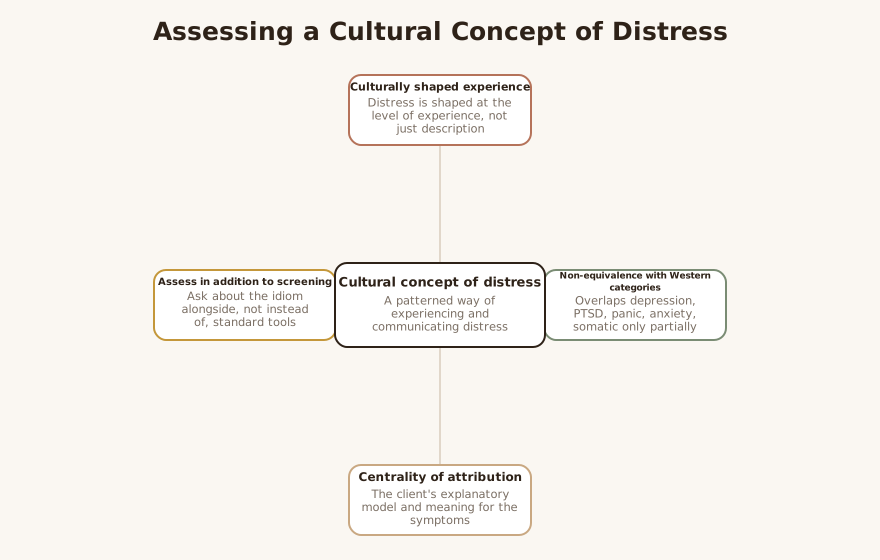
The foundational principle is that distress is culturally shaped at the level of experience itself, not merely at the level of how it is described after the fact 2. An idiom of distress provides a “collective, shared way of experiencing and talking about personal or social concerns” 2. This means a client’s report of nervios or ataque is data about their inner life, not noise obscuring a “true” diagnosis underneath LLM.
A second principle is non-equivalence with Western categories. These syndromes overlap with depression, PTSD, panic disorder, generalized anxiety, and somatic disorders, but the overlap is partial 1. Susto overlaps with PTSD yet “doesn’t map cleanly onto DSM-5 criteria,” with the consequence that “Latino trauma survivors screened only by DSM-5 criteria may be systematically missed” 5. The clinical principle that follows is to assess for the idiom in addition to, not instead of, standard screening LLM.
A third principle is the centrality of attribution and explanatory model. A cultural explanation indicates “culturally recognized meaning or etiology for symptoms” 2. Whether a client attributes their symptoms to a frightening event (susto), to chronic life adversity and “nerves” (nervios), to an acute interpersonal or grief-laden crisis (ataque de nervios), or to another’s envious gaze (mal de ojo) reshapes what they expect from treatment and from the clinician LLM.
A fourth principle is embodiment. These idioms are heavily somatic: susto presents with weakness, fever, appetite loss, sleep disturbance, headaches, nausea, and vomiting alongside psychological features such as apathy, restlessness, and crying 1. Distress is felt and reported in the body, which is why purely cognitive or verbal framings can feel alien to clients who experience their suffering as physical LLM.
Interventions & Techniques
Because these are constructs rather than modalities, the relevant “techniques” are assessment and integration practices clinicians layer onto established therapies LLM.
The primary clinical tool is the Cultural Formulation Interview, used to elicit the client’s own naming of the problem, its perceived cause, its course, and what help they have sought 2. Eliciting the explanatory model—asking directly what the client calls the problem, what they believe caused it, and what they fear it will do—operationalizes the cultural-explanation principle in session 2.
A second technique is integration with traditional healing rather than competition with it. Traditional management of susto includes “calling the lost soul,” ritual cleansing of the body with medicinal plants and prayer, herbal teas with “fear-suppressing, anxiolytic, and calming effects,” and direct family participation in healing 1. Curanderismo uses ritual cleansing ceremonies known as limpias or barridas 5. Effective clinical care is described as combining such practices with “culturally adapted Western psychological interventions,” respecting both the explanatory model and evidence-based methods 5.
A third technique is cultural adaptation of standard therapy: “Western therapies can be adapted to the use of cultural concepts of distress” through culturally sensitive cognitive behavioral approaches 1. In practice this means using the client’s idiom as the working vocabulary of therapy—framing exposure, behavioral activation, or grief work in terms the client already uses—rather than insisting on diagnostic relabeling LLM.
LLM-generated illustrative example (not a guideline): A clinician meeting a client who reports susto after a car accident might say, “Tell me what susto feels like in your body, and what you understand made your spirit take fright.” The clinician can then introduce trauma-focused work as a way to help the spirit “return,” aligning evidence-based exposure with the client’s own metaphor rather than overriding it LLM.
Evidence Base
The evidence base should be characterized as established for the constructs themselves and emerging for treatment integration LLM. As cultural concepts, these idioms are well documented: susto is “highly prevalent among people in Mexico, Central America, and South America,” with reported prevalence ranging from 37% in Guatemala to 59% among Mexican Americans in Texas, though the authors caution that “data are largely lacking” and definitions are “not universally accepted” 1.
There is meaningful evidence that these are not merely linguistic curiosities but markers of real morbidity. Susto shows symptomatic overlap with depression, PTSD, somatic disorder, panic disorder, and generalized anxiety disorder 1. Substantial research links susto to heightened diabetes risk, though causation remains unclear 1. Strikingly, “people diagnosed with susto died at significantly higher rates than matched community members without it,” suggesting genuine physiological consequence rather than purely psychological distress 5.
Honesty requires noting two limits. First, a core unresolved question is directionality: whether susto “precedes mental disorders or represents a way of designating existing distress” is not settled 1. Second, controlled treatment-outcome trials for therapy explicitly adapted to these idioms are sparse; the strongest claims in the literature concern recognition, assessment, and the rationale for cultural adaptation rather than head-to-head efficacy data 1. Comparative epidemiological work across Spanish and Hispanic-American samples helps establish cross-cultural validity but is descriptive rather than interventional 6.
Populations & Indications
These idioms are most salient with Latino and Hispanic populations, including those of Mexican, Central American, South American, and Caribbean origin 1. Ataque de nervios is particularly associated with Caribbean Latino communities and figures prominently in the DSM-5 cultural-concepts literature as a culturally recognized response to acute stress, grief, and family conflict 2.
Indications to assess for these idioms include immigrants and refugees, especially those exposed to “poverty, displacement, community violence, and exposure to natural disasters”—the very conditions under which susto concentrates 5. Indigenous communities with soul-loss cosmologies (the loss of “soul, shadow or ajayu”) are a further indicated population 1. More broadly, any culturally diverse client whose presenting complaint includes a non-Western explanatory model warrants this lens, since the CFI’s supplementary modules were built for exactly such breadth 2.
The practical indication is straightforward: when a client volunteers a folk-illness label, or when somatic and emotional symptoms cluster in ways that resist clean DSM mapping, elicit the idiom explicitly LLM.
Problems-for-Work
Acute stress reaction and trauma sequelae. A client who frames a recent frightening event as susto is signaling a trauma response in cultural terms; the problem-for-work is processing the precipitating fright while honoring the soul-loss metaphor 1.
Panic attacks and acute emotional crises. Ataque de nervios presents with “intense emotional upset, including acute anxiety, anger, or grief; screaming and shouting uncontrollably,” frequently triggered by family stress or loss—closely adjacent to panic but embedded in interpersonal context 2.
Generalized anxiety and chronic stress. Nervios typically indexes ongoing life adversity and chronically frayed “nerves,” making chronic worry and stress-reactivity the natural problem-for-work 6.
Major depressive disorder and grief. The apathy, introversion, crying, appetite and sleep disturbance of susto overlap substantially with depression and bereavement, which become the targets even as the client retains the susto frame 1.
Somatic symptom presentations. Because these idioms are heavily embodied—fever, nausea, headache, weakness—clients may present somatically; the problem-for-work is linking bodily distress to emotional and contextual drivers without dismissing the body 1.
LLM-generated illustrative example (not a guideline): A grandmother attributes her grandchild’s irritability and poor sleep to mal de ojo (evil eye). Rather than disputing the attribution, the clinician validates her vigilance, assesses the child for sleep and anxiety problems, and frames behavioral sleep work as compatible with the family’s protective rituals LLM.
Contraindications, Cautions & Cultural Humility
There is no “contraindication” to a folk idiom, since it is the client’s experience rather than a treatment; the cautions concern how the clinician responds LLM. The first caution is against dismissal: treating mal de ojo or susto as mere superstition ruptures alliance and signals cultural disrespect LLM. The second is against over-pathologizing: forcing a one-to-one DSM translation can both miss the idiom’s meaning and impose a diagnosis the client did not seek 5.
A subtler caution is under-detection of serious comorbidity. Because susto overlaps with PTSD, depression, and panic—and because it carries elevated diabetes and mortality associations—a clinician who accepts the folk frame without standard screening may miss treatable disorders 1 5. The reverse error, screening only with DSM criteria, may “systematically miss” Latino trauma survivors 5. Both directions require the dual-track stance of holding the idiom and the clinical assessment together LLM.
Cultural humility here means recognizing the limits of the constructs themselves: definitions are contested and “not universally accepted,” and prevalence data are thin, so a clinician should hold the categories loosely and let the individual client define their own experience 1. It also means respecting traditional healing as a parallel resource—families directly participate in susto healing rituals—rather than positioning therapy as a replacement 1.
Treatment-Plan Suggestions & SMART Objectives
| Goal | SMART objective (example) | Mechanism |
|---|---|---|
| Elicit the client’s explanatory model | Within 2 sessions, client will describe their idiom (e.g., susto), its perceived cause, and feared outcome using the Cultural Formulation Interview | Cultural-explanation elicitation builds shared understanding and alliance 2 |
| Process the precipitating fright (susto) | Over 8 weeks, client will complete trauma narrative work framed around the frightening event, reporting reduced re-experiencing on a weekly rating | Culturally adapted trauma processing aligned to soul-loss metaphor 1 |
| Reduce frequency/intensity of ataque de nervios | Within 10 sessions, client will identify 3 interpersonal/grief triggers and apply 2 grounding skills, reducing episodes from weekly to ≤1/month | Emotion-regulation and trigger awareness for acute crises 2 |
| Address somatic burden of nervios | Over 6 weeks, client will link 3 bodily symptoms to stressors via a daily symptom-mood log | Mind-body linkage reduces somatic amplification 1 |
| Screen and treat comorbid depression | By session 3, client will complete a depression measure; if elevated, begin behavioral activation with weekly activity scheduling | Detects DSM comorbidity masked by folk frame 1 |
| Integrate traditional healing respectfully | Within 4 sessions, client will identify which traditional practices (e.g., limpia) they wish to continue alongside therapy | Honors explanatory model; reduces treatment conflict 5 |
| Strengthen family/contextual support | Over 8 weeks, client will involve 1 family member in a support plan consistent with cultural healing roles | Family participation is intrinsic to folk healing 1 |
| Build coping for chronic stress/adversity | Within 12 weeks, client will practice 2 stress-management skills 4x/week, tracked via self-report | Culturally sensitive cognitive behavioral adaptation 1 |
Common Misconceptions
“These are just superstitions.” They are recognized cultural concepts of distress in DSM-5, with documented symptom clusters, prevalence, and associations with morbidity and even mortality 2 5. “Each one equals a DSM diagnosis.” They overlap with multiple disorders partially and do not map cleanly onto any single category 1 5. “They only matter for recent immigrants.” Reported susto prevalence reaches 59% among Mexican Americans in Texas, indicating relevance well beyond newly arrived populations 1. “Acknowledging the idiom means abandoning evidence-based care.” The literature explicitly frames the goal as adapting evidence-based therapy to the idiom, not replacing it 1 5. “They are purely psychological.” The heavy somatic loading—and the diabetes and mortality associations of susto—argue against treating them as ‘all in the mind’ 1 5.
Training & Certification
There is no certification in folk-illness idioms, because they are cultural constructs rather than a licensed modality LLM. The relevant clinical competency is fluency with the DSM-5 Cultural Formulation Interview and the cultural-concepts-of-distress framework, which is taught through the DSM-5 materials, the 16-question CFI, and its 12 supplementary modules 2. Broader competency develops through training in cultural psychiatry, medical anthropology, and explanatory-models interviewing, and through supervised exposure to the relevant communities 2. Familiarity with the comparative epidemiology of these idioms across populations and migration contexts further sharpens assessment 6.
Key Terms
Cultural syndrome — a cluster of co-occurring symptoms recognized locally as a coherent pattern of experience 2. Idiom of distress — a shared way of expressing and experiencing suffering that need not involve a specific symptom set 2. Cultural explanation of distress — a culturally recognized meaning or etiology attributed to symptoms 2. Susto — illness attributed to a terrifying event causing the soul to leave the body, with somatic and psychological features 1. Ataque de nervios — an acute episode of intense emotional upset including anxiety, anger, or grief, with uncontrollable screaming, often triggered by family stress or loss 2. Nervios — a chronic idiom indexing ongoing life adversity and frayed “nerves” 6. Mal de ojo — the “evil eye,” distress attributed to another’s envious or malevolent gaze LLM. Cultural Formulation Interview (CFI) — a 16-question DSM-5 instrument with supplementary modules for assessing cultural context 2. Curanderismo — traditional Latino folk healing, including cleansing rituals such as limpias and barridas 5.
Resources & Further Reading
▶ Watch — a video introduction to this concept:
- Susto as a cultural conceptualization of distress (Martínez-Radl, Hinton & Stangier, 2023, PMC)
- DSM-5 on Culture: A Significant Advance (Foundation for Psychocultural Research)
- Ataque de Nervios — overview (ScienceDirect Topics)
- Culture-Bound Syndromes: Susto (SAGE Encyclopedia of Multicultural Psychology)
- Susto Psychology: Exploring the Cultural Syndrome and Its Impact on Mental Health (NeuroLaunch)
- Cross-cultural study of idioms of distress: susto, nervios and ataque de nervios (ResearchGate)
Reflective / Supervision Questions
- When a client offers a folk-illness label, do I instinctively reach for the “real” diagnosis underneath, and what is lost when I do? LLM
- How do I hold standard screening and the client’s idiom simultaneously without privileging one over the other? 5
- Am I treating traditional healing as a competitor to therapy or as a parallel resource the client may legitimately want? 1
- What is my own discomfort with explanatory models—soul loss, evil eye—that fall outside biomedicine, and how might that discomfort leak into the room? LLM
- Have I checked for comorbid depression, PTSD, panic, or somatic and metabolic conditions that the folk frame might obscure? 1
- How would I document and case-conceptualize this client in a way that honors their idiom while remaining clinically rigorous? LLM