
Type & Discipline
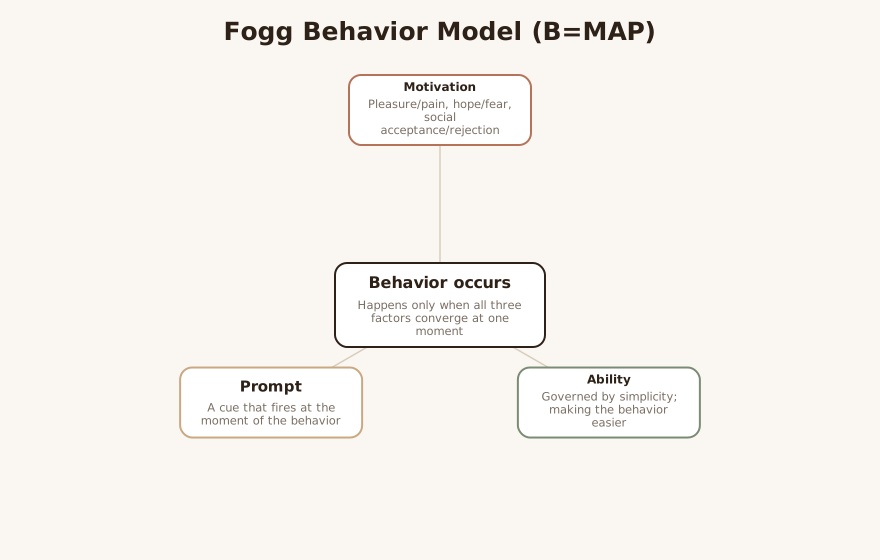
The Fogg Behavior Model (FBM, often written as the equation B=MAP) is a behavior-design framework, not a therapy in its own right 1. It originated in the field of persuasive technology and human-computer interaction, where the practical question was how to design products and experiences that reliably produce a target behavior 1. Its central claim is deceptively simple: a behavior occurs only when three elements arrive at the same moment — sufficient Motivation, adequate Ability, and an effective Prompt 2. When any one of these is missing, the behavior does not happen, no matter how strong the other two are 2.
For clinicians, the value of the FBM is conceptual leverage rather than a new treatment protocol LLM. It belongs to the broader family of behavior-change design models and sits comfortably alongside the behavioral and operant traditions that already inform behavioral activation, exposure hierarchies, and contingency management LLM. The discipline it comes from — persuasion science and product design — explains both its strengths (it is concrete, actionable, and easy to teach to patients) and its limits (it was built to be useful, not to be validated against clinical outcomes in randomized trials) 1.
Creators & Lineage
The model was developed by BJ Fogg, a behavioral scientist who founded and ran the Behavior Design Lab at Stanford University 2. He first formalized the model in a 2009 conference paper, “A Behavior Model for Persuasive Design,” presented at the 4th International Conference on Persuasive Technology 1. That paper introduced the three-factor structure and the idea that motivation and ability can trade off against each other along a curve, with a prompt acting as the trigger that converts potential into action 1.
Intellectually, the FBM draws on the behaviorist and operant-conditioning tradition, where antecedents (prompts) and consequences shape the probability of a response LLM. It overlaps conceptually with stage-based frameworks such as the transtheoretical model of change, in that it implicitly assumes a person must be ready and able before a prompt will land, and with habit-formation theory, which Fogg later elaborated into his “Tiny Habits” approach LLM. The lineage is therefore a blend of applied behaviorism, persuasion science, and the practical engineering culture of product design 1. The official articulation of the model and its terminology is maintained at behaviormodel.org 2.
Core Principles
The first principle is the convergence rule: behavior happens only when motivation, ability, and a prompt occur together, and the absence of any single factor blocks the behavior 2. This is why the model is written as a multiplication-style relationship rather than a sum — a prompt fired at a person with no ability and no motivation produces nothing 2.
The second principle is the motivation-ability tradeoff. Fogg describes an action line: as a behavior becomes easier to do (higher ability), it requires less motivation, and as motivation rises, people will tolerate harder behaviors 1. A behavior succeeds when the combination of motivation and ability sits above this action line at the moment a prompt arrives 1. Practically, this means that for any stalled behavior you have two levers — raise motivation or increase ability — and increasing ability (making the behavior easier) is usually the more reliable lever 3.
The third principle concerns the components themselves. Motivation has core dimensions — pleasure/pain, hope/fear, and social acceptance/rejection — that operate as motivators 1. Ability is governed by simplicity, and Fogg breaks simplicity into factors such as time, money, physical effort, mental/cognitive effort, social deviance, and routine (whether the behavior fits existing patterns) 1. Prompts come in different forms depending on where the person sits on the motivation-ability map: a “spark” prompt adds motivation, a “facilitator” prompt makes the behavior easier, and a “signal” prompt simply reminds someone who is already motivated and able 3.
The fourth and most clinically useful principle is the design heuristic that follows from all of this: because motivation is unreliable and fluctuates, the most robust intervention is to make the target behavior tiny — so small that it requires almost no motivation to perform — and then attach it to a clear prompt 5. This is the operational core that clinicians can teach directly to patients LLM.
Interventions & Techniques
The model becomes actionable through a small set of moves. First, when a behavior is not happening, diagnose which factor is missing — motivation, ability, or prompt — rather than assuming it is always a motivation problem 5. This diagnostic step is itself a clinical reframe, because patients and clinicians alike tend to over-attribute failure to willpower LLM.
Second, simplify the behavior. Because ability is the more dependable lever, the primary technique is to reduce the time, cost, physical effort, cognitive load, and disruption to routine that the behavior demands 1. Fogg’s guidance is to shrink the behavior until ability is high enough that even low motivation will clear the action line 5.
Third, design the prompt. A behavior with adequate motivation and ability still fails without a trigger, so the technique is to attach the new behavior to a reliable cue — frequently an existing routine (“after I X, I will Y”) — and to match the prompt type to the person’s state: spark when motivation is low, facilitate when ability is low, signal when both are already adequate 3. Fourth, use motivation strategically rather than as the foundation, recognizing that motivation spikes and crashes and is therefore a poor thing to depend on for behaviors that must repeat daily 5.
LLM-generated illustrative example (not a guideline): A patient with depression cannot “start exercising 30 minutes a day.” Using B=MAP, the clinician keeps the prompt (“after I pour my morning coffee”) and the ability axis is maximized by shrinking the behavior to “put on my running shoes.” The behavior is now so small it needs almost no motivation, and once shoes are on, the larger behavior often follows on its own. LLM
Evidence Base
Be clear with patients and supervisees about what “established” means here. The FBM is established as a framework — it is widely cited, taught, and applied across product design, public health, and behavior-change practice, and it is anchored in a peer-reviewed conference paper 1. The model is indexed and referenced in the academic literature, reflecting durable uptake within human-computer interaction and persuasion science 4.
What it is not is a clinically validated treatment with its own body of randomized controlled trials demonstrating superiority for a defined disorder LLM. The 2009 source is a design paper that proposes and reasons through the model; it is a conceptual and engineering contribution, not an outcome trial 1. Its constructs — that easier behaviors require less motivation, that cues drive action, that habits build from small repeated actions — are highly consistent with the well-supported behaviorist and habit literatures, which lends the model strong convergent and face validity LLM. The honest framing for clinical use is therefore: a robust, theory-consistent design heuristic that organizes and operationalizes mechanisms that are themselves evidence-based, deployed inside therapies that carry their own evidence base LLM. Treat the FBM as scaffolding for a billable, evidence-based modality, not as a substitute for one LLM.
Populations & Indications
The model was built for general adult behavior change and translates most directly to adults who are trying to start, stop, or sustain a specific, repeatable behavior 1. It is well suited to people explicitly seeking habit change, where the daily-repetition and tiny-behavior logic is most powerful 5.
It maps cleanly onto health-behavior-change populations and people with chronic illness, where adherence to medication, monitoring, movement, or dietary routines is the clinical target and where small, prompt-anchored behaviors are easier to sustain than ambitious resolutions LLM. It is also frequently applied in workplace and organizational populations, reflecting its design-world origins, where the goal is to engineer environments and prompts that make desired behaviors easy 5. Across these groups the common thread is a discrete, observable target behavior that can be made smaller and cued reliably LLM.
Problems-for-Work
The model is most useful for problems that are fundamentally about doing or not doing a specific behavior, rather than about insight, meaning, or trauma processing LLM.
- Treatment nonadherence: Reframe a missed regimen as a missing-factor problem — usually low ability (too many steps, too effortful) or a missing prompt — and redesign accordingly rather than exhorting the patient to try harder 5. For example, anchoring a single pill to an unavoidable daily cue raises both ability and prompt reliability LLM.
- Procrastination and goal-setting difficulties: Shrink the avoided task to a “tiny” first action that clears the action line at low motivation, then let momentum carry the rest 5.
- Low motivation: Because motivation is the least reliable lever, the FBM directs the work toward ability and prompts so the behavior no longer depends on the patient feeling motivated 3.
- Habit formation and broader behavior/health-behavior change: Build sequences of small behaviors attached to existing routines, matching prompt type to the patient’s current motivation and ability 3.
LLM-generated illustrative example (not a guideline): A patient with diabetes “keeps forgetting” to check blood glucose. Diagnosis with B=MAP reveals motivation is adequate but the prompt is unreliable and ability is low (meter is in a drawer in another room). The plan moves the meter next to the toothbrush (prompt + ability) rather than adding a motivational lecture. LLM
Contraindications, Cautions & Cultural Humility
The first caution is scope. The FBM addresses discrete behaviors and is not a model for processing trauma, grief, psychosis, or relational dynamics; using behavior-design language for problems that require safety, stabilization, or meaning-making can feel reductive and invalidating LLM. It also assumes the target behavior is genuinely under the person’s volitional control, which may not hold in active substance dependence, severe depression with anergia, or compulsive disorders, where “just make it tiny” can inadvertently imply the problem is effort LLM.
A second caution is its persuasion-science heritage. The same techniques that help patients can be used to manufacture compliance, so clinicians should apply the model collaboratively and transparently, in the service of goals the patient owns, not to engineer behavior the clinician prefers 1. Informed, shared goal-setting protects against this drift LLM.
On cultural humility: the model’s “simplicity factors” — time, money, social deviance, and routine — are not culturally neutral, because what is effortful, affordable, socially acceptable, or routine varies enormously across communities, family systems, and economic circumstances 1. A behavior that is “tiny” for one patient may carry real social cost or logistical burden for another, so the simplicity analysis must be done with the patient rather than for them LLM. Avoid pathologizing low ability that is actually structural (poverty, caregiving load, discrimination) as a personal motivation deficit LLM.
Treatment-Plan Suggestions & SMART Objectives
| Goal | SMART objective (example) | Mechanism |
|---|---|---|
| Improve medication adherence | Patient will take prescribed evening medication on at least 6 of 7 days for 3 consecutive weeks by placing it on the nightstand and taking it “after brushing teeth.” | Raises ability + anchors a reliable prompt to an existing routine 5 |
| Activate behavior in depression | Patient will complete one “tiny” activating action (e.g., open curtains, put on shoes) within 5 minutes of waking on 5 of 7 mornings for 2 weeks. | Shrinks behavior so it clears the action line at low motivation 3 |
| Reduce procrastination on avoided task | Patient will spend 2 minutes on the avoided task immediately after lunch on 4 of 5 weekdays for 2 weeks, logging completion. | Tiny first action + fixed prompt; momentum extends the behavior 5 |
| Build a daily movement habit | Patient will walk to the end of the driveway and back after the morning coffee on 6 of 7 days for 3 weeks. | High ability + existing-routine prompt; habit accrues by repetition 3 |
| Establish glucose monitoring | Patient will check blood glucose once daily after a fixed meal on 6 of 7 days for 4 weeks, with meter stored at the check location. | Removes friction (ability) and co-locates a facilitator prompt 5 |
| Increase between-session homework completion | Patient will complete a 1-item version of the assigned worksheet before bed on 5 of 7 nights for 2 weeks. | Reduces cognitive/time load so low motivation still produces action 1 |
| Match support to readiness | Clinician and patient will identify, for each target behavior, whether a spark, facilitator, or signal prompt fits the patient’s current motivation and ability, reviewed at each session. | Prompt type matched to motivation-ability state 3 |
Common Misconceptions
A frequent misconception is that B=MAP is primarily about motivation — that the goal is to get patients more “fired up” 3. The model says the opposite: motivation is the least reliable factor, and durable change comes from raising ability and engineering prompts 3. A related error is treating the three factors as additive, so that high motivation can “make up for” a missing prompt; in the model, a missing factor blocks the behavior outright 2.
Another misconception is that “tiny” means trivial or unambitious LLM. The tiny-behavior strategy is a deliberate mechanism for getting a behavior to occur reliably at all, after which it can grow, not a ceiling on the patient’s goals 5. Finally, some treat the FBM as an evidence-based therapy with its own outcome trials; it is better understood as a well-validated design framework that organizes mechanisms which are themselves supported, and that should be embedded in an established treatment LLM.
Training & Certification
There is no clinical license, credential, or certification associated with the Fogg Behavior Model, and none is required to use it competently in practice LLM. The primary sources for learning the model directly are the original 2009 paper, which lays out the constructs and reasoning, and the official site behaviormodel.org, which presents the current canonical terminology and diagrams 1 2. Practitioner-oriented explainers, including accessible write-ups of the model and guides to making it actionable in design and behavior work, are useful supplements for translating the theory into session-level technique 3 5. Clinicians should layer this learning on top of, not in place of, formal training in the billable modality (CBT, behavioral activation, MI) within which they intend to apply it LLM.
Key Terms
- B=MAP: The model’s equation — Behavior happens when Motivation, Ability, and a Prompt converge at the same moment 2.
- Action line: The threshold on the motivation-ability map above which a prompt successfully triggers behavior; easier behaviors clear it at lower motivation 1.
- Motivation (motivators): The drive to act, with core dimensions of pleasure/pain, hope/fear, and social acceptance/rejection 1.
- Ability (simplicity): How easy the behavior is, governed by factors such as time, money, physical effort, mental effort, social deviance, and routine 1.
- Prompt: The cue that triggers the behavior; types include spark (adds motivation), facilitator (increases ability), and signal (reminds the already-able-and-motivated) 3.
- Tiny behavior: A target behavior shrunk so small it requires almost no motivation, used as a reliable entry point for habit formation 5.
Resources & Further Reading
▶ Watch — a video introduction to this concept:
- Fogg, B.J. (2009). A Behavior Model for Persuasive Design — ACM Proceedings
- Fogg Behavior Model — official site (behaviormodel.org)
- The Fogg Behavior Model: B = MAP — The Behavioral Scientist
- A behavior model for persuasive design — Semantic Scholar record
- Making the Fogg Behavior Model actionable — UI-Patterns
Reflective / Supervision Questions
- When a patient “fails” a between-session task, do I reflexively read it as low motivation, or do I diagnose which of motivation, ability, or prompt was actually missing? 5
- Am I sizing homework and activation tasks small enough that they would succeed even on the patient’s worst-motivation day? 5
- For each target behavior, have I identified a specific, reliable prompt anchored to something the patient already does? 3
- Where am I leaning on raising motivation when redesigning for ability would be more durable? 3
- Have I done the simplicity analysis with the patient, accounting for cultural, social, and structural costs I might not share? 1
- Am I using this framework in service of goals the patient owns, with transparency, rather than to engineer compliance with goals I prefer? 1
- Is B=MAP embedded inside an evidence-based, billable modality, and is my documentation framed around that clinical intervention rather than the framework itself? LLM