
Type & Discipline
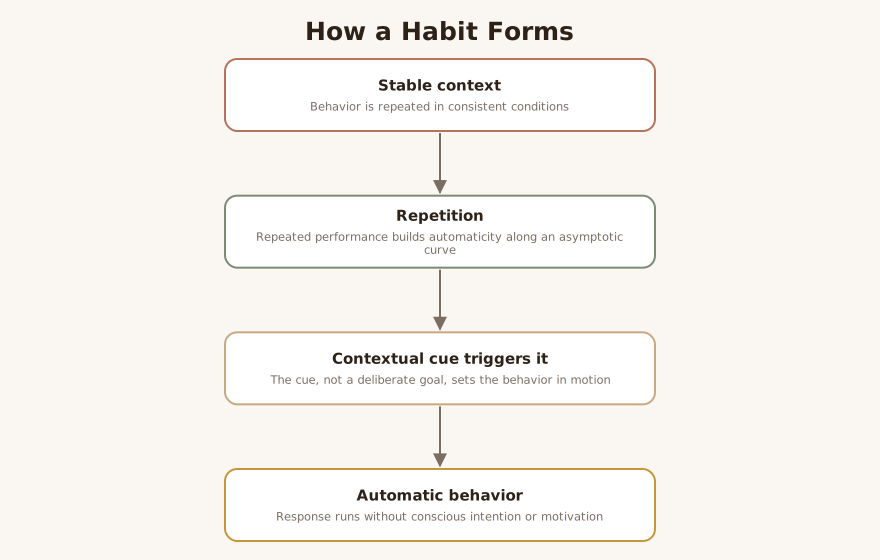
Habit formation theory is a descriptive and applied theory of behavior, not a packaged therapy LLM. It sits within behavioral science and health psychology, and it explains how voluntary actions become automatic, context-cued responses through repetition 2. The defining feature of a habit is automaticity: the behavior is initiated quickly, with little conscious thought, and is difficult to inhibit once the cue is encountered 4. Crucially, the theory distinguishes habitual behavior from goal-directed behavior. Goal-directed behavior depends on current intentions and the perceived value of the outcome, whereas habitual behavior is triggered by a stable contextual cue and persists even when motivation wanes or the original goal changes 2.
For clinicians, the practical implication is that habit theory is best treated as a mechanism layer that can be embedded inside recognized modalities such as cognitive behavioral therapy, behavioral activation, or motivational interviewing, rather than as a billable standalone treatment LLM. It tells us why a behavior repeats and how to make a desired behavior repeat with less effort over time 5.
Creators & Lineage
The theory descends directly from operant conditioning and behaviorism, which established that responses repeated in the presence of reinforcement become more probable LLM. The popularized “cue–routine–reward” loop framing, often associated with Charles Duhigg’s trade writing, is a useful heuristic but a simplification of the empirical model LLM.
The contemporary scientific account is most associated with Wendy Wood, whose synthesis frames habits as learned context–response associations stored in procedural memory and triggered automatically by recurring cues 2. Phillippa Lally and colleagues produced the influential real-world habit-formation study that quantified how automaticity develops over time 1. Benjamin Gardner and colleagues advanced the measurement and conceptual clarity of “habit” in health behavior, arguing that automaticity, not mere frequency, is the construct of interest 4. The lineage also overlaps the transtheoretical model of change and behavioral activation, which share habit theory’s emphasis on enacting behavior to shift internal states rather than waiting for motivation first LLM.
Core Principles
1. Habits are cue-triggered, not goal-triggered. Once formed, a habit is set in motion by the contextual cue rather than by a deliberate decision. In daily-life sampling, habitual behaviors were performed in stable contexts and were not reliably preceded by a conscious goal; people often misattribute their habitual actions to goals after the fact 3. This is why insight alone rarely changes an entrenched habit LLM.
2. Repetition in a stable context builds automaticity. Automaticity grows as a behavior is repeated in the same setting, following an asymptotic curve: gains are steep early and flatten as the behavior approaches its automaticity ceiling 1. Context stability is itself an active ingredient — performing the behavior in consistent conditions accelerates automaticity and improves goal attainment compared with inconsistent contexts 7.
3. Formation takes longer and varies more than folklore suggests. In Lally’s study the median time to reach the automaticity plateau was roughly two months, but individual estimates ranged from about 18 to 254 days, and varied with the behavior’s complexity 1. The popular “21 days” figure is not supported 6.
4. A single lapse is not fatal. Missing one opportunity to perform the behavior did not meaningfully reduce the eventual automaticity achieved, which argues against all-or-nothing framing during habit building 1.
5. Habits decouple from value over time. Because habitual responses run on cues rather than current outcome value, they can persist even when they are no longer rewarding or even when they conflict with the person’s goals — the core problem in maladaptive habits and relapse 2.
Interventions & Techniques
Habit theory translates into a small set of concrete techniques 5:
- Cue selection and “if-then” anchoring. Tie the target behavior to a specific, reliable, already-present cue (a time, a location, or the completion of an existing routine), so the cue can eventually trigger the behavior without deliberation 5.
- Context stabilization. Hold the where and when as constant as possible during the formation phase, since context stability independently boosts automaticity 7.
- Repetition with self-monitoring. Track daily performance to support consistent repetition and to surface where the cue is and is not firing 1.
- Environmental restructuring (friction engineering). Reduce friction for desired behaviors and add friction for unwanted ones, because cue exposure and ease of execution drive habitual responding more than willpower 2.
- Realistic timeframe setting and lapse normalization. Tell clients formation commonly takes weeks to months and that an occasional miss does not undo progress, protecting against premature abandonment 16.
LLM-generated illustrative example (not a guideline): A client wants to take a morning antidepressant consistently. Rather than relying on intention, the clinician anchors the pill to an existing stable cue — the client’s first cup of coffee — and places the bottle beside the coffee maker. The coffee routine becomes the trigger; over several weeks the client reports “I don’t even think about it anymore.” LLM
For breaking maladaptive habits, the techniques invert: identify and avoid or disrupt the cue, change the context that triggers the response, and substitute a competing behavior, since the cue–response link is hard to extinguish directly 2.
Evidence Base
The maturity of habit formation theory is established LLM. The core empirical claims — that automaticity grows with repetition along a decelerating curve, that context cues rather than conscious goals drive habitual behavior, and that context stability accelerates formation — are supported by prospective real-world studies, daily-life experience sampling, and experimental work 137. The theory has a validated measurement tradition through automaticity-based self-report instruments developed in the health-behavior literature 4. It is integrated into a major reference handbook of behavior change, signaling consensus standing 5.
Honest caveats remain. The foundational Lally study was small and used relatively simple health behaviors, so precise time-to-automaticity figures should be treated as illustrative rather than prescriptive 1. Much of the strongest evidence concerns forming new habits; evidence for reliably breaking established maladaptive habits is comparatively weaker, and habit interventions are usually one component of a larger treatment package rather than a tested standalone cure 25. Self-reported automaticity, while validated, is still an indirect index of an internal process 4.
Populations & Indications
Habit theory is broadly applicable wherever the clinical goal is to make a desired behavior durable or to weaken an automatic unwanted one LLM. It is well suited to people changing health behaviors, where the aim is to convert effortful new routines into low-effort automatic ones 4. It supports individuals with chronic illness and others facing adherence demands, since consistent medication and self-care behaviors benefit from cue anchoring 5. It is relevant to people with obesity or weight concerns, whose eating and activity patterns are heavily cue- and context-driven 4. It informs work with people with addictions, where understanding cue-triggered automaticity clarifies relapse risk 2. And it is a natural fit for clients in behavioral therapy and coaching clients pursuing goal maintenance 5.
Problems-for-Work
- Poor medication and treatment adherence. Anchor doses to a stable daily cue and stabilize the context to build automaticity 7.
- Sedentary behavior. Attach a brief walk to a fixed cue (e.g., immediately after lunch) and hold the time/place constant during formation 1.
- Unhealthy eating behaviors. Map the cues that trigger automatic eating and restructure the environment to reduce cue exposure 2.
- Smoking and substance use disorders. Identify the contextual triggers that fire the automatic response and disrupt or avoid those cues during early change 2.
- Procrastination and goal maintenance difficulties. Convert an intended behavior into a cued routine so it no longer depends on fluctuating motivation 3.
- Compulsive and other maladaptive habits. Recognize that the behavior is cue-driven and decoupled from current goals, then target context change and competing responses 2.
LLM-generated illustrative example (not a guideline): A client in early recovery reports that walking past a particular convenience store after work reliably triggers a craving and purchase. Treating this as a cue-driven habit, the clinician helps the client re-route the commute to remove cue exposure during the highest-risk window, pairing this with a planned competing behavior (calling a peer) when a cue is unavoidable. LLM
Contraindications, Cautions & Cultural Humility
Habit theory has no formal “contraindication,” but several cautions apply LLM. It is not a substitute for treating underlying disorders. For substance use disorders, eating disorders, or OCD-spectrum compulsions, habit techniques should be embedded within an evidence-based treatment, not used alone, because the maintaining factors extend beyond simple cue–response learning 2.
Avoid willpower-shaming and rigid timelines. Framing habit failure as a character flaw misreads the theory, which locates difficulty in context and cue design rather than in moral resolve; the wide variability in formation time means imposing a fixed deadline can set clients up to feel defeated 16. Normalize lapses explicitly 1.
Cultural and contextual humility matters. The theory depends on the client having a stable context to anchor behaviors to. Clients experiencing housing instability, shift work, caregiving demands, poverty, or chronic unpredictability may lack the environmental regularity the model assumes, and recommendations must be adapted to the client’s real conditions rather than an idealized routine 7LLM. Cues, rewards, and acceptable routines are also culturally embedded, so collaborative selection of cues with the client is essential LLM.
Treatment-Plan Suggestions & SMART Objectives
| Goal | SMART objective (example) | Mechanism |
|---|---|---|
| Build medication adherence | Client will take the prescribed dose within 5 minutes of a fixed daily cue (morning coffee) on at least 6 of 7 days for 8 consecutive weeks | Cue anchoring + repetition builds automaticity 15 |
| Increase physical activity | Client will complete a 10-minute walk immediately after lunch in the same location on 5 of 7 days for 6 weeks | Context stability accelerates automaticity 7 |
| Reduce cue-driven eating | Client will identify 3 environmental eating cues and restructure 2 of them within 4 weeks, logged in a daily monitor | Reducing cue exposure weakens the cue–response link 2 |
| Disrupt a substance-use cue | Client will map high-risk contextual triggers and implement an alternative route/competing response for the top trigger by session 4 | Context disruption + competing behavior 2 |
| Reduce procrastination on a target task | Client will attach the task to a stable existing routine and complete it within 10 minutes of that cue on 5 of 7 weekdays for 6 weeks | Converts goal-dependent action into cue-triggered routine 3 |
| Sustain a gain (relapse prevention) | Client will maintain the target behavior in its stable context with self-monitoring, reviewing automaticity ratings monthly for 3 months | Maintenance leverages decoupling from motivation 2 |
| Normalize lapses | Client will record lapses without abandoning the plan and resume at the next cue opportunity across the formation period | Single misses do not derail formation 1 |
Common Misconceptions
- “It takes 21 days to form a habit.” The evidence points to a median of roughly two months with very wide individual variation, not a fixed three weeks 16.
- “Habits are about motivation and willpower.” Once formed, habits run on cues independent of current motivation, which is precisely why motivation-based strategies often fail to sustain them 2.
- “If I miss a day, I have to start over.” A single missed opportunity does not meaningfully impair eventual automaticity 1.
- “Insight breaks bad habits.” Because habitual responses are cue-triggered and decoupled from goals, understanding the habit is not enough; the cue or context usually has to change 23.
- “Frequency equals habit.” Doing something often is not the same as automaticity; it is the automatic, cue-triggered quality that defines a habit 4.
Training & Certification
There is no certification in “habit formation,” and clinicians should be skeptical of programs implying one, because it is a body of theory rather than a credentialed therapy LLM. Competence comes from grounding in the primary literature — the real-world formation model 1, the psychology-of-habit synthesis 2, and the applied behavior-change handbook chapter 5 — and from training in the host modalities (CBT, behavioral activation, MI) within which habit techniques are delivered LLM. Familiarity with automaticity-based self-report measurement supports tracking progress clinically 4.
Key Terms
- Automaticity — the quality that defines a habit: fast initiation, low conscious awareness, and difficulty inhibiting the response 4.
- Cue / contextual trigger — the recurring feature of the environment (time, place, preceding action) that elicits the habitual response 3.
- Context stability — keeping the conditions of performance consistent; an active ingredient that accelerates automaticity 7.
- Cue–routine–reward loop — the popular heuristic describing the structure of a habit cycle LLM.
- Goal-directed vs. habitual behavior — the distinction between action driven by current intentions/value versus action driven by cues 2.
- Asymptotic formation curve — the decelerating growth of automaticity with repetition, plateauing at a ceiling 1.
Resources & Further Reading
▶ Watch — a video introduction to this concept:
- Lally et al. (2010), How are habits formed: Modelling habit formation in the real world — European Journal of Social Psychology
- Wood & Rünger (2016), Psychology of Habit — Annual Review of Psychology
- Neal, Wood, Labrecque & Lally (2012), How do habits guide behavior? Perceived and actual triggers of habits in daily life
- Gardner et al., A review and analysis of the use of ‘habit’ in understanding, predicting and influencing health-related behaviour — Health Psychology Review
- Gardner & Rebar, Changing Behavior Using Habit Theory (Ch. 13) — The Handbook of Behavior Change (Cambridge)
- British Psychological Society Research Digest — How to form a habit
- Context Stability in Habit Building Increases Automaticity and Goal Attainment — Frontiers in Psychology (2022)
Reflective / Supervision Questions
- For this client, what stable context and reliable cue actually exist in their daily life, and am I anchoring to those rather than to an idealized routine? LLM
- Am I framing change as a willpower problem when the leverage is in cue and context design? LLM
- Have I set a realistic, individualized timeframe and explicitly normalized lapses, or have I implied a fixed deadline? LLM
- For a maladaptive habit, have I identified the controlling cue and a feasible competing response, rather than relying on insight alone? LLM
- Does this client have the environmental stability the model assumes, and if not, how have I adapted the plan to their real conditions? LLM
- Within which billable modality am I delivering and documenting this habit work, and is it clearly tied to the disorder being treated? LLM