
Type & Discipline
Dialogical philosophy is a strand of twentieth-century Western thought, not a clinical treatment, and its central document is Martin Buber’s 1923 book Ich und Du, rendered in English as I and Thou 6. Buber writes as a philosopher of relation, asking not what the self is in isolation but how the self comes into being through its modes of relating to the world 1. The framework’s defining move is to identify two “primary words” or basic word-pairs, I-Thou and I-It, that name two fundamentally different ways a person can stand toward another being 2. Because Buber approaches even psychology and psychotherapy from the standpoint of a social philosopher or philosophical anthropologist rather than as a clinician, the work is best read as an orienting stance toward human meeting rather than as a manualized method 1. For practicing therapists its value is therefore conceptual and relational: it supplies a vocabulary and an ethic for what it means to be genuinely present with a client, and it underwrites much of what later humanistic and relational traditions assert about the healing power of the relationship itself LLM.
Creators & Lineage
The work belongs almost entirely to Martin Buber (1878-1965), the Austrian-born Jewish philosopher whose mature thought crystallized in I and Thou 1. Buber’s philosophical formation drew on Kant’s distinction between phenomena and things-in-themselves, on Nietzsche’s Thus Spoke Zarathustra, and on Wilhelm Dilthey’s emphasis on lived experience (Erlebnis) over detached, abstract knowledge (Erfahrung) 1. Equally important was his immersion in Hasidic Judaism, in which Buber found the elements he most prized: attention to the particular, the primacy of relation, and the hallowing of everyday life through dedicated action 2.
Buber is routinely grouped with existential and religious-existential thinkers, but he himself resisted the label and criticized Sartre, arguing that an overemphasis on self-consciousness is itself one of the main barriers to spontaneous meeting 2. The cleaner description is that his work sits within a dialogical and relational tradition that runs adjacent to existential philosophy without being reducible to it LLM. Its downstream influence on the helping professions was substantial: I and Thou helped shape humanistic psychology, and Buber lectured at the Washington School of Psychiatry and engaged in a now-famous public dialogue with Carl Rogers about the therapeutic relationship, while his ideas were taken up by clinicians such as Hans Trüb and Ludwig Binswanger 2. The concept’s reach extended beyond therapy as well; Martin Luther King Jr. invoked the I-Thou and I-It distinction in his Letter from Birmingham Jail 6.
Core Principles
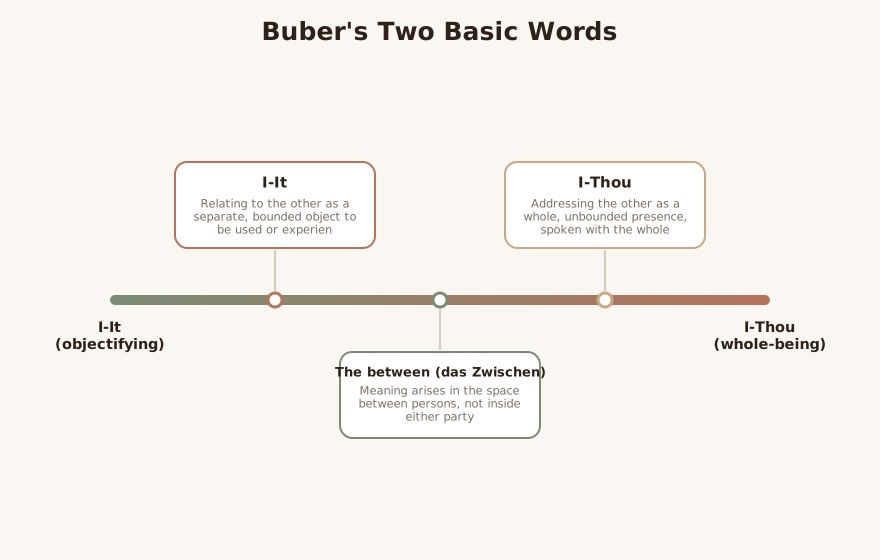
The first principle is the two basic words. To say “I-It” is to relate to the other as an object that is separate, bounded, and available to be used or experienced, a stance Buber says can never be spoken with one’s whole being 3. To say “I-Thou” is to address the other as a presence without discrete bounds, met as a whole and unique entity rather than as a collection of qualities, and this word can only be spoken with the whole being 3. The I-It attitude is governed by the categories of same and different and by universal definition, whereas the I-Thou encounter sets those categories aside 2.
The second principle is the primacy of the “between” (das Zwischen). Buber locates relation not inside either party but in the space between them, so that the I itself is constituted differently depending on which word it speaks 1. There is no isolated I that exists prior to and apart from relationship to an other 1. Paradoxically, distance is the ontological precondition for relation: only because human beings can set the world at a distance and grasp others as independent beings can genuine meeting occur at all 2.
The third principle is that genuine encounter is dialogical rather than monological; the I-It posture is a turning away from the other and back onto oneself, while dialogue requires presence, trust, and the willingness to imagine the reality of the other person without losing one’s own standpoint 2. From this Buber draws his most quoted axiom, that “all real living is meeting” 4. He further distinguishes confirmation, the act of meeting and recognizing the other as a subject capable of actualizing their potential, from mere unconditional acceptance; confirmation can at times mean helping a person become what they could be, even against their immediate inclination 2.
Interventions & Techniques
I-Thou is a stance, not a set of procedures, so its “techniques” are really disciplines of attention rather than scripted moves LLM. The foundational discipline is presence: meeting the client as a whole person rather than as a diagnosis, a category, or a problem to be managed, which in Buber’s terms is the difference between addressing a Thou and handling an It 4. A second discipline is the suspension of instrumental aim in the moment of meeting; Buber describes genuine encounter as one in which no aim, no craving, and no anticipation comes between the I and the Thou 4. A third is the refusal of premature objectification through labeling, since reducing a person to a category such as “the homeless” or “the borderline” collapses them into an It and forecloses the encounter 5.
In Buber’s account of healing, the clinical relationship is characterized by what he called inclusion: the therapist actively lives through the situation from the client’s side while remaining anchored in their own. Crucially, this relation is not symmetrical, because the client is not asked to do the same for the therapist, and so the therapeutic I-Thou is a one-sided form of inclusion rather than a relationship of equals LLM. Buber also criticized approaches that try to “resolve” guilt internally without addressing the damaged relations at its root, proposing instead that healing be grounded in genuine encounter and restored relationship 2.
LLM-generated illustrative example (not a guideline): A clinician notices that for several sessions she has been quietly treating a chronically late client as “the resistant one,” tracking his lateness as data and rehearsing interventions for it. Catching the I-It drift, she sets the formulation aside and asks, with real curiosity, what the morning is actually like for him; he describes a caregiving situation she had never heard of, and the alliance shifts when he feels met as a person rather than managed as a case LLM.
Evidence Base
The honest position is that dialogical philosophy is an established and historically influential body of thought, not a trial-validated treatment, and there is no body of randomized outcome data for “I-Thou therapy” as such LLM. Its standing rests on its place in the philosophical canon and on its documented influence on the helping professions, including humanistic psychology and the dialogical strands of psychotherapy 6. Buber’s significance for clinicians is mediated rather than direct: his ideas helped shape person-centered, Gestalt, and existential therapies, and the empirical literature that does exist sits with those downstream traditions and with the broader research program on the therapeutic relationship and working alliance LLM.
Two limits should be stated plainly LLM. First, Buber wrote as a philosopher and approached psychology from an extraneous position, so his work offers an ethic of meeting rather than testable clinical predictions 1. Second, core terms such as the “between,” presence, and genuine meeting are evocative but hard to operationalize and falsify, which is the same limitation that constrains rigorous testing of allied humanistic constructs LLM. The defensible clinical use is therefore to treat I-Thou as a relational foundation that informs how any evidence-based modality is delivered, while disorder-specific care is provided through approaches with stronger trial support where indicated LLM.
Populations & Indications
The framework speaks most directly to relational suffering, and it is a natural fit for couples and families, where the everyday slide from meeting a partner as a Thou into handling them as an It is often the heart of the presenting problem 5. It is well suited to adults in individual therapy who experience loneliness, alienation, or a pervasive sense of disconnection, because Buber locates the cure for isolation not in self-improvement alone but in restored, genuine relation 1. It is relevant to clients grappling with existential concerns, who are addressed by the tradition’s attention to meaning as something that arises in encounter rather than in solitary introspection 4. It also speaks to the therapeutic relationship itself across all populations, since the stance describes what the clinician brings to any client 2. With people carrying relational trauma, the concept names precisely what was injured and what the relationship must offer to repair it, namely the experience of being met as a whole person rather than used or ignored LLM.
Problems-for-Work
The concept is strongest where the problem is the quality of relating itself. For objectification in relationships and intimacy problems, the I-It/I-Thou contrast gives a couple a shared language for the difference between using a partner and meeting them, and between cataloguing a partner’s qualities and addressing the whole person 4. For relationship conflict, the work targets the monological turn in which each party retreats into themselves and stops genuinely encountering the other 2.
LLM-generated illustrative example (not a guideline): A couple in therapy describes evenings spent “co-managing logistics” with no real contact. Using Buber’s frame, the clinician helps them notice how thoroughly each has reduced the other to a function (the one who handles bills, the one who handles the kids) and structures a brief nightly practice of undistracted, aim-free attention, asking them to simply be present to each other for a few minutes before any problem-solving begins LLM.
For loneliness, alienation, and disconnection, the work reframes the goal away from internal adjustment and toward the recovery of genuine meeting 1. For empathy deficits, the relevant capacity is what Buber called imagining the real, grasping the particular reality of a particular person without losing one’s own perspective 2. For existential distress, the tradition offers meaning as something disclosed in encounter rather than manufactured alone, since for Buber all real living is meeting 4.
Contraindications, Cautions & Cultural Humility
A relationship-centered, presence-oriented stance is necessary but not sufficient in acute crisis, active psychosis, acute suicidality, or significant instability, where structure, containment, safety planning, and evidence-based stabilization must take priority over open-ended encounter LLM. The stance complements rather than replaces indicated, disorder-specific treatment; offering only relational presence where an established first-line intervention is called for can underserve the client LLM. Clinicians should also avoid the romantic misreading that one can simply choose to dwell permanently in I-Thou; Buber is explicit that every Thou must repeatedly lapse back into an It, and the I-It mode is not evil but a normal and necessary part of living and working in the world 2.
Cultural humility matters because Buber’s vocabulary carries particular philosophical and theological assumptions, including a religious horizon in which the ultimate Thou is God 6. Clients do not share a single religious or metaphysical frame, and the dialogical ethic should be offered in secular, experience-near language unless a client invites the spiritual dimension LLM. Equally, the prizing of mutual encounter should be calibrated to clients whose relational worlds are organized around duty, hierarchy, or community rather than reciprocal intimacy, so that “genuine meeting” is not imposed as a single culturally specific ideal LLM.
Treatment-Plan Suggestions & SMART Objectives
| Goal | SMART objective (example) | Mechanism |
|---|---|---|
| Reduce objectifying, label-driven relating to a partner | Within 8 sessions, client will identify 3 recurring instances of reducing their partner to a “function” or label and describe the whole person behind each | Shifting from I-It to I-Thou relating 4 |
| Increase genuine presence in a key relationship | Over 6 weeks, the couple will practice 2 brief weekly periods of undistracted, aim-free attention to each other before any problem-solving | Encounter in the “between” 1 |
| Reduce loneliness and felt disconnection | Within 10 sessions, client will initiate and report on 1 weekly interaction in which they aim to meet the other person as a whole presence rather than instrumentally | Restoring genuine meeting 1 |
| Strengthen empathic perspective-taking | Over 8 weeks, client will practice articulating a conflict partner’s particular experience in their own words without abandoning their own viewpoint | “Imagining the real” / confirmation 2 |
| Repair relational trauma through corrective experience | Across treatment, client will identify and name moments of being genuinely met versus used or dismissed, in and out of session | Confirmation of the other as a subject 2 |
| Address existential distress through connection | Within 10 sessions, client will name 2 relationships or shared activities in which they experience meaning and increase engagement with one | Meaning as arising in encounter 4 |
| Interrupt the monological turn during conflict | For 6 weeks, client will notice and log moments of “turning back on the self” during arguments and practice one re-engagement attempt | Dialogue versus monologue 2 |
Common Misconceptions
The most clinically consequential misconception is that an I-Thou relationship in therapy means clinician and client meet as equals in full mutuality. Buber’s own account of healing is one of inclusion in which the therapist lives through the client’s side of the situation, but the relation is inherently asymmetrical because the client is not asked to do the same in return LLM. A second misconception is that I-Thou is the same as Rogers’s unconditional positive regard; Buber’s confirmation differs from unconditional acceptance and can include calling a person toward their unrealized potential, even against their immediate inclination 2. A third is the romantic belief that one should try to remain in I-Thou at all times, when in fact the I-It mode is necessary, ordinary, and not a moral failure, since every Thou inevitably becomes an It again 2. A fourth is the assumption that Buber was an existentialist in the Sartrean sense; he explicitly resisted that grouping and held that preoccupation with self-consciousness obstructs genuine meeting 2. Finally, presence is sometimes mistaken for passivity, when in Buber’s account meeting requires the whole being and the active, demanding work of imagining the real 3.
Training & Certification
There is no license or certification in “dialogical philosophy,” and no credential called “I-Thou therapist”; the framework is a conceptual resource that licensed clinicians integrate into their existing scope of practice LLM. The primary source is Buber’s I and Thou, and the philosophy is taught chiefly in philosophy, religious studies, and the theory courses of clinical training programs rather than through a procedural curriculum 6. Clinically, the stance is most often acquired indirectly through training in the traditions it influenced, including person-centered, Gestalt, and existential therapies, and through the relationship-focused, dialogical strands of psychotherapy associated with figures such as Hans Trüb 2. Therapists who wish to ground their practice in Buber’s thought are best served by primary reading paired with supervision focused on the use of self and the quality of presence in the room LLM.
Key Terms
I-Thou – the basic word naming an encounter with the other as a whole, unbounded presence, spoken with the whole being 3. I-It – the basic word naming a relation to the other as a separate, bounded object that is used or experienced, never spoken with the whole being 3. The between (das Zwischen) – the relational space in which genuine encounter occurs, where the center of the relation lies in neither party alone 2. Genuine meeting / encounter – direct, present, aim-free relation with another, captured in Buber’s claim that all real living is meeting 4. Dialogue versus monologue – the contrast between truly turning toward the other and turning back on oneself 2. Confirmation – meeting and recognizing the other as a subject capable of actualizing potential, distinct from mere unconditional acceptance 2. Imagining the real – grasping the particular experience of a particular person without losing one’s own standpoint 2. Inclusion – the therapist’s living through the client’s side of the encounter in an inherently asymmetrical relation LLM. The eternal Thou – Buber’s name for God as the ultimate Thou met in the life of dialogue 6.
Resources & Further Reading
▶ Watch — a video introduction to this concept:
- Martin Buber – Stanford Encyclopedia of Philosophy
- Martin Buber (1878-1965) – Internet Encyclopedia of Philosophy
- I and Thou (Martin Buber, 1923) – Simon & Schuster edition
- I and Thou: Martin Buber on the Art of Relationship – The Marginalian
- Martin Buber: Are You a ‘Thou’ or an ‘It’? – Saybrook University
- I and Thou – Wikipedia
Reflective / Supervision Questions
- Where in my current caseload have I quietly slipped from meeting a client as a Thou into managing them as an It, and what category or label marks the shift LLM?
- How do I hold the asymmetry of the therapeutic relationship honestly – offering full presence and inclusion without pretending the relationship is one of equal mutuality LLM?
- When I aim for acceptance, am I confirming the client as a person capable of growth, or am I confusing confirmation with simply approving of everything they do 2?
- In couples or family work, can I help clients see their own drift into instrumental, monological relating without shaming the ordinary and necessary I-It mode 2?
- For clients whose relational worlds are organized around duty or community rather than reciprocal intimacy, am I offering genuine meeting in their terms or imposing a culturally specific ideal of it LLM?
- Where might my emphasis on relational presence be displacing an indicated, evidence-based intervention this client actually needs LLM?